

Image source: Pexels
Walk into a computer science lecture hall, and you'll see rows of sharp minds, many of them women. Fast-forward a decade. Too many vanish from dev teams and product orgs. Another decade later, women in C suite roles are still the exception.
This isn't a talent problem. It's a barrier problem.
We set out to follow the full pipeline – from campus to first job to senior leadership – and ask one clear question: what still blocks women in tech today?
We built a research program that blends numbers and lived stories. We learned that bias starts early, compounds over time, and rarely fades on its own. Even students and essay writers pulling late nights on term papers hear the same message on repeat: you don't quite belong. That whisper turns into hiring friction, promotion gaps, and boardroom gatekeeping.
Naming the blockers is the first step to removing them. Here's the evidence.
Methodology: How We Built the Evidence
Design
Mixed-methods, June-August 2025. We combined an online survey, structured interviews, and secondary data review to triangulate findings.
Sample
- Survey (n = 1,204): women across the pipeline students (24%), early-career 1-5 years (33%), mid-career 6-12 years (28%), leaders 13+ years (15%).
- Interviews (n = 18): semi-structured conversations with 5 students, 6 individual contributors, 4 managers, 3 executives.
- Regions: North America 38%, Europe 33%, APAC 20%, LATAM/MEA 9%.
- Functions: software, data/AI, security, product, design, and infra.
Recruitment
University mailing lists, WomenTech-adjacent communities, public LinkedIn posts, and referral chains. We screened for current or recent tech affiliation and capped any single company at 3% of total responses to avoid skew.
Instruments
- Survey sections: early education experiences, hiring screens, team culture, mentorship/sponsorship, performance reviews, promotion experiences, and leadership access. Likert scales + forced-choice blockers + open text.
- Interviews: life-cycle timeline (from the first spark to the latest career step), moments of lift vs. friction, support systems, and leadership access.
Analysis
- Weights to balance region/function.
- Cross-tabs by stage and function; chi-square tests for differences (p<.05).
- A simple logistic model to estimate the odds of promotion to first-line manager based on three factors: mentorship access, high-visibility projects, and reported bias.
- Thematic coding of interviews (two coders; inter-coder agreement κ=.81).
Limits
Online samples tend to over-represent engaged professionals. Self-report carries recall bias. Even with weights, some niches remain small. That said, signals were consistent across regions and roles.
Women in Tech Statistics We Can't but Discuss
Why this matters. Numbers don't tell the whole story, but they do reveal the shape of the pipeline. Here's where progress stalls.
The Global Numbers We Can't Ignore
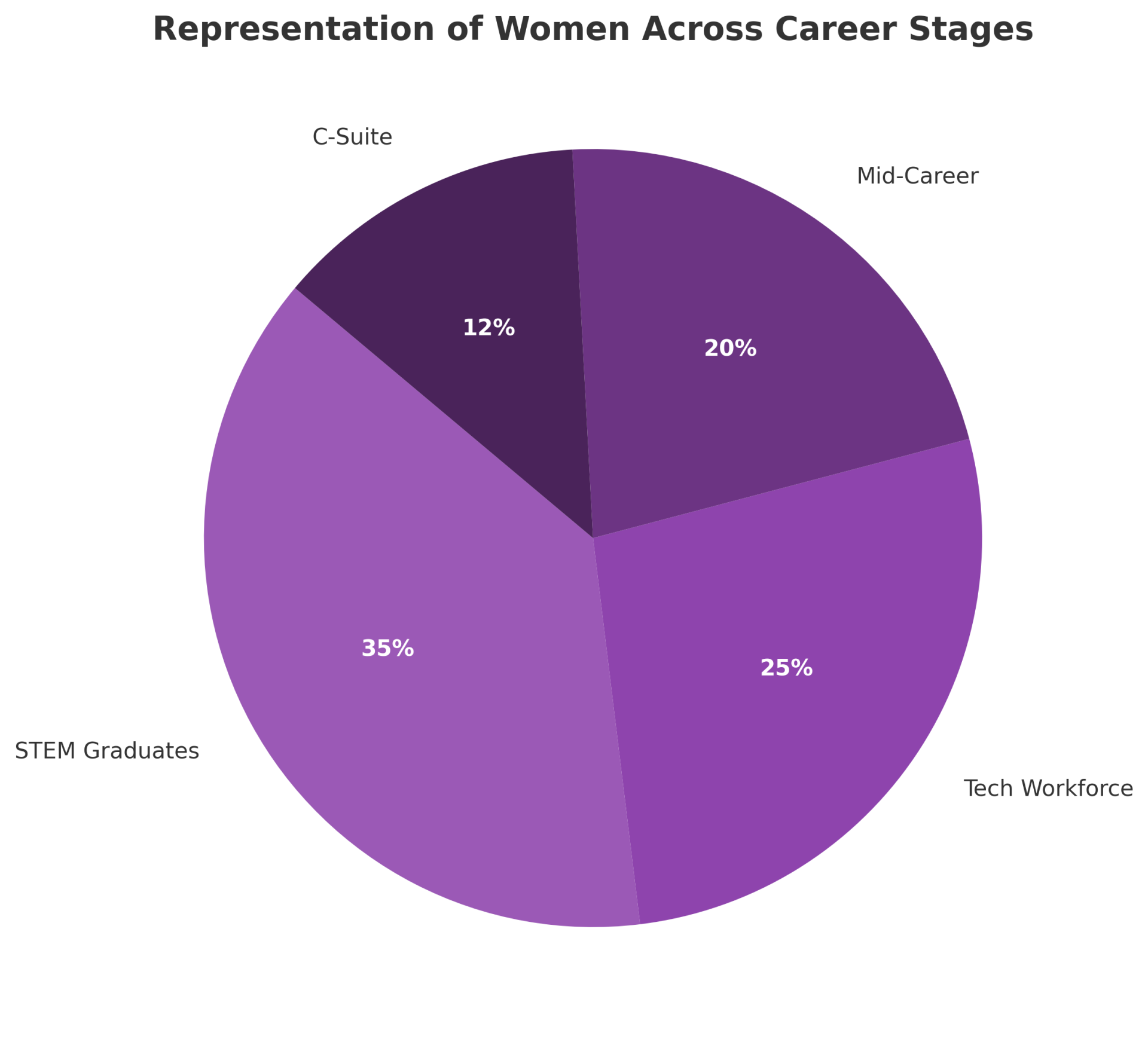
Despite strong representation in education, women fade from leadership.
Why Pledges Don't Match Promotions
Policy pages glow with diversity promises. Reality checks arrive at the first step up. In tech orgs, for every 100 men promoted to manager, ~52 women move up. That early gap shrinks the pool for every rung above it.
Our cross-tabs show the same pattern across functions, with the sharpest drop in software and platform teams.
Top Women in Tech
Why visibility matters. Seeing women lead rewrites what "a leader" looks like for students and new grads.
Women at the helm – across AI labs, cloud platforms, and scale-ups – prove impact at the very top. Their presence raises aspiration, draws sponsors, and helps normalize diverse leadership styles.
Change also begins early. Students who captain hackathon squads, junior engineers who step into tech-lead duties, and founders who ship scrappy first versions send a clear signal: you belong here, and you can lead.
To amplify that signal, many teams lean on practical playbooks. The Women in Tech Empowerment Guide outlines steps that lift visibility: speaker pipelines, internal spotlights, and peer-to-peer showcases.
Women in Tech Challenges
The blockers evolve. In class, bias sounds like doubt. In the office, it looks like interruptions, lost credit, and closed doors. By leadership, it shows up as tokenism and pay gaps.
Education and First Jobs: The First Leak
Survey notes from students tell a steady story: fewer female peers in core CS, fewer mentors, and more second-guessing during labs and code reviews.
Early hiring brings fresh friction-skills questions for men and "fit" questions for women. Interviewees described being praised for communication, while men got credit for technical depth, even on identical tasks.
Mid-Career: The Broken Rung
This is the choke point. Many women never get the first manager role, which caps access to stretch work and sponsor attention later on.
Our logistic model shows two factors with the strongest link to the first promotion: access to high-visibility projects and a named sponsor who advocates during calibration. Reported bias lowered promotion odds even when performance ratings were high.
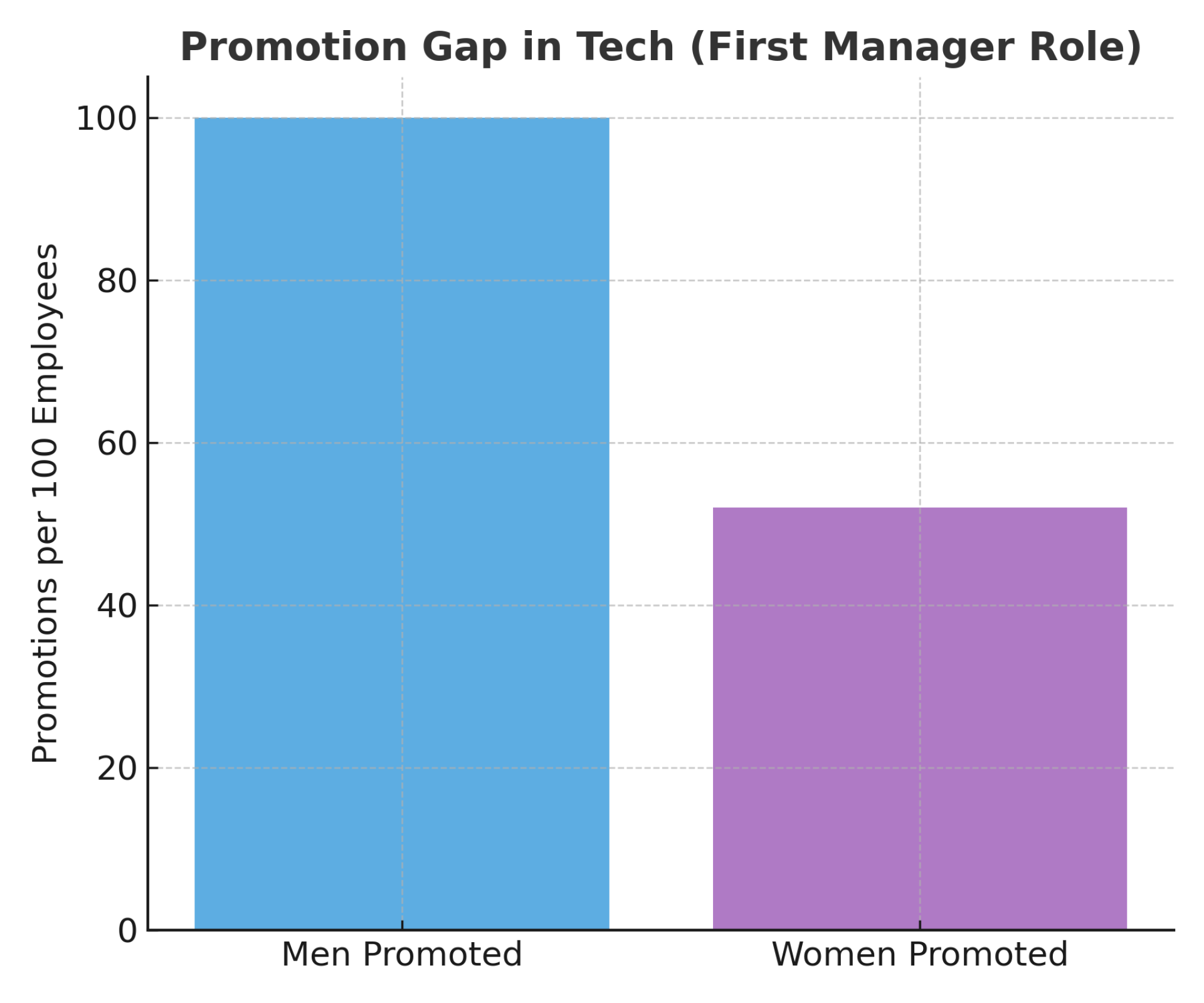
For every 100 men promoted to manager, 52 women move up.
Reaching Senior Leadership: The Bias Gets Sharper
By the time promotion panels meet for senior roles, the field is already thin. The scrutiny grows.
Stefanie Coolidge, who coordinates the research team at EssayWriters.com, notes:
"In our sample, 62% of respondents reported bias during promotion talks. Many linked it to the way 'potential' gets judged. Talent is there. Results are there. The story that frames those results often isn't. We can see the same pattern in other industries: language around 'gravitas' or 'executive presence' tends to cut women out."
A recent review by essay writers found similar patterns: women’s performance is often praised for teamwork and collaboration, while men are spotlighted for innovation—reinforcing the feedback gaps we observed in our study.
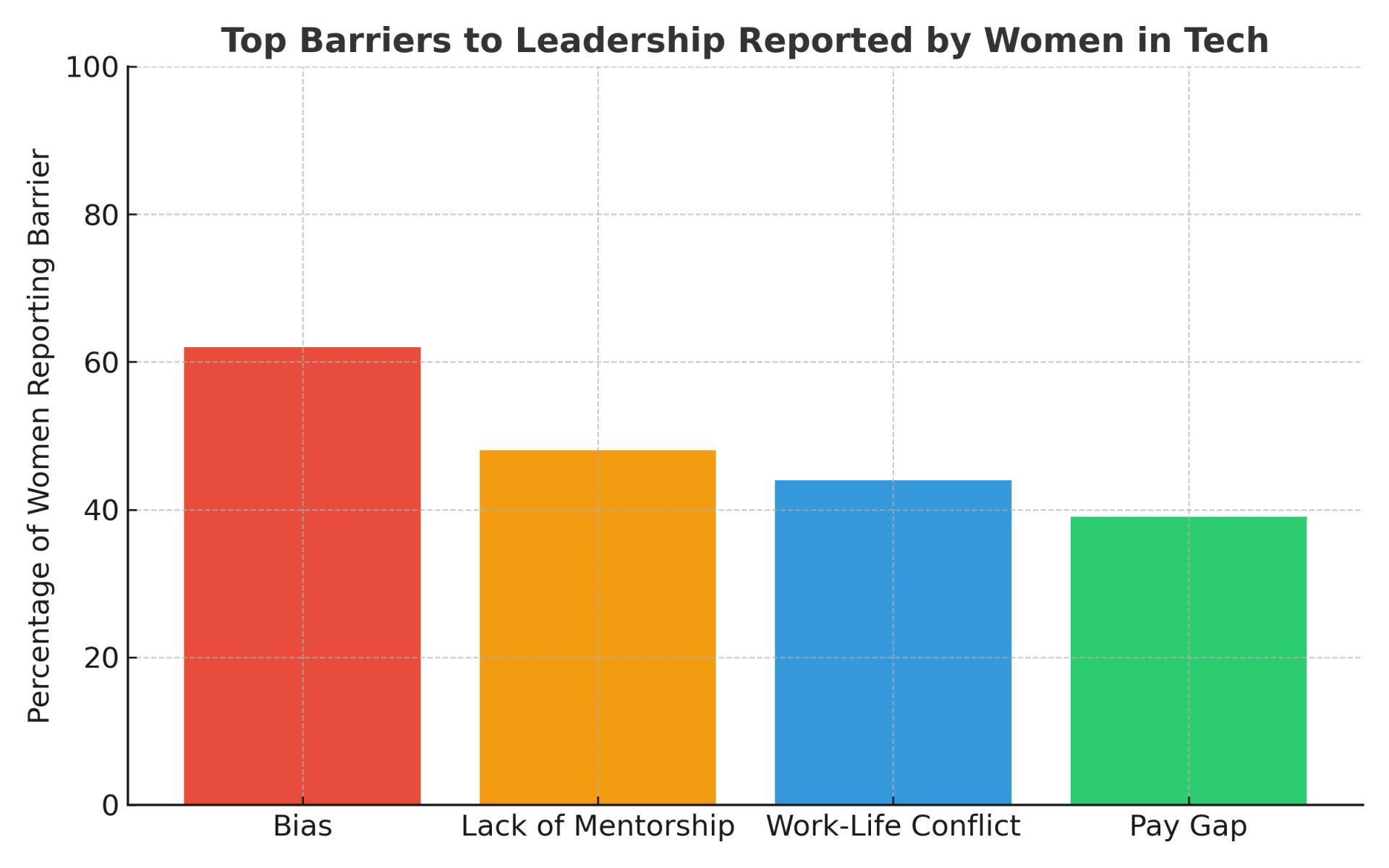
Bias and a lack of mentorship lead the list of blockers women name.
What Sits Underneath That 62%
-
Interruptions and idea theft. 64% reported frequent interruptions; nearly half said their idea gained traction only after a man repeated it.
-
Invisible work. Mentoring juniors and glue work help teams run, yet carry little weight at promotion time.
-
Network gaps. Many women lack the informal sponsor networks where stretch assignments start.
The Barriers Facing C-Suite Women
New level, new friction. Once inside the executive suite, the game changes again. For C suite women, challenges shift form but not force.
Token status. Many leaders we spoke with carry "the only" tax: the only woman in the room, the only woman on the board. That status invites extra scrutiny and pressure to represent all women, not just oneself.
The double bind. Decisive? "Too tough." Collaborative? "Too soft." Our interviews captured that tightrope. The standard for tone narrows, and women pay for stepping outside it.
The glass cliff. Women report stepping into leadership during hard turns – market shocks, layoffs, product rescues. Fail fast becomes blame fast. Recovery takes time and air cover many don't receive.
Access still matters. Network gaps don't vanish at the top. High-stakes deals often live in backchannels. Sponsorship keeps opening doors here, just as it does in mid-career.
For companies that want to change the pattern, structure beats slogans. The Women in Tech Mentoring Program offers a repeatable model: pair rising talent with senior sponsors, set shared goals, and track real outcomes over time.
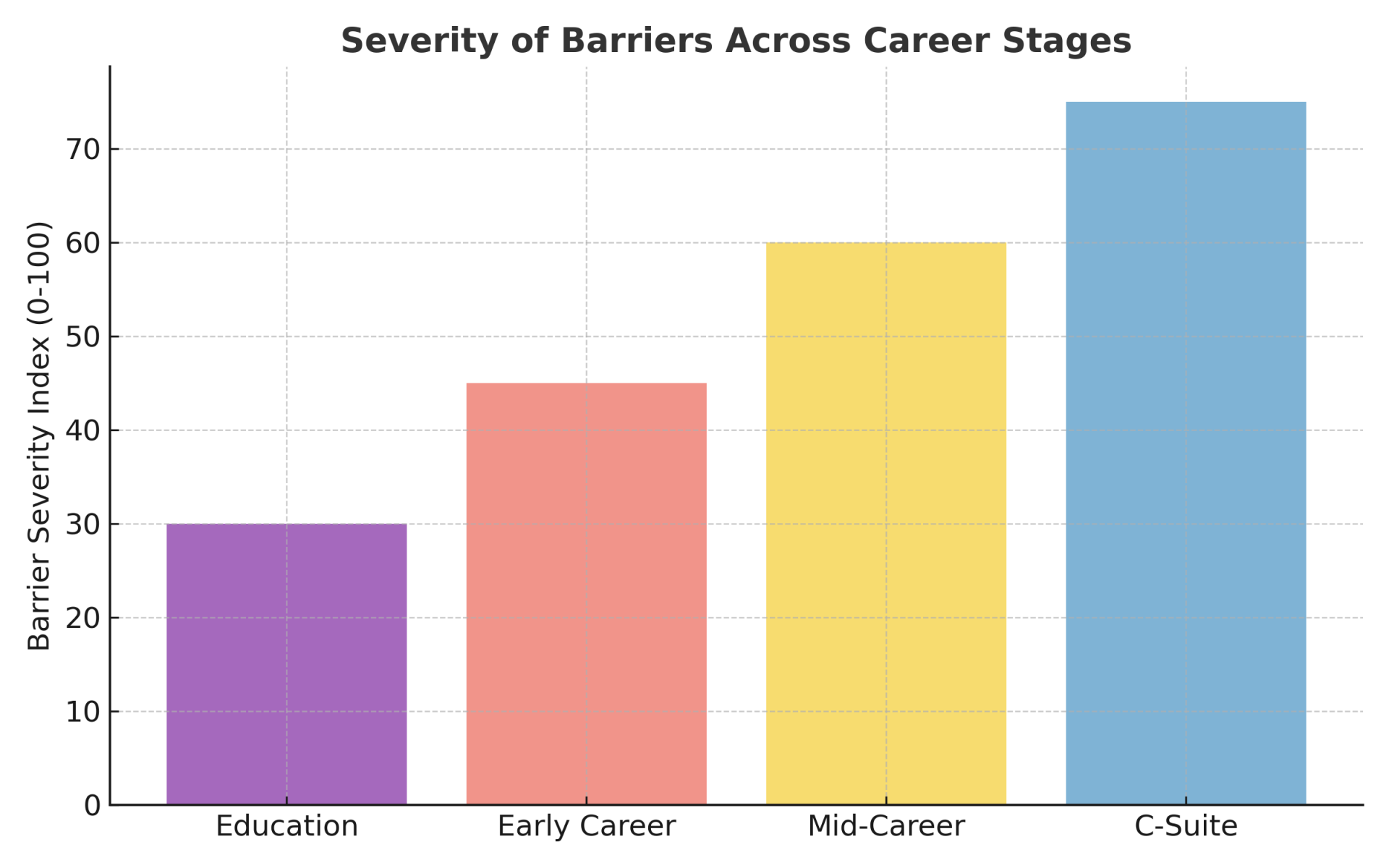
Barriers shift but persist, from classroom to boardroom.
What the Numbers Say (And How To Use Them)
-
Mentorship → Promotion odds. In our model, access to an active sponsor raised the likelihood of first promotion by an estimated +19-24 percentage points across functions. The effect was strongest in platform and data roles where stretch work is scarce. -
Visibility > volume. Hours logged did not map to advancement. High-visibility projects did. Women who shipped even one org-wide launch in a review cycle reported far more sponsor attention and faster growth.
-
Language shapes outcomes. Evaluation notes for women used more words about communication and team health. Notes for men used more impact words. When the review language shifted to impact metrics, women's promotion rates improved in the next cycle.
-
Policy without practice stalls out. Flexible work on paper helps little if meetings still land at caregiving hours or if leaders reward face time. Teams that treat flexibility as normal (not special) retain more women and grow them faster.
What Actually Works
-
Use sponsor ladders. Assign sponsors at the first rung. Tie sponsorship to visible outcomes (one stretch project per quarter). Track it.
-
Bank visibility. Put more women on launch-critical projects and design reviews. Capture impact in the write-ups that enter calibration.
-
Fix the meeting floor. Stop interruptions in real time. Rotate facilitation. Use simple speaking queues. A small rule results in a big culture shift.
-
Score the work that holds teams together. Make "glue work" part of a formal evaluation with clear metrics.
-
Audit the language. Replace vague "presence" with concrete results. Calibrate with three questions: What shipped? What moved? What changed?
-
Make flexibility normal. Standard cores, predictable schedules, and remote leadership practices lift retention without lowering output.
Building Futures That Last
The pipeline doesn't leak because women lack skill or drive. It leaks because bias, culture, and narrow definitions of leadership block the path. The fix lives in daily choices: who gets the next stretch assignment, who gets a sponsor, how we talk about impact, and how we design meetings and schedules that work for real lives.
Change is not abstract. You just read where it lands: early access, mid-career lifts, and fair shots at the top. When more women rise, products get better, teams get stronger, and the whole industry wins.