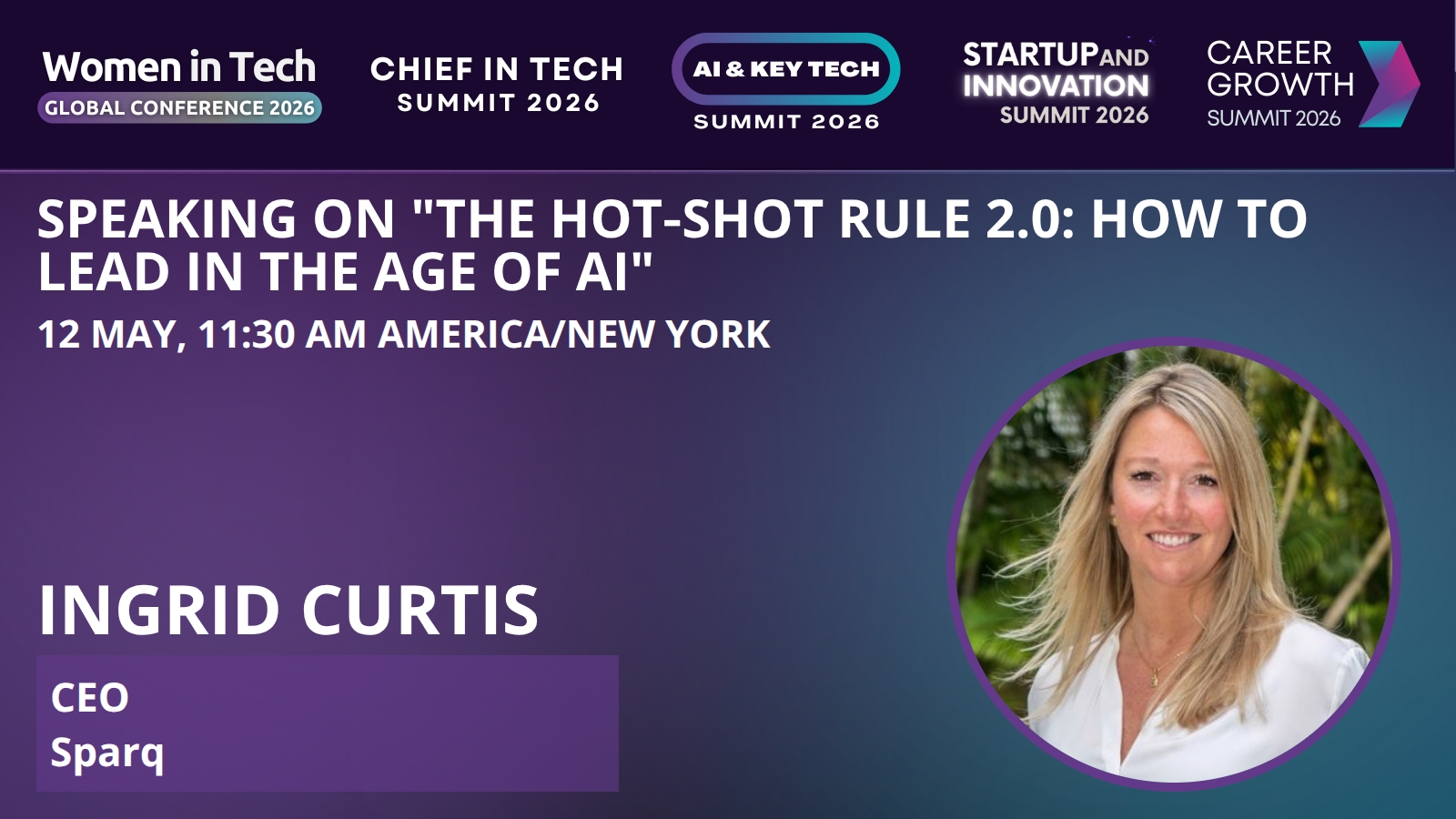

Ingrid
Curtis
CEO at Sparq

"The Hot-Shot Rule 2.0: How to lead in the age of AI"
"The Hot-Shot Rule 2.0: How to lead in the age of AI"
Tue May 12 - 11:30 AM EDT/New York (See in local time)
Add to Calendar
05/12/2026 11:30 AM
05/12/2026 11:50 AM
America/New_York
#WTGC2026
"The Hot-Shot Rule 2.0: How to lead in the age of AI"
#WTGC2026
"The Hot-Shot Rule 2.0: How to lead in the age of AI"
https://www.womentech.net/ringcentral
https://www.womentech.net/ringcentral
"The Hot-Shot Rule 2.0: How to lead in the age of AI"
"The Hot-Shot Rule 2.0: How to lead in the age of AI"
Don’t miss out and join visionaries, innovators, and thought leaders from all over the world at the Women in Tech Global Conference.
Vote by Sharing
Unite 100 000 Women in Tech to Drive Change with Purpose and Impact.
Do you want to see this session? Help increase the sharing count and the session visibility. Sessions with +10 votes will be available to career ticket holders.
Please note that it might take some time until your share & vote is reflected.
Session: The Hot-Shot Rule 2.0: How to lead in the age of AI
As organizations grow, leaders often become further removed from the work that actually delivers results. The distance is subtle, but the impact is not. Decisions slow down because teams are hesitating, while progress stalls because leadership direction is no longer anchored in how work really gets done.In this session, Ingrid Curtis, CEO of Sparq, makes the case that proximity to everyday work is a core leadership discipline, especially at scale. Leaders do not need to do every job, but they do need to understand how decisions land on the ground if they want work to move with pace and confidence.
To counter that drift, Ingrid shares a simple but confronting leadership tool she learned called the “hot-shot rule.” Leaders are asked to imagine being replaced tomorrow by someone exceptional. What would that person change immediately? What would they refuse to accept? The exercise removes hesitation and brings stalled decisions out into the open.
This session is intended for leaders who feel the gap widening between strategy and execution as their organizations scale. It teaches leaders how to identify where leadership distance is slowing decisions, how to surface and resolve stalled calls using the “hot-shot rule,” and how to maintain judgment and momentum as teams grow.
After this session, attendees will be able to pinpoint execution drag inside their own organizations, make clearer decisions faster, and keep strategy grounded in how work actually gets done.
Key Takeaways
- Why distance from the work creates execution drag and decision delays as organizations scale
- How proximity improves clarity, alignment, and accountability in growing teams
- A practical way to identify stalled decisions at scale using the “hot-shot rule”
- How leaders can increase speed without micromanaging as complexity increases
- Why grounded leadership matters more as AI and automation accelerate change at scale
Bio
Ingrid Curtis is the CEO of Sparq, a product-engineering and AI-driven consulting firm known for its deep technical capability and outcome-focused delivery. She began her Sparq journey in her mid-twenties, when she relocated to rural Arkansas to help rebuild a small acquisition that had no active clients and needed a fresh start. That early chapter shaped her leadership style and set the foundation for the company’s long-term evolution.Over nearly two decades, Ingrid has guided Sparq through multiple phases of growth, including a shift into higher-value product and engineering work, private equity investment, nearshore expansion across six Latin American countries, and four strategic acquisitions that positioned the firm as an AI-first organization.
Today, she leads a global team and continues to drive Sparq’s vision of making intelligence operable at scale.