From Curator to Tech Founder, A Mission Driven Mid-Career Switch by Kristen Carbone
19:162022
Her breast implants pulled heat from her body, so she built a fix
After a preventative mastectomy, the implants in her chest acted as a heat sink and she felt cold almost all the time. Her first fix ran on a yellow DeWalt drill battery. Former museum curator Kristen Carbone, who later launched an app-controlled warming wearable with zero engineering background, shows what it takes to turn a nagging personal problem into a product, and what she wishes she had known before quitting her day job.
Get the five steps she recommends before you chase your own big idea
Kristen Carbone tells how a former museum curator with no engineering background became the founder of Brilliantly after a preventative mastectomy left her constantly cold. She argues that a personal problem can become a real product if you validate it with users, prototype early and, above all, ask for help, while warning founders to pressure test their assumptions about time and cost.
“My mom's cancer had been caught extremely early and she died anyway. So for me early simply wasn't good enough.”
“Make sure that you've pressure tested all of your assumptions.”
What you will learn
Map every part of starting a business, circle your gaps and recruit people from your network who are strong in them.
Validate demand by talking with potential users in online communities before paying anyone to manufacture a product.
Build a rough proof of concept with help from friends before raising money, even without an engineering background.
Pressure test your assumptions about time and cost before leaving a day job to found a company.
Check every product change with users, including people outside your original target audience.
Details
Level
All levels
Format
Talk
Technical depth
Non-technical
For
Career changer, Founder, Mid-career
Length
19:16
Published
July 2022
Questions this talk answers
How can a non-technical person start building a hardware product?
Carbone, a museum curator with no engineering knowledge, had friends help her make a proof of concept from thermally conductive material. She advises doing this before raising any money so you know the idea is even possible.
How did she confirm that other people needed her product?
She joined Instagram and Facebook groups and talked with hundreds of women in the breast cancer community over the summer of 2017. She learned that, by her count, over 75% of women with implant reconstruction experience constant coldness.
How do you get help when you know almost nothing about running a business?
She listed every part of starting a business, circled the ones she knew nothing about, listed people in her network who excelled at them and invited them to dinner. Those people kept helping her for almost five years and formed the base of her advisory board.
What would she do differently as a first-time founder?
She would pressure test her assumptions and build a realistic view of time and cost. She worked from before 5 a.m. to midnight for a year, then quit her job, and the business took years and hundreds of thousands of dollars more than expected.
Who ended up using the warming wearable?
A quarter of launch orders came from outside the breast cancer community. Women use it for pain and temperature management, at cold desks, for skiing and running, while nursing, and for menstrual cramps.
The dinner party that built her startup team (75 s)
Be smarter than me: a founder's cautionary tale (78 s)
No engineering skills? Prototype with friends first (61 s)
Speaker 1: Thanks so much for having me today. Just some quick housekeeping. If you have any questions, please drop them in the text. I'm happy to be interrupted. And I tried to leave a moment of time at the end for some Q and A. I'm really excited to be here today and share a bit more about my background.
And my how and why for starting brilliantly. If we were together in person, I would be asking with a quick show of hands who here has had an idea for a product or a service or a business that would make the world a better place or improve lives. Even if it was just your life. But because I can't see you, I'm just going to assume that every single one of you would have your hand raised because we Speaker 1: We all constantly have amazing ideas. And for me, having a big idea that I wanted to see to fruition did not make it easy. It did not fit seamlessly into my life, but it didn't stop me and it shouldn't stop you either.
Speaker 1: So my story of my big idea started about 10 years ago and I'll give you a little context. This is me about 10 years ago with my two kids. We were moving to Providence, Rhode Island with my then husband. And our move was meant to be. You know, a whole new fresh start for us. But. It was proving to be a big idea.
Speaker 1: My undoing and my becoming. But I didn't know that yet. And as any mother can test. Motherhood is exhausting both physically and emotionally. And I'd entered into motherhood already worn out from the caretaking and eventual death of my mom, Lisa, who died from metastatic breast cancer before she even turned 50. Speaker 1: And from the outside, my little family appeared happy and much like what I'd always imagined my adulthood would look like. I persevered. I started to build my own family and my own life, but I was really bogged down by grief and I was struggling to feel happy and fulfilled with my place in the world and how to make a good life for my kids.
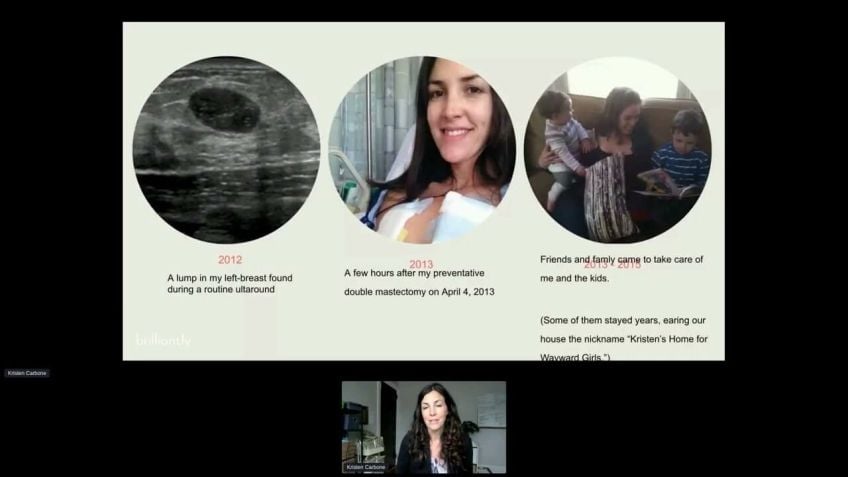
Speaker 1: Also during that time. So we're talking 10 years ago, March 2012 during a routine ultrasound. Speaker 1: They found a lung. And before anybody told me, I knew they found something. Speaker 1: The ultrasound tech was almost holding her breath. Well, she went over and over the same upper quadrant of my left breast and took measurements. And in the few minutes that I was waiting all by myself for the radiology.
Speaker 1: I made a decision that I was going to have a preventative mastectomy. The first time a doctor recommended I have a preventative mastectomy, I was horrified. Speaker 1: But in that moment, faced with the possibility of being diagnosed with cancer, having a preventative mastectomy didn't seem crazy at all. Speaker 1: My mom's cancer had been caught extremely early and she died anyway. So for me early simply wasn't good enough.
Speaker 1: Thankfully, the lump was benign, but I'd already started down the path of having my preventative mastectomy. Speaker 1: And as I said, this was back in 2012. And not many people were talking about that procedure back then. Speaker 1: There weren't online support communities in the way there are now. And I personally didn't know anyone who was facing the same decision.
Speaker 1: So I forged ahead into a life altering decision, sort of blindly, which you're going to see is a bit of a theme in my life. Speaker 1: It took me a year of fighting with my health insurance before they agreed to cover even part of the cost of the procedure. Speaker 1: And over that year, my husband moved out. My grief had worn down our bond in a way that we just couldn't seem to overcome.
Speaker 1: And as a newly single mom of two very small children who haven't been working for almost two years, I realized that I needed to find a job ASAP. Speaker 1: And I'd spent most of my professional career working in museums. So I managed to network my way into a three quarter time position at the Rhode Island School of Design.
Speaker 1: So with a job and some health insurance and an army of friends and family supporting me, I went into the OR in April of 2013, feeling really confident. Speaker 1: It was the first time I felt like I was taking action to ensure a healthy future. And doing that forced me to do something that was even scarier than having surgery, which for me is asking for help.
Speaker 1: I don't know about you guys, but I'd always felt like there was some value in being able to do it all, all by myself. Like, wouldn't it be awesome if I could do everything perfectly all on my own? Speaker 1: No, it totally doesn't work. It doesn't happen. And this is the perfect example of that.
Speaker 1: The gift of my physical health until this moment meant that I'd almost never needed to say I need help. Speaker 1: But because my kids were two and four and I was about to have multiple surgeries, I simply had no choice. Speaker 1: So for months, there was a rotating cast of visitors living with us and it was a new phase of parenting and of cohabitating and honestly of becoming myself.
Speaker 1: And the relief that I felt for not only asking for help, but accepting it was truly profound. Speaker 1: So for me, my mastectomy, I think made me a better person and a better parent and a better friend. Speaker 1: The positive outcomes of this experience were like completely unforeseen as were the negatives. Speaker 1: And one of the big negatives was how I felt in my body.
Speaker 1: I was completely unprepared for what it would feel like to live in a body that had been surgically altered. Speaker 1: And one of the strange and unexpected outcomes was that I feel cold all the time. Speaker 1: So hopefully this gives a little bit of clarity to that problem. Speaker 1: But if you are a woman in the audience, you probably have found that you feel cold in normal daily situations where other people seem comfortable.
Speaker 1: And we will get to that later. Speaker 1: But this slide hopefully clearly illustrates the problem that happens when you have implants without breast tissue insulating them. Speaker 1: Without breast tissue, nothing's keeping them at body temperature and they are a heat sink and the implants are just pulling heat from your core. Speaker 1: And for years, I assumed that I was the only person dealing with this problem.
Speaker 1: And while I never asked my doctor about it, my close friends knew that I was uncomfortable pretty much all of the time. Speaker 1: This is where my big idea comes in. Speaker 1: I really wanted to make something that would make me feel warmer and more comfortable and less distracted so I could focus on what was important in my life and stop thinking about this constant nagging coldness, which reminded me of this terrible experience that I had.
Speaker 1: And my dear friend found this thermally conductive material and offered to help make me something to wear. Speaker 1: And I knew right away that I didn't want to make a jacket or a vest and I really didn't want to try to make a bra. Speaker 1: What I wanted was something that would fit easily into any one of my bras and be invisible under any outfit.
Speaker 1: And guess what we did it. Speaker 1: But I mean it fit into all my bras and you can see in the front in that first image that there's like a hot pink reddish bra and what we made is laying inside of it. Speaker 1: But you can see in the second picture that it's hooked up to a drill battery.
Speaker 1: So a big yellow DeWalt drill battery, not super discreet, not invisible under any outfit. Speaker 1: And I knew it would be expensive and time consuming to find someone who could make it and it didn't make sense to me to have them do that for just me. Speaker 1: So in an effort to understand if other people needed it, I joined Instagram and Facebook groups and started reaching out to other women to chat about their sensation, but also their life post-surgery cancer or treatment.
Speaker 1: And over the summer of 2017, I learned from hundreds of women in the breast cancer community that over 75% of women who've had implant reconstruction experience coldness as a regular and constant pain point. Speaker 1: And that's when I knew I had to do something to solve this problem. Speaker 1: My big idea had to happen.
Speaker 1: So I'm not sure if you guys are going to be able to guess what I'm going to say here, but the first step in me starting this business was asking for help. Speaker 1: But before I could ask anyone for help, I needed to know like what I needed help with. Speaker 1: So I made a list of all of the parts of starting and running a business that I could think of.
Speaker 1: And then I circled the ones that I knew nothing about, which if I'm being totally honest was almost all of them. Speaker 1: And then I made another list of all of the people in my network who were amazing at those things. Speaker 1: And then I invited them to dinner. Speaker 1: And in September of 2017, I had a dinner party with coworkers, former colleagues, friends, like basically the smartest group of people I had access to.
Speaker 1: And I told them about my big idea. Speaker 1: And then I asked them for some guiding principles so I could at least get started. Speaker 1: And I'm like honored and delighted to say that every single one of them has continued to help me for the last almost five years. Speaker 1: And with their help, I've started an advisory board.
Speaker 1: I found a design firm. Speaker 1: I've learned about financial projections and fundraising and marketing and business plans. Speaker 1: I've read suggestions of books and listen to podcasts and started building a plan that has guided me through four years of R and D and user testing and now a pandemic and created content and services that would help me meet some of the needs, the quality of life needs of women in the breast cancer community.
Speaker 1: But I'm totally getting ahead of myself. Speaker 1: This is my only cautionary moment in what I'm hoping will be an inspiring chat that makes you guys want to pursue your big idea. Speaker 1: But if you've pursued something like this before or you own a business or you've worked in a startup, you probably already know that it has the potential to completely take over your life.
Speaker 1: And before we created all of the things that I just listed, I spent about a year getting up before 5:00 a.m. Speaker 1: So I could do work before the kids got up and then going to my day job and then working on brilliantly until about midnight. Speaker 1: After that year, I was so physically worn out, but also still really, really excited.
Speaker 1: And I decided to quit my job and work on brilliantly full time, despite my dad being really nervous about this major risk I was taking. Speaker 1: And the cautionary part of this is if you are going to pursue your idea, be smarter than me. Speaker 1: Make sure that you've pressure tested all of your assumptions.
Speaker 1: And if you want more than just this one cautionary tale, please feel free to reach out to me after this talk. Speaker 1: I'm full of them, but make sure you have a really realistic idea of the time and cost it's going to take to bring your idea to life. Speaker 1: I forged ahead with brilliantly with a very healthy dose of naivete and optimism and some really unrealistic projections from my then design firm.
Speaker 1: And when I left my day job to start this business, I had no idea that it was going to take years and hundreds of thousands of dollars more than I ever expected. Speaker 1: So be smarter than me. Speaker 1: You have access to people. Speaker 1: You have not have access to me and make sure that you really have a good, helpful, solid plan for how to move forward so you can take care of yourself and your family the best way possible.
Speaker 1: Cautionary tale over and my cursor is gone again. Speaker 1: Here we go. Speaker 1: So with that said, I am truly thrilled to report that almost exactly a year ago, we launched brilliantly warm, which you can see here. Speaker 1: It is our app controlled warming wearable that indeed fits into any bra and is safe for all day wear.
Speaker 1: And safe was really important to me, just as a side note, because in those interviews with women that I did in 2017, the DIY solutions that women had were so unsafe, hot hands in their bra, hot water bottles. Speaker 1: And with limited sensation, it was really easy for people to get burned. Speaker 1: So safety was paramount for me.
Speaker 1: And the amazing thing that happened was when we launched a quarter of our orders were from outside of the breast cancer community. Speaker 1: So it turns out that women are using it for both temperature and pain management. Speaker 1: And here we have some of the women who are brilliantly warm users that allowed me to go and take photos of them using it.
Speaker 1: So we learned from our extensive user feedback campaign last fall that women use brilliantly warm, not only because of chronic health conditions, Speaker 1: but because they're just tired of sitting at their desk all bundled up with their mug of tea and their office sweater and their space heater. Speaker 1: They love it for outdoor activities like skiing or running and even nursing moms love brilliantly warm and report that it helps ease discomfort and aids with letdown.
Speaker 1: And we also learned that some of our users put brilliantly warm in their pants when they have menstrual cramps. Speaker 1: All of those insights led us into a deep dive into the market opportunity for this patent pending technology. Speaker 1: And I'm sure none of you are surprised. Speaker 1: I was that the opportunity for helping women feel more comfortable so they can focus on what's important is absolutely huge.
Speaker 1: Building brilliantly has been the most important chapter of healing my grief. Speaker 1: And the most impactful learning experience both personally and professionally that I've ever had. Speaker 1: It's been a truly amazing and exhausting effort, and I want to share just a few things that I did right. Speaker 1: So you leave this talk feeling encouraged and hopeful about your own big idea.
Speaker 1: First, I joined a number of online communities that were not only so I could reach the customers I wanted to serve, Speaker 1: but also ones that supported founders. Speaker 1: This means that I have people I can talk to when things get tough and who will celebrate the wins with me. Speaker 1: And just a note, make sure that you celebrate every single tiny win.
Speaker 1: Life is hard and each hint of success is worth a toast. Speaker 1: Second, I talk a lot. Speaker 1: I talked a lot shamelessly to anyone who would listen to me about my idea. Speaker 1: And spoke to anyone who then introduced me to someone in their network who might be a helpful resource. Speaker 1: I talked to women who might use this product at every opportunity I had, and that included women from outside my target audience.
Speaker 1: I wanted to know that my big idea had legs outside of this community of women that are so near and dear to me. Speaker 1: And lastly, I just want to leave you with some key takeaways that are not about me that are helpful advice if you decide to move forward with your own idea. Speaker 1: Honor those big ideas.
Speaker 1: I'm sure you have them all the time. Speaker 1: Research what else is out there and if your idea is better, and it probably is, especially if it's something that is a problem you're trying to solve for yourself and Google is the first place to start. Speaker 1: Try to make it yourself. Speaker 1: I am not a technical person.
Speaker 1: I was a museum curator. Speaker 1: I knew absolutely zero engineering, found out really easily that I had friends who could help me at least make a proof of concept design, and you want to do that before you raise any money so you know if it's even possible. Speaker 1: Confirm with other people who want your idea at every step of the way.
Speaker 1: Every time you make a change just because you think it's a good idea doesn't necessarily mean that your users will, so talk to them constantly. Speaker 1: And the most important thing, and I can't stress this enough, is make sure that you ask for help. Speaker 1: You probably have many, many people who want to help you and who want to share their expertise and you should use them because you would definitely do it for someone else.
Speaker 1: So thanks so much for having me. Speaker 1: If you have any questions, please feel free to drop them in the chat. Speaker 1: There we go. Unshare. Speaker 1: It's really been a pleasure talking to you. so it had been a long time since that was part of my daily experience and I'm truly delighted to be supporting a community of moms as well. Thank you all for coming and enjoy the rest of the conference.
Bye-bye.
Transcribed automatically; names checked against the speaker record. Select a time to jump there.
Article based on this talk
How a museum curator with no engineering background built a warming wearable
Kristen Carbone turned the constant cold she felt after a preventative mastectomy into a product, and shares the lessons she learned the hard way.
In short
Kristen Carbone shows that you do not need a technical background to build a technical product: you need a real problem, constant contact with users and the courage to ask for help. After a preventative mastectomy left her cold almost all the time, the former museum curator founded Brilliantly and launched an app-controlled warming wearable. She is also candid that it took far more time and money than she expected, and urges founders to plan more carefully than she did.
Key takeaways
Map every part of starting a business, circle your gaps and recruit people from your network who are strong in them.
Validate demand by talking with potential users in online communities before paying anyone to manufacture a product.
Build a rough proof of concept with help from friends before raising money, even without an engineering background.
Pressure test your assumptions about time and cost before leaving a day job to found a company.
Check every product change with users, including people outside your original target audience.
A decision made in a radiology waiting room
Carbone's story begins about ten years before the talk, with a move to Providence, Rhode Island, two small children and deep grief. Her mother, Lisa, had died of metastatic breast cancer before turning 50. In March 2012 a routine ultrasound found a lump, and while she waited alone for the radiologist she decided to have a preventative mastectomy. Her reasoning was blunt:
"My mom's cancer had been caught extremely early and she died anyway. So for me early simply wasn't good enough." (2:56)
The lump turned out to be benign, but she went ahead. In 2012 there were few online support communities and she knew no one facing the same choice. It took a year of fighting her health insurer to get even part of the cost covered, and over that year her marriage ended. As a newly single mother who had not worked for almost two years, she networked her way into a three-quarter-time position at the Rhode Island School of Design, which gave her a job and health insurance.
The hardest lesson: asking for help
With children aged two and four and several surgeries ahead, Carbone had to do something she found scarier than surgery: ask for help. For months a rotating cast of family and friends lived with her. She describes letting go of the idea that doing everything alone is a virtue:
"No, it totally doesn't work. It doesn't happen." (5:21)
She credits the experience with making her a better person, parent and friend. It also became the foundation of how she would later build a company.
A cold that would not go away
One unforeseen outcome of surgery was how her body felt afterwards. She was cold all the time. Using a slide, she explains why:
"Without breast tissue, nothing's keeping them at body temperature and they are a heat sink and the implants are just pulling heat from your core." (7:05)
A friend found a thermally conductive material and helped her make an insert that fit inside any bra. The first version was powered by a big yellow DeWalt drill battery, hardly invisible under an outfit. Before paying anyone to build it properly, she wanted to know whether others needed it. She joined Instagram and Facebook groups and, over the summer of 2017, spoke with hundreds of women in the breast cancer community. As the speaker cited, over 75% of women who have had implant reconstruction told her coldness was a regular, constant pain point. That was when she knew the idea had to happen.
A dinner party instead of a business degree
Carbone's first step as a founder was, once again, asking for help. She listed every part of starting and running a business she could think of, then marked her gaps:
"And then I circled the ones that I knew nothing about, which if I'm being totally honest was almost all of them." (10:00)
She listed the people in her network who excelled at those things and, in September 2017, invited them to dinner. Every one of them kept helping her for almost five years. Through them she formed an advisory board, found a design firm and learned about financial projections, fundraising, marketing and business plans, guiding four years of research, development and user testing through a pandemic.
The cautionary tale
Carbone calls this her only cautionary moment. For about a year she got up before 5 a.m., went to her day job and then worked on Brilliantly until midnight. Exhausted but excited, she quit her job to work on the company full time, with naive optimism and unrealistic projections from her then design firm.
"And when I left my day job to start this business, I had no idea that it was going to take years and hundreds of thousands of dollars more than I ever expected." (12:54)
Her advice is direct: "Make sure that you've pressure tested all of your assumptions." (12:03)
Launch, surprise users and advice for founders
About a year before the talk, Brilliantly launched Brilliantly Warm, an app-controlled warming wearable that fits into any bra and is safe for all-day wear. Safety mattered because the do-it-yourself fixes women described, such as hand warmers and hot water bottles, could burn skin with limited sensation. Then came a surprise:
"And the amazing thing that happened was when we launched a quarter of our orders were from outside of the breast cancer community." (14:11)
User feedback showed women using it for pain and temperature management, at cold office desks, for skiing and running, while nursing and for menstrual cramps. That led the team to study a much larger market opportunity.
What did she do right? She joined online communities of both customers and founders, celebrated every small win and talked shamelessly about her idea to anyone who would listen, including women outside her target audience. Her closing advice: honor your big ideas, research what already exists, try to make it yourself, confirm with users at every step and ask for help. On prototyping without technical skills, she says:
"I knew absolutely zero engineering, found out really easily that I had friends who could help me at least make a proof of concept design, and you want to do that before you raise any money so you know if it's even possible." (17:28)
Watch the talk
From Curator to Tech Founder, A Mission Driven Mid-Career Switch, by Kristen Carbone (about 19 minutes): https://www.womentech.net/video/curator-tech-founder-mission-driven-mid-career-switch-kristen-carbone-0
About the speaker
Kristen Carbone is a former museum curator who made a mission-driven mid-career switch to become a tech founder. In this talk she shares how she founded Brilliantly to help women in the breast cancer community and beyond feel warmer and more comfortable.
Questions this talk answers
How can a non-technical person start building a hardware product?
How did she confirm that other people needed her product?
How do you get help when you know almost nothing about running a business?
What would she do differently as a first-time founder?
Who ended up using the warming wearable?
Drafted with AI from the talk transcript. Editor review pending.
Resources mentioned
Google (to research existing solutions)
Instagram and Facebook groups (for user research)
Cite this talk
WomenTech Network. "From Curator to Tech Founder, A Mission Driven Mid-Career Switch by Kristen Carbone." WomenTech Network, 2022. https://www.womentech.net/video/curator-tech-founder-mission-driven-mid-career-switch-kristen-carbone-0