Lessons learned from Mars and Moon Exploration: diversity, inclusion and gender balance
Maria-Paz Zorzano18:202023
Mars rover teams show how flat, flexible structures let women rise
Every day, the Curiosity rover on Mars waits for instructions decided within hours by scientists spread across the world's time zones, a system that has run for 11 years. Planetary physicist Maria-Paz Zorzano, who works on NASA and ESA Mars missions, found that its competitive, shift-based structure brought many brilliant women onto the team, a lesson for any hybrid workplace. What made it work, and what would it take to copy it?
Learn three levers, visibility, objectivity and flexibility, that help teams keep their best talent
Planetary physicist Maria-Paz Zorzano uses NASA's Mars Science Laboratory (Curiosity rover) mission as a case study in how gender balance becomes achievable in a highly competitive field. She argues that visibility of diverse role models, objective and openly shared decisions, and flexible, flat, shift-based working structures retain talent and let women rise, and she urges other institutions to copy these practices.
“And the reason why this happens is not because female girls have different qualities or aptitudes, it's because there are different stereotypes and there are different expectations of what they can do.”
“So what I suggest is that we try to promote visibility, objectivity and flexibility as three fundamental areas of work to break this gap.”
What you will learn
Explain why the STEM gender gap widens from early education through to professorships and decision-making roles.
Apply three levers, visibility, objectivity and flexibility, to attract and retain women in technical teams.
Make selection, funding and promotion decisions objective and ready to withstand outside scrutiny.
Design shift-based, shared-responsibility work so no one has to choose between a long program and family or illness.
Use flat, networked, online structures like Mars rover operations as a model for blended work.
Key takeaways from the speaker
gender balance
digital nomad
excellence, diversity and inclusion
STEM
space exploration
Details
Level
All levels
Format
Talk
Technical depth
Non-technical
For
People manager, Executive, Senior individual contributor
Length
18:20
Published
June 2023
Questions this talk answers
Why do so few women reach senior positions in STEM research?
Zorzano attributes it to stereotypes from media and society that adults absorb and perpetuate in their decisions. In the European Union women enter science studies at almost 50%, but only about one in four or five professorships go to women.
What can organizations do to close the gender gap in technical fields?
She proposes three levers: visibility of role models at every level, objectivity in decisions about funding and promotion, and flexibility so people can balance work and life.
How did the Mars Science Laboratory mission bring more women onto its team?
Early leadership roles were mostly male, but the competitive participating scientists program, selected purely on excellence, naturally brought many brilliant women into the team.
Why does flexibility matter so much in long scientific programs?
Responsibilities are shared in shifts, so no one person must lead alone for years, and people can still teach, supervise students or care for family while remaining accountable for their own ideas.
Why should decisions be made openly rather than at the top of a hierarchy?
Hidden decisions in pyramidal structures carry no accountability and perpetuate past mistakes, while open, flat networks let the best candidates rise on merit.
About this talk
The number of female students enrolled STEM have been decreasing in the last twenty years, while the number of women resigning from technological job positions remains unacceptably high. New multi-factor approaches are being suggested to fight this trend, such as promoting interaction with professional women working in STEM environments and increasing the visibility of female role models. The NASA Mars Science Laboratory rover mission operation, with its flat and rotating working structure, is a practical case where some of these factors are already in place. Given the popularity of space exploration an adequate representation of female scientists and engineers in this field at all levels,
from initial educational and training programs to managing decisions, this field could be used to illustrate to the public how gender balance is achievable even in this very specialized, competitive, subject. Furthermore, by setting role models, this can awake the interest of girls in STEM disciplines from childhood and, therefore, contribute positively to the fourth (quality education) 2030 sustainable development goals.
From MSL operation we have learned that when a challenging task requires the added effort of multiple, top-quality talents, these need to be selected without biases, as any discrimination would imply a loss of potential talents. This selection approach, based exclusively on excellence, contributes to promoting gender diversity. Another key factor is flexibility of the working process, for instance space mission operations, are nowadays implemented online, allowing for the cooperation of people in multiple time zones, with varying schedules and roles. The main lesson learned from MSL operation is that flat competitive, flexible, structures give opportunities for women to rise to the level where this system is implemented, but this should be reinforced to allow women to get through the next ranks. This may be applicable in other fields now that blended work (a combination of remote and physically present work) is becoming a universal need.
Good afternoon, everyone. Thank you for joining us today here. I want to share with you some of my experience in promoting gender balance and what kind of experiences I've seen in science and technology that happen to work efficiently. I'm focusing here today on one particular example, the one that I'm more familiarized with. It comes from the area of space exploration. I'm a planetary physicist. I'm a scientist by training. And what I do for a living is that I explore Mars using robotic missions, like those that are developed by NASA or the European Space Agency. And this is basically an area of research where we work together, physicists, engineers, chemists, biologists, mathematicians, informaticians. You can think of all the fields that are traditionally described as STEM. That means science, technology, engineering, and mathematics.
And what I think is very important for us is to be aware that we have responsibilities to contribute somehow to a better world in whatever position we have, in particular when we are researchers, there is, of course, an expectation that we give something back to society. And there are two topics where I think we can contribute positively.
One of them is regarding the United Nations Sustainable Development Goal No. 4, which is education, and the other one is gender equality. And I'm going to give here a few examples of how we can promote that. You may be aware that according to the recent study of UNESCO, Cracking the Code, Girls and Women's Education in Science, Technology, Engineering, and Mathematics, it has been demonstrated that gender differences in STEM education already start at the very early years.
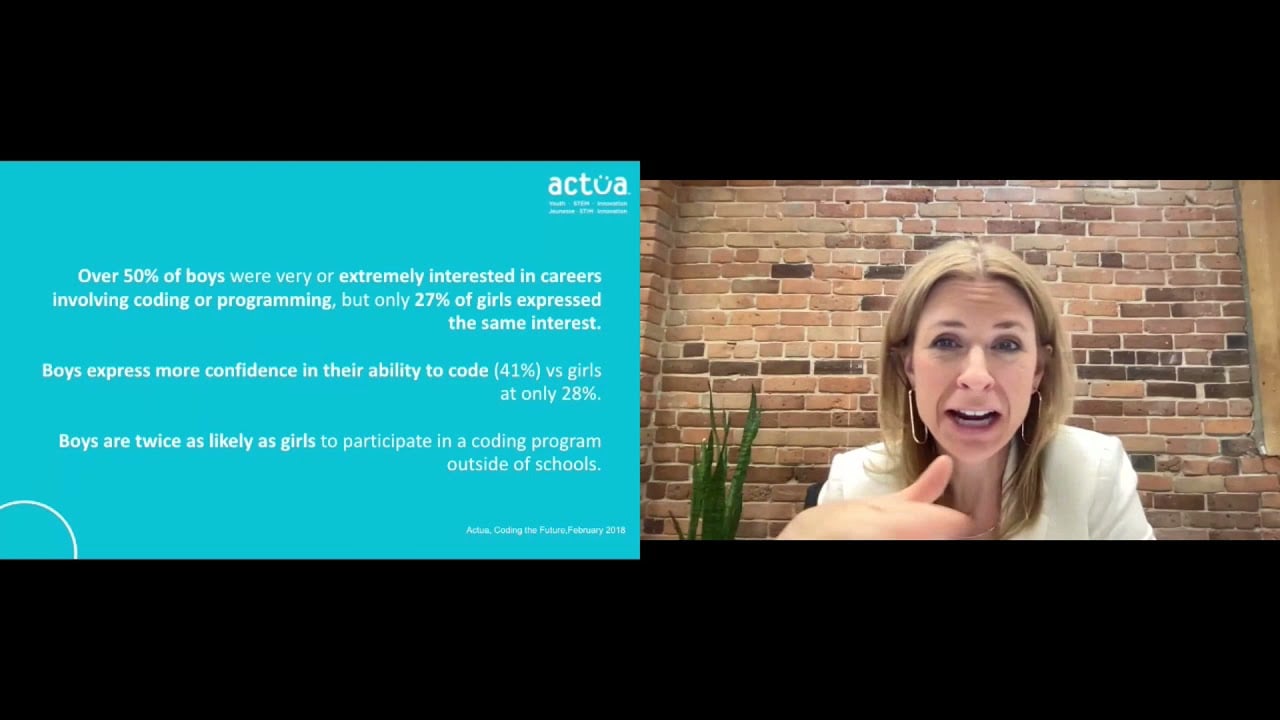
And the reason why this happens is not because female girls have different qualities or aptitudes, it's because there are different stereotypes and there are different expectations of what they can do. So in order to bring this talent, female talent, to STEM disciplines, we need to give visibility to give examples and to make it more accessible and more appealing in the early years of their education.
But this problem also continues all the way through the professional track and statistics, in this case from the US, show us that whereas you can find almost 50% of females in topics of biology, when you talk about chemists or mathematics or engineering or physics, then this percentage is very rapidly reduced. In spite of examples that we have had of female researchers in the past who have had spectacular contributions, it turns out that we are not aware of these professionals, how they contributed, and then therefore these role models don't exist in our minds.
The fact is that only 35% of STEM students in higher education globally are women. And when I say globally, this is an average. So it means that there are many countries where the situation for women and their access to university is even harder. We can only change things by setting examples in those institutions and countries that can afford to make this effort.
When it comes to research, only 30% of the world's average population are females. And then the reason behind this is always attributed to be the stereotypes, the stereotypes that are portrayed in the media, in the movies, in journalism. And these are assimilated by adults also, and they're perpetuated through every decision that we make. So not only we need to attract the female talent to science and technology, but also we need to make sure that they are retained, And that there are safe conditions for female workers to continue their full path.
I want to bring to your attention here some of the analysis done in this research program. It's a study that is regularly maintained at the European Union. It's called the SHE-Figures, and it's updated regularly. And here we can see, for instance, that even though about 48 percent of women of researchers are females, when you look at technical paths of research and academia, only 24 percent are covered by females.
And when you look at the higher rank positions in research and the decision making positions, they are only covered by maybe one every four or one every five by females. And in return, this is going to perpetuate the situation for many years. So we have to change that. I like this kind of graphs where you see the evolution from the early stages of studies in the university.
When we have access to science studies, we are almost represented at 50%. This is, again, for the European Union. However, as you continue your training and you go through PhD and postdoc and then the early stages of teaching or international collaborations, then this gap is opening until the moment when you get to the highest position, which could be a professorship in the university, where generally you tend to have only one every five or every four given to females.
So how can we change these trends? If you compare consecutive periods of years as the ones that are shown here, there is a slight tendency for things to change. So some activities that are being implemented, apparently they are effective. There are three major blocks where I think we can act, in my opinion. As I mentioned, the first one is breaking the stereotypes, providing visibility to females that are working in every kind of level of the spectrum.
But also breaking stereotypes about any other thing, like age stereotypes. Do you have an expectation of what is the age of a professor? Do you have an expectation of what is the age where you should start doing the PhD? And the same for race and economical level and country of origin and so on. Then we have to be very active, breaking the unconscious biases that we all have.
Whenever we are making a decision, who are we giving funding to? Who are we promoting for this position? Who are we giving the responsibility to supervise somebody else? We tend to have biases that come from many years of working the same way. We expect to have a kind of candidate there. So we have to be always fair when we take this decision, be ready to be extremely objective, to share the ideas that made us take this decision openly.
And that way we're going to break this sick trend. And finally, of course, even if you promote females and you give visibility to them, there is a possibility that females decide not to continue in this career because it's very difficult to maintain a balance between work and life. And this affects not only women, but also obviously men and not even people that have family.
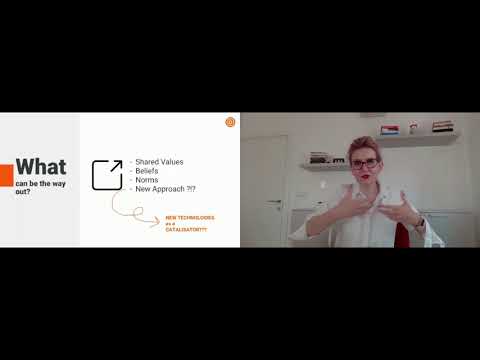
You may be single and you may want to have a healthy balance between your work and your life. And nowadays, there are ways of using computers and teleworking and networking to promote this. So what I suggest is that we try to promote visibility, objectivity and flexibility as three fundamental areas of work to break this gap. I'm going to give a few examples. Here we have the Artemis crew that has been selected for the next NASA mission to the moon.
And you already see how we are breaking stereotypes. We're giving examples to the society of different people that are clearly heroes to our mind. They're brilliant, they're successful, and they represent a different spectrum of society. And this has been done already in the International Space Station. This is an international cooperation program between NASA, the European Space Agency, Canadian Space Agency, Japanese and Russian Space Agencies.
And regularly, we see astronauts here, and some of them also have covered leading positions, like Samantha Custavoretti, who has been the commander of the International Space Station. And then here, I'm giving another example of how to break stereotypes. So now we have the Chinese experiment on the space station, and again, we have a female astronaut, and she's communicating from orbit with Earth.
She's sharing videos of science. And this is something that we are well aware of now, that astronauts, besides being super clever, intelligent, having many studies and languages and being physically fit, they are also extremely good at communicating. They are ambassadors for science and technology, and they have a lot of responsibility in breaking these kind of stereotypes and also in promoting interest in society.
So we can, by no doubt, we think of an astronaut, we think that it's a hero that is well prepared, is extremely brilliant. And obviously they must have been selected objectively. So we think that in this case, visibility and objectivity manage to give a team where there is a balance. Maybe this is not the most common example for a job career because there are very few profiles and because it's not the best one to have in parallel with a personal life on Earth.
But I want to give a few other examples of the way we're doing this in space exploration. So not only you can explore when you're an astronaut, but you can also do it from your home using your computer when you're using robots. So if the rover is exploring the surface of Mars, this rover is communicating with Earth on a daily basis.
And here I'm giving examples from the Mars Science Laboratory, the Curiosity rover, but it works the same for the Perseverance rover that is also working right now on Mars. These platforms have to communicate on a daily basis with Earth. They are sending data back to Earth and receiving instructions from Earth. And when these decisions are made on Earth, they have to be done with themes that are distributed all over the world.
And they have to decide this within a few hours and in a cohesive way, arguing, why do I recommend to do this or that? Now, in the case of Curiosity, I know for a fact that this has been working successfully for already 11 years. It has been in operation on Mars. And when you put together brilliant people with a good attitude, with a good spirit, and you're using this kind of teleconferences, networking infrastructures, then things can run very smoothly.
And finally, the goal of this community is to make sure that you get the best out of the rover and you produce the best science and you don't document this in scientific articles. I'm sharing here some statistics, some analysis that I've done on the population and the gender distribution of the community of the Mars Science Laboratory. And if you start from top and go down, as you can see at the beginning of the mission, when the mission was proposed prior to being designed and built and launched, most of the critical roles were covered by mail and this is what happens always in science that leadership positions are generally covered by mail and they are the ones that are getting the funding and the support from their institutions now as the mission was built and more investigators
were joining the team and especially once it landed there was a program called participating scientists that allows for scientists to apply to be part of the team for a couple of years and this is a competitive program and you have to say i'm going to do this science if you allow me to join the team i'm going to use this data and i'm going to produce these papers and because it's so competitive and you really want the best it turns out that the at the end naturally we ended up having many brilliant women in the program and this is a graph that i'm not going to explain in detail unless you have questions about it but it shows the evolution over the years of the percentage of female participation in planetary exploration and in particular in the
case of the Mars Science Laboratory. And I'm comparing the blue line which is based on the data that we have and where we are right now with the red line that it's what it tells you how many PhD students at the academic level have the training that could allow them to join the mission. So there is always a shift between the people that are actually ready to join and the the ones that really join there's always this trend to have less women that we should but the gap is going to be broken um so in summary what i've seen that i think to me were the keys of success of this mission is that a participating sorry participating scientists are always competitively selected and this decision is done in a organic way by by the network and the reasons
why you choose somebody they might be they must be objective and you have to be able to present them to other people, external to the program. The people that join the team have responsibilities that are shared. So you don't have to commit to be like five years leading this and you're the only one. I cannot get sick and I cannot have a leave to take care of my kids. You're going to be doing this in shifts. You're going to distribute or have a share of responsibility. But I'm always going to be accountable for my own ideas. I'm going to have this ability. If I perform well, going to be recognized for that and what this means is that at the end this is going to allow me
independent of my gender to build my cv and to apply for other things uh beyond this this mission so these are my recommendations for other institutions basically for scientific technical institutions and technical programs i think we have learned that if you really have to do something that is extremely challenging you want to have the best people in the team you cannot afford to lose talent and you're going to focus your decision is just going to be focused on the qualities of the people not on their gender or the race or the age and if you have this selection approach based exclusively on excellence then at the end what you're going to end up doing is that you're going to give an example of diversity and inclusion and you're going to promote people
through the career path allowing them to have more chances. A key factor at least to me was the flexibility in the in the group because if you're going to commit to 10 years program I want to make sure that this is not going to be observant that I can keep some of the things in parallel maybe I have to teach maybe I have to supervise my other student or as I said maybe I have to I may need some time to to dedicate to my family and also it's very important this networking idea that things are discussed openly and there is a flat structure we have this pyramidal structure where things are decided at the top in a hidden way you don't have to be accountable for the decisions then we're going to perpetuate these mistakes of the past
so my recommendations make a flat competitive and flexible structure so that you give rise to the best not only women but to the best candidates to to promote based on their merits and their work If you take these advices and you implement it in other fields, then I think we're going to feel this is a contagious, positive effect on other areas.
And again, we have this responsibility in the case of research because we are the avant-garde of knowledge. We are the ones that we have to change the trends. But in general, if we are working in countries that have a well-established educational system, a safe working environment, I think that we also can hope that we can give example to other countries where these things are not guaranteed.
With that, I would like to stress once again, this is my take-home message for you. I would like you to encourage to provide visibility to all kinds of roles, not only female roles, to be objective in your decisions and make sure that you can share them openly, that you would be ready to confront the scrutiny of people from outside.
and to implement working policies that are flexible. And that way, I can guarantee that you're going to get the best of your team. So thank you very much. And if you have any questions, I'm happy to answer them. Thank you. thank you all and have a nice afternoon or nice day wherever you are take care
Transcribed automatically; names checked against the speaker record. Select a time to jump there.
Article based on this talk
What can Mars rover teams teach organizations about gender balance?
Planetary physicist Maria-Paz Zorzano argues that visibility, objective decisions and flexible, flat structures let women rise even in the most competitive fields.
In short
Maria-Paz Zorzano, a planetary physicist who explores Mars with NASA and European Space Agency robotic missions, argues that gender balance is achievable even in a field as specialized and competitive as space exploration. Drawing on her analysis of the Mars Science Laboratory (Curiosity rover) community, she shows that selection based purely on excellence, shared and shift-based responsibilities, and flat, open, online working structures brought many brilliant women into the mission. Her prescription for other institutions comes down to three words: visibility, objectivity and flexibility.
Key takeaways
Gender balance
Digital nomad
Excellence, diversity and inclusion
STEM
Space exploration
Where the gap starts and why it persists
Zorzano opens by framing research as work that owes something back to society, pointing to two United Nations Sustainable Development Goals: quality education and gender equality. Citing the UNESCO study Cracking the Code, she explains that gender differences in STEM education appear in the very early years, and she is clear about the cause.
"And the reason why this happens is not because female girls have different qualities or aptitudes, it's because there are different stereotypes and there are different expectations of what they can do." (2:00)
As the speaker cited, only 35% of STEM students in higher education globally are women, and only 30% of researchers worldwide are women. She stresses that these stereotypes, absorbed from media and film, are also carried by adults into every decision they make. Attracting girls is therefore only half the work.
"So not only we need to attract the female talent to science and technology, but also we need to make sure that they are retained, And that there are safe conditions for female workers to continue their full path." (3:34)
The leaky pipeline in European research
Using the European Union's She Figures study, Zorzano traces how women are represented at almost 50% when they begin science studies, yet the gap widens through PhD, postdoc and early teaching roles. By the time researchers reach professorships and decision-making positions, as the speaker cited, only about one in four or one in five are women. Comparing consecutive periods, she sees a slight positive trend, which suggests that some current measures are working.
Three levers: visibility, objectivity and flexibility
Zorzano groups her proposals into three blocks. The first is breaking stereotypes by making women visible at every level, and by questioning other assumptions too, such as the "right" age for a professor or a PhD student, race, economic background and country of origin. The second is tackling unconscious bias in decisions about funding, promotion and supervision.
"So we have to be always fair when we take this decision, be ready to be extremely objective, to share the ideas that made us take this decision openly." (6:43)
The third is work-life balance, which she notes affects men and single people as much as parents, and which teleworking and networking tools now make easier to support.
"So what I suggest is that we try to promote visibility, objectivity and flexibility as three fundamental areas of work to break this gap." (7:41)
Astronauts illustrate the visibility lever. Zorzano points to the diverse Artemis crew, to Samantha Cristoforetti's command of the International Space Station, and to a female astronaut on the Chinese space station sharing science videos from orbit.
"They are ambassadors for science and technology, and they have a lot of responsibility in breaking these kind of stereotypes and also in promoting interest in society." (9:04)
Exploring Mars from home
Astronaut careers are rare and hard to combine with personal life, so Zorzano turns to a more transferable example: robotic exploration. Rovers such as Curiosity and Perseverance send data to Earth and receive instructions every day, and those decisions are made within a few hours by teams distributed around the world. She notes that Curiosity's operations have run successfully for 11 years.
"And when you put together brilliant people with a good attitude, with a good spirit, and you're using this kind of teleconferences, networking infrastructures, then things can run very smoothly." (10:48)
Her own analysis of the Mars Science Laboratory community shows that when the mission was proposed, most critical roles were held by men, as is typical of funded leadership in science. After landing, a competitive participating scientists program let researchers apply to join for a couple of years, and because the program sought the best, it ended up with many brilliant women. She compares female participation with the share of PhD-trained women who could join, and observes that a gap remains but is closing.
Why the structure works
Zorzano identifies the keys to the mission's success: competitive, organic selection by the network, reasons that must be objective and explainable to outsiders, and shared responsibilities rather than single-person ownership for years at a time.
"You're going to be doing this in shifts. You're going to distribute or have a share of responsibility." (13:40)
Each person remains accountable for their own ideas and is recognized for good performance, which, regardless of gender, lets them build a CV and apply for opportunities beyond the mission. In contrast, she warns, pyramidal structures where decisions are made at the top in a hidden way perpetuate the mistakes of the past. She calls on research institutions, as the avant-garde of knowledge, to lead this change and set an example for countries where education and safe workplaces are not guaranteed.
"I would like you to encourage to provide visibility to all kinds of roles, not only female roles, to be objective in your decisions and make sure that you can share them openly, that you would be ready to confront the scrutiny of people from outside." (16:39)
Watch the talk
Lessons learned from Mars and Moon Exploration: diversity, inclusion and gender balance, Maria-Paz Zorzano, 18 minutes: https://www.womentech.net/video/lessons-learned-mars-and-moon-exploration-diversity-inclusion-and-gender-balance
About the speaker
Dr. Maria-Paz Zorzano is a Scientist and Civil Servant at the National Institute of Aerospace Technology (INTA) in Spain, working at the Center for Astrobiology, and a planetary physicist with more than two decades of research on the habitability of Mars across NASA and ESA missions including Curiosity, Perseverance, ExoMars Trace Gas Orbiter and Mars Sample Return. She has authored more than 150 peer-reviewed publications, sits on the COSPAR Planetary Protection Panel, and wrote a research paper on gender balance lessons from the Mars Science Laboratory.
Questions this talk answers
Why do so few women reach senior positions in STEM research?
What can organizations do to close the gender gap in technical fields?
How did the Mars Science Laboratory mission bring more women onto its team?
Why does flexibility matter so much in long scientific programs?
Why should decisions be made openly rather than at the top of a hierarchy?
Drafted with AI from the talk transcript. Editor review pending.
Frameworks and ideas mentioned
Visibility, objectivity and flexibility
Participating Scientists program
UN Sustainable Development Goals
Resources mentioned
UNESCO, Cracking the Code: Girls and Women's Education in Science, Technology, Engineering and Mathematics
She Figures (European Union)
Cite this talk
Maria-Paz Zorzano. "Lessons learned from Mars and Moon Exploration: diversity, inclusion and gender balance." WomenTech Network, 2023. https://www.womentech.net/video/lessons-learned-mars-and-moon-exploration-diversity-inclusion-and-gender-balance