Yes you can become a technical leader even if you haven't coded in forever!
Beckie Riss19:412023
Her last coding assignment was in 1996, and she still became a tech leader
Picnic planning, employee resource groups and team building often fall to women, and none of it counts in a performance review or builds a technical reputation. Beckie Riss, Principal Enterprise Architect at Ford Motor Company, has not coded since 1996, yet she now leads work that makes software developers more productive. So how does someone rebuild a technical identity after years away from code?
Get a five-step plan to upskill, speak up and be seen as a technical leader again
Beckie Riss, Principal Enterprise Architect at Ford Motor Company, argues that women who started out technical and drifted into organizing, program or people roles can still become technical leaders. Drawing on her own path from a last coding assignment in 1996 to senior technology leadership, she lays out five moves: trust yourself, commit time to learning, be vocal, take the scary path and stay authentic.
“My last software coding assignment was in 1996. Imagine how practices have changed in that time.”
“The bottom line is you need to commit to spending the time and you need to start now.”
What you will learn
Identify the technologies your company values and match them to adjacent skills you already have.
Commit a realistic number of hours per week or month to upskilling, using company platforms, audiobooks and libraries.
Build a technical reputation by asking a question in every meeting and answering questions in group forums.
Find one or more mentors outside your leadership chain so you can practice safely and hear new perspectives.
Stay authentic by protecting personal time and getting comfortable saying "I don't know, but I can find out."
Key takeaways from the speaker
Trust yourself.
Just because you haven't done it before does not mean you can't learn.
Take the path that scares you the most.
Staying true to yourself and being authentic
Details
Level
All levels
Format
Talk
Technical depth
Non-technical
For
Mid-career, People manager, Career changer
Length
19:41
Published
May 2023
Questions this talk answers
Can I become a technical leader if I haven't coded in years?
Yes. Beckie Riss last coded in 1996 and is now a senior technology leader, and she notes that almost everyone learns a new job while doing it.
How much time should I set aside to upskill?
Pick a specific commitment carved from the time you spend on others. She aimed for four hours a week and realistically landed nearer four hours a month.
How do I find a mentor?
Approach someone in your company whose style you admire, ideally outside your leadership chain, and ask for a one-time conversation about your career.
How do I get others to see me as technical?
Be vocal: share what you know with supportive groups first, ask a question in every meeting, answer questions in team forums and work up to speaking at events.
How do I stay authentic while pushing into a technical role?
Keep time for family and self-care, and treat vulnerability as a strength by saying you don't know but can find out.
About this talk
Often times women in tech tend to get assignments that are less technical and more product or people management focused. Many times it is the women in organizations who do most of the softer things - picnic planning, team building, DEI employee resource groups, etc. that are not part of your performance review and further entrench your reputation as a non-technical person. Join me to learn how you can invest in yourself to upskill, change perceptions and become a technical leader without losing your authentic self.
Leading change for 12,000 people with no playbook (43 s)
Ask one question in every meeting (83 s)
Vulnerability as a secret power (49 s)
Hello, everyone. Thank you so much for joining us today. Here at this session, we're having Beckie Ris. She is the principal enterprise architect of Ford Motor Company. She has more than two decades of experience with domestic and international organizations, and she's going to be telling you a little bit more about becoming a technical leader, even if you haven't called it in forever. In the session, she's going to cover more about staying true to your authentic self and taking on the path that might be a little bit scary. So, Beckie, thank you so much for joining us today. Whenever you're ready, feel free to take it away.
Great. Thank you so much, Adrienne. I really appreciate being here today. And hello, everyone. Welcome. I hope you've been enjoying this wonderful event where we come together as women in technology. I am Becky Ris, and I have had a very diverse career at Ford Motor Company. I'm currently a principal enterprise architect responsible for enabling software developers to be even more productive. I've learned several things in my journey that may help you become a technical leader, even if you haven't coded in forever. My last software coding assignment was in 1996. Imagine how practices have changed in that time. And yet here I find myself with 29 years of experience and a senior technology leader at one of the largest automotive companies in the world.
So let's start with some audience participation. Just give me a thumbs up if you started out technical And you kind of have been away from that for a while. So you can use your little emojis and give me a thumbs up if you're in this situation where you started out technical and perhaps aren't so technical now. So I saw a couple of thumbs up. Thank you for that.
All right. Well, that's exactly why we're here today. And frankly, what's happening at my company is people want technical roles. They want leaders in technical roles. So there's a big shift that we're experiencing. So let's start with perhaps why you decided to join today. Do any of these statements resonate with you? And let's start at the top. So again, audience participation. Give me a thumbs up if you started in in a technical role and maybe have moved into less technical roles as your career has progressed.
Anybody like that? All right. How about the next one? Are you good at organizing and managing things? So have been guided by your leaders to move to a less technical path? Anybody like that? You can give a thumbs up or high five, whatever emoji is working for you. How about this one? That you're maybe a diversity, equity, and inclusion advocate and actively participate in groups to promote awareness. I think that heavily falls on women in my company anyway. And then how about this? You do many things at work that aren't really part of your performance review, like team building, picnics, employee resource group management, things like that. Anybody in the same boat as I am? You can, again, show me.
Show me your love with your thumbs up. So it looks like we have like-minded people out there. I started out, as I said, as a software developer, website development at the very start of Ford's intranet use. And after that, I never really did hands-on coding again. I moved into other roles, business analyst, project manager. I was an agile scrum master. I led a large program office. And I found throughout my experience and also mentoring other people that oftentimes because women are good at organizing and managing things, they end up in those types of roles. So I also find that myself and my colleagues are overwhelmingly involved in the DEI advocacy area. And we are first to volunteer for group events and really help build community at our company. And it's not bad. It just is.
So I'm going to encourage you to think of the time you may spend doing these things compared to the time you spend investing in your own skills development. So give me a thumbs up or put in the chat if you tend to spend more time on others than you do on yourself. Does this sound like you? I see some thumbs up. Awesome. Yeah, certainly that's me too.
So you being here is a good first step. I encourage you to trust yourself. The first thing that you need to do is to change your own mind that you can do something different. And I suggest that when you identify what's valued at your company and decide of those things that are valued what you may be interested in and it's a really good place to start. So use this chat feature and just a shout out there in the chat what you're seeing in your company that's valued. I know at Ford things that are valued now are all things cloud related. Moving our application portfolio to the cloud is one of our big initiatives we've been on for many years. Digital transformation is big. We're implementing some new technologies.
So what about you? What are you guys seeing that's being valued from a technology perspective in your company? I see digital transformation, security by design, new technologies. Absolutely. So in my case, over the past six years, we've been on this major digital transformation. I'm sure like many of your companies I've been on. So six years ago, I was asked to lead a culture change initiative. Now that may sound like a soft skill for sure, but it taught me so much.
And imagine getting an assignment where you had to change the hearts and minds of 12,000 technical people. I didn't know what the heck I was getting into. I didn't know how to do organizational change management. At that time, when they asked me to do this, I was deploying SAP for our service parts management in North America. I was in a highly technical software delivery role. And I asked the hiring manager, why did they ask me to apply for this role? And they said, we need someone who's been in the trenches, who's authentic to teach the organization a different way forward. And that was the path I took.
So let me ask you this question. Use the thumbs up or put in the chat if you believe you already have the skills you need today to succeed at your company. And maybe use the thumbs down or frowny face if you know you need to work on your skills. So where are you guys at? Do you have all the skills you need to be successful? Or do you still need to work on them? So I'm seeing some we need to work on them. That's why you tuned into the session. Definitely more. All right, but now I'm going to ask you another question.
Use like a heart or love emoji or even a thumbs up emoji. If you ever got a new job that you had to learn about the new job while you were in the job. Absolutely. That's part and parcel of getting a new job. You always have to learn something. So it's no different now when you're thinking of moving into a more technical role. Many, most people have to learn things on the job. And most companies allow you to learn a portion of them along the way. So let's talk next about how you can learn.
So the first thing again is to overcome your own mental blocker that you can learn. And action is really everything. So now that you've thought about the time that you spend investing in others, what portion of that time are you going to spend on investing in yourself? So in the chat, light it up. How many hours per week or hours per month are you committing to yourself to upskill, to grow your skills, to become a technical leader? I know I started out with four hours a week, which was super aggressive. And I probably ended up more like four hours per month.
What are you guys going to commit to with all the time you spend investing in other people? How much of that are you going to carve out now to spend on yourself? I love it, Keisha. Thank you. Two is reasonable. Yeah, an hour per week. Yeah, two hours per week. That's awesome. So for me, it came naturally as my children grew up and became more independent in high school.
I had time to read, to listen to books and podcasts, to look and inquire at different learning opportunities at my company. So most of the skills that I built were upon skills I already had. Right? So I did a self assessment to say, what skills do I already have? What do I enjoy doing? What does the company need that are adjacent to them? And how can I amplify those?
You can look at things like what resources that your company may have for you to build up your skills even more. In my case, my company has subscriptions to Pluralsight, which is a technical learning platform, and also LinkedIn Learning, which are great sources of all sorts of online virtual content that I can use to learn any number of subjects. When I got this role about 16 months ago, I did their DevOps and DevSecOps learning journey because I needed to quickly come up to speed on what this was all about because I hadn't led a team like this before. Other great resources I use, I have an audible subscription.
So I pay my monthly subscription and I get an audio book credit each month. I also am an avid library reader and I request books from our local libraries and they have affiliate cooperation with other area libraries to get me the content I need so I don't have to necessarily buy all the books. that I want. So these are things that I do. I also find listening to books for me works well because at night, as soon as I settle in to read a book at night and I'm laying down, my eyes tend to close.
I'm like those little dollies that we used to have where you lay them down and their eyes closed. So I find listening to books is much more energetic for me. So please share in the chat, what places do you go for learning? Is it books? Is it podcasts? Is it websites? Which area do you find the best source to learn something new? I see podcasts? Books? Audiobooks?
Yeah, LinkedIn Learning, YouTube. YouTube's great. Yeah. Oh, Udemy. Awesome. Online stuff. Excellent. So keep these tips in mind. We're all learning from each other and great sources to leverage. Another area that you can speak about that you could seek is thinking about what skills you want to build upon. Who in your company has those skills? And reach out and learn how did they get their knowledge? You can look and see, is there any internal classes like lunch and learns that you can join, for example? The bottom line is you need to commit to spending the time and you need to start now.
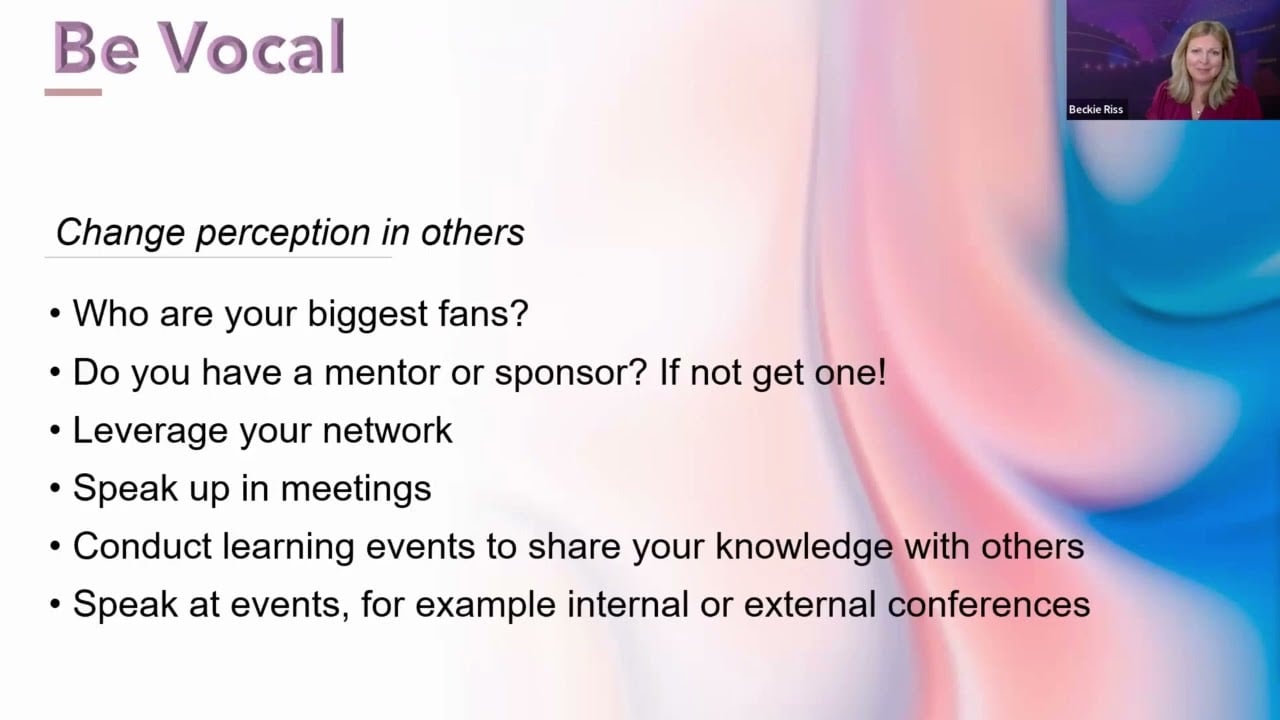
Right? You need to start readying yourself. You can learn. We all proved ourselves that we can learn when we went through college and every job we've had and we've learned on the job. The next thing is be vocal. So you need to be starting to be perceived as a technical person or leader. And to do that, you need to be vocal. My suggestion here is you're changing the perception and others of how they see you when you show up and are vocal with your aptitude, your technical attitude that you have. And I say start with people who are your biggest fans, your mentors, your past supervisors, your current supervisors, an employee resource group you're affiliated with where you can share what you know in small groups. So I'm curious, how many of you have a mentor already? So give me a
thumbs up or a sign in the chat if you have a mentor already. And does anybody have more than one mentor? Awesome. Several. You just, you just got one. Go, Kalisha. That's awesome. So mentors are important because they give you a different perspective of you than you probably will hear from your supervisor. And you can also try things with them and practice things with them safely, right?
Because you're not measured by them. So I suggest that you have a mentor. If you can get a mentor, they're great. If you don't, what's holding you back? Like what harm is it to have a mentor? I mean, you have to spend maybe an hour a month with them. You have to prepare for that. But that's about it. I actually suggest people have more than one mentor. I think having a variety of mentors help you grow fully. Some might be a technical mentor, some might be leadership members, and you really need diversity in your mentors to get those different perspectives.
So by leveraging the network of people you already know, you can comfortably practice your technical skills. And they'll also, the people that you practice with, will recommend other groups for you to go speak to and share your knowledge with. You may need to know the foundational information that you have. Okay. So I see a question in the chat. How do you find a mentor? So typically what I say is, who do you like in your company? Who do you aspire to be like? That's a good person to start with and ask, hey, I'm looking for some advice. Do you think we can meet and we could talk about my career?
And you might just start it as a one thing, one time thing. So usually I look for people who I would like to get to know more. That's how I get started. Another question, I would like a mentor and how do you suggest connecting with one? Again, it's through your company is usually the easiest way. And it's somebody you appreciate their style and you'd like to get to know them more and probably not in your leadership chain. Again, to be a little bit separate from that performance review stuff.
So another way to get started is you can take the very small step of forcing yourself to ask a question in every meeting that you attend or force yourself to provide an answer to someone who asks in a group forum. So many of us have Zoom or WebEx teams or Microsoft teams where we have these instant messages and forums that we're part of. Ask and answer questions in there. It's a good way to have yourself be able to practice your skills as well as pretty low risk of you giving an answer or asking a question to help develop your skills. When I became an architect for the first time, it helped me with my competence.
I needed to learn a little bit about the business and a lot about being an architect. So I forced myself to ask a question in every meeting. And what I found is a lot of people on the call said, Oh, good question. I had the same question. So your silence isn't helping anybody, but you're you being vocal will. So look for things like this that can give you confidence and seek feedback from your peers and people leader how you're doing so you can improve. I started sharing at our Women Afford forums different topics. I had skills I thought others would be interested in. Most of them started out like this where I'm talking to you about my journey and how you can be perceived differently. I also
committed to myself that I was going to speak at department meetings and lunch and learns on a quarterly basis so I could practice. And I worked myself up to speaking at an internal API conference. And that was really my first, you know, broadly seen activity at my company where I was being perceived as a technical leader by speaking at that conference. And now I speak at internal and external conferences regularly. Now, it might scare you, but you need to practice this. And you need to be seen as a technical person in order to get the roles that you desire to seek. So a couple more things I'd like to connect on with you before we end today. What is your commitment? How are you going
to start? Are you going to start asking questions? Are you going to start being more vocal? What are you going to do? Yes, I'm asking. Yes, speak up. Excellent. Excellent. Okay, so we have about two minutes left. And I don't want to miss out on the authenticity part. So be authentic. Throughout your journey, it's important for you to be authentic. This is the time to think about what you want and how you might get there. But don't lose yourself in the mix. You still need to have time to go to the soccer game or to do your own self care routine.
And I found one big help for this is changing my mindset to be okay with saying things like, I don't know, but I can find out. I've done a lot of reading about vulnerability. So Brene Brown is an excellent source for this. She's an expert. And I found in particular, women can be a little more vulnerable and say things like, I don't know, but I can find out or let me ask because there's not that ego or red tape that sometimes comes in more quickly with my male colleagues. So I think vulnerability can be our secret power. I hope that you appreciated this discussion today. I really liked interacting with you on the platform. And I'll close with the kind of tips that I had shared here. Trust yourself,
you can learn, be vocal, take the scary path and be authentic. So wonderful to see everybody today and enjoy the rest of your conference. It was great to connect.
Transcribed automatically; names checked against the speaker record. Select a time to jump there.
Article based on this talk
How to rebuild a technical reputation after years away from code
Ford's Beckie Riss explains how women steered into non-technical work can upskill, speak up and step into technical leadership.
In short
You do not need recent coding experience to become a technical leader. Beckie Riss, Principal Enterprise Architect at Ford Motor Company, last coded in 1996 and now enables software developers at one of the world's largest automakers. Her route back rests on five habits: trust yourself, commit time to learning, be vocal, take the path that scares you and stay authentic.
Key takeaways
Trust yourself.
Just because you haven't done it before does not mean you can't learn.
Take the path that scares you the most.
Stay true to yourself and be authentic.
Why capable women drift away from technical work
Riss began as a software developer building websites in the early days of Ford's intranet. After that she never did hands-on coding again, moving through business analysis, project management, scrum master work and leadership of a large program office. Mentoring others, she saw a pattern: women who are good at organizing and managing things are guided into those roles, and they also carry much of the advocacy and community work.
She asked the audience whether they champion diversity, equity and inclusion groups, adding: "I think that heavily falls on women in my company anyway." (2:48) She was careful not to frame this as a failing: "And it's not bad. It just is." (3:39) The real issue, she argued, is how much time goes into supporting others compared with investing in your own skills, especially when that work rarely appears in a performance review and quietly cements a non-technical reputation.
Trust yourself and aim at what your company values
The first step is internal. "The first thing that you need to do is to change your own mind that you can do something different." (5:07) From there, Riss suggests identifying what your company values and picking the areas that interest you. At Ford that meant cloud migration, digital transformation and new technologies.
Her own story shows how unfamiliar assignments can become turning points. Six years before the talk, while deploying SAP for service parts management in North America, she was asked to lead a culture change initiative aimed at the hearts and minds of 12,000 technical people, with no background in organizational change management. When she asked why she had been approached, the answer surprised her: "And they said, we need someone who's been in the trenches, who's authentic to teach the organization a different way forward." (6:31)
Commit the time, then choose your sources
Riss reminded the audience that nearly every new job requires learning on the job, so a move toward technical work is no different. What matters is action. She asked viewers to name a weekly or monthly number of hours to invest in themselves, and was candid about her own: "I know I started out with four hours a week, which was super aggressive. And I probably ended up more like four hours per month." (8:26)
She started with a self-assessment: which skills she already had, what she enjoyed and what adjacent skills the company needed. When she took her current role about 16 months before the talk, she completed the DevOps and DevSecOps learning journey on Pluralsight, which Ford provides alongside LinkedIn Learning. She also uses an Audible subscription and her local library network, and prefers audiobooks because reading in bed sends her to sleep. Another route is to find colleagues who already have the skills you want and ask how they built them, or join internal lunch and learns. "The bottom line is you need to commit to spending the time and you need to start now." (11:35)
Be vocal, and start with your biggest fans
To be seen as technical, you have to show your technical aptitude out loud. Riss recommends starting small with supportive audiences: mentors, past and current supervisors and employee resource groups. She encourages having more than one mentor, ideally outside your leadership chain. "So mentors are important because they give you a different perspective of you than you probably will hear from your supervisor." (13:08) To find one, she suggests approaching someone you admire and asking for a single conversation about your career.
Her most practical habit came when she first became an architect. "So I forced myself to ask a question in every meeting." (16:00) Colleagues often replied that they had the same question. She also answered questions in team chat forums, committed to speaking quarterly at department meetings and lunch and learns, and worked up to an internal API conference. That was the first time she was widely seen as a technical leader, and she now speaks at internal and external conferences regularly.
Stay authentic, and use vulnerability
Riss closed by insisting that the push toward technical leadership should not cost you yourself. There still needs to be time for the soccer game and your own self-care routine. What helped her most was a change of mindset that let her say "I don't know, but I can find out." Citing Brené Brown's work on vulnerability, she observed that women often say this more readily than some male colleagues. "So I think vulnerability can be our secret power." (18:21)
Watch the talk
"Yes you can become a technical leader even if you haven't coded in forever!" by Beckie Riss, about 20 minutes: https://www.womentech.net/video/yes-you-can-become-technical-leader-even-if-you-havent-coded-in-forever-beckie-riss
About the speaker
Beckie Riss is Principal Enterprise Architect at Ford Motor Company, a senior technical leader with over two decades of domestic and international experience across enterprise architecture, SAP delivery, program management and culture transformation through organizational change. She is currently responsible for developer relations at Ford Motor Company.
Questions this talk answers
Can I become a technical leader if I haven't coded in years?
How much time should I set aside to upskill?
How do I find a mentor?
How do I get others to see me as technical?
How do I stay authentic while pushing into a technical role?
Drafted with AI from the talk transcript. Editor review pending.
Frameworks and ideas mentioned
DevOps
DevSecOps
Agile Scrum
Resources mentioned
Pluralsight
LinkedIn Learning
Audible
Public library networks
YouTube
Brené Brown's work on vulnerability
Cite this talk
Beckie Riss. "Yes you can become a technical leader even if you haven't coded in forever!." WomenTech Network, 2023. https://www.womentech.net/video/yes-you-can-become-technical-leader-even-if-you-havent-coded-in-forever-beckie-riss