In short
Women are starting businesses in growing numbers, but the financial system still makes it harder for them to borrow, raise money and reach customers. Bhuva Shakti, Chief Ethics & Culture Officer at Women in AI, argues that financial inclusion, meaning affordable and responsible access to everyday financial products, is the lever that lets women entrepreneurs thrive. Her prescription: build digital finance that is inclusive by default, use free public data and partnerships to shape policy, and design business models where social impact and revenue grow together.
Key takeaways
- Women's financial inclusion: why it matters
- Essential tools for a digitized global economy
- Financing for women tech entrepreneurs
- Pandemic barriers and opportunities
- Government and private sector commitments
What financial inclusion really means
Bhuva opens by placing financial inclusion next to the more familiar ideas of diversity and digital inclusion. "Likewise, financial inclusion means how can we provide affordable and also responsible access to everyday financial products and services, be it for individuals anywhere or for small businesses as well." (0:57) In practice it covers the everyday: buying something online, using a mobile payment service without heavy fees, getting a credit card without bias about who you are, or taking out an insurance policy.
She grounds the stakes in a global view, noting that the World Bank considers financial inclusion a key enabler for reducing extreme poverty and boosting shared prosperity. Access to finance, she adds, helps families and businesses plan for both long-term goals and unexpected emergencies.
Women founders lift each other up, yet funding lags
After the pandemic, Bhuva has seen more women move into entrepreneurship. The reasons she lists include the freedom to pursue a passion without workplace bias, frustrations with hybrid or remote arrangements, and gaps in workplace benefits such as healthcare or parental support. These founders tend to build social impact into their culture from day one, and they support one another. "Women do certainly pay it forward. Most women entrepreneurs have women mentors, or they support another woman." (2:30) She adds that recent research, as she cited it, indicates women of color and non-binary people hire more diverse candidates.
The obstacles are still real. Bhuva describes how the framing of questions differs by gender: "For example, when we are raising funds for startups or applying for a microloan to fund your small business, many times questions are posed that include, how will you not lose versus how will you win, right?" (3:11) She cites that before the pandemic women received less than 3% of total money raised or invested in businesses at any stage, with diverse women and non-binary people facing additional challenges. High interest rates make it harder still for founders without sufficient collateral.
Why the urgency, and why systems must be inclusive by default
The pandemic, Bhuva argues, accelerated societal divides and exposed gaps in digital access, financial literacy and social norms. Financial education is not taught in schools the way science or math is, so young people start earning without guidance on balancing spending and saving. Meanwhile local and global economies are intertwined, as supply chain and digital infrastructure problems showed.
The goal she sets is inclusive access for everyone, especially the unbanked and underbanked, a population she describes as a couple of billion people, many of them women. That has direct design consequences: "And when we build these digital systems, they should be by default inclusive." (5:35) A product must work for someone in a remote village on low-bandwidth internet, not only on city broadband. And it must protect user data, gaining consent at every step, which in turn builds trust and expands the business's network.
Tools for change: the SDGs, public data and partnerships
To move from challenges to opportunities, Bhuva points to the United Nations' 17 Sustainable Development Goals as a shared blueprint for people and planet, used by developed and emerging nations alike. At WalletMax, she explains, ending poverty goes hand in hand with women's health and education, reducing inequalities and tackling climate change.
She recommends practical resources too. The World Bank tracks gendered income globally in a free database that anyone can use to define local policy changes, which can then scale to regional and national levels. "Also, we recommend leveraging public-private partnerships." (6:58) Many non-traditional funds, she says, are available to be mobilized for women's small businesses and tech startups.
Her broader mission spans digital, financial and social inclusion: omnichannel access to financial services across any device, meeting customers where they are, and removing bias in AI algorithms and technical platforms so people can exercise basic human rights.
A shared loyalty network for women-led small businesses
Bhuva closes with the model WalletMax uses, drawing on what she describes as her 25 years of corporate executive and nonprofit C-suite experience. The company partners exclusively with women-led startups, with a clear principle: "So the goal is to grow their social impact as well as revenue together. They are not mutually exclusive, right?" (8:45)
She cites research indicating women-led startups are losing market share to large franchises because they lack the financial or human capital to expand marketing, sales and business development. WalletMax responds with affordable loyalty rewards, either digital or crypto, that eco-conscious shoppers earn at one small business and redeem at another in the network. "So which means it's a win-win-win for sustainable consumers, women business owners and, of course, for WalletMax bottom line, right?" (10:23)
Watch the talk
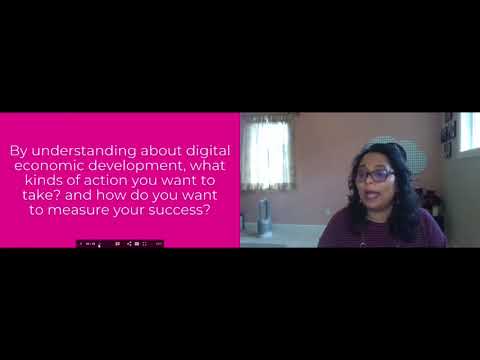
Advancing Women's Inclusion in Sustainable FinTech Startups, by Bhuva Shakti (11 minutes): https://www.womentech.net/video/advancing-womens-inclusion-in-sustainable-fintech-startups
About the speaker
Bhuva Shakti is Chief Ethics & Culture Officer (CECO) at Women in AI, where she is also Regional Head of Americas, and a Senior Director at Capgemini who has launched several fintech transformation products in investment banking and compliance. As financial inclusion advisor at Wallet Max and an early-stage investor in social impact startups with a Columbia University MBA, she works to empower the unbanked and underbanked and reduce inequalities.
Questions this talk answers
- What is financial inclusion?
- Why are more women becoming entrepreneurs after the pandemic?
- What financing barriers do women entrepreneurs face?
- How should digital financial systems be built to include everyone?
- How does WalletMax support women-led small businesses?
Drafted with AI from the talk transcript. Editor review pending.