Swap "I think we should" for evidence and stand out in any job
A professor once lost six months hunting for a single library textbook because he never noted where a quotation came from. Organizational psychologist and UX researcher Shivangi Sharma, founder of Psysquare, uses stories like this to show why research is a career skill for graduates and career changers alike. So how do you prove research skills to an employer before anyone hires you?
Learn three research habits and how a passion project can set your job application apart
Shivangi Sharma, organizational psychologist, UX researcher and founder of Psysquare, argues that research is a skill every professional uses and that graduates and career changers can show it to employers. She shares three tips (use your local library, run independent passion projects, and research ethically) and calls for more women researchers, since women make up about 30% of researchers worldwide as she cited.
“So to begin with, everyone is a researcher.”
“Not only will that add valuable experience on your resume, but you learn more by doing.”
What you will learn
Replace opinion-based statements at work with evidence gathered through research.
Plan an independent passion project on a target company's product to strengthen a job application.
Use libraries and librarians as a reliable, systematic starting point for research questions.
Distinguish primary, secondary and tertiary data and use them in a logical sequence.
Document and cite every source as you go to avoid plagiarism and lost references.
Key takeaways from the speaker
Understanding the importance of research skills in advancing your career
Insights on tools and methods to conduct independent research projects
Learn innovative strategies to demonstrate research skills as a graduate student
Importance of being an ethical researcher
Details
Level
Beginner
Format
Talk
Technical depth
Non-technical
For
Student, Early career, Career changer
Length
20:13
Published
June 2021
Questions this talk answers
Do you need to be good with numbers to become a researcher?
No. Qualitative research works with non-numeric data such as interviews and pictures, and the speaker sees the field moving toward mixed methods and qualitative work.
How can a graduate student demonstrate research skills to employers?
Run independent passion projects, for example researching how a product like Spotify could be more user friendly, and talk in interviews about what you researched, how, and which roadblocks you solved.
Why use a library when so much information is online?
Libraries give access to reliable, current and very old sources and offer a more systematic way to find credible material, and librarians know which databases to use.
What are primary, secondary and tertiary data?
Primary data is collected first hand through interviews or surveys, secondary data is peer-reviewed research by others, and tertiary sources are broad pools like encyclopedias. Start with tertiary for an overview, move to secondary, then collect primary data if it adds value.
Which sources should you consult first when researching?
The speaker starts at the library and with reputed journals, and online she advises verifying sources and preferring valid or government-funded organizations over random websites.
About this talk
Research skills are in great demand. Employers today are looking for graduates that have research and problem-solving skills. There is no right age or degree required to become a researcher and in this talk, I will make research your superpower. Learn practical strategies to demonstrate your research skills as a graduate student/anyone transitioning to make research their full-time career.
What share of the world's researchers are women? (81 s)
The professor who lost six months to one citation (78 s)
You don't need to love numbers to do research (87 s)
Speaker 1: So we're going to start with a quick trivia question on which color do you think symbolizes women? So you can type in your answers in the chat that we have. No, pink answer. So purple is the internationally recognized color to symbolize women and how unique of us to be part of Women Tech Global Conference 2021, an amazing platform that is bringing together 1 million women across the globe together on this platform.
Speaker 1: So I am Shivangi and my pronouns are she and her. I am the founder of SciSquare and through my education, I'm an organizational psychologist and a full time practicing UX researcher. So in today's session, our three main goals are to understand the importance of research skills today, research tips and learn a bit about ethics in research.
Speaker 1: So to begin with, everyone is a researcher. So from scientists, scholars, entrepreneurs and even social media influencers in the age of information today, we have learned not only how to find information, but how to analyze it and utilize it for reporting and better decision making. So whether you are trying to book a trip online or you're planning to buy a house, everyone does some form of the research or the other.
Speaker 1: And in this session, we are going to be focusing on how you can include research skills in your resume in your career to advance at the next stage that you imagine it to be. Speaker 1: So research is the world's biggest industry. At this point, there is no job across different occupations that does not require research skills.
Speaker 1: So from the science to social science to all the other fields, marketing business research has become an integral aspect of all the market and industry. Speaker 1: So once you have graduated and you transition into a full time job or a career, Speaker 2: You find yourself in a conference room sitting with your colleagues and your supervisors try to replace I think we should statement with the research indicates and supports that we should do this.
Speaker 1: Because when you are stating examples saying that I think we should be doing this versus not doing your homework and not doing your research that does not add value to your argument or argument. Speaker 1: or the evidence that you're trying to support. And as researchers, we collect information to use as evidence and to support our claims when we are discussing any aspect of the business.
Speaker 1: And a fun fact, the data is a plural term and a single bit of data is known as data. Speaker 1: Today, data has become the most valuable asset. So whether you are a graduate student recently graduated or professional or making a career transition research skills show companies that you are able to suggest new ideas and help the business adapt to the ever changing world we live in.
Speaker 1: So take initiative to conduct independent research projects for case studies and portfolio and a passion project can differentiate between you and thousands of applicants applicants to your dream job. Speaker 1: So for example, you imagine Spotify to be in a different way that there should be different features that could be included to make the product more user friendly, then you can conduct your own independent research and showcase your passion towards the product and the company.
Speaker 1: And when you're applying for your dream employers job, if you have supporting research that you have done for the company as a passion project that really motivates the recruiting manager or the hiring manager to consider your application over the others. Speaker 1: And next, we are going to do a quick trivia. So according to this, this stat is according to the UNESCO, what percentage of the world's researchers are women today?
Speaker 1: You can use the chat option to add your responses that what percentage of the researchers across the globe do you think are represented by women? Speaker 1: The number is not really high, not really low. It's just somewhere in the middle. If you want to take a guess. Speaker 1: Correct. Viviana, your number is correct. And so 30% of the world's research are women. And surprisingly, there are some exceptions to it. So the overall world number is 30%. But some countries, for example, in Bolivia, women represent 63% of the total researchers in the country. And France has a rate of 26%.
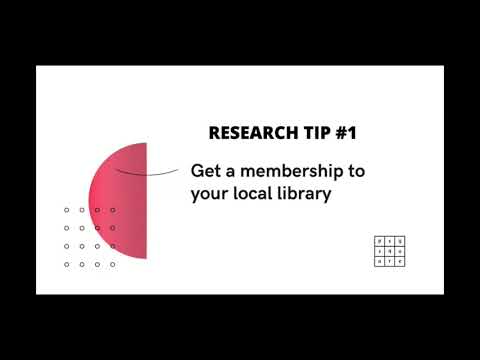
Speaker 1: Ethiopia has a rate of 8%. So I would love to know how your country is representing women researchers. And we would love to discuss more about it sometime on LinkedIn. Speaker 1: Moving on to the major trucks of my session, I'm going to share some research tips that I have learned along the way through my graduate years, or I have learned these tips from my very valuable Speaker 1: mentors. And these have really pushed me to do research in the right way in the ethical way. So I'm going to be sharing those three top tips with you today. So research tip number one is that get a membership to your local library as vague that it would sound in an information absorbed age that we are today. Given the volume of data available on the internet, you might think that libraries
Speaker 1: histories are no longer necessary. But this is a myth, because so much information is now at our fingertips. Libraries have become even more essential when conducting research because libraries help us access information that is reliable. And also you will be able to find information that is current up to date. And as long as old as you can remember. So 100 year old manuscripts or 200 year old manuscripts are also Speaker 1: available in libraries. So library also offers a more systematic and productive method for discovering useful and credible resources. So it can be a great starting place to explore some research questions. So for example, if you're trying to study a new phenomenon, you might be able to find some correlation of the previous data. And you'll be able to do your research in a more systematic and thorough way. And the
Speaker 1: The more you read the more you read the more as a researcher you're able to have different perspectives included in your research. Speaker 1: Secondly, independent passion projects will help you learn and shape your career. So as much value I give to the formal education that we receive from colleges, universities, and now since the pandemic, all the learning has moved online. So platforms like courses, Speaker 1: and Coursera are offering courses. Those courses books are a great starting point. But as important as the formal education is putting those into practice is even more important at this point. Because once you do your independent projects, then only you are able to really learn and understand the aspect from a practical standpoint. So case studies for portfolios, dissertations, publications,
Speaker 2: experiments, you can gain experience, you can gain experience through volunteering, supporting a family or a friend's business and volunteer with them to do research projects. Not only will that add valuable experience on your resume, but you learn more by doing. So in interviews, you can talk about what you researched about and how you did it. And what roadblocks came your way and how you solved it. So demonstrate your Speaker 2: Research skills by sharing your research skills by sharing what you know about the industry and the company you want to work for. And the more you know, the more likely you will be noticed among the pool of millions of applicants.
Speaker 1: Moving on to the most important tip as a researcher that I can share is to be ethical. So document and cite each source of information accurately. So as a researcher, there are three types of Speaker 2: data that you can include in your project or any paper that you're publishing. So first is primary data. Primary data is something that you have collected first handedly that you're, for example, conducting interviews, you're conducting surveys. So the information that you've collected is the primary data. Secondary data is peer reviewed resources that have that other researchers have conducted the research and Speaker 2: published it and you're referring to their research in the context. And the third is tertiary resources. Tertiary resources are a pool of all the data that is available. So you can relate it to somewhat an encyclopedia or Wikipedia where all the different information is available. So the logical sequence of looking at different information as a researcher is that you can use tertiary data to understand the overall
Speaker 2: field of topic that you're trying to study and then move on to secondary sources that are more specific to your topic. And then if you think that adding primary data or collecting data will add value to your research, then you go on to collecting primary data. It is very important that not only for your memory that you remember that from where did you report a different resource.
Speaker 2: You need to document your resources, you need to document your resources, not only so that you can credit your resources, but when you write about it also that you can recall. I remember one of my professors spent two years on one of his dissertation. And he, the biggest tip this he shared was that he, there was that one quotation that he had read in one of the library. And when the time to publish the dissertation came, he misplaced those Speaker 2: The source of the source of it. So it was from a physical textual book in a library. And he did not make note of it. And he wasted six months to locate just that one textbook so that he could add the reference. So whenever you find any information, have a habit of creating a bibliography so that you create the list of all the citations that you have referred into your project. So you can think that
Speaker 2: This advice is overly cautious, but this advice is overly cautious, but it isn't plagiarism is unethical. Do not claim credit for others work and do not misinterpret or miss report sources such as inventing data or reporting fake results. When you report your research ethically, you join. Search for common good. Speaker 2: So if you have any questions, please feel free to reach out through the chat and you can click to my bio and find links to my profile on LinkedIn and my work. And I would be happy to answer any questions during the session. And also beyond the session, you can reach out to me on LinkedIn and I would be happy to connect and respond to your questions.
So finally, the one message or quote that I would like to sum up my talk for today is with it needs more inquisitive, savvy and ethical women researchers today. Because as we a few slides ago, we saw that only 30% of the researchers in the world are women. And the more women researchers that are present in the industry who are creating their own research projects or who are allowing women to represent themselves in research, the better the society we are able to create. It was only until 1990, late 1990s, that women were allowed to be a part of clinical and other research studies. Before that, it was only the men who were represented as sample. So as women researchers, it is our responsibility to have more representations for all the different, you know, parts of societies
that are underrepresented to create a more diversified and a more equal world. And with that, I have a few minutes to answer any questions that you may have for me today. And I was really happy to be a part of this platform and share some of the research tips that have helped me along the way. And I hope this would inspire you and, you know, move forward to do your own research projects. And, and I'm happy to take any questions now.
And while we're waiting for some questions, just to give you a brief idea about my experience. So I have studied to be an organizational psychologist and from the academia of research field, I have now moved on to the applied research. And currently I'm working as a UX researcher. And I'm really passionate about research because each day is a new way to, you know, explore something to learn something. And to be a researcher is to be a be a learner for life. And this allows me to learn from whatever is happening around me and do my bit to represent women in the research and create more diverse divide projects.
Thank you so much, Trish for joining. I'm so happy to see you here. Thank you so much for being a part of the session today. And which one is better technical or non-technical research? So yeah, one myth I would like to share is that some people think that you have to be really good with numbers to be a researcher. That is not the fact. And so there are two types of research.
One is a quantitative research and one is a qualitative research. So in quantitative, it's more data driven and in qualitative, it is the analysis of, you know, it can be any non-numeric data. It could be interviews. It could be pictures and other forms of data that is not numeric. And at this point, I'm seeing that the trend is moving both towards having a mixed methods research and more on the qualitative side. So there is no better way to say that if it's technical or non-technical. But if there is somebody who's not good with numbers and you're still passionate about research, you can do it.
And to answer to Viviana, which research database do you suggest to consult at first? So for me personally, like my go-to point is that I really visit the library and I find the librarians are really well-versed with the different research material that is available. And you can, you know, search for specific databases for sciences, for social sciences, for, and the reputed journals are a great start point, personally, I feel.
And apart from that, you can, if you're searching online, my tip for you is that always verify the, the source of information. And because there are a lot of mixed kind of data that is available online. So any valid platform or a funded or a government funded organization can give you a more verified data as compared to just the random websites that are available.
So verify your sources and if the source is good, then you can rely on the information that you collect from there. I, Viviana, I hope I answered your question and Gagan your question as well. Perfect. And yeah, please feel free to connect with me on LinkedIn, Instagram, and you can email me. If there is any particular question that you have, I would be happy to answer it in a more personalized way.
And also connect for a long-term and share the information that we are building. Great. That brings us to the end of the session today. Thank you so much. And a big thank you to Women Tech Global Conference 2021 for having me. I'm Shivangi. I'm founder of SciSquare and I wish you a great evening ahead. Thank you.
Transcribed automatically; names checked against the speaker record. Select a time to jump there.
Article based on this talk
How can you prove research skills to employers before your first research job?
Shivangi Sharma explains why research is a career skill for everyone and shares three habits that make it visible and trustworthy.
In short
Research is not reserved for scientists with a doctorate. Shivangi Sharma, organizational psychologist, UX researcher and founder of Psysquare, argues that every professional researches, and that graduates and career changers can stand out by showing it through independent passion projects, library-grounded sources and ethical citation. She closes with a call for more women researchers, noting that women make up about 30% of researchers worldwide, as she cited from UNESCO.
Key takeaways
Understand the importance of research skills in advancing your career.
Gain insights on tools and methods to conduct independent research projects.
Learn innovative strategies to demonstrate research skills as a graduate student.
Understand the importance of being an ethical researcher.
Everyone already does research
Sharma opens by widening the definition of a researcher. Scientists, scholars, entrepreneurs and even social media influencers all find, analyze and use information to make decisions, and so does anyone booking a trip or buying a house.
"So to begin with, everyone is a researcher." (1:15)
The practical point is about how you speak at work. Once graduates join a team, she suggests replacing statements that start with "I think we should" with evidence that the research supports a course of action. Without that homework, she says, an opinion adds little value to an argument. She describes research as the world's biggest industry and data as today's most valuable asset, framing research skills as proof that a candidate can suggest new ideas and help a business adapt.
Passion projects as a hiring advantage
For job seekers, Sharma's central advice is to take the initiative and run independent research projects for case studies and portfolios. Her example: if you imagine Spotify could add features to become more user friendly, research that idea yourself and show your passion for the product and the company. When a hiring manager sees supporting research done for their own company, she argues, it motivates them to consider that application over others.
She extends the idea to anyone without formal research roles. Online courses on platforms like Coursera are a good starting point, but putting knowledge into practice matters more. Volunteering, or helping a family member's or friend's business with a research project, counts as real experience.
"Not only will that add valuable experience on your resume, but you learn more by doing." (8:47)
In interviews, she recommends talking about what you researched, how you did it, which roadblocks came up and how you solved them.
Why the library still matters
Sharma's first tip may sound old-fashioned: get a membership at your local library. Given how much information sits online, she calls the idea that libraries are no longer necessary a myth.
"Libraries have become even more essential when conducting research because libraries help us access information that is reliable." (6:47)
Libraries hold current material alongside manuscripts that are a hundred or two hundred years old, and they offer a more systematic way to find credible sources. In the Q&A she adds that librarians know the specialist databases for sciences and social sciences, and that reputed journals are a strong starting point. Online, she advises verifying every source and preferring valid or government-funded organizations over random websites.
Research ethically and document everything
Sharma calls ethics the most important tip. She explains three types of data: primary data you collect yourself through interviews or surveys, secondary data from peer-reviewed work by other researchers, and tertiary sources such as encyclopedias or Wikipedia that pool information. Her suggested sequence is to use tertiary sources for an overview, move to secondary sources specific to the topic, and collect primary data only when it adds value.
She illustrates the cost of poor documentation with a professor who spent two years on a dissertation, then lost the source of a single quotation from a library textbook and spent six months tracking it down. Her habit: build a bibliography as you go.
"Do not claim credit for others work and do not misinterpret or miss report sources such as inventing data or reporting fake results." (12:17)
Why more women researchers matter
Sharma returns to the UNESCO figure she shared earlier: about 30% of the world's researchers are women, with variation she cited from Bolivia at 63% to Ethiopia at 8%. She links this gap to who gets studied.
"It was only until 1990, late 1990s, that women were allowed to be a part of clinical and other research studies. Before that, it was only the men who were represented as sample." (13:13)
For her, women researchers carry a responsibility to bring underrepresented parts of society into research. Answering an audience question, she also removes a common barrier: you do not need to be strong with numbers, because qualitative research works with interviews, pictures and other non-numeric data.
Watch the talk
Make Research Your Superpower, Shivangi Sharma, about 20 minutes: https://www.womentech.net/video/shivangi-sharma-make-research-your-superpower
About the speaker
Shivangi Sharma is the Founder of Psysquare, an organizational psychologist and UX researcher whose expertise is understanding human behavior and its interaction with technology. She has worked across technology, healthcare, hospitality, education and transportation, and through Psysquare she builds training and mentoring programs that strengthen graduate students' employment and life skills.
Questions this talk answers
Do you need to be good with numbers to become a researcher?
How can a graduate student demonstrate research skills to employers?
Why use a library when so much information is online?
What are primary, secondary and tertiary data?
Which sources should you consult first when researching?
Drafted with AI from the talk transcript. Editor review pending.
Frameworks and ideas mentioned
Primary, secondary and tertiary data
Quantitative and qualitative research
Mixed methods research
Resources mentioned
Local library membership
Coursera
Reputed journals and research databases
Cite this talk
Shivangi Sharma. "Make Research Your Superpower." WomenTech Network, 2021. https://www.womentech.net/video/shivangi-sharma-make-research-your-superpower