State of the deep tech entrepreneurship in the UK and the emerging trends by Natalya Vilyavina
22:292022
Women lead 28% of AI startups yet win only 1.5% of the funding
Female-only teams make up 28% of AI companies but, as the speaker cited, receive only 1.5% of funding, even as UK deep tech investment grows faster than anywhere else. Natalya Vilyavina, a venture manager at Oxford's Creative Destruction Lab, explains why science-based startups carry different risks and where European capital is going. So why do investors keep failing to back women who build deep tech?
Learn what sets deep tech apart, where European capital flows and why women founders miss out
Natalya Vilyavina gives an overview of deep tech entrepreneurship in the UK and Europe: what makes deep tech different, why foundational technologies are driving a golden age, and where investment is flowing. She also looks at how university spin-out equity terms affect founders and argues that two overlapping biases keep venture money away from women building deep tech companies.
“Your technology needs to do something better, faster or cheaper.”
“There is a lot of bias in the VC industry that women can do beauty, but they cannot maybe do deep tech.”
What you will learn
Distinguish deep tech, built on scientific discovery, from new apps built on existing technology.
Explain why a broad lab technology must become one product for one use case before it becomes a platform.
Assess how university equity stakes and later dilution affect a spin-out founder's incentive to keep building.
Spot the European deep tech areas drawing investment, including climate-focused deep tech for good.
Recognize the two overlapping biases that limit venture funding for women deep tech founders.
Details
Level
Beginner
Format
Talk
Technical depth
Introductory technical
For
Founder
Length
22:29
Published
June 2022
Questions this talk answers
What is deep tech and what is it not?
Deep tech is new technology based on scientific discovery whose commercial applications are still being developed. It is not an application of existing technology, such as a new app built for existing digital infrastructure.
Why is deep tech riskier than a typical startup?
On top of market risk it carries R&D and commercialization risk, often starting with a technology rather than a problem. It also needs patient capital because the R&D phase can last many years.
Why are Europe and the UK strong places for deep tech?
The speaker points to a quarter of European VC funds going to deep tech, fast UK investment growth, a high share of highly cited research and many top computer science universities, four of them in the UK.
How do university spin-out policies affect deep tech founders?
When a university takes a large stake, founders are left with a small share that dilutes further in each funding round, which weakens their incentive. Oxford has moved to a default of about 20%, which still leaves founders a good incentive.
Why do women deep tech founders receive so little venture funding?
Two biases overlap: one against women in business and one against women doing deep tech science. Long development cycles also mean VCs have seen few successful female-led spin-outs, so they do not recognize the pattern.
How university equity stakes hurt spin-out founders (70 s)
The deep tech gender funding gap in numbers (82 s)
Why VCs miss women founders: pattern recognition (83 s)
Natalya Vilyavina: My topic today is the state of deep tech entrepreneurship in the UK and emerging trends. My name is Natalya Vilyavina. I'm a venture manager and AI stream lead at Creative Destruction Lab at the University of Oxford. Creative Destruction Lab, for those of you who don't know, is a deep tech program for startups. Natalya Vilyavina: It started at the University of Toronto in 2012 and since then it's grew to 11 sites globally. And our aim is to help founders commercialize their deep tech and increase the probabilities of success for deep tech founders.
Natalya Vilyavina: So first of all, let's think about like what is deep tech. Let's have some definitions. So deep tech is a technology Natalya Vilyavina: based on scientific discovery. This is new technology, which commercialization application are just being developed and what deep tech is not deep tech is not an application of existing technology. This is Natalya Vilyavina: Not a new piece of software or an app built for pre existing digital infrastructure.
Natalya Vilyavina: So how deep tech is different. Natalya Vilyavina: So first of all, deep tech is a higher, high risk. And in addition to Natalya Vilyavina: usual market risk, there is a risk of commercialization, R&D risks. And I just, so in the deep tech, what we usually have is the Natalya Vilyavina: commercialization usually comes in a normal startup.
Natalya Vilyavina: You would go with the what you will start with. Why? Why we're creating startup because there is a problem that we want to solve in a deep tech. Sometimes it comes in a different way. So sometimes we see that there is a research being done. Natalya Vilyavina: Interesting technology being developed, but the commercialization strategy is not really clear.
Natalya Vilyavina: And this is why it's usually it's often we can see that in a deep tech, you come with the Natalya Vilyavina: First, you have the already the technology and then you need to figure out what a commercial strategy for it. Natalya Vilyavina: This is why it's even more risky and the venture VC found VCs are often very Natalya Vilyavina: aware of it because they have to take higher risk. And sometimes we have founder that come to us and create a destruction lab and they can say, for instance, we are our technology is Natalya Vilyavina: broad technology that can apply to different areas. We developed it in the lab. It's like a calculator. It can do Natalya Vilyavina: Multiplication, division and subtraction and what we always tell them is that first your technology needs to be a product and then a platform. So you cannot start from the platform from abroad technology. You first need to find your unique use case and apply it to
Natalya Vilyavina: Other to different verticals. What is also very common for deep tech. It's always rely on IP Natalya Vilyavina: Usually it relies on IP and about 70% of the companies that we see have Natalya Vilyavina: Have developed their own IP and have secured this IP. Natalya Vilyavina: Another differentiation of deep tech is usually it comes in the intersection of technologies. So, for example, it can be AI and biology AI and material science and about 90 over 90% of the companies don't use like just one technology in deep tech. They use a combination of technology.
Natalya Vilyavina: And finally, the other differentiation of deep tech is that it requires patient capital. It means that the Natalya Vilyavina: The capital for deep tech is your development of the deep tech requires a lot of time. So the first time the first phase is R&D phase, which is can be many years, especially for like drug discovery when you can Natalya Vilyavina: Clear different regulatory hurdles. And that's why it's also very common for for deep tech startups to first have first money usually come from grants and government funding and these kinds of things.
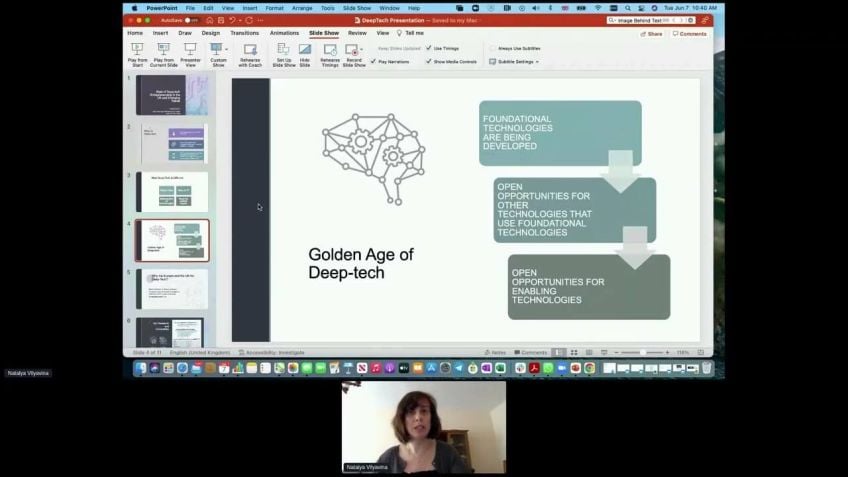
Natalya Vilyavina: Okay, let's move on and talk about why deep white golden age of deep tech right now. Natalya Vilyavina: I believe it is because a lot of foundational technologies are being developed. And by foundational technologies, I mean technologies such as AI, quantum or CRISPR technology, which is create basis for other technologies being developed. So for example, if you Natalya Vilyavina: In CDL, for instance, we say that Natalya Vilyavina: Your technology needs to do something better, faster or cheaper. And technologies like artificial intelligence or quantum computing, they do make things better, faster or cheaper. For example, founder of creative destruction lab, Ajay Agrawal, he wrote a book that is called Natalya Vilyavina: Prediction Machine, where they argue that AI makes cost of prediction cheaper and by making cost of prediction cheaper, you can create other technologies based on
Natalya Vilyavina: Because the cost of prediction become cheaper, the other technologies can be developed based on this foundational technology, which is artificial intelligence and same things for quantum computing. Quantum computing makes the computing makes the computation faster and more efficient. And therefore, other technologies can be developed based on this foundational technology. So this is like one thing. So these foundational technologies in deep tech create opportunities for other technologies that use them as a basis. Also, foundational technologies create opportunities for enabling technologies.
So what it means is, for example, if we take quantum computing and in quantum age, every task can be done really, really quickly. What it means, it means that, for instance, the cyber security in quantum age is really vulnerable because all our passwords by default can be really quickly solved by quantum computers. So we need to rethink and startups have to rethink what is the security in quantum age look like and develop respective technology. So therefore, these foundational technologies, they both create the background for new technologies to be developed.
So the next part of my presentation is about Europe and the UK. So why deep tech in Europe and in the UK? So first of all, a quarter of European VC funds go to deep tech. So the quarter of the money go to deep tech. There was research that UK deep tech investment was 17% up in 2020. And this was the highest growth rate globally. And this is also due to a high rate of top educational institutions in the UK in Europe.
And let's look at the next slide and see what exactly in the top research and universities are happening in Europe. So first of all, high share of highly cited research publication, about 43% go to UK and Europe. So European students are more likely to do STEM degrees as compared to their US peers. So you can see that in Germany, for instance, 35% of students are actually do STEM. In the UK, this is 26%. And in the US, it's only 18%.
Also, you can see that in Europe, universities that are at the top of the rank of the computer science, it's out of 20 universities, seven universities are allocated in Europe. And out of this seven, four are actually in the UK. But if you see the size of Europe and UK, especially UK, you can see that UK actually lifts much above its own weight. So the size of the economy and size of the country is not that big as the US, for instance, but it has a lot of research and computer science opportunities.
So next, I'd like to share with you the fact that deep tech investment and spin-outs in the universities are growing exponentially. So this map is, we will not read this map, but I just want to share it with you so that you see, this is a map of Oxford University spin-outs in the university. Oxford University spin-outs from 1959 to 2021 of the Oxford University innovation, which is tech transfer office of the university, which is responsible for the spin-out startups. And you can see that over the course of these years, the number of the spin-out startups grow, grow really exponentially.
And there is a slight concern and trick here that UK and Europe in general, traditionally didn't have very favorable spin-out policy for the founders of the deep tech startups. This means that in the US, it means that in the US it is traditional that the university could take like three to 5% of the share of the startup when it spun-out of the university.
And in the UK, it's sometimes in Oxford, for instance, it used to be like, can be like 50% or 60%. So in this scenario, it's really difficult for the scientists who have developed some technology that can be commercialized to have an incentive to actually move this technology forward. Especially this is relevant for the technology that requires a lot of funding because the further you go down in the series A, series A, series B, you have to give up a lot of shares of your company.
And if you start with a relatively small number of shares, let's say 40%, then the next round you get with a really small percentage because of the dilution of your own shares. And it makes it really hard for the scientists and startup founders to be incentivized to continue building these technologies for a long period of time. Luckily, this policy is changing in the UK specifically and in Oxford specifically.
So I think now the default rule is that University of Oxford is taking about like 20% for deep tech spin-outs, which still gives a good incentive for founders to continue building. In the next slide, I'd like to talk about like European deep tech investment scene in general. This is an atomic report and we can see that in this is a report of like just nine months of 2021.
And it's you can see that capital investment in the startups in Europe in 2021 in the deep tech startups in Europe almost doubled in the just in the first nine months of 2021 from 9.4 billion dollars. So we see that the trend is going up so this means that deep tech technology will continue to develop and grow.
It's a lot of interest in the VC community to continue investment and in the deep tech. These two stars on the right represents the average around of the funding. It says that over 50, about 50% of the startups in deep tech received the funding of less than 5 million. And in the again, in 2021, it was only 12 deals that received more than 250 million dollars in one round, which obviously, which is maybe obvious because it's at the first at first you VC VC money go to like small, larger proportion, but the smaller amount of checks.
And further down the line, there are there were less successful startups and the follow on rounds are getting larger, but the number of those rounds are getting quite small. Okay, so next I'd like to give you a quick overview of the emerging trends of the deep tech in Europe that we observe. These data comes from pitch book and also like atomic report.
So at the first glance, if you see at this slide, it looks like by the number of deal count, the largest, by far the largest investment, largest investment money go into quantum computer computing, digital twins, AI powered for drug discovery, neurotechnology. However, if you look at this gray boxes at the bottom, you can see some areas like battery technology, carbon capture, hydrogen energy, waste to energy, long duration energy storage.
So to me, it looks like this comprises a big chunk of the investment money in Europe. And I would call this deep tech for good investments. So it looks like there is a trend being developed in not only deep tech, but also in investing deep tech for good. So I found it interesting and I wanted to share this with you as well.
So finally, I'd like to quickly stop at the deep tech gender gap. And here we all know that there are very few percentage of money in the VC go to female led startups and especially small amount go to only female led startups. So here is some stats for you only 15% of deep tech startups are founded or co-founded by women and only 6% have all women founding teams for every one pound in venture capital in the UK in general.
Female founder, female founded teams get less than one penny and all male founded teams get 89 pennies and mixed gender teams 10p. So again, you see like if at least like one co-founder, it's only 11% pretty much of venture money that goes to teams where at least like one female founder and to all female teams. It's only 1% it's general for the VC for the VC money at the same time, if you look at female startups in the industry, such cosmetics, shoes, home decor, fashion, flowers, wedding, beauty, 22% of the money go to female teams.
There is a lot of bias in the VC industry that women can do beauty, but they cannot maybe do deep tech. Female only led teams comprise 28% of all AI companies, but get only 1.5% of funding, which is 53% of a dollar as well. So this gives you an idea about where we stand with the investment and gender bias in the deep tech investment.
And it seems that there are two biases here. Like one is that in general, there are much less money go to female teams, which basically translates into the language that VC say we don't think that females are really good in doing business. But there is another bias as well, which says that it seems like female females are less likely to do deep tech science and therefore it's another bias that basically overlaps with the first one.
So it creates this really tricky environment for deep tech founders. I also spoke to teams at creative destruction lab, female lab teams, and they often tell me that when they lead the company as a chief executive officer, they often hear from the VCs that they need to hire a professional CEO. So basically giving them this idea that maybe they need to step down and maybe have a secondary role in startup, not a CEO role.
So this is also really hard for the female founders to have energy and the strengths to overcome these biases and perception. So I also think that in deep tech, why it's so little money goes to deep tech female founders, because I think that VC don't recognize this pattern. So there is not enough spin out companies founded by VCs that have funded by females that have become already successful.
And also the development cycle of deep tech is so long. So it's really hard for VC to see the pattern that actually I know the female founder and I know the startup that worked and I know this can be successful. And as we all know, all the money in VC, this is about pattern recognition. And as soon as we teach venture capital industry to recognize the pattern and to see that female founders can be successful, the more money go into the deep tech for female founders.
And then the second bias about the opportunity, opportunity for women to actually do deep tech. I want to leave you with one slide here, which is the successful female scientist in the past century. And you can see here the Marie Curie, who got the Nobel Prize for in 1903 for researching of radioactivity. You see the Sarah Gilbert, who was one of the researchers at the University of Oxford and the founder of Oxford AstraZeneca vaccine successful.
You see Emanuele Carpenter, if I pronounce it right, and Jennifer Doe, who also won the Nobel Prize in 2020 for CRISPR technology, gen editing technology. So you see all these female founders, female scientists that are actually there and female can do science and female can do deep tech. So I want to leave you with this and thank you very much for your attention.
Apologies for my not perfect use of technology. And I wish you a really pleasant day today. And I hope to see you at the Hopin platform. Thank you.
Transcribed automatically; names checked against the speaker record. Select a time to jump there.
Article based on this talk
Why is deep tech booming in the UK while women founders are left out?
Natalya Vilyavina explains what makes deep tech different, where European capital is going and the biases that keep it from women.
In short
Deep tech, meaning technology built on scientific discovery, is having a golden age in the UK and Europe, driven by foundational technologies such as AI, quantum computing and CRISPR. Natalya Vilyavina, who introduces herself as a venture manager and AI stream lead at Creative Destruction Lab at the University of Oxford, explains why these startups are riskier than most and where investment is flowing. She also argues that two overlapping biases keep venture capital away from women building deep tech companies.
Key takeaways
Distinguish deep tech, built on scientific discovery, from new apps built on existing technology.
Explain why a broad lab technology must become one product for one use case before it becomes a platform.
Assess how university equity stakes and later dilution affect a spin-out founder's incentive to keep building.
Spot the European deep tech areas drawing investment, including climate-focused deep tech for good.
Recognize the two overlapping biases that limit venture funding for women deep tech founders.
What makes deep tech different
Vilyavina starts with a definition. Deep tech is new technology based on scientific discovery whose commercial uses are still being worked out. It is not a new piece of software or an app built on existing digital infrastructure.
That difference changes the risk. A typical startup begins with a problem to solve. Deep tech often begins in a lab with an interesting technology and no clear commercial strategy, so founders face R&D and commercialization risk on top of market risk. Founders at Creative Destruction Lab sometimes describe their invention as a broad technology that can do many things, like a calculator. The advice they get is to make it a product before a platform: find one unique use case first, then expand to other verticals.
She lists other features of deep tech. Most companies rely on intellectual property, and about 70% of the companies her program sees have developed and secured their own IP, as she cited. Over 90% combine technologies, such as AI with biology or materials science. And the R&D phase can take many years, which is why first money often comes from grants and government funding.
"And finally, the other differentiation of deep tech is that it requires patient capital." (4:19)
Foundational technologies and a golden age
Vilyavina believes this is a golden age because foundational technologies such as AI, quantum computing and CRISPR create a base for other innovations. She points to Prediction Machines, the book by Creative Destruction Lab founder Ajay Agrawal, which argues that AI lowers the cost of prediction and so makes new technologies possible. Quantum computing makes computation faster, but it also creates the need for enabling technologies. If quantum computers can crack today's passwords quickly, startups must rethink what security looks like in a quantum age.
"Your technology needs to do something better, faster or cheaper." (5:03)
Why the UK and Europe, and the spin-out problem
As she cited, a quarter of European VC funds go to deep tech, and UK deep tech investment rose 17% in 2020, the highest growth rate globally. The UK and Europe produce about 43% of highly cited research publications. European students are also more likely to study STEM than their US peers, with figures she gave of 35% in Germany, 26% in the UK and 18% in the US. Seven of the top 20 computer science universities are in Europe, and four of those are in the UK.
"But if you see the size of Europe and UK, especially UK, you can see that UK actually lifts much above its own weight." (9:03)
Using a map of Oxford University spin-outs from 1959 to 2021, she shows exponential growth, but also a catch. US universities traditionally take about 3 to 5% of a spin-out, while Oxford could once take 50 or 60%. Founders who start with a small share are diluted further through Series A and Series B, which weakens their incentive to keep building over many years. That policy is changing.
"So I think now the default rule is that University of Oxford is taking about like 20% for deep tech spin-outs, which still gives a good incentive for founders to continue building." (12:20)
Where European deep tech money is going
Drawing on Atomico and PitchBook data, Vilyavina reports that deep tech investment in Europe almost doubled in the first nine months of 2021. About half of deep tech startups raised rounds of less than 5 million dollars, and only 12 deals passed 250 million dollars in one round. By deal count, quantum computing, digital twins, AI for drug discovery and neurotechnology lead. But battery technology, carbon capture, hydrogen energy, waste to energy and long duration energy storage together make up a large share of the money.
"And I would call this deep tech for good investments." (15:31)
The deep tech gender gap
The last part of the talk turns to funding for women. As she cited, only 15% of deep tech startups are founded or co-founded by women and only 6% have all-women founding teams. In UK venture capital overall, all-female teams get less than one penny of every pound, mixed teams 10p and all-male teams 89p. Female-only teams make up 28% of AI companies but receive only 1.5% of funding, while in categories such as cosmetics, fashion and beauty, 22% of money goes to female teams.
"There is a lot of bias in the VC industry that women can do beauty, but they cannot maybe do deep tech." (17:33)
She describes two overlapping biases, one against women in business and one against women doing deep tech science. Female CEOs at Creative Destruction Lab tell her that VCs suggest they hire a professional CEO. She also blames long development cycles: there are not yet enough successful female-founded spin-outs for investors to recognize.
"And as we all know, all the money in VC, this is about pattern recognition." (20:11)
She closes with women scientists who prove the point: Marie Curie, Sarah Gilbert of the Oxford AstraZeneca vaccine, and Emmanuelle Charpentier and Jennifer Doudna, who won the Nobel Prize for CRISPR.
Watch the talk
State of the deep tech entrepreneurship in the UK and the emerging trends by Natalya Vilyavina, Natalya Vilyavina, 22 minutes: https://www.womentech.net/video/state-deep-tech-entrepreneurship-in-uk-and-emerging-trends-natalya-vilyavina-0
About the speaker
The session record includes no speaker bio. In the talk, Natalya Vilyavina introduces herself as a venture manager and AI stream lead at Creative Destruction Lab at the University of Oxford, a deep tech program that helps founders commercialize their technology.
Questions this talk answers
What is deep tech and what is it not?
Why is deep tech riskier than a typical startup?
Why are Europe and the UK strong places for deep tech?
How do university spin-out policies affect deep tech founders?
Why do women deep tech founders receive so little venture funding?
Drafted with AI from the talk transcript. Editor review pending.
Frameworks and ideas mentioned
Better, faster or cheaper test
Product first, then platform
Resources mentioned
Prediction Machines (book by Ajay Agrawal)
Atomico report on European deep tech investment
PitchBook data
Cite this talk
WomenTech Network. "State of the deep tech entrepreneurship in the UK and the emerging trends by Natalya Vilyavina." WomenTech Network, 2022. https://www.womentech.net/video/state-deep-tech-entrepreneurship-in-uk-and-emerging-trends-natalya-vilyavina-0