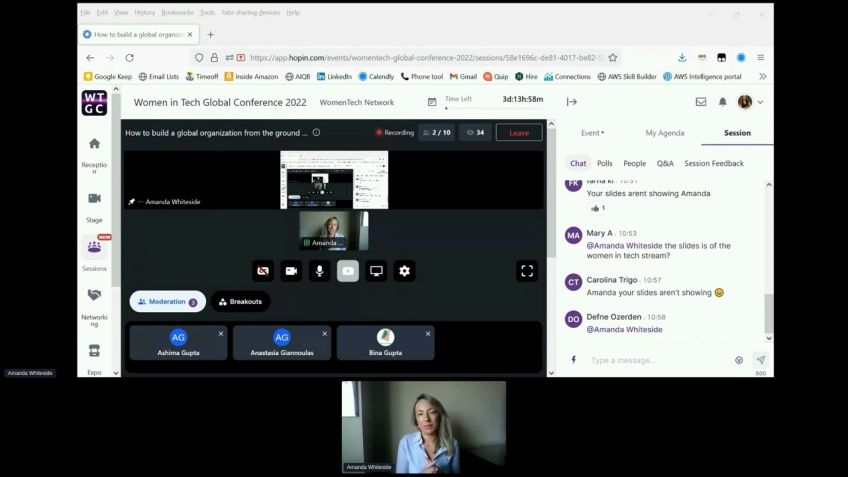
Building for scale - how to build a global organization from the ground up by Amanda Whiteside
19:372022
Your org structure will break as you scale, so plan the next one now
Only 44% of executives in a McKinsey survey, as the speaker cited, agreed their organizational structure created clear accountabilities. Amanda Whiteside, who leads Worldwide Customer Optimization and Enablement for AWS, has worked inside functional, divisional and matrix models at HelloFresh, Amazon and AWS. As a business spreads across regions, duplication, slow approvals and competing priorities creep in, so what should be global, what should stay local, and who decides?
Learn when functional, divisional or matrix structures fit and how to evolve from one to the next
Amanda Whiteside, who leads Worldwide Customer Optimization and Enablement for AWS, explains how organizational structures must evolve as a business grows from a single market into a global operation. Drawing on her roles at HelloFresh, Amazon Shipping and AWS, she compares functional, divisional and matrix models, offers questions for deciding what should be global versus local, and sets out practical steps for designing and governing an organization that scales.
“It's really important that we don't build an organization around people. We build it around the business needs and the business outcomes.”
“Regional duplication is something that is very difficult to navigate. And it's something that just comes naturally as you start to scale.”
What you will learn
Compare functional, divisional and matrix structures and the trade-offs of each as a business grows.
Spot the warning signs of poor organizational design, such as unworkable jobs, over-regulation and competing priorities.
Decide what should be global and what should stay local using questions about pace, local assets, relationships and decision rights.
Plan organizational changes around business outcomes rather than around individual people.
Set up change management, governance and customer feedback mechanisms that keep a new structure working.
Details
Level
Intermediate
Format
Talk
Technical depth
Non-technical
For
People manager, Executive, Founder
Length
19:37
Published
June 2022
Questions this talk answers
What are the main organizational structures a growing company can use?
Amanda Whiteside describes functional structures (functions reporting to the CEO), divisional structures (each region with its own functions) and matrix structures, where worldwide functional leaders cut across regional leaders and teams often have two bosses.
What goes wrong when organizational design is poor?
She points to unworkable jobs with responsibilities bolted on, over-regulation where many leaders must approve decisions, and a lack of one voice, all of which cause confusion, stress, delays and attrition.
How do you decide what should be global and what should stay local?
Ask how fast-paced your sector is, how much the business depends on local assets, how close your relationships with local teams are, and how you expect to be involved in decision-making. Where things need to be local, give local teams the space and autonomy to run them.
Should an organization be designed around its star employees?
No. She argues organizations should be built around business needs and outcomes rather than people, and that doing this well ultimately benefits the people too.
How do you keep a redesigned organization working after the change?
Invest in effective change management with dedicated project or program managers, then put governance in place, sometimes a PMO or a few owners, and establish regular mechanisms that connect teams directly to the customer.
Questions to ask about your own organization (59 s)
Thank you everyone for having me. I'm thrilled to be here and excited to be talking about this theme today. I really appreciate everyone taking the time out of their day. So today we'll be talking a little bit about the fundamentals and pitfalls of building and scaling a large global organization. And as I haven't already introduced myself, my name is Amanda Whiteside and I lead Worldwide Customer Optimization and Enablement for AWS. So why am I here? Well, I have a little bit of experience in this topic and something that I've become very passionate about over my career.
And a lot of the jobs that I've worked in have given me a slightly different perspective on organizational design and helped me see what has worked and what maybe hasn't worked as well as just the general challenges of organizational design. It's something that I think every company tries to iterate through and work through. And I wanted to share with all of you some of what I've learned as well as hear from you how your experience has gone in your organization and what works well and what doesn't. So please feel free to add anything you'd like in the chat today.
So one of or a couple of the most recent roles that I've had, I guess, go back to my time at HelloFresh where I led UK sales. And what was interesting about my role here, I led direct sales, which was really a startup phase for HelloFresh, trying to get in front of as many customers as possible. And really in that structure, we were very functional. The CEO was really the head of the business and each function sat under the CEO. So you maybe had sales, marketing, our tech team and our BI team and et cetera, et cetera. So those teams all worked with a very clear leader, a very clear remit.
And often is the case for a startup or businesses that are in the early phase of their growth. Then I moved into Amazon shipping, very fast growing business, lots of complexities, trying to scale across multiple geos. And I started to build a large program and product organization that really supported very different and very highly localized needs of each specific business. And therefore, my experience versus HelloFresh became very different versus a very simple format to something that started to navigate more complexity and more of a divisional model. Most recently, I've moved to AWS where they're really supportive of a highly matrixed organizational model. And it's really because of the amount of geos that we work in today and making sure that we provide a consistent experience for our customers.
But equally, a matrix organization is something that requires a different skill set to try and navigate. What are my observations? A couple. I have plenty, but here are a couple. Regional duplication is something that is very difficult to navigate. And it's something that just comes naturally as you start to scale. So if a business is centered within one geo and you start to launch additional new markets, each of those marketplaces will try and do something a little different and they should. There's an opportunity for new innovation, accommodating and looking out for any local nuances. But what you'll find is there's a pull between the ownership model there and duplication.
You're having same people in same geos doing somewhat similar things. So there's always something to learn for how you try and streamline that. The second is different growth phases. You're launching different businesses at different times. You've got mature businesses versus ones that are in startup mode. And it's very difficult to bring those together when they are in different phases and they really need to be accounted for and allowed to go through those phases in the right way.
Lastly, iteration can be ugly. I haven't seen a case where someone has sat down and built an organizational structure and said, "This is not going to last me the next 10 years." It doesn't happen. It's really important that you know that your organizational structure evolves over time and takes time to get right. And therefore leaders really need to invest time and constantly looking at their organizational design, thinking about how it's set up, how they can iterate on it, as opposed to it building in the background to something that's quite problematic and then becomes a big buying change where you have to completely restructure people's organization and their roles.
So when we look at McKinsey, there was a recent survey for over 300 executives that said only 44% agreed that their organizational structure created clear accountabilities, which is crazy. This is something that gets in the way of people's jobs, of how they feel about their jobs, of how they can deliver. And again, it re-emphasizes my point. It's just how important it is to get this right.
So what does it mean for people? Poor organizational design can mean the unworkable job. And I'm sure some of you have experienced this. You've started with a manager with set clear responsibilities, perhaps outlined in the job spec, and then you suddenly find out that things have been bolted on. You've got a new remit. You have to work over multiple time zones.
And it just becomes unsustainable for employees. The second is over-regulation. We can find ourselves in a position, particularly with a matrix organization, where multiple leaders need to be involved in the approval making or the decision making. Or perhaps it's not clear how many leaders need to have approval. And therefore you go searching for however many people need to sign something off.
This then inherently causes delays. The third is lack of one voice. With multiple leaders involved, multiple teams, you can be pulled in different directions. Often this can be called competing priorities, when actually there just needs to be a single voice that is telling the organization what matters and getting those teams with the right assigned ownership and accountability.
All of this leads to confusion and stress and failure to share new ideas. If managers are not able to navigate the complexity, it can mean leading to employee attrition. So let's take a little look at the different organizational structures that exist today. If we look to the left, functional structure. This is what I outlined in my time at HelloFresh.
Very simplistic. CEO model, multiple functions reporting in. It gives quite clear accountability. Divisional structure. That really looks at how a business is set up, perhaps by region. So maybe you have a North American business that has all of those functions sat underneath them and they work as their own entity. And then matrix structure. This can often mean that teams have two bosses and it is something that requires a completely different skill set. We're seeing more and more global organizations move into a matrix model.
And I don't think we I think we can be better at helping teams and organizations understand how it's important, why it's important and the benefits it'll bring as well as how to navigate it because it's very different to the other two. So a little diagram here on the functional structure, exactly how I said, CEO, multiple functions, really simple.
There's some advantages to this, of course, if you're in a tech function, you have a tech leader, you're with your community, you have very clear priorities. And also promotion process is better because everyone can see what good looks like. And there's a clear decision authority. But there are always disadvantages to these things. Sometimes you can get completely siloed from the wider organization, kind of in your own bubble, running your own initiatives, but very detached from the wider strategy and from some of the other teams that exist.
This often means that you can develop some tunnel vision. It means that you're maybe not coming up with the ideas that the business really needs at that time. So let's have a look at the visual structure. It starts to get a little more complicated now. As I said, you're looking at, excuse me, each function can report into a specific region.
So, for example, here, EMEA would have a sales team, but so would North America, Latin America, APAC, etc. And this means EMEA, in a sense, can work entirely in its own model, in its own structure. But, of course, that's where you have some pulling and differences and, say, branding in how the product is launched. It means it's harder to reach across and build a global product where possible because each business exists in its own entity.
But it has some advantages. So, as I said, each one operates separately. It's a good thing, but it can also be a challenging thing. That localization is really helpful because it means that you become an expert in your own region. So, North American folks know exactly what North America needs. They've done the benchmarking. They've done the research. They're often in-country and, therefore, they can apply the expertise and do what customers need quickly.
Disadvantages. One of the key disadvantages for this model is the cost of headcount. If you're duplicating multiple functions in multiple regions, you're going to find that the business becomes overloaded with excess headcount, often doing a lot of the same things. If you think about something like a pitch pack or a new product that needs to be launched, each business is going to try and do that independently.
When, actually, if they collaborated and one team did it, it would be much more effective. You also lose the benefits of economy and scale, even things like procurement and purchasing. If each team are trying to purchase something like Salesforce, they would go in, they would purchase it, and they would find out that, actually, if they combined their efforts, they would get a better cost.
And, finally, matrix structure. Please chime in in the chat if it's something that's new to you. I'd love to see it. But really how matrix structure is working, and I think this is also an evolution, is you have these kind of regional models. So, if you look on the left, you'll have EMEA, North America, LATAM, and they still have all of their own responsibilities.
So, sales, marketing, tech, finance, for example. But then you have a worldwide leader that cuts through that. And, essentially, the idea here is that if you take worldwide tech, for example, the worldwide tech leader is going to get up every day and think about worldwide tech. They're going to think about global solutions, global models, global products that are really going to solve for the global customer.
Where the benefit of that is when you work with those in region leaders like EMEA, North America, and LATAM, you're going to see that they are able to then bring a lot of that local nuances, the local information, the local customer up into the worldwide tech org so that they don't create something that isn't relevant for that particular market.
But it means that the model has two bosses or two managers, like I said, so that tech team would have to not only report and speak to the worldwide tech leader, but also to each of those in region leaders too. So, when it's created and it takes some time, it can have a clear objective. This idea that someone is thinking about the world is a very big deal and it stops some of these siloed teams or siloed geos and tries to streamline those efforts so that they are more effective.
You're also bringing particular skills and knowledge together. So, instead of having an individual marketing department reporting into a CEO, you're bringing all of those marketing teams together under a worldwide leader. So, you're getting such cultural diversity, such inclusion across lots of different marketplaces and teams to deliver, hopefully, a solution that they cancel for all and we'll talk a little bit about that later.
Some of the disadvantages, I mentioned it, working across two bosses and this skill set that is very new to a lot of us of how do we compromise and negotiate? You almost have to put your ego at the door at a matrix structure because it will be the case that there's a lot of collaboration, more than what you would have been used to and, you know, that can have a pull on the organization, but it also requires you to really over-index and earn trust and ownership and giving it out and using it where it's clear.
So, that accountability becomes even more vital. Oh, sorry. I just wanted to put this quote here and really what it says is when you have a global offering, it's much easier. If you're selling a set of steak knives, then it should be fairly easy to put it on a global marketplace and sell it as standard. However, when you have a local business, it requires a lot of local thinking.
It maybe needs local resourcing, local NGO fulfillment centers, source centers, and that can mean that it's not always a one-size-fits-all. So, how do we think about global versus local? Well, here are some questions that are worth asking. The first one is, how fast-paced is your business sector? If you need your teams to be on the ground, listening to customers, able to react quickly, having a local team there is super important.
And giving them that autonomy to make those decisions is also important. The second is, how much does your business depend on local assets? So, if you need local procurement, if you need services that are in NGO, how dependent are you? That means that they will always remain there. And anything global that you build needs to account for that.
The third and the fourth are more about the relationships that you build with a local team. And I've seen it in the past. Having that close relationship with local teams couldn't be more important. I've seen how successful it is when global teams and local teams collaborate. And they're all working towards the same vision. And they really appreciate the differences in country.
Four is, how do you expect to be involved in the decision-making? Autonomy means that you give them the ownership that they can go and solve something when they need to. But do you still feel like it needs to be communicated to the global organization? And how does that work? It's really important to get ahead of time and really spend time with these teams to set and outline those expectations from day one.
It can also be an evolution. Like I said in the beginning, these things don't stand up from day one and then exist forever. I think in every case it should be an evolution, in fact. And I would almost say when you're starting off in that kind of HelloFresh phase where the business is growing, that functional structure works really well.
But then as you start to build into new geos, multiple regions, you need to start considering how you streamline and you don't have different organizations building the same things in different areas. Then number three, thinking about centralized leadership. Bring in a worldwide team. Get them to start to move that thinking towards less kind of locale-centric and more into, well, what would the world say?
Would this work in North America, but would it also work in EMEA? If not, why not? And having those honest discussions. If you find that you haven't iterated through this, it could be that you need a full reorganization, or hopefully you can iterate to get to the point where it becomes a very natural evolution for your business.
So doing it in line with, as the business grows, you can also see your organization evolving and changing as well. So if I summarize some of the steps to success, I think these are really important. Recognize the trend that you're seeing. Recognize the fact that the business is evolving and changing, and your organization needs to change to I've seen businesses before kind of sit in a silo and not think about organizational design.
And before they know it, they can't deliver on what they outlined because they just didn't see it coming. So try to plan ahead. Be clear on what needs to be global. And this is a fascinating topic for me because there's lots of ideas that 80% of things can be global, 20% can be local. Maybe it's 90-10, maybe it's 50-50.
But where can we land and how does that work and help change and improve the organization as we see it? But really sitting down and working out those processes, policies, products from day one, and then constantly revisiting it is key. Where it does need to be local, let the teams be local. Let them have the space to be able to do and run whatever they're accountable for, and support them in whatever way is possible.
Try to have that close collaboration. Four, build the business for the business. I know it can be really hard. You hire a superstar and you want to put them in the right place, but you don't know what their job is today. It's really important that we don't build an organization around people. We build it around the business needs and the business outcomes.
In a sense, if it's done right, it will always benefit the people. So something to really think about there. Five is embrace effective change management. I know it's something everyone is trying to get much better at. The pandemic taught us a lot. But effective change management is a real skill and it's something that requires dedicated project managers, program managers to really help navigate and communicate out to teams.
Then once that change is made, thinking about the governance. How do you keep the model that you have designed intact? And when there's challenges, how can you get ahead of them so it doesn't smile out of control? Sometimes this can be its own PMO. Sometimes it's just assigning a couple of folks in your team to own this as a side project.
It depends on your business. And last is establishing regular mechanisms that collects your team directly to the customer. So what I mentioned earlier, by bringing local NGO teams with worldwide teams together, listening to the customer, what does the customer need? Constantly bringing yourself back to make sure that you're focusing on the right things. So in closing, some things to ask yourself.
Is the way your organization designed today effective? Is it something you know who to speak to? You know who to work with? And you don't find yourself having churn. Great if you do. If you don't, how can you help improve some of the organizational structure today? How can you yourself start to design your own organization? This can be even with the three people you work with today and the teams you collaborate with.
It doesn't always have to be your reporting line. And how can you bring a new solution to your manager, to your leadership to say, "Hey, I'm thinking about this differently." Because I guarantee they'll be open to the conversation. And lastly, what am I willing to negotiate or compromise on to build an effective organization? I said, you sometimes have to leave your ego at the door.
I've had things that have existed in my organization and I've just had to hand them off. You know, I maybe built them from day one. They mean everything to me. I love the team that work on them, but actually they fit better over there. So really thinking without bias, what is the right thing for the business? And everything should fall into place.
Okay. Well, thank you everyone for joining. If you have any questions, feel free to connect with me on LinkedIn, wherever you like. I would love to hear from you and continue this fascinating topic and hear a lot of your other ideas and perspectives.
Transcribed automatically; names checked against the speaker record. Select a time to jump there.
Article based on this talk
How should an organization's structure change as it scales globally?
Amanda Whiteside of AWS compares functional, divisional and matrix models and explains how to balance global consistency with local needs.
In short
No organizational structure lasts forever, and the one that works for a startup will strain once a business expands into new regions. Amanda Whiteside, who leads Worldwide Customer Optimization and Enablement for AWS, argues that leaders should treat organizational design as a continuous practice: choose the structure that fits the growth phase, decide deliberately what is global and what is local, and build around business outcomes rather than individual people.
Key takeaways
Compare functional, divisional and matrix structures and the trade-offs of each as a business grows.
Spot the warning signs of poor organizational design, such as unworkable jobs, over-regulation and competing priorities.
Decide what should be global and what should stay local using questions about pace, local assets, relationships and decision rights.
Plan organizational changes around business outcomes rather than around individual people.
Set up change management, governance and customer feedback mechanisms that keep a new structure working.
Three roles, three structures
Whiteside grounds the talk in her own career. At HelloFresh, where she led UK sales during a startup phase, the company was organized functionally: the CEO headed the business and each function, such as sales, marketing, tech and BI, sat directly beneath. At Amazon Shipping, a fast-growing business scaling across multiple geographies, she built a program and product organization serving highly localized needs, closer to a divisional model. At AWS she now works in a highly matrixed organization, which she says exists because of the number of geographies served and the need for a consistent customer experience.
From these roles she draws a few observations. Duplication appears as soon as new markets launch: "Regional duplication is something that is very difficult to navigate. And it's something that just comes naturally as you start to scale." (2:40) Businesses in different growth phases are hard to bring together, and redesign is never finished. As she puts it, "Lastly, iteration can be ugly." (3:53) Leaders who neglect design, she warns, end up facing a large, painful restructure instead of steady iteration.
What poor design costs people
Whiteside cites a McKinsey survey of more than 300 executives in which, as she cited, only 44% agreed that their organizational structure created clear accountabilities. She then describes what that looks like for employees. "Poor organizational design can mean the unworkable job." (4:57) Responsibilities get bolted on, remits grow, and people find themselves working across multiple time zones.
She adds over-regulation, where it is unclear how many leaders must sign off a decision, and a lack of one voice, where teams are pulled in different directions under the label of competing priorities. The result is confusion, stress, fewer new ideas and, when managers cannot navigate the complexity, attrition.
Functional, divisional and matrix compared
The functional structure gives clear priorities, a visible picture of what good looks like for promotion, and clear decision authority. Its weakness is isolation: "Sometimes you can get completely siloed from the wider organization, kind of in your own bubble, running your own initiatives, but very detached from the wider strategy and from some of the other teams that exist." (7:21)
The divisional structure, organized by region, lets teams become experts in their own markets and act quickly for local customers. The cost is duplication: "One of the key disadvantages for this model is the cost of headcount." (9:07) Each region builds its own pitch packs and launches, and loses economies of scale in areas such as procurement, for example when separate teams each buy Salesforce instead of negotiating together.
The matrix structure keeps regional leaders but adds worldwide functional leaders who cut across them. Whiteside explains the idea: "And, essentially, the idea here is that if you take worldwide tech, for example, the worldwide tech leader is going to get up every day and think about worldwide tech." (10:11) Regional leaders feed local nuance into the global function, which reduces silos and brings skills and cultural diversity together. The trade-off is that teams often answer to two bosses, which demands compromise, negotiation and a willingness to leave ego at the door.
Deciding what is global and what is local
A standardized product can be sold globally with little adaptation, but a local business may need local resourcing and fulfillment. Whiteside offers four questions: how fast-paced the sector is, how much the business depends on local assets, how close the relationships with local teams are, and how leaders expect to be involved in local decisions. On the first, she is direct: "If you need your teams to be on the ground, listening to customers, able to react quickly, having a local team there is super important." (12:51)
She frames the journey as an evolution: a functional structure suits the early phase, then expansion into new regions calls for streamlining, and eventually a centralized worldwide team that asks whether an idea would work in North America and in EMEA, and if not, why not.
Steps to success
Whiteside closes with a set of steps: recognize the trend and plan ahead; be clear on what needs to be global; let local teams be local where it matters; build the business for the business; embrace effective change management with dedicated project or program managers; put governance in place to keep the design intact; and establish regular mechanisms that connect teams to the customer.
The fourth step carries her strongest message: "It's really important that we don't build an organization around people. We build it around the business needs and the business outcomes." (16:47) She admits this sometimes means handing off teams she built and loved because they fit better elsewhere. Her final prompt to viewers is to ask what they are willing to compromise on: "So really thinking without bias, what is the right thing for the business? And everything should fall into place." (18:58) She also encourages anyone, not only senior leaders, to rethink how they work with the few people and teams around them and bring new ideas to their managers.
Watch the talk
Building for scale - how to build a global organization from the ground up, by Amanda Whiteside (about 20 minutes): https://www.womentech.net/video/building-scale-how-build-global-organization-ground-amanda-whiteside-0
About the speaker
Amanda Whiteside leads Worldwide Customer Optimization and Enablement for AWS, as she introduces herself in the talk. Her earlier roles include leading UK sales at HelloFresh and building a program and product organization at Amazon Shipping.
Questions this talk answers
What are the main organizational structures a growing company can use?
What goes wrong when organizational design is poor?
How do you decide what should be global and what should stay local?
Should an organization be designed around its star employees?
How do you keep a redesigned organization working after the change?
Drafted with AI from the talk transcript. Editor review pending.
Frameworks and ideas mentioned
Functional structure
Divisional structure
Matrix structure
Global versus local split (80/20)
Cite this talk
WomenTech Network. "Building for scale - how to build a global organization from the ground up by Amanda Whiteside." WomenTech Network, 2022. https://www.womentech.net/video/building-scale-how-build-global-organization-ground-amanda-whiteside-0