What We Can Learn from Women in the C-Suite by Kristen Dyck
37:302022
Hard work kept her invisible until a VP said no one knew who she was
A vice president closes the office door and tells a hard-working communications advisor that her work is great, but no one knows who she is. Within a couple of years, with no extra hours and no new degree, that advisor is advising the president and CEO. Kristen Dyck, who now coaches driven women on personal branding, asks what senior women do differently, and how to talk about your value without feeling like you are bragging.
Learn the brand statement framework and influencing-up habits senior women use to get noticed
Kristen Dyck argues that great work does not speak for itself and that women who reach the C-suite deliberately communicate their value. Drawing on her own jump from overlooked communications advisor to adviser to a CEO, she teaches four habits: clarifying and sharing goals, influencing up, describing value in business results rather than job titles, and using a one-sentence personal brand statement.
“I was working really hard, but I was actually hiding behind my work.”
“Personal branding is building trust by communicating your value to your target audience.”
What you will learn
Write a one-sentence personal brand statement that names the value you deliver, how you deliver it and who you serve.
Translate your work into the goals of your company's business plan and track its measurable results.
Clarify your career goals and share them with mentors, peers and your boss to uncover the next stepping stones.
Practise influencing up through regular results emails, asking to attend meetings as a proxy and short coffee chats.
Reframe talking about your work as building trust rather than bragging.
Details
Level
All levels
Format
Talk
Technical depth
Non-technical
For
Early career, Mid-career, People manager
Length
37:30
Published
July 2022
Questions this talk answers
What does personal branding mean for professionals who are not CEOs or celebrities?
Kristen Dyck defines it as building trust by communicating your value to your target audience, such as company leadership, colleagues and people in your industry. The most focused brands share only what the audience needs to trust you.
How can you talk about yourself without sounding like you are bragging?
Use a one-sentence brand statement that states the value or solution you provide, how you do it and who you do it for. Grounding it in business results makes it informative rather than boastful.
Why is a job title not enough to describe your value?
People bring their own biases and past experiences to a title, and peers with the same title often do very different work. Describing specific results lets people know when to call on you.
What does influencing up look like in practice?
Build relationships with your boss and her boss, ask to attend meetings as a proxy, send a weekly or biweekly email on what you worked on and the results, and request short coffee meetings. Delegating frees time to do this.
What if your company does not share its business plan?
Ask for it and explain that you want to be strategic with your time and understand how your work affects the plan. In interviews, ask which goals and objectives the role rolls up to.
Rewrite your job title as a brand statement (59 s)
Simple ways to influence up remotely (85 s)
We're here to talk about women in the C-suite, what we can learn from them, okay? So the struggle is real. If you're anything like me, you are here because you want to know what steps to take as a professional in tech, what it means to actually have a personal brand. You know that the women that are in the C-suite, the women that you admire, they have personal brand and they're professionals. What does it take to have a personal brand in this day and age as a professional? And how can we stand out without braids? We're going to talk about all of those things and more today. Now, I totally understand if you are concerned and you're kind of like, I don't know how to share the value of my work. I don't know
how to talk about myself without bragging. Being humble is really, really important to me. Listen, I totally, totally get that. Okay. So I've been there and I have done that and I have written a number of blogs about it. Okay. So you're in the right place today. We're going to talk about overcoming self-doubt, building confidence. I want to talk to you about what myself and my clients have found works for senior level roles and what the research also tells us that women in the C-suite have done that has made a huge impact on their careers.
Okay. So I want to take you back in time. I want to tell you a story about years ago when I was a communications advisor working at one of the largest nonprofits in Canada. That's where I'm from. And I was really driven. I still am. Um, but I was making some mistakes and I didn't realize it. I believed, and I was sort of told by other people around me that it was really important to work hard, you know, put your head down, work hard, put in all of the hours, do great work. And that great work will speak for itself and it will speak for you. And that's how you build a great reputation for yourself.
And that is how you advance your career. So what's happening to me at this point in my career is really nothing. Um, I'm working hard, I'm getting good and really positive feedback on my work, but I'm starting to look around and see my peers on my team getting to do the really cool projects, the things that I joined the organization because I wanted to work on these kinds of things and they're advancing. They're becoming leaders. They're getting pulled into other cool meetings that I want to be in. And so I start to go, what is going on? Well, I'm maybe just need to work harder. Um, maybe I need to start thinking about another degree or something like that. Anyways, fast forward a little while and a new vice president of
marketing communications joins the team and she comes into my office one day. And this is after her noticing me and realizing like, okay, there's something with this young woman. Um, I'm, I'm seeing a lot of talent in here, but she isn't getting anywhere. And so she was asking me about what my goals were and things like that. So after this conversational initially, she comes back into my office one afternoon and she closes the door behind her. So it was a moment that I knew, okay, she's going to say something. She goes, Kristen, I know why you're not getting the jobs and the projects that you want.
And I'm like, okay, why? And she says to me, Kristen, you do great work, but here's the thing. No one knows who you are. And it was honestly one of those punch to the gut moments for me. Uh, one that I won't forget. I wanted to disagree with her. I kind of wanted to hide and put my tail between my legs, but I let it sink in and I realized she was right. I was working really hard, but I was actually hiding behind my work. I didn't know how to stand in front of it and own it and communicate it and communicate about myself. As a result, I wasn't really going anywhere in my career. So I knew I had to make a change. And
with some support from a great leader and mentor and my own, um, drive and willingness to push myself out of my comfort zone, I started to build my personal brand without knowing that that's really what I was even doing. And things started to change for me. I got my first leadership role, then I went on to become the manager of the department. Then I got to become the advisor to the president of the organization and be leading her personal brand, sharing, um, media information on her behalf, all of these things. So I literally went in a couple of years from being told, no one knows who you are to advising the president and CEO. Did I start working harder and more hours? No. Did I go on and get an advanced degree? No. My work style didn't change. The one
thing that did was that I built a personal brand. So that is what I want to talk to you about today, because I realized that other women who are at the top, who are in the C-suite, they're senior leaders, they do many of the same things. So let's uncover what those are. So I haven't had the pleasure of meeting you yet. My name is Kristen Dick. I am an international speaker, workshop facilitator and personal branding strategist. That means that I guide driven women like you to reach your career roles using my signature personal branding process. That is a QR code right there that will lead you to my LinkedIn profile where I'd love it if you connected or followed me there. If you want to know how to
create your very own LinkedIn QR code right in the platform with like two clicks of a mouse, I've got a very short tutorial on my LinkedIn profile that will show you exactly how to do that. So maybe you have experienced something like this to something where you, you just felt stuck, you felt like you weren't going anywhere in your career. And I know how disappointing it can feel and frustrating it can feel and you really kind of start to question things, right? Okay, well, no more.
Because I know you are here, you're part of Women Tech, you're taking time out of your very busy day. Some of you might be here at very odd hours, it might be the middle of the night for you. But you're here because you want to have a bigger impact. And you're in tech, so you're in the place to do that, right? But how? How?
Well, it doesn't have to be this way. Okay, there are some things that we can do to change this. Because I bet you do great work. So I want to talk about first and foremost, what is personal branding, because that is the core of my business. And that is really what all of the pieces that I'm talking to you about today are grounded in. So there's so many different definitions out there of personal branding, you've heard all of them. I'm sure you can do a quick Google search, and it'll be page after page of different ideas. But many of the same things come up. The Jeff Bezos quote, your brand is what people say about you when you're not in the room. That's one of them. Your brand is your essence,
it's your reputation. It's the combination of all the things that make you who you are. And that is in some ways true, but it's actually a little misleading, because we don't have to share everything about ourselves, ourselves to have a personal brand and to have a great personal brand. In fact, the most focused personal brands are actually the ones that are the most successful.
So what does it mean to have a personal brand, especially for those of us who are professionals, who have jobs, who aren't CEOs yet, or who aren't celebrities? This is what it means to have a personal brand. Trust. People trust you. Have you read the book, The Speed of Trust? Or heard the saying, nothing moves faster than the speed of trust? It's one of my favorite sayings, because it's so, so true. Think about it. You would never hire someone, you never want to buy or work with someone unless you trusted them, right? So how can we get people to trust us? So the full definition that I've created about personal branding is this one. Personal branding is building trust by communicating your value to your target audience. Okay, so we're going to talk about the different ways you can be
communicating your value to your target audience today. So your audience being the leadership within your company, people inside your industry, your colleagues, things like that. Okay, so let's just touch on this before we go any further, because I know you might be thinking that this isn't going to work for me. And I just want to acknowledge that first. So maybe you're like a lot of people I'm thinking, but I'm not a celebrity or a CEO. I don't need a personal brand. I don't need to communicate my value. But here's the thing. If you don't talk about your impact, who will? It really is your job.
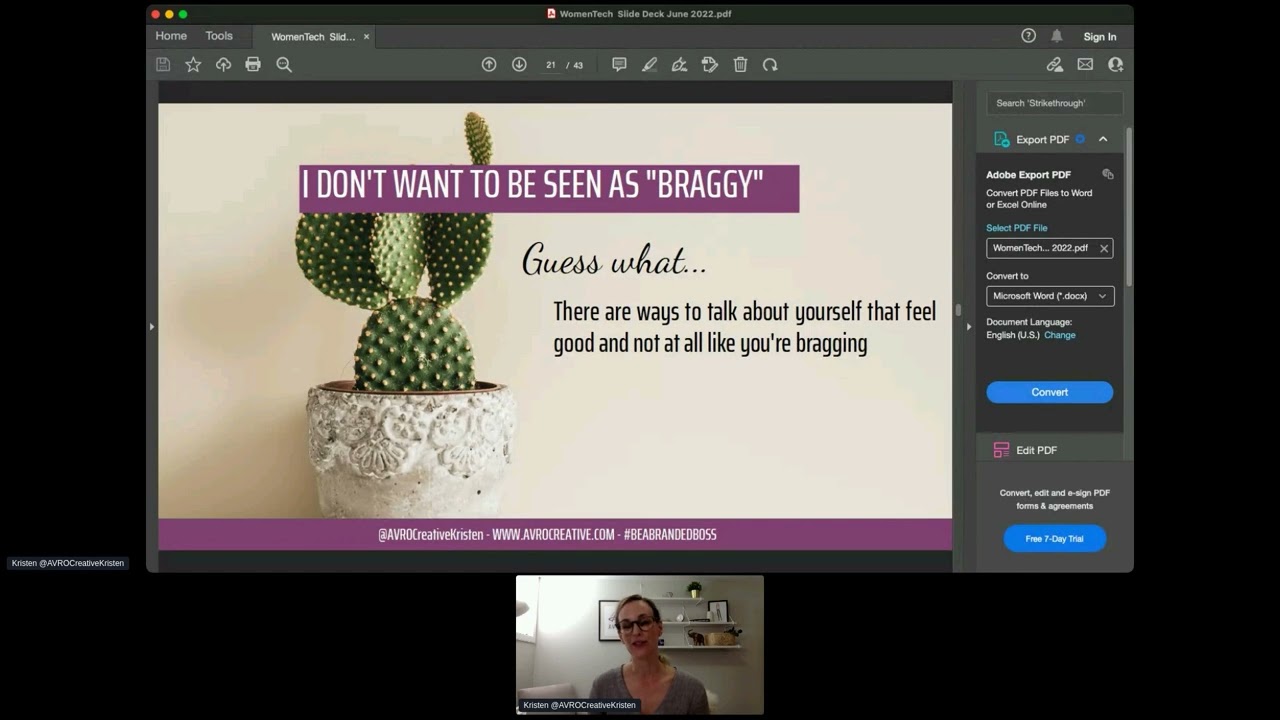
You might think, no, that's my boss's job. No, your boss is out there communicating her value, communicating the work and the worth of the entire team. It's your job to talk about your own impact and talk about the value that you bring to the company or to your organization. Maybe you're thinking, I don't want to be seen as braggy. Who can, who feels this one? This one was a really big one for me. But then I discovered there are ways to talk about ourselves and they don't feel braggy. And this one is kind of like a dual approach. Okay. So on the one hand, there are ways that we can do it that don't feel as braggy. Okay. We're going to talk about that today, but they're new to us. We're
still talking about ourselves and we're talking about ourselves in a new way. And many of us have been socialized and conditioned to think that anytime we talk about ourselves, talk about something great that we've done that that is bad. I want you to sit in that discomfort and embrace that discomfort a little bit, because I know how challenging this can be for many of us, but I'm encouraging you to push through it and think about the people that you know, that you admire and see the ways in which they're building trust with people. They are talking about their work. They are talking about what they can do, what their abilities are. And it's not coming off like, Oh, this person's bragging, right? You're thinking, Oh, good. I'm so glad she's here. I'm so glad they're on our team. So we're going to talk
about that a little bit more. Here's another common one. What I do is really straightforward. It's not. It's not to everyone, maybe to your colleagues, it is. But it's not to everybody else. You are people in the tech industry, you're probably getting phone calls and emails and texts from relatives going, Hey, can you can you come over this weekend and fix my computer? They don't really know what you do right now. That's one example. But think about it. If someone in your industry doesn't fully understand what you do or the potential of your work, that can hold you back. So we want to make sure that we overcome that don't assume that people understand exactly what you do. So I want to show you how to
overcome this. But like I said, got to put in the work and the work means a little bit of discomfort. OK, so I'm going to ask you to just take baby steps, sit in some of that discomfort and little by little it will become easier. So I want to share with you what I've learned through my own experience working with women leaders and what the research also tells us about women who are in the C-suite and in other senior and leadership roles. All right. I'm just popping over to see if there's any new questions.
I got to get that voice out of my head, Mary A. Severus. Yes. Fake it until you make it, Samantha says. Yeah. And you know what? Just embrace some of that discomfort. You don't have to fake anything. I don't I believe you've got everything that it takes already. All right. Elaine is ready. Awesome. Let's dive in. So this might feel so obvious to some of you, and that's OK. Just know that for some of your peers, it's not. It's this. Clarify your goals. So clarify your goals first to yourself. OK, when I was, you know, in my story, when I was sharing with you, I was too afraid to clarify my goals to myself because I was so afraid of failure. What I realized, though, was when I started to create goals
for myself, I had great things happen to me. I was working in a certain direction. I could communicate those values with the people that needed to know them. And new opportunities came up like being becoming the advisor to the president and CEO was not on my radar. But that opportunity presented itself to me. And I took it because my initial goal was to grow and become more of a leader.
It doesn't mean that you're stuck with that. And it doesn't mean that you're a failure if you don't reach that because you're probably going to go in another direction and find something else that's even better than what you could have imagined. OK, so clarify your goals. Think of, you know, think big. What do you dream of? What are ways that you can contribute more fully? And make sure that you are directing your time more strategically so that you're working in effort to reach your goals. OK.
Now, now that you've gotten clear with your goals for yourself and your behavior is changing around them, you're focusing your attention on them, share them. So think about the people who can help you reach your goals. So these are people both in your professional life, but also in your personal life, right? Who can support you get creative, maybe create a small mentorship group or an accountability group.
And the really cool thing about sharing your goals is you're going to start to see a natural way to progress in your career towards your goals. These are your stepping stones. But when you share your goals with a mentor, with a friend or a colleague or your boss, they're going to be able to point out to you other stepping stones that exist or hopefully kindly point out to you something that you need to develop, whether it's a skill or some kind of certification that you may be missing, that you need to overcome and achieve so that you get to where you're going. And you won't get that information if you are not sharing your goals. Okay. Let's talk about self-advocacy. So we think of self-advocacy as
kind of talking about ourselves, right? And that's, that's a good thing. We need to be advocates for ourselves. We think about this. If you've ever been in the healthcare system, it's important that we advocate for ourselves. We've got to do this within our careers as well. What the research tells us that women are often challenged with is influencing up. Now, women who overcome this often move on to high levels within their organization. And according to the research from Lee Hesh Harrison that I have reviewed, they say that the women that they have surveyed and studied claim that they influence up and they make it a big priority. So what does it mean to influence up?
This might be a new language to you. So let's start with, you know, the influence, the influence and impact you have within your company, within your industry. When we get to those leadership roles, oftentimes we think about our influence. And I'm talking about a traditional organizational hierarchy, which, um, which, um, in North America is very like up and down. So, and I realized that, um, we're speaking globally today and for many other countries, it's more flat, but I want you to look at it, um, as if it were that, that vertical. So you are influencing your colleagues and you're influencing the people that report into you. So the people that are lower than you inside that traditional organizational hierarchy. Now that's great. You're nurturing them. You're growing them. You're helping
them develop in their career. This is a great sign of a leader. What I don't want you to lose sight of though, is looking up, influencing up, look at your boss, look at her boss. How are you communicating with them? Are you building a relationship with them? Because if you want to move yourself and your team forward, show the value that you and your team are bringing to the company, it's really important that you look up, you influence upward and you have relationships with those people. Okay. So this also includes delegating because this is another struggle that is commonly felt, uh, or experienced by women.
It's delegating. So that's one way that you can free up some of your time so that you are influencing up. You are picking up the phone, booking meetings, asking for time on someone's agenda so that you can influence up. It's important to learn how to delegate to other members of your team to do the work. And then I'll also be looking at who can support you in doing this.
I don't see any other questions yet, but we've got time for questions at the end. So this is, this is a big one. Your value is not your title. So I know that we talk about, um, the word value a lot here today. And I want to be really, really clear that when I say communicate your value and how you're communicating your value, this isn't how, uh, this is, this is not about your worth. Your worth is never in question. We're talking about your value in the sense of the profitability, the impact that you have within your company, the impact of your work.
So talking about your work and talking about yourself using your job title is not how you do that. Okay. So when you, when you talk about yourself as your job title, people are bringing their own biases, they're bringing their own ideas of what your job is to you. And in some cases, that's really, really great. Um, but for some of us, that's going to be really limiting and that's not going to be telling the whole story. So for example, someone may have worked with someone like you that has the same job title as you in a different industry, in a different, um, field and had, did not have a good experience, or maybe your title isn't as highly respected in other industries. It's really, really important that we
talk about your work specifically because, as you know, many of you will have the same job title as someone else on your team, as your peers in the industry, but you're doing different things and people need to know what those specifics are so that they can call on you for those specific things. So how do we talk about our value? First, we need to understand what it is. Okay. So let's look at the most obvious way, which is to look at the company's business plan. And how are you impacting that business plan? So if you have access to your company's business plan, pull it open. If you've got the hard copy of it or go and download it from your internet or website, look at, you know, if you can
say I, my work aligns specifically to goal number two B and how is that measured? That's how you talk about your work because that is how the board, that is how the C-suite is looking at your job. They don't want to know all of the minutia of your day to day work. They want to know the results that you're getting in that specific area. That's how they're being measured by their board, by their investors. So think like they are. They're thinking about the board. They're thinking about global investors. They're thinking about geopolitics. So think really high level and strategic like they are. So it's not just the work you do. It's the reasons for that work. It's the results.
of that work. So start a notebook, start a file spreadsheet and start tracking and measuring the impact of your work. You will thank me the next time you go to apply for a job because you will have that information to pop into your resume. You can use it not only then, but when you are negotiating for more resources or more money. So your value is the result of working with you. And this is also a really great tool. Anytime you're experiencing those moments of self-doubt because we all experience those moments from time to time. But if you know, and you can say objectively that you are helping move the business forward in this specific way. And you can share that with others too. That can be really,
really powerful intrinsically in motivating you to keep going and knowing that you are making an impact. So your personal brand statement. So this is one of the tools that we have in our toolbox to talk about ourselves without bragging. Okay. So I want to share with you a personal brand statement. Probably you've heard this before. It's not the same as an elevator pitch. You're not pitching anything really though. What I want you to take away from the personal brand statement, because I'm going to share my own framework with you. The one that I used with all of my clients. It works. I promise you it's very effective. But what I want you to know as you're evolving your own statement, as you're trying this out for the first time is that this is all about trust. Okay. So yes, it's going to be a little
bit uncomfortable to introduce yourself and say, rather than hi, I'm Kristen, and I'm a personal branding strategist to say, hi, I'm Kristen, I'm a personal branding strategist and speaker, and I work with driven women to help them communicate their value using my signature personal branding process that those are very, very different, right? One, when I say I'm a personal branding strategist, if I only say that, if I only leave it at that, and I've tested this out, what do you think people say? Does anyone want to guess what or what, when I say what they say, what they think I do?
What does that mean? Yeah. A lot of what does that mean? What's a personal branding strategist. So they say that they also say, Oh, another one. It's not very specialized. They also say, Oh, you work with influencers. No, I don't work with Instagram influencers. It's not what I do. I work with driven professionals who are women. So it's really leaving a lot of great conversations on the table. It's leaving. It's I'm missing out on an opportunity to really connect with someone.
And yeah, so when I do share with people, what my personal brand statement is, even if it's someone who does not see themselves as a woman or as a woman who is driven there, they go, Oh, you should speak to my partner. Oh, I know someone who could have you in for a workshop. Let me connect you with them.
Or they ask, or they do see themselves as that driven woman. And then they ask, ask really, really specific questions. And we have a great conversation. So it might feel like, Oh, you know, she's, she's leaving out people because I'm really saying like, this is who I am. This is who I work with and I work for, but that's okay. Because the people who do see themselves as the person I described in my brand statement, they're like, Oh, that's me. Or, Oh, I know that I know someone like that. I can connect them. So yeah, it felt feels or felt really scary at first, but it is really effective.
So what is a personal brand statement? What needs to be in it? Well, things that are going to help people trust you and people can't trust what they don't know. They can't trust what they don't see, right? So just like if I say I'm a personal branding strategist, they're going to bring their own ideas, their own experience with that word personal brand to the table. They can't understand what I am because I'm not showing them. I'm not bringing that to them. They can't trust me.
So what could they do or what could I do? And what can you do instead? Well, you can use my framework and I'll share it in a second. Get it down to one sentence though. Whatever you do, you can change it up if you'd like, but get it to one sentence so you can remember it. And this brand statement, it's positioning you, but it can absolutely evolve with you.
We've all seen our favorite brands that we know and love evolve over time, right? We are personal brands. The expectation is that we're growing and evolving more rapidly than a business brand. But really the power of a personal brand and a brand statement is we have the opportunity to shape how other people see us. Okay, we get to shape how other people see us. So I want you to visualize because I've gotten really good feedback on this, which is to think of your personal brand like a Venn diagram. So here's you in circle one, and it's all the things about you, your personality, your qualities, the education that you have, all of the things, your passions, your family life, and then over here is your audience. What's important to them in your industry?
It's evolving, all of the things, right? Now, where do they intersect? Where do they overlap? This intersection here, that is your personal brand. You don't need to share everything with your audience, but what do they need to know about you so that they can trust you? Okay, they don't need to know your favorite breakfast hangout. They don't need to know, you don't have to go and tell everyone your personal, super personal stories. Take that pressure off. What do they need to know about you so that they trust you and they trust that you can do the job. So what you want to have in this framework is the value or the solution that you provide in your work. So we talked about that a few minutes ago and we clarified
what our value is, the impact of our works. You really want to make sure that you have that in there. This is another way that we can be talking about ourselves without bragging. How you do it. So your how could be your job title. You don't need to overthink it. Who you do it for. So the customers, your industry, think like that. So here are some examples and I want to show you some side by side. So I could say if you look on the left hand side here. So I'm a marketing manager.
Well, I don't know what that means. That's very general. Marketing is like the most broad field. What if you said this instead? I'm a marketer on a mission to help brands in highly competitive industries connect with customers so their product is top of mind. So the results of the impact of her work is getting a product top of mind. She does this by, so how, is by connecting with customers.
And her audience, the companies that she works for are brands in highly competitive industries. Or this one. This is another one of my clients. I'm the managing director of agriculture. Well, how about it's my job to make sure our banks aid customers become loyal fans by accelerating internal change. Do you see how that changes everything? And you still might be thinking, okay, don't still fully understand what she does there, but it's going to peak your interest.
It's going to make you ask some much better questions than you would have if you just heard, I'm the managing director of agriculture. And think about it from someone on the board of your company, someone in the C-suite or a senior leader. They hear these two examples. Like light bulbs are going off in their head, right? Okay, so this is what influential women do. Women who are in the C-suite and in other senior leader positions, they are clear on their goals and they share them. They advocate for themselves and they remember to influence up. And they have a brand statement and use it as a tool to introduce themselves repeatedly, whether it's on the company intranet, introducing themselves in meetings all the time, at events. They use that statement. That's like their humble brag. That's how you talk about the great work
that you do. And if there is only one thing that you take away from this presentation, I want it to be this. You do great work. And it is time to make sure people know about it. Okay, thank you so much, everybody. I've got a download on my website that helps you communicate your value if you want to check it out. There's a QR code if you want to use it. And let's get to questions.
Okay, so I think we have five minutes left. If anyone would like to ask questions, I would love to answer your questions. How did you start your business? Okay, I started my business after I became the communications advisor to the president and CEO. And I started to work with her and realized that although we were in the nonprofit industry, which is dominated by women, I realized that she is one of the few women who is in the C-suite, even in the nonprofit field. And her and I, you know, we really got to talking, and she shared with me some of how she got there, some of her challenges. And I was sitting in her corner office meeting all these people across Canada and in the United States, and thinking there needs to
be more people like this, we need more diversity, we need more women and non binary people in these corner offices making these big decisions. And I made the jump to start my business. That was a big how. And then it's a whole messy roller coaster ride after that. When you say, learn the business plan of the company we work for, can we ask our leaders if they do not have anything online? Namrata asked that question. That is such a good question. If you are not, so some companies are really transparent about their business plan. Some aren't. Ask for ask for that information.
Something that you can ask for if you're interviewing for a job to just say, you know, can you tell me about how this role impacts the business plan? Can you tell me which goals and objectives this work rolls up to within the business plan and talk about it like, I really want to be as strategic as possible with my time. And I'd like to have a better understanding of how my work impacts the business plan. Can I have access to it? For some companies, they're going to be less transparent about that. But if you explain why you're looking for that information, I would hope that they would give it to you even if they're just sort of copying and pasting the information from it for you. I joined late, but this is a super session.
Oh, thank you so much. I can use the personal brand statement as a 30 second pitch in the interviews. Yeah, you absolutely can. You can use it all the time, Usha. So definitely use it when you're doing job interviews. Definitely use it. You know, if you're introducing yourself in other future sessions like this, honestly, when you're in meetings and you're going to meetings, you're in a virtual meeting and you're doing that round table where you're introducing yourself, share your personal brand statement. I know it's going to feel uncomfortable. Just try it. Oh, do you have more information about how to manage up? Yeah. So this is this is this is challenging. And I think asking your boss to be invited to meetings is one way you can do it. Ask, you know, if he or she or they are not able to attend,
say, hey, can I come in here as your proxy? Can I can I come to this meeting and sit in with you? I'm looking to learn. That's one way you can do it. Influencing up can also look like and this is helpful in the remote world that many of us are working in sending a weekly or every other week email to your boss saying, these are the things that I worked on. These are these are the results that I've seen. We might, you know, we might kind of criticize or challenge our boss with, you know, you're not paying enough attention. You don't understand what I do. Make it really clear and easy for them to understand what you do. And again, if you have access to that business planner, you're working
toward team goals for your department, then you're also able to say on a weekly or monthly basis that you're measuring things, you're really on track or you're not on track. I need help here. That's another way that you can manage up. There's lots of informal ways that you can do it too, just by asking for 10 minute coffee meetings with people. When you are especially in this virtual remote world that we're in. You can do that too. And then, you know, Senna, that's a really great question. I have some more ideas, but Google, Google influencing up and you should see some other articles about it too. Thank you all so much for joining me today. I hope we can continue some of this conversation on LinkedIn. I know some of you shared your,
your handles, your LinkedIn handles already. So keep in touch with everybody and let's continue the conversation.
Transcribed automatically; names checked against the speaker record. Select a time to jump there.
Article based on this talk
Why great work is not enough, and what women in the C-suite do instead
Kristen Dyck shows how sharing goals, influencing up and a one-sentence brand statement turn invisible effort into career momentum.
In short
Great work does not speak for itself. Kristen Dyck argues that the women who reach the C-suite and other senior roles deliberately communicate their value: they clarify and share their goals, influence upward, describe their impact in business results rather than job titles, and introduce themselves with a focused personal brand statement. She frames all of this as building trust, not bragging.
Key takeaways
Write a one-sentence personal brand statement that names the value you deliver, how you deliver it and who you serve.
Translate your work into the goals of your company's business plan and track its measurable results.
Clarify your career goals and share them with mentors, peers and your boss to uncover the next stepping stones.
Practise influencing up through regular results emails, asking to attend meetings as a proxy and short coffee chats.
Reframe talking about your work as building trust rather than bragging.
Hiding behind great work
Kristen Dyck opens with her own story. Years ago, as a communications advisor at one of the largest nonprofits in Canada, she followed the advice she had been given: put your head down, work hard and let the work build your reputation. Her feedback was positive, yet peers were getting the interesting projects and the leadership roles. Then a new vice president of marketing communications closed her office door and told her that she did great work, but no one knew who she was.
The comment stung, and it was right. "I was working really hard, but I was actually hiding behind my work." (3:39) With support from that leader and her own willingness to leave her comfort zone, she began building a personal brand, moving into her first leadership role, then managing the department, then advising the president and CEO. What changed was not her effort: "Did I start working harder and more hours? No." (4:29)
Personal branding as trust
Dyck acknowledges the many definitions of personal branding, including the Jeff Bezos line that your brand is what people say about you when you are not in the room. She cautions that the idea of sharing "everything that makes you who you are" is misleading, because the most focused brands tend to be the most successful. Her own definition centres on trust: "Personal branding is building trust by communicating your value to your target audience." (8:31) For most professionals, that audience is company leadership, colleagues and the wider industry.
She then tackles the objections she hears most. Many people feel they are not a celebrity or CEO, assume their boss will speak for them, fear sounding braggy, or believe their work is self-explanatory. Her answer is direct: "If you don't talk about your impact, who will? It really is your job." (9:28) She asks viewers to sit with the discomfort of talking about themselves and to take small steps until it becomes easier.
Clarify your goals, then influence up
The first habit she sees in senior women is clarity about goals, first to yourself and then to others. Dyck admits she once avoided setting goals for fear of failure. Once she did, she could direct her time strategically, and unexpected opportunities followed. Sharing goals with mentors, friends, colleagues or a boss matters because they can point out stepping stones or skills you still need: "And you won't get that information if you are not sharing your goals." (15:51)
The second habit is self-advocacy, specifically influencing up. As the speaker cited, research from Lee Hecht Harrison found that women who reach high levels make influencing up a priority. Leaders naturally nurture the people who report to them, but Dyck urges them to look the other way too: "What I don't want you to lose sight of though, is looking up, influencing up, look at your boss, look at her boss." (18:28) Delegating to the team frees the time to book meetings and build those relationships.
Your value is not your title
Dyck draws a clear line between worth and value. Worth is never in question; value means the impact and profitability your work brings. A job title cannot carry that message, because people bring their own biases to it and peers with identical titles often do very different work. "Your value is not your title." (19:41)
Her practical step is to open the company business plan and identify which goal your work supports and how it is measured, because that is how the C-suite and board see your role. She recommends keeping a notebook or spreadsheet of results to use in resumes, negotiations for resources or pay, and moments of self-doubt. "So your value is the result of working with you." (22:57)
The one-sentence brand statement
The final tool is a personal brand statement, which Dyck distinguishes from an elevator pitch. When she introduced herself only as a personal branding strategist, people asked what that meant or assumed she worked with Instagram influencers. A fuller statement sparks better conversations and referrals. Her reasoning is simple: "Well, things that are going to help people trust you and people can't trust what they don't know." (26:57)
She suggests picturing a Venn diagram, with everything about you in one circle and what your audience cares about in the other; the overlap is your brand. The statement covers the value or solution you provide, how you do it and who you do it for, kept to one sentence. Her before-and-after examples turn "I'm a marketing manager" into a marketer helping brands in highly competitive industries stay top of mind with customers. Senior women, she says, use statements like this repeatedly in meetings, on intranets and at events. Her closing message: "You do great work. And it is time to make sure people know about it." (31:59)
In the Q&A she adds concrete ways to influence up: asking to attend a meeting as your boss's proxy, sending a weekly results email, and requesting ten-minute coffee chats.
Watch the talk
What We Can Learn from Women in the C-Suite by Kristen Dyck, about 38 minutes: https://www.womentech.net/video/what-we-can-learn-women-in-c-suite-kristen-dyck-0
About the speaker
Kristen Dyck spoke at this WomenTech Network session; the session record does not include her role, company or bio. In the talk she describes herself as an international speaker, workshop facilitator and personal branding strategist who works with driven women, after a career that included advising the president and CEO of a large Canadian nonprofit.
Questions this talk answers
What does personal branding mean for professionals who are not CEOs or celebrities?
How can you talk about yourself without sounding like you are bragging?
Why is a job title not enough to describe your value?
What does influencing up look like in practice?
What if your company does not share its business plan?
Drafted with AI from the talk transcript. Editor review pending.
Frameworks and ideas mentioned
Personal brand statement framework (value, how, who)
Personal brand Venn diagram
Influencing up
Resources mentioned
The Speed of Trust (book)
Kristen Dyck's LinkedIn tutorial on creating a LinkedIn QR code
Kristen Dyck's website download on communicating your value
Cite this talk
WomenTech Network. "What We Can Learn from Women in the C-Suite by Kristen Dyck." WomenTech Network, 2022. https://www.womentech.net/video/what-we-can-learn-women-in-c-suite-kristen-dyck-0