When “Don’t Be Evil” Isn’t Good Enough: A Framework to Evaluate Your Next Opportunity in Social Impact Technology by Alicia Chen
22:102022
Code is fast and laws are slow: the trap in social impact tech jobs
At Dropbox, "making the world a better place" looked more like eking out 3% more productivity from white collar workers. Alicia Chen, Dropbox's first woman engineer and now co-founder and CTO of CoProcure, spends about two years searching for technology work with real social impact and gets burned along the way. So how can a technologist tell a genuine mission from marketing before signing on?
Get four questions to test any social impact tech role before you accept it
Alicia Chen, co-founder and CTO of CoProcure, argues that a good mission is not enough reason to join a social impact technology organization. Drawing on her path from Microsoft and Dropbox through the Chan Zuckerberg Initiative to founding her own startup, she offers four questions for evaluating opportunities: is the mission a true north star, is it really a technology problem, how is it funded, and is it a great place to work.
“So, code is fast and laws are slow.”
“Because wanting to do good doesn't make up for fundamental flaws in an organization.”
What you will learn
Test whether an organization's mission is its true north star or only marketing for one team or the brand.
Judge whether the blocker to a social problem is software or something code cannot fix, such as laws, policy or elections.
Compare the built-in risks of nonprofit, user-funded, government, gov tech and volunteer funding models.
Check product-market fit and early team composition before joining a mission-driven organization.
Spot hypergrowth companies by asking about their metrics and talking to their investors.
Details
Level
All levels
Format
Talk
Technical depth
Non-technical
For
Early career, Mid-career, Career changer
Length
22:10
Published
July 2022
Questions this talk answers
How can I tell if a company's social mission is real?
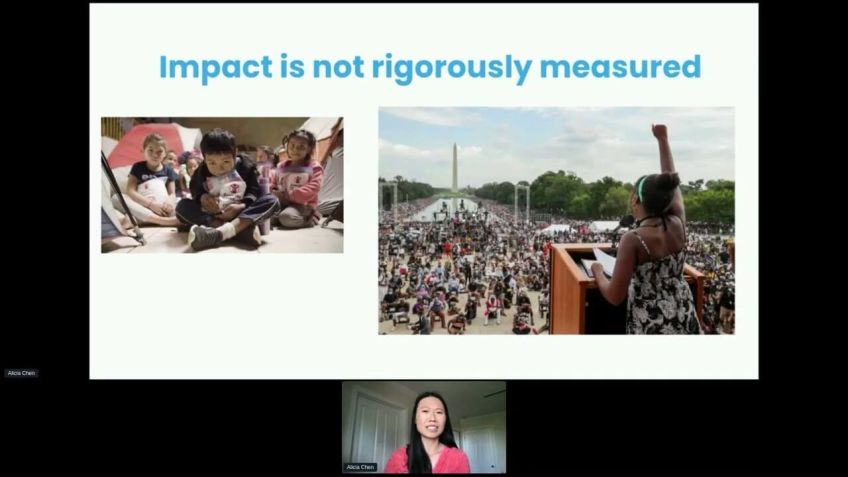
Check whether the mission guides the whole organization rather than one team, and whether impact is rigorously measured rather than shown through heartwarming pictures.
When is technology the wrong tool for a social problem?
When the real blocker is passing laws, winning elections, changing policy, getting FDA approval or changing hearts and minds, shipping features faster will not help much.
What are the risks of each funding model in social impact tech?
Nonprofits answer to donors rather than users, user-funded companies may drift toward users who can pay, government is slow, gov tech faces long procurement cycles, and volunteer groups cannot earn the institutional trust needed for deep integration.
Should I join a startup or a larger company early in my career?
Alicia Chen says each has benefits, but she prefers hypergrowth organizations because constant change gives many chances to learn, wear different hats and see how culture, processes and hiring scale.
Is a B Corp the same as a public benefit corporation?
She describes a B Corp as more a signal of intent, while a public benefit corporation carries some legal benefits; CoProcure is currently neither.
How a free-classes mission drifts to paid upskilling (50 s)
Government buying as an algorithm of go fish (77 s)
Hi, everyone. I'm Alicia. So today we'll be covering why work on social impact, why work on social impact technology specifically, and how to evaluate opportunities. So firstly, a very brief intro of myself. I'm the co-founder and CTO of CoProcure, a marketplace for government purchasing. I have two kids, and because I have a company and two kids, I no longer have any time for hobbies like rock climbing or knitting or reading.
And you'll learn all about my career shortly. So maybe brief survey for those who are here. What are your goals for your career? Just to know who my audience is. Can you just drop them in the chat if you're inclined to? Are you thinking of making some cutting edge technology that'll shape the future? Maximizing for personal growth at a fast growing org?
Is anyone already prioritizing mission or at least a little curious about it? I assume so if you're here. Anyway, feel free to drop them in or not. But for myself, I always kind of assumed that I would build my career first and then maybe I would retire and make a lot of money and then I would donate that money and maybe I would volunteer in my spare time.
But really, I had friends who got into social impact tech like right away and I was like, "Oh, that seems smarter. I could do this now." So I, you know, at the beginning did end up building my career. I started at Microsoft, where I really learned the basics of software engineering and then I was at Dropbox. Fun fact, I was actually the first woman engineer at Dropbox.
So I saw it, I saw it grow from about 70 full time to about 2000 full time and that's really where I learned to build a product and a team and understood how to build a company. But Silicon Valley is also where I was exposed to the idea of, you know, making the world a better place, whether that's real Silicon Valley or HBO Silicon Valley.
But at Dropbox, I really started to wonder, you know, because they talked about making the world a better place and I was like, strong engineering team with great people, yes. Business impact with tens of millions of users, yes, but actually making the world a better place is more like eking out 3% more productivity from white collar workers.
So not really my definition. Silicon Valley disproportionately targeting people who already have a lot, whether that's at work or in their personal lives. And I really wanted to think about how to disproportionately serve populations that were being overlooked by Silicon Valley. I mean, what are tech companies really doing for working class people and vulnerable populations? And so I decided to leave Dropbox and I wound up at the Chan Zuckerberg initiative where I learned all about social impact.
And, you know, we looked into a lot of thorny societal problems like everyone is talking about climate change, but not only do we need to fight climate change, but also the social injustices that happen as a result of climate change, where the top 1% of earners are disproportionately creating pollution and carbon emissions. And people of color and low income people are paying the price globally as well as in the United States or government inefficiency.
Why does our bureaucracy in America work so poorly that it takes almost four years for a veterans insurance appeal to be processed and veterans are literally dying while waiting for the paperwork to come through? So at CZI, I worked on CZI, I worked on a lot of different kinds of problems and worked with a lot of different types of organizations, but I found that while the problems were very interesting and thorny, as I mentioned, the way that I wanted to tackle those problems were more the way a tech startup would, you know, find a user who has a problem, solve that problem iteratively, and create a positive feedback loop.
Where by providing value to your users, you get the opportunity to keep building, which is not really the way that philanthropy and nonprofits typically work, or governments for that matter. I also wanted to have my impact via technology, I like to move fast, I'm very impatient, I like to build solutions that scale, you know, I could have been a doctor or a teacher, actually, no, I couldn't, I don't have enough patients.
And those are, those are roles that impact people on a personal level, I wanted to do something at scale, I wanted not just to put band-aids on top of existing symptoms, but really to refactor major systems in our society that aren't working well. So what I really ended up exploring was the intersection of social impact and technology, but here be dragons.
I've been burned, I've been disappointed, I spent a long time looking, a long time in my book is like two years, give or take. And in the end, I ended up co-founding my own startup. And so that leads me to this point in my career where I'd co-procure, I'm putting it all together. But to save you all some work.
This is essentially the CliffsNotes of what I learned during my exploration, a framework for evaluating opportunities in social impact. And so it comes down to four questions, we'll go into each of these in more detail. First, is the mission a true North Star? Two, is it really a technology problem? Three, how is this organization funded? And four, is it a great place to work?
So one, is the mission a true North Star? There's several versions of failure here. One is the mission is just marketing. There's lots of ways to run a successful company that aren't better for the world and priorities change over time. So if you're, if social impact is not the North Star, it's easy to wander, or there may be even just, it's pure marketing from the get-go.
Could also be a North Star for your team, but not the whole org. So everyone immediately around you wants to make the world a better place. But the top brass is still really prioritizing making the company a lot of money. It's really easy in this instance for conflicts of interest to hamstring your progress or for your whole division to get cut.
Because it's not contributing to the bottom line enough. So pretty common for the social impact wing of a bigger company. And then the last issue, which is a lot harder to find out and harder to fix, is impact isn't rigorously measured. When you're talking about root causing really tough problems, it's not as easy as give $10 feed a child per month.
So, you know, if we change the education system or help people find better housing, is that actually changing their life outcomes? And, you know, in many instances, people want to see heartwarming pictures, or they just want to be part of something that feels really principled. It's much less exciting to talk about science and randomized controlled trials and whether or not those actions are actually having the outcomes that you want.
Moving on to the next problem. Is it really a technology problem? So, code is fast and laws are slow. So, no matter how fast you ship your next feature, it's not really going to help you do things like pass laws, win elections, change policy, get FDA approval, or change hearts and minds. So, you really have to ask yourself, whatever problem you're trying to solve, what is the blocker to making this happen?
Because if it's one of these things and it's not software, software isn't necessarily going to make that big of an impact. And it's not to say that these kinds of efforts aren't important, but the question is, should you try to apply technology or should you use another tool like starting a movement or lobbying Congress? And it's also a question of how much patience you have because progress is measured in decades, not in sprints.
So, you know, you can stand up a website and then go do a whole nother company and then come back and they'll still be working on it. Another is that the culture clash is real in tech companies. There are concepts that we take for granted that if you work in a nonprofit or in the government, you'll either have to personally evangelize these things or just learn to do without.
The next issue is how is this thing funded? Every funding model has its unique problems, so we'll go through them one by one. If you're working at a nonprofit, as I mentioned, funding is not tied to user value, so there's not a positive feedback loop. Donors are different than end users, which means that you have to keep two different groups of people happy.
These two different groups often have, you know, different ideas of what should be done. And when push comes to shove, the more important group for your survival to please is actually donors. And there's no such thing as hockey stick growth. You have to get new users and then separately, you have to get money. Another funding model is the user funded tech company.
Typically, you charge your users for, you know, providing some product or service. But the question, especially if you're looking to serve vulnerable populations, are do your users have enough money? Because if they don't and you need to make money, then oftentimes you'll find yourself catering to users who do have money. So, for example, your company might start with the aspirational mission of providing free classes to the unemployed.
And then in an effort to stay afloat monetarily, you end up pivoting to providing paid classes to upskill people who already have jobs. So hard to stay true north in this situation. Another way you could get funding is to work in the government. The government has lots of money and it serves all populations and disproportionately serves vulnerable ones.
The nonprofit sector is only 5.4% of US GDP, while government is 17%. So it's big. And you can enter programs like the USDS or 18F to directly apply your technology skills. The issue with government, as you probably know, is it's super slow. There really is a huge culture difference and red tape and all kinds of policies that make it hard to iterate the same way you do as a tech startup.
So in between those two is gov tech, you know, don't work in the government. You can work with the government and then you can sort of maintain your own culture and all of those things. But the issue with gov tech typically is that there's a months long procurement cycle that you have to go to through in order for governments to adopt your technology.
The sales cycle is a minimum of four months, typically much longer. And no government really wants to innovate and go first. And so basically you have to go through this months long cycle again and again and again. So good luck finding product market fit and making enough money before you go bankrupt. And lastly, no money, no problem.
We'll just run a volunteer organization. But the problem with that is if you want to have meaningful change, you have to put in sustained effort over long periods of time. And usually you will need the trust of established institutions. But hospitals, schools and governments aren't going to deeply integrate a team of volunteers. They could disappear at any moment and leave the government holding the bag.
And so they just won't do it. But deep integration is what's necessary for real impact. So a wide array of funding problems. Last but not least, is it a great place to work? Because wanting to do good doesn't make up for fundamental flaws in an organization. So in order for you to be happy there and for this group to be effective at what they want to do, you still have to make sure that they have sound product and funding strategy.
Strong leaders, an amazingly talented team, and a really strong culture. I'll go through two of the more common pitfalls I saw. One is product market fit. Just because something benefits the greater good doesn't mean it'll get adopted. So you have to ask yourself, is this solution great for students but really hated by teachers and school admins? Is it better for citizens but worse for public servants?
If so, that's a boulder you're going to be pushing uphill forever. And it's going to make it really hard to have a strong go-to-market strategy if that was something you were even thinking about. Another common issue is early team DNA. You want to make sure you have the right set of coverage. You don't want to have a bunch of technologists who are just trying to disrupt the status quo without really understanding what it is.
And you also don't want to have a bunch of domain experts who are clueless about building technology and a strong technology team. Both of them are probably doomed to fail. So don't skip your due diligence just because you're going to work on something that's meaningful and going to save the world. So at this point, you're probably saying, hey, Alicia, you're hunting for Bigfoot.
These kinds of organizations don't exist. Well, they do. But in my case, I did have to start it. And so this is where I'll talk a little bit more about the startup that I work at, Co-Procure. Because for us, the mission is a true north star. My co-founder and I both arrived at this idea because we wanted to have social impact at scale.
But the problem we're tackling is not obvious. It's both not an obvious problem and not obviously a social justice problem. So a little bit more about what we do. Procurement is a $2 trillion a year industry at the state and local level. That's 9% of GDP that goes towards paying for goods and services like school lunch and buying electric buses and so on.
And it's a huge part of policy implementation. You can't fight climate change or run a government health care system without procuring like appliances and software and contract staffing. But the way procurement works these days is, you know, not like going on Amazon or Yelp to use the Internet to buy stuff. But instead, they write up like a thousand pages of specification and then they put it out there and they let vendors come to them with their bids.
They're legally required to wait for a minimum of four months and it's considered a good day, especially if you're a small agency. If you get even three qualified bids, oftentimes it's zero or one. And in many places, the policy is such that you have to accept your legally required to accept the cheapest piece of junk that someone is offering you that meets all of the requirements.
So this is how the government spends two trillion dollars a year. And you can see how this results in many of the inefficiencies. That's how we buy everything from, you know, printers to fighter jets. Now, the way Copercure is solving this is a purely technical solution. What you can do is that you can actually skip over the four month long bidding process by piggybacking on another government agency's existing contract.
There will be a recording later. You can piggyback on another agency's existing contract. This is a legal and widely known practice. It's just very inefficient because the way they're doing this search now is by calling and emailing each other. I joke that it's an algorithm of go fish. And so if you're looking for desks, you call them up.
You're like, do you have a contract for desks? Do you have a contract for desks? So really apply technology. You put all the contracts in one place, you make them searchable. For Silicon Valley, it's actually a pretty simple problem. And the funding is pretty well solved. It's a two trillion dollar market, as I said, and we're starting with a 200 billion dollar niche in cooperative purchasing.
And we plan to monetize on the supplier side, which means that we don't have to be procured by government so we can grow virally as fast as any, you know, SaaS company can. And obviously, I'm pretty biased, but I think it's a great place to work. We have strong product market fit. We have 35% quarter over quarter growth.
So we have shown that it actually can work. It's better for buyers. It's better for suppliers. It's better for the public good. And it's taking like crazy. Obviously, I'm biased. I think we have a great team. And my point is, you can have your cake and eat it too. You just might have to ask a lot of questions.
You will probably have to keep searching if your initial few options don't meet the criteria you want. And in the end, you might have to start something yourself. That's it for my talk. Does anyone have any questions? Yes. Are we a B Corp? So we are not currently a B Corp. We are, I think at the time that our company was started, we didn't know about B Corps.
We have investigated that. I think there's a difference between a B Corp, which I think is more just like a signaling of intent versus a public benefit corporation, which actually has some legal benefits. And so that is something we will look into in the future. For now, I think we just want to survive. Yes. So we are currently neither, but that's something we will explore again.
We didn't even know that was a thing. We're both first time founders. Also, for anyone who's here, would love to connect with you via LinkedIn. And these, this talk is actually available as an article. And I will also share the slides. And it is being recorded. So I think the YouTube video will be available afterwards sometime. If you want it, you can connect with me and I will send it to you.
Let's see. Here is the original article that this is based on. Regarding, do I like working on startups better than my former organizations? I think each had their benefits. Quite nice to start my career at Microsoft. Um, it had a lot of support for learning as a software engineer. Um, like honestly out of school, I had no idea what I was doing, but my manager was very helpful.
Um, and there were just classes on how to software engineer. Um, Dropbox was a good change because it was just way faster. There was a lot more learning by doing a lot less supports. It was good that I kind of, you know, already knew a little bit, but for some people, I think it's a great option to just start right off the bat.
Um, I think for a small startup, you will get a lot of, a lot of variety. Small startups can expand the whole spectrum where I really like to go is a hyper growth organization because everything is growing and changing all the time. And you get lots of opportunities to learn and do things yourself and wear different hats.
So at a startup, you know, you might end up in sort of the same product market fit loop for a long time and never really get traction, um, and never really grow. So you don't get to learn things like how to build a culture or healthy processes for a larger organization or hiring. Um, but you will get all of those things at a fast growing organization.
The trick is finding some, some place that is in hyper growth. So, yeah, that's where I looked for my career. Um, I think Dropbox and hopefully co-procure, um, Dropbox basically doubled in every stat every year that I was there over about five years. Um, and co-procure is aiming to do the same. So lots of learnings. Hyper growth companies and identification thereof.
Um, it's, uh, you can definitely hear the company talk about their metrics. Um, we offer for most of our new hires to talk to our investors because you can tell from, you know, an investor's track record and then what they think about the company. Um, so I think one of, one of our big bragging rights is, uh, one of our early investors, uh, one of our investors was an early investor in the likes of Facebook, Airbnb, Dropbox.
Um, and he thinks that we are the hottest thing in his portfolio. So that, that is, that is how I knew it was a good thing when I joined. Um, but otherwise, yeah, looking at their metrics, um, and really asking those questions about like the business. Is it sound, how is it growing? What is their culture like?
All right. Well, it's been fun. Thank you all so much for listening to my talk and, uh, have a great rest of your day or evening or wherever it is where you are. Bye. .
Transcribed automatically; names checked against the speaker record. Select a time to jump there.
Article based on this talk
How can technologists tell if a social impact job is worth taking?
Alicia Chen offers four questions that separate real mission-driven opportunities from good intentions and marketing.
In short
A good mission is not enough reason to join a social impact technology organization, argues Alicia Chen, co-founder and CTO of CoProcure. After a long search that took her from Microsoft and Dropbox to the Chan Zuckerberg Initiative and finally to co-founding her own startup, she condenses what she learned into four questions: is the mission a true north star, is it really a technology problem, how is the organization funded, and is it a great place to work.
Key takeaways
Test whether an organization's mission is its true north star or only marketing for one team or the brand.
Judge whether the blocker to a social problem is software or something code cannot fix, such as laws, policy or elections.
Compare the built-in risks of nonprofit, user-funded, government, gov tech and volunteer funding models.
Check product-market fit and early team composition before joining a mission-driven organization.
Spot hypergrowth companies by asking about their metrics and talking to their investors.
From "a better place" to a real search
Chen once assumed she would build her career first, make money, then donate and volunteer later. Friends who went straight into social impact tech changed her mind. She learned software engineering basics at Microsoft, then joined Dropbox, where she watched the company grow from about 70 to about 2,000 full-time employees. "Fun fact, I was actually the first woman engineer at Dropbox." (1:31)
Dropbox talked about making the world a better place, but to Chen that looked more like extra productivity for white collar workers. She wanted something different: "And I really wanted to think about how to disproportionately serve populations that were being overlooked by Silicon Valley." (2:35) At the Chan Zuckerberg Initiative she studied problems such as the social injustice of climate change and veterans waiting almost four years for insurance appeals. She found the problems compelling but wanted to tackle them the way a startup would: find a user with a problem, solve it iteratively and build a positive feedback loop. Her search for that combination took about two years.
Question one: is the mission a true north star?
Chen describes three ways this can fail. The mission may be pure marketing, or priorities may drift because there are many ways to run a successful company that are not better for the world. The mission may belong to one team but not the whole organization, which leaves social impact wings exposed to conflicts of interest or cuts when they do not contribute enough to the bottom line. The hardest failure to spot is impact that is never rigorously measured. "When you're talking about root causing really tough problems, it's not as easy as give $10 feed a child per month." (6:41) She notes that heartwarming pictures are more exciting to many people than randomized controlled trials, even though the trials show whether actions produce the intended outcomes.
Question two: is it really a technology problem?
Chen's sharpest line on this point is short: "So, code is fast and laws are slow." (7:33) Shipping features faster will not pass laws, win elections, change policy, secure FDA approval or change hearts and minds. Those efforts matter, she says, but they may call for a movement or lobbying rather than software. Patience is part of the calculation too: "And it's also a question of how much patience you have because progress is measured in decades, not in sprints." (8:09) She also warns that the culture clash is real, and technologists in nonprofits or government may have to evangelize practices tech companies take for granted, or learn to work without them.
Questions three and four: funding and fundamentals
Every funding model has its own problems. In nonprofits, funding is not tied to user value and donors are different from end users. "And when push comes to shove, the more important group for your survival to please is actually donors." (9:25) User-funded companies serving vulnerable populations can drift toward users who can pay, such as a mission to give free classes to the unemployed that turns into paid upskilling for people who already have jobs. Government is large (she cites the nonprofit sector at 5.4% of US GDP against 17% for government) and programs like USDS and 18F welcome technologists, but red tape slows iteration. Gov tech keeps its own culture but faces procurement cycles of at least four months, and volunteer groups cannot earn the deep institutional integration that real impact requires.
Finally, Chen insists on ordinary due diligence. "Because wanting to do good doesn't make up for fundamental flaws in an organization." (12:12) She highlights two common pitfalls: weak product-market fit, where a solution helps students but is hated by teachers and administrators, and unbalanced early teams made up only of disruptive technologists or only of domain experts who do not know how to build technology.
Proof that such organizations exist
Chen admits that in her case she had to start the organization herself. CoProcure tackles state and local government procurement, which she describes as a $2 trillion a year industry. Agencies can legally skip a four-month bidding process by piggybacking on another agency's existing contract, but finding those contracts is slow. "I joke that it's an algorithm of go fish." (16:04) CoProcure puts contracts in one searchable place and plans to monetize on the supplier side so it does not have to be procured by government. Her closing advice is to keep asking questions and searching: "And in the end, you might have to start something yourself." (17:30)
In the Q&A she explains the difference between a B Corp and a public benefit corporation, and recommends hypergrowth organizations for learning, suggesting candidates ask about metrics and talk to investors.
Watch the talk
When "Don't Be Evil" Isn't Good Enough: A Framework to Evaluate Your Next Opportunity in Social Impact Technology, Alicia Chen, 22 minutes: https://www.womentech.net/video/when-dont-be-evil-isnt-good-enough-framework-evaluate-your-next-opportunity-in-social-impact
About the speaker
Alicia Chen introduces herself in the talk as co-founder and CTO of CoProcure, a marketplace for government purchasing. She began her career at Microsoft, was the first woman engineer at Dropbox and worked at the Chan Zuckerberg Initiative before co-founding CoProcure.
Questions this talk answers
How can I tell if a company's social mission is real?
When is technology the wrong tool for a social problem?
What are the risks of each funding model in social impact tech?
Should I join a startup or a larger company early in my career?
Is a B Corp the same as a public benefit corporation?
Drafted with AI from the talk transcript. Editor review pending.
Frameworks and ideas mentioned
Four-question framework for evaluating social impact opportunities
Randomized controlled trials
B Corp
Public benefit corporation
Product-market fit
Resources mentioned
The original article the talk is based on (not named)
USDS
18F
Cite this talk
WomenTech Network. "When “Don’t Be Evil” Isn’t Good Enough: A Framework to Evaluate Your Next Opportunity in Social Impact Technology by Alicia Chen." WomenTech Network, 2022. https://www.womentech.net/video/when-dont-be-evil-isnt-good-enough-framework-evaluate-your-next-opportunity-in-social-impact