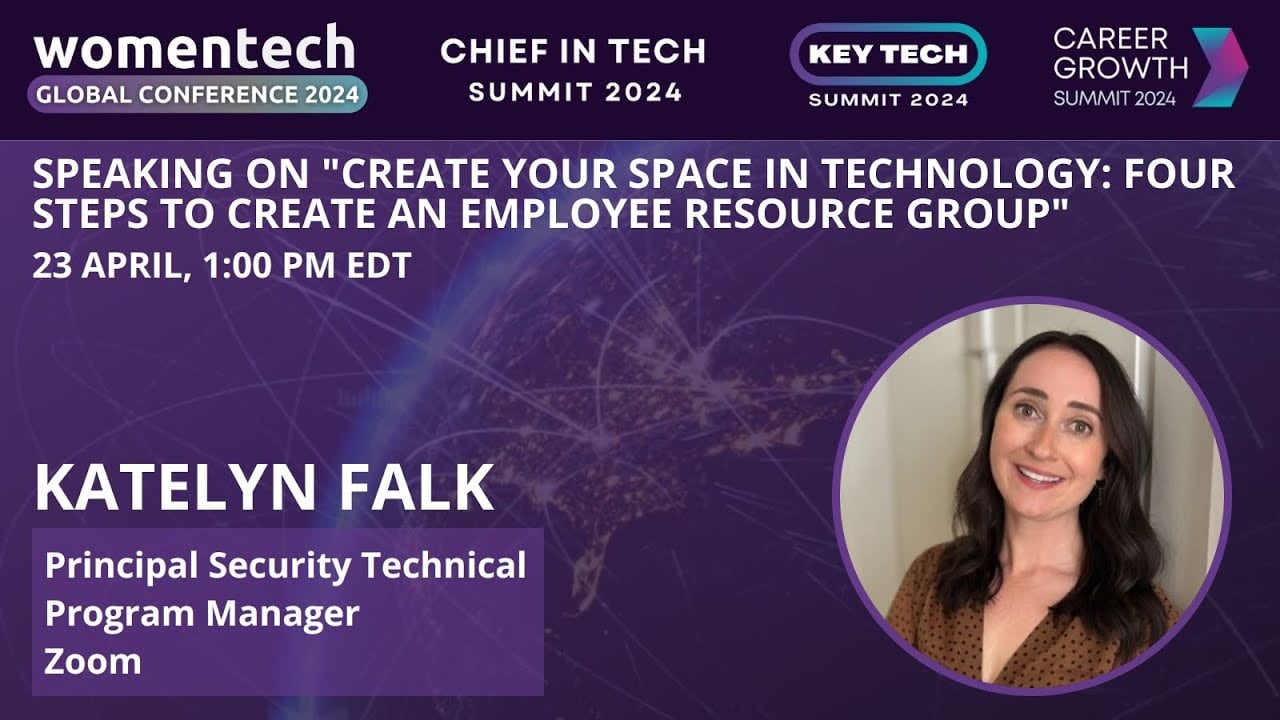
Create Your Space in Technology: four steps to create an employee resource group
Katelyn Falk19:562024
You don't need a budget to start a women in tech ERG, you need time
Many women hold back from starting a women in tech group over the same worries: no budget, no time, and a quiet suspicion that someone else should lead it. Katelyn Falk, co-founder of Zoom's Women in Security employee resource group, knows that self-doubt firsthand, and her group began with little more than a chat channel of about 100 women. So what turns that first chat into a community that lasts?
Get a four-step playbook to launch and sustain a women in tech ERG with little or no budget
Katelyn Falk, co-founder of Zoom's Women in Security employee resource group, explains why women in tech ERGs matter and how to build one. She lays out four steps (establish leadership, create a mission statement and goals, recruit and retain members, listen and adjust) and argues that an ERG can be started virtually, with little or no budget.
“I like to start out by saying that you do not need a budget to get your women in technology group up and running. The biggest resource that you're going to need at the very beginning is time.”
“I would challenge all of you that if you're here today, that something that you're thinking about, you are the right person, you can do it and squash that self doubt again easier said than done, but just know that you're not alone in dealing with that.”
What you will learn
Plan an ERG leadership team that shares the workload, even if each person can give only an hour a month.
Draft a mission statement and simple goals, plus one stretch goal, that a D&I team and executive sponsor can review.
Recruit first members through the chat, calendar and video tools your company already uses, then hold a short kickoff.
Retain members with low-cost events such as a quarterly internal speaker series, book clubs or newsletters.
Build feedback loops with short surveys and tell members what changed because of their input.
Key takeaways from the speaker
the importance of women in tech focused employee resource groups and how to partner with your DEI teams, stakeholders, and/or executive sponsors
Four steps to create an employee resource group for women in technology 1. Establish leadership 2. Create mission statement 2. Recruit and retain members 4. Listen and Adjust
Main take away: ask for all participants to create a mission statement for the employee resource group and share with someone
Details
Level
Beginner
Format
Talk
Technical depth
Non-technical
For
All career stages
Length
19:56
Published
May 2024
Questions this talk answers
Do I need a budget to start a women in tech employee resource group?
No. Falk says time is the biggest resource at the start, and the video conferencing, calendar and email tools you already use for work are enough to get going.
Why does an ERG need a mission statement first?
The mission statement sets the foundation for the group's goals and is one of the main things a potential executive sponsor will want to see. She recommends documenting it, asking the D&I team for review and adjusting it based on feedback.
How do you recruit the first members of a women in tech ERG?
At Zoom, the founders added the roughly 100 women in the CISO organization to a team chat channel, then held a short kickoff meeting to share the mission statement and collect ideas.
How do you keep ERG members engaged over time?
Give them something of value: events, information or simply a safe space, such as a quarterly speaker series, a book club or a newsletter. Accept that members participate in different ways, including quietly.
What should you do with member ideas you can't deliver yet?
Treat them as a chance to ask for volunteers: invite the person to lead the idea with support from the leadership team, and accept it if they would rather only give feedback.
About this talk
Does your organization lack a Women in Technology employee resource group? No problem. In this session we will follow basic steps to establish a Women in Technology group, obtain executive sponsorship, and drive engagement amongst members. Learn how to establish leadership, create a charter and yearly goals, all while creating a supportive and inclusive environment for women in the technology profession. All this can be done virtually and with little budget. Join this session to learn more!
I'm going to go ahead and get started. Hi, everybody. Thank you for joining. Today, I'm going to talk to you about how you can create your space in technology or four steps to create an employee resource group or an ERG. You'll hear me say ERG probably throughout the rest of the session. Katelyn Falk: Hi, everyone. My name is Katelyn Falk, and I am a Principal Cybersecurity Technical Program Manager, or TPM. I'm currently working at Zoom. I'm in the larger Seattle area, and I started out my career in the finance space as a technical writer, and then I moved into IT for a few years, and then I found myself in cybersecurity, and I've been here in the cybersecurity field for about seven years now.
Katelyn Falk: I'm an active board member of the DIANA Initiative for 2024, which is a wonderful nonprofit space that's focused on creating an inclusive space for those underrepresented in the cybersecurity community. Katelyn Falk: And during my time in my career, I've spent time creating and supporting women-specific ERGs. Most recently has been creating a Women in Security ERG at Zoom as the co-founder, and this is what I'm going to talk to you about today.
Katelyn Falk: Again, some of that experience that I have creating and supporting that group. Katelyn Falk: So before we talk about how to create a Women in Technology ERG, I want to spend a little bit of time talking about why. Why you would possibly want to take on this challenge and why it's important. Katelyn Falk: Here on the right side of the screen, you can see a graphic that was created and a study that was done by the Anita B organization in late 2023. So just last year, with close to 1400 women and 72% of those women say that the tech industry is more gender imbalance than most. 24% feel strongly about this. I don't think that these are probably numbers that I need to talk to you too much about today because most of us are living and breathing.
Katelyn Falk: Some of those numbers are some of those numbers or some of those feelings of the gender imbalance that we experience in meetings or in calls in virtual events that may take place. Katelyn Falk: So what do we do? How do we shift these numbers? One thing that we can do is we can recruit and retain women. We can focus on changing the imbalance.
Katelyn Falk: Over time with supportive allies and we can create space for ourselves. We can create space for ourselves. We can take up that space rightfully so in technology. And one way that we can do this just one way is through an ERG. Katelyn Falk: Now, within a women in technology ERG, you can create create that sense of community and help create that sense of community for others through that community. You'll see the representation shift throughout your meetings and trainings that you may do. And what I mean by that is a lot of us.
Katelyn Falk: You can create that sense of community and help create that sense of community for others through that community. Katelyn Falk: You'll see the representation shift throughout your meetings and trainings that you may do. And what I mean by that is a lot of us. Katelyn Falk: A lot of us may sit in meetings or events that we really experience that gender imbalance. Now, when you have your women in technology ERG, you get to watch those numbers shift in a in a positive way closer to 100% of the participants being women, which is a really amazing feeling.
Katelyn Falk: In the ERG engagements, whether in person or virtual women will start to share knowledge and resources with the larger group, which really helps break down some of those barriers. Katelyn Falk: Across the company that you're working at. And I would also like to say across the industry. I think all of us coming together today is a great is a great representation of that.
Katelyn Falk: So again, I don't like to spend a ton of time on this because I feel like we all know what that gender imbalance feels like, but I do I do like to break it down for those that are that are thinking of stepping into this space. Katelyn Falk: So let's move on to the how. How can you create your women in technology ERG. I have this broken out what I like to call four steps to success.
Katelyn Falk: We're going to talk through each of these today in a little bit more detail. The first is to establish your leadership team. We'll talk through why a leadership team is needed and what that role really means. Katelyn Falk: Step two is creating your mission statements and goals. We'll talk through why this is needed and different resources that you can leverage to pull these together.
Katelyn Falk: Step three is recruiting your members and retaining them. We'll talk through different tools and resource that were resources that you can do to obtain that. Katelyn Falk: And then the last step. Step four is listen and adjust. Now, this is to listen and adjust to the group as the group has stood up and matures over time.
Katelyn Falk: So just four high level steps. Are we ready? Okay, let's jump in. Katelyn Falk: All right. Step one, like I said, is establishing that group. Katelyn Falk: Leadership. So right out of the gate, you have to ask yourself, are you going to lead your women in technology group? Are you up for it? Katelyn Falk: I hope that by seeing you in the audience today that that answer is yes, or maybe that you're an ally that's here looking to support or encourage someone to also step into the space in that leadership role.
Katelyn Falk: But I also understand from my own personal experience and talking with women that there are concerns. There's concerns of stepping into a leadership role of what it looks like, Katelyn Falk: How it could impact your day to day job. So the four items that I have here on the screen are sort of the top four areas that I hear that are concerns from women.
Katelyn Falk: I like to start out by saying that you do not need a budget to get your women in technology group up and running. The biggest resource that you're going to need at the very beginning is time. Katelyn Falk: You're going to need that time to get the group moving. If you're concerned about managing your day to day responsibilities and a women in security group, please go speak with your manager.
Katelyn Falk: If you have a D&I team at your company, please go speak to them and talk through what that might look like. Let them know that this is something that you are interested in taking on. Katelyn Falk: You could potentially team up with a coworker. You could divide the responsibilities of the leadership of the leadership responsibilities.
Katelyn Falk: Something that I may have skipped over earlier, but I am the co founder of zooms women in security ERG. Katelyn Falk: And I like to I like to be very clear about being a co founder, because what that means is that I have a partner. I have another co founder, as well as amazing volunteers that have stepped up over time to help support the group.
Katelyn Falk: It's not something that you have to do alone or take on, you know, all on your shoulders, you will find others that are interested and even if they can commit a small amount of time, it will really help as you are establishing that group leadership team. Katelyn Falk: So don't let the concern of time get in your way easier said than done. I know.
Katelyn Falk: And you may be asking yourself, wait a minute, do I need budget for this? I like to say that you don't need budget initially as you're getting the group stood up. Katelyn Falk: You may be thinking, you know, wait, did I hear her right? I don't need a budget, of course, it is helpful if you have that as an option, definitely take advantage of it.
Katelyn Falk: But to get your group stood up and moving, you have all of the different tools that you may need, whether it's, you know, video conferencing calendar email tools right at your fingertips that you're most likely using for your day to day job. Katelyn Falk: So take a rough inventory of what those tools may be and how you can leverage them to bring to bring your group together.
Katelyn Falk: You don't need fancy tools. So think of those tools again that you have that are already already at your fingertips. Katelyn Falk: The last, the last hurdle here that I like to talk about is self doubt. And this is a personal one for me because this is something that I struggled with when I thought about creating a women in security group at zoom and going, I'm not sure. I'm not sure if I'm the right person.
Katelyn Falk: I'm not sure if maybe somebody else is interested in doing it or maybe I'll just sit back for a little bit and see if someone else is going to do it. Katelyn Falk: I would challenge all of you that if you're here today, that something that you're thinking about, you are the right person, you can do it and squash that self doubt again easier said than done, but just know that you're not alone in dealing with that.
Katelyn Falk: If you want to talk more about that one on one message me, I'll share my information at the end, and I'm more than happy to talk through sort of how I battled my way through that. Katelyn Falk: But it's, it's very encouraging to hear other women that may struggle with that. Just know that you're not alone. And it's something again, if you're in this in this session today, I have no doubt that you would be you would be a great leader.
Katelyn Falk: So step one is really about establishing that group leadership squashing any of that self doubt setting aside any concerns about budget that you may have and realizing that you can take this on from a time perspective, even if you can just come in an hour a month, and you have the tools that you initially need right at your fingertips.
Katelyn Falk: All right, let's move on to step two, which is creating your mission statement and goals. Katelyn Falk: Now the mission statement is key to set the foundation of the group and the starting point to be able to set goals on top of that group. Katelyn Falk: My recommendation is to get the mission statement documented, get it in a Word document, get it in a Google document and get it in front of the group, keep it there, it's going to be one of the main aspects of potential executive sponsor will want to see.
Katelyn Falk: If you have a D&I team, which I hope you do, they'll probably want to help you with that, or at least review it, which is great. Katelyn Falk: Ask for feedback and adjust as necessary. Katelyn Falk: Now once you have your mission statement start to create some simple goals off of that mission statement be gentle to yourself as you're stepping into this space.
Katelyn Falk: And keep your goals. Katelyn Falk: Simple, yet I would also challenge you to create a stretch goal for that for that group. Katelyn Falk: Now, as you go out and you write your mission statement, you don't have to start from scratch. Katelyn Falk: Of course, there are amazing women in technology focus groups and conferences, just like the one that we're at today, that you can go out take a peek at their website review.
Katelyn Falk: Pull some pieces or pull some inspiration from what you see that currently exists to help shape what you are experiencing and hope to create at your company. Katelyn Falk: I have an example on the screen here today that if you would like to leverage i'm more than happy to share with folks after. Katelyn Falk: A goal that I also like to share with with folks that I hope applies to to your company as well, is to be able to drive member participation and engagement via group events.
Katelyn Falk: Again, these might be in person, they may be hybrid something that we leveraged at zoom was to conduct a speaker series event at least once a quarter. Katelyn Falk: Which was a very achievable goal just four events a year and we were able to. Katelyn Falk: pull internal speakers at zoom in our security community to say hey can you talk about your career, can you talk about maybe different challenges and obstacles that you've overcome.
Katelyn Falk: Share a little bit about what you do in your day to day job and it really helped create a sense of community and break down some of those barriers. Katelyn Falk: As that group was stood up. Katelyn Falk: So again, step to create your mission statement and goals. Katelyn Falk: Highly recommend that you get it together get a draft get it documented and get it in front of the future group.
Katelyn Falk: So step three is my favorite step because it is about the members, which is arguably the most important part of your women in technology. Katelyn Falk: E R G E R G excuse me so step three is to recruit and retain those members. Katelyn Falk: Now in order to recruit members, you will need specific tools.
Katelyn Falk: Think about how you are going to bring together members, whether it's virtual or maybe a hybrid option. Katelyn Falk: You can bring members together virtually in a chat client if you have that as an option. Katelyn Falk: Ask women to introduce themselves. Katelyn Falk: Share a little bit about their career progressions or what they do at your company.
Katelyn Falk: Let them know that you are stepping into that leadership role and you're going to be bringing them together to do some type of a kickoff meeting. Katelyn Falk: Now don't let that scare you. Sometimes folks think that the kickoff meeting has to be big and fancy. Katelyn Falk: It doesn't have to be. It could be simply bringing your interested members together for 20 to 30 minutes to share that mission statement.
Katelyn Falk: And ask for ideas. Ask for ideas of what the members would like to see. Katelyn Falk: The reason I have that ideas galore bullet here is because what you'll most likely see are many members sharing different ideas that they would love to see. Katelyn Falk: You'll get all sorts of things from a book club to technical trainings to in-person events.
Katelyn Falk: Absorb those like a sponge, but also set the expectation for the group that it's going to take time for some of these to happen. Katelyn Falk: It's also a wonderful time for you to ask for support. Ask for volunteers. You can say these are wonderful ideas. Katelyn Falk: I'm just one, maybe two, three people on that leadership team, and I, we will most likely need volunteers.
Katelyn Falk: So you can ask for that multiple times a year. Never stop asking, even if folks are able to commit five, ten minutes to something, Katelyn Falk: whether they're reviewing material before it goes out or they're bringing folks together or they're leading sessions. Katelyn Falk: Welcome any and all support because you don't have to do it alone.
Katelyn Falk: An example that I like to use is at zoom. We created a zoom team chat channel. We added all of the women from our CISO organization. Katelyn Falk: At the time, it was about 100 women into a team chat channel. And we said, boom, that was our initial recruitment. Katelyn Falk: Now, how are we going to keep these members engaged? We walk through the steps that I outlined here of having that kickoff meeting, getting some great ideas, and then, of course, asking for volunteers and asking for support.
Katelyn Falk: Again, people are normally very excited, but not a lot of people offering up their time initially. Katelyn Falk: They're kind of want to they want to feel out the group a little bit understand what that commitment may look like and see if it's something that they will they're able to commit time to. Katelyn Falk: Now, in order to retain your members, you have to be able to provide them with something.
Katelyn Falk: And I don't mean swag hoodies or mugs like yes, that's great. And who doesn't want that. Katelyn Falk: But I mean events information or simply that safe space for them to come together. Katelyn Falk: Something that you can think about are the different types of events that you would like to do. Katelyn Falk: These may be online offline in person hybrid just a few examples that I'll throw out.
Katelyn Falk: I mentioned the speaker series earlier, which is free. Of course, you'll have to have members commit their time to share a little bit about their career progression or any obstacles that they've overcome. Katelyn Falk: You can also do a monthly book club, a quarterly book club. If you are in person, you can do a happy hour bringing folks together. It really depends on the time that you're able to commit and then what the engagement is like from your members.
Katelyn Falk: I've also seen some groups have really great success in doing some type of email blasts to their groups or newsletters. Katelyn Falk: I would just mention to folks that your members are going to be participating in all sorts of different ways. Katelyn Falk: I struggled a little bit with wanting to see engagement in the meetings or in the survey forms from all of the members of the group, which I understand is not realistic.
Katelyn Falk: So something that I've learned along the way is that you might have folks that come to every meeting and never participate maybe vocally or in the chat channel. Katelyn Falk: And that's fine right everyone wants to participate in in their own ways that they're comfortable with. Katelyn Falk: And part of that women in technology ERG is accepting that and having a safe space for everyone so whether they are the most vocal or very quiet in meetings that is completely fine and in time they may want to reach out to you to share their ideas and that's great absorb that.
Katelyn Falk: But also they may not and that's fine too. Katelyn Falk: There's something that I learned along the way that I like to share with women as they step into this space. Katelyn Falk: So again, this is my favorite step because it is about the members as you think about how you can recruit and retain those members.
Katelyn Falk: Let's move on to step four, which is listening and adjust. Katelyn Falk: I talked about this a little bit in step three when I mentioned surveys, but this is really the time for you to create those feedback loops for the group. Katelyn Falk: Please listen to your women technology ERG members. Katelyn Falk: Again, you'll get all sorts of feedback in different ways.
Katelyn Falk: Some of them may be, you know, folks stopping you in the hallway or hitting you up one on one on a call. Katelyn Falk: They may want to fill out your survey forms if you're able to pull something together. Katelyn Falk: This may look like, you know, two or three question Google form that you're able to send out to the members.
Katelyn Falk: Keep those survey results help drive the direction of the group and after you make adjustments if you do to the group or your approach. Katelyn Falk: Let the members know that let them know hey, you know I got some great feedback that the speaker series is sort of coming to an end and maybe folks are asking for more technical trainings.
Katelyn Falk: I'm going to deliver you a threat modeling one on one technical training based off of that feedback. Katelyn Falk: That's a great way for members of the group to feel like they have a say and they have an opinion on how the group is being ran a little bit, which is really great. Katelyn Falk: I mentioned the example of the speaker series, you may hear folks sharing ideas as well or feedback that maybe you can't action on immediately and that's fine, too.
Katelyn Falk: I like to use that as another opportunity of calling for support or calling for volunteers if they're interested in saying hey, you know I love your idea of running a quarterly book club. Katelyn Falk: We don't have the bandwidth right now to do that, but is that something you're willing to take on. Katelyn Falk: If not absolutely fine.
Katelyn Falk: If you'd like to be supported in that something that you can talk through with the leadership team. Katelyn Falk: And some folks are really excited about the possibility of sort of expanding that leadership team and running different initiatives. Katelyn Falk: Or maybe other folks are like, nope, I just want to share my feedback. Katelyn Falk: I'd like to participate.
Katelyn Falk: And that's absolutely fine as well. Katelyn Falk: Let's see. Katelyn Falk: You'll also like I sort of mentioned earlier, but just continue to ask for those ideas and involvement. Katelyn Falk: You might feel like okay I keep asking and folks aren't they aren't volunteering, but as we all know our day to day jobs take up so much of our time and.
Katelyn Falk: And as those as our data responsibilities sort of ebb and flow there might create pockets for others to step in and help as well. Katelyn Falk: So welcome that again. Katelyn Falk: So step four is listening and adjusting to the group as it stood up over time. Katelyn Falk: Now I do have a challenge for all of you that are here today.
Katelyn Falk: As you walk through or you're thinking about again I am I the right person to step into creating a women in technology ERG whether you're completely sold on the idea of doing it or not today. Katelyn Falk: I'd like to challenge all of you to go out and create a mission statement for what a group would look like at your company.
Katelyn Falk: You could scribble that scribble it on a sticky note. Katelyn Falk: Put it on a whiteboard put it in the word doc, it doesn't need to be official, but my ask of all of you is to create that mission statement and then share it with someone that you work with. Katelyn Falk: I'd like for you to see where that conversation takes you see if there's potentially someone that wants to step into this with you and say oh wow I didn't know that you were thinking about doing this.
Katelyn Falk: I love to partner with you on this or hey let's tweak the mission statement this way or maybe I'm not interested that's fine as well. Katelyn Falk: Stepping into the space is really going to be a understanding that different people want to be involved at different levels and accepting that across the board. Katelyn Falk: So again.
Katelyn Falk: If you're interested in stepping into the space, please challenge yourself to create a mission statement and share it with someone. Katelyn Falk: I am here to help you as a resource if and when you're ready to step into this space. Katelyn Falk: So please reach out to me on LinkedIn and check out my website. Katelyn Falk: I'm more than happy to help support you review mission statements grab a coffee, whatever it may be.
Katelyn Falk: Thank you for your time and I hope that you have a wonderful conference and please if you do step into this space shoot me a LinkedIn message. Katelyn Falk: I'd love to hear about your journey and we can share different ideas together again. Katelyn Falk: Thank you. Thank you.
Transcribed automatically; names checked against the speaker record. Select a time to jump there.
Article based on this talk
How to start a women in tech employee resource group with little or no budget
Katelyn Falk, co-founder of Zoom's Women in Security ERG, shares four practical steps from leadership to listening.
In short
A women in technology employee resource group (ERG) does not need a budget to get started, says Katelyn Falk; it needs time, a small leadership team and a clear mission statement. Drawing on her experience as co-founder of Zoom's Women in Security ERG, she offers four steps: establish leadership, create a mission statement and goals, recruit and retain members, and listen and adjust. Her closing challenge is simple: write a mission statement for your company and share it with one colleague.
Key takeaways
The importance of women in tech focused employee resource groups, and how to partner with your DEI teams, stakeholders and executive sponsors.
Four steps to create an employee resource group for women in technology: 1. Establish leadership, 2. Create a mission statement, 3. Recruit and retain members, 4. Listen and adjust.
Main takeaway: every participant creates a mission statement for the employee resource group and shares it with someone.
Why a women in tech ERG matters
Falk opens with the why. As the speaker cited, a late 2023 AnitaB.org study of close to 1,400 women found that 72% say the tech industry is more gender imbalanced than most. She keeps this part short because, as she puts it, most women in tech already live that imbalance in meetings, calls and events.
An ERG is one way to change how that feels and to create space for women to take up their place in technology. It builds community, encourages women to share knowledge and resources, and helps break down barriers across the company and the industry. It also changes who is in the room:
"Now, when you have your women in technology ERG, you get to watch those numbers shift in a in a positive way closer to 100% of the participants being women, which is a really amazing feeling." (2:42)
Step one: establish leadership and face the doubts
The first question Falk asks is personal: are you going to lead this group? She acknowledges the concerns she hears most often from women, including how leading an ERG might affect their day job. Her answer starts with money:
"I like to start out by saying that you do not need a budget to get your women in technology group up and running. The biggest resource that you're going to need at the very beginning is time." (5:21)
To find that time, she suggests speaking with your manager and, if your company has one, your D&I team. She also stresses that she is a co-founder, with a partner and volunteers who joined over time. Even an hour a month helps, and the tools you need (video conferencing, calendar, email) are probably already at your fingertips.
The last hurdle, self-doubt, is the one Falk felt most. She remembers wondering whether she was the right person to start the group at Zoom, or whether she should wait for someone else. Her message to the audience:
"I would challenge all of you that if you're here today, that something that you're thinking about, you are the right person, you can do it and squash that self doubt again easier said than done, but just know that you're not alone in dealing with that." (7:36)
Step two: a mission statement and simple goals
Falk calls the mission statement the foundation for everything else, and one of the first things a potential executive sponsor will want to see.
"Now the mission statement is key to set the foundation of the group and the starting point to be able to set goals on top of that group." (8:37)
Her advice is practical: write it down in a Word or Google document, put it in front of the group, ask your D&I team for review and adjust it based on feedback. You do not have to start from scratch either: women in technology groups and conferences publish their missions, and they can be a source of inspiration. From the mission, set simple goals and one stretch goal. At Zoom, one goal was to drive member engagement through a speaker series at least once a quarter. Internal security colleagues talked about their careers and the obstacles they had overcome, which built community at almost no cost.
Step three: recruit and retain members
This is Falk's favourite step, because members are the most important part of the group. Recruitment can begin in an existing chat tool. At Zoom, the founders created a team chat channel and added all the women in the CISO organization, about 100 people at the time. A kickoff meeting can be just 20 to 30 minutes to share the mission and collect ideas, while setting the expectation that not every idea will happen at once. Ask for volunteers often, she says, even if people can only give five or ten minutes.
Retention is about value, not merchandise:
"But I mean events information or simply that safe space for them to come together." (13:33)
Speaker series, book clubs, happy hours, email blasts and newsletters all work, depending on your time and your members' engagement. Falk also shares a lesson she had to learn: not everyone will speak up in meetings or fill in surveys, and that is fine.
"And that's fine right everyone wants to participate in in their own ways that they're comfortable with." (14:48)
Step four: listen, adjust and keep asking
The final step is building feedback loops. Feedback arrives in hallways, one-to-one calls and short two- or three-question survey forms. Falk recommends acting on it and telling members what changed, for example replacing a speaker series that has run its course with a threat modeling 101 technical training.
"That's a great way for members of the group to feel like they have a say and they have an opinion on how the group is being ran a little bit, which is really great." (16:38)
Ideas the leadership team cannot deliver yet become invitations to volunteer, with support from the leadership team. She closes with a challenge for everyone, whether or not they are ready to lead:
"Put it on a whiteboard put it in the word doc, it doesn't need to be official, but my ask of all of you is to create that mission statement and then share it with someone that you work with." (18:35)
That one conversation, she suggests, may surface a partner who has been thinking the same thing.
Watch the talk
Create Your Space in Technology: four steps to create an employee resource group, by Katelyn Falk (20 minutes): https://www.womentech.net/video/create-your-space-in-technology-four-steps-create-employee-resource-group
About the speaker
Katelyn Falk is a Principal Security Technical Program Manager at Zoom, based in Seattle, with more than 13 years of experience, and was named one of the 2023 SIA Women in Security Power 100. She co-founded Zoom's Women in Security employee resource group and is passionate about the recruitment and retention of women in the security field.
Questions this talk answers
Do I need a budget to start a women in tech employee resource group?
Why does an ERG need a mission statement first?
How do you recruit the first members of a women in tech ERG?
How do you keep ERG members engaged over time?
What should you do with member ideas you can't deliver yet?
Drafted with AI from the talk transcript. Editor review pending.
Frameworks and ideas mentioned
Four steps to success (establish leadership, mission statement and goals, recruit and retain members, listen and adjust)
Resources mentioned
Websites of women in technology groups and conferences (for mission statement inspiration)
Katelyn Falk's example mission statement (offered on request)
Katelyn Falk on LinkedIn
Katelyn Falk's website
Cite this talk
Katelyn Falk. "Create Your Space in Technology: four steps to create an employee resource group." WomenTech Network, 2024. https://www.womentech.net/en-at/video/create-your-space-in-technology-four-steps-create-employee-resource-group