
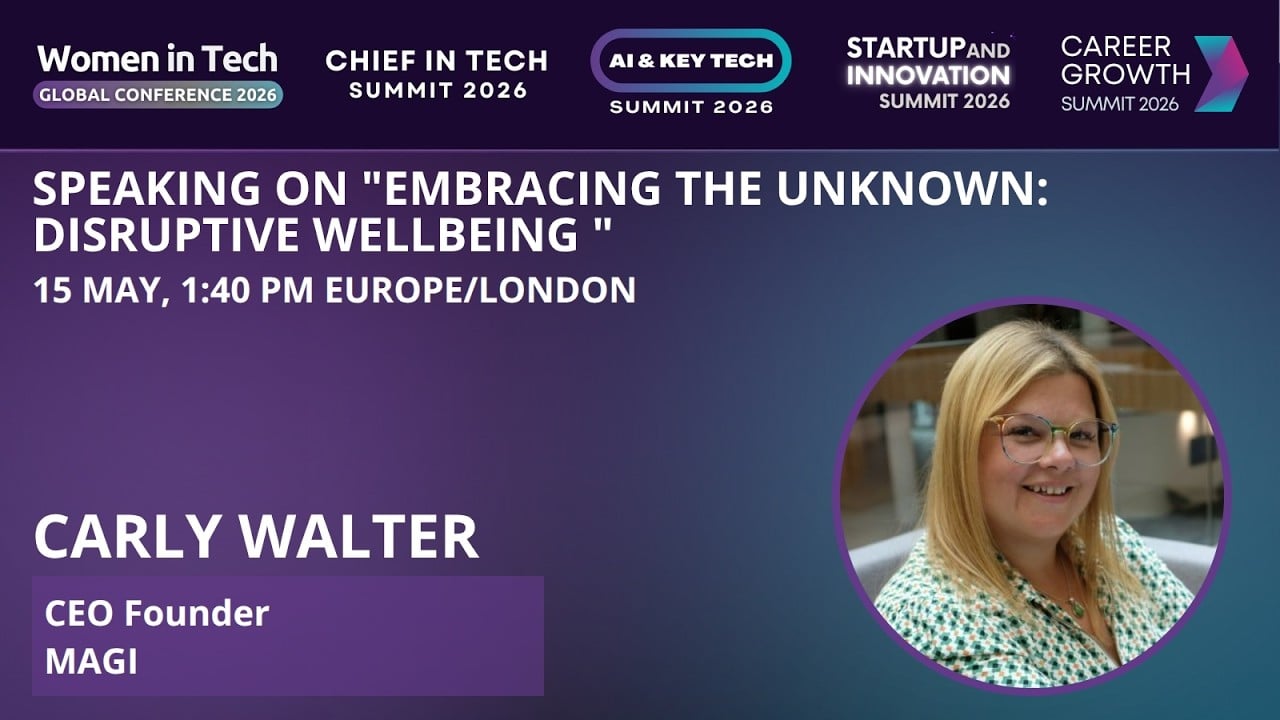
In short
Carly Walter argues that many neurodivergent women are not failing or broken, they are unsupported, and that hormones amplify neurodivergence in ways most systems ignore. Drawing on her own diagnosis in her early 40s, she explains why most wellbeing technology fails women whose capacity changes from day to day, and how that insight led her to found MAGI, a compassionate wellbeing companion app built around how women actually live.
Key takeaways
- How lived experience can fuel innovation and disruption
- Why women's wellbeing needs neuro-affirming, inclusive solutions
- How personal struggle can become a blueprint for change
- The power of embracing the unknown when building a business or brand
- What makes MAGI different from traditional wellbeing tools
Decades of being misunderstood
Walter opens with the belief she grew up with: that life had a plan, and that if you studied, worked hard and followed the rules, things would eventually click into place. Undiagnosed ADHD meant some of those rules got broken, and for years she was misunderstood and misdiagnosed. She was told it was all in her head, that she was too emotional, too sensitive, too much, or simply anxious or depressed.
What made it confusing was that she could achieve, perform and build things, yet could not sustain life in the way others around her seemed to. That gap, she explains, leads to self-blame, masking and a long stretch of survival mode.
"And when you spend decades feeling different but not understanding why, you start to blame yourself." (6:07)
It was not until her early 40s that she discovered she was neurodivergent and had premenstrual dysphoric disorder (PMDD). The emotional intensity, the overwhelm, the burnout cycles, the impulsivity and the rejection sensitivity suddenly had an explanation.
"And honestly, that discovery was both devastating and freeing all at the same time because suddenly, my life made sense." (6:27)
Capability on the outside, battles on the inside
Walter is candid that before her diagnosis she lived through burnout, breakdowns, addictions and broken relationships, while also building businesses, studying and helping people. She describes this contradiction as something many neurodivergent women share.
"From the outside in, people see capability, but internally, you're fighting battles that no one else can see, especially when hormones enter the picture." (7:01)
She points to hormones as the missing piece of the conversation. Puberty, monthly periods, pregnancy, fertility, perimenopause, menopause and the years beyond can each change how women experience ADHD, autism, emotional regulation, sensory overwhelm and mental health. Yet many women are still dismissed or misdiagnosed, and she warns that the consequences show up in careers, relationships, confidence, health and even life expectancy.
"And one of the things that nobody really talks about enough is how hormones amplify neurodivergence." (7:21)
From personal realisation to purpose
Rather than breaking her, the realisation became her why. Once she understood her own story, Walter began to see it everywhere: in clients of her therapy business, in friends, in women online and in professional women quietly falling apart behind the scenes while showing up every day as if they were fine. As the speaker cited, more than 800 million women globally are navigating hormones, overwhelm and neurodivergence without the right support, the right systems or even the right language.
"Women who had spent decades believing that they were lazy, dramatic, difficult, or failing, when actually, they were just unsupported." (8:26)
Why most wellbeing tech misses the mark
Walter's critique of the wellbeing market is direct. Most tools rest on an assumption that does not hold for many women: that people function the same way every day. Some days are proactive, social and full of ideas; others are overwhelmed, dysregulated and exhausted, when even replying to a text message is hard. Apps that expect perfect routines, consistency and self-discipline do not reflect that reality.
"And the truth is, most technology still assumes humans function consistently every single day. And we don't, especially women, and especially neurodivergent women." (8:51)
That gap pushed her to do something she never imagined: become a health tech founder. MAGI is what she calls disruptive wellbeing, a non-judgemental companion designed to meet women where they are rather than where the world expects them to be. It uses AI in compassionate, human ways rather than cold or clinical ones, helping women recognise patterns, regulate emotions, reduce overwhelm and feel seen in real time. The design principle is to understand changing capacity and emotional load, and to accept that wellbeing is not linear, instead of forcing perfection or shaming inconsistency.
"Because technology shouldn't make people feel more disconnected from themselves. It should help people feel understood." (9:40)
Fix the systems, not the women
The closing argument widens from one app to how systems should change. Walter notes that neurodivergent women often spend their lives translating themselves into systems that do not speak their language, sometimes without having the words themselves.
"Women and girls do not need fixing. The systems need to evolve, and we need to help them evolve." (10:25)
She argues that technology reflecting how women experience emotions, hormones and neurodivergence could change outcomes for future generations, noting, as the speaker cited, that undiagnosed neurodivergent girls hear around 20,000 more criticisms than their peers while growing up. The bigger purpose behind MAGI is to help close the life expectancy gap for neurodivergent and hormonally challenged women and girls. She admits she does not have all the answers, but has learned that embracing the unknown is where disruption begins. She ends by telling the audience that their struggles are not their weakness:
"They become your blueprint for change. When you stop waiting for permission and start building from your truth, amazing things can happen." (11:49)
Watch the talk
"Embracing the Unknown: Disruptive Wellbeing" by Carly Walter (12 minutes): https://www.womentech.net/video/embracing-unknown-disruptive-wellbeing
About the speaker
Carly Walter is CEO Founder of MAGI and an award-winning digital wellbeing innovator and therapist, whose company builds a disruptive app supporting neurodivergent and hormonally challenged women. She turns lived experience into purpose, creating inclusive solutions that close the wellbeing gap.
Questions this talk answers
- How do hormones affect neurodivergent women?
- Why do most wellbeing apps fall short for neurodivergent women?
- What makes MAGI different from traditional wellbeing tools?
- How can personal struggle become a source of innovation?
- What is the bigger purpose behind MAGI?
Drafted with AI from the talk transcript. Editor review pending.


