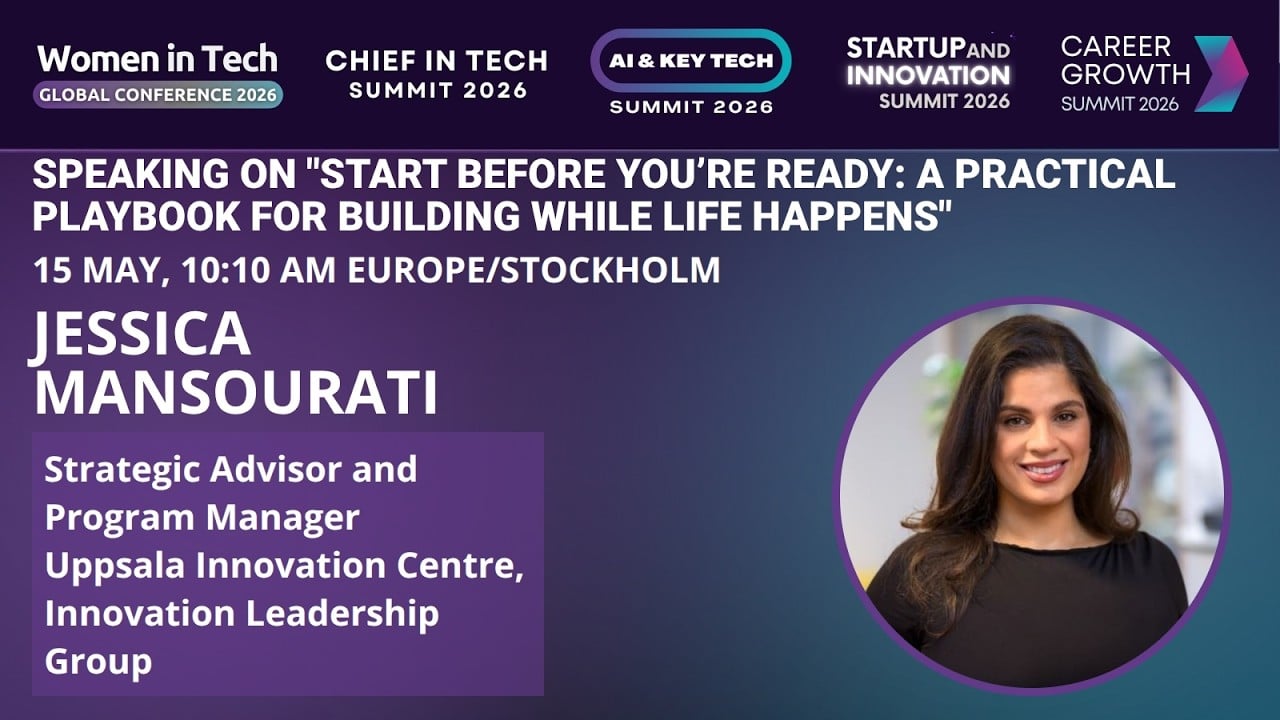
Start before You’re Ready: A Practical Playbook for Building while Life Happens
Jessica Mansourati18:462026
She went all in on her startup and spent three years building the wrong thing
Going all in meant no salary for years, moving back in with her parents, and polishing pitch decks instead of talking to customers. Jessica Mansourati, a former founder of two audio startups who now advises early-stage founders at Uppsala Innovation Centre, argues there is a slower, steadier path that fits around a job and real responsibilities. So what does starting actually look like when you only have a few hours a week?
Get a five-step playbook for testing an idea with real customers before you quit your job
Jessica Mansourati, a startup advisor and former two-time founder, argues that you do not need to quit your job or plan every step to start building something. She offers a five-step playbook: start small, do things that don't scale, find true early adopters, test with an MVP, and avoid the most common startup killer by talking to customers before building.
“The people who start are not the ones who had more time, but rather the ones who decided that this is something that they're going to make time for.”
“So, in practice, what that means is, instead of building a system, be the system yourself.”
What you will learn
Break your first step down into an action that takes less than 30 minutes, such as contacting one person who might have the problem.
Distinguish true early adopters, who feel the problem intensely and already hack their own fixes, from supportive friends and family.
Test assumptions before building with fake ads, a simple landing page or a newsletter.
Use manual, unscalable work with your first users to learn whether the problem and solution are real.
Run customer conversations with open questions and attention to body language instead of pitching your idea.
Key takeaways from the speaker
starting small
venturing into tech
entrepreneurship
side-hustles
confidence
Details
Level
Beginner
Format
Talk
Technical depth
Non-technical
For
Founder, Career changer
Length
18:46
Published
August 2026
Questions this talk answers
Do I need to quit my job to start building a startup?
No. Building slower but steadily alongside real life lets you make mistakes while you are not dependent on the startup, and avoid chasing funding until you have validation and traction.
What should my very first step be?
Something tiny, such as reaching out to one person who might have the problem you want to solve. If the step takes hours, break it down into an action of under 30 minutes.
Who are early adopters, really?
Not your family and friends, who may not have the problem and will be nice to you. Early adopters feel the problem deeply and have probably already tried to hack a solution themselves.
How can I test an idea before I have a product?
Create fake ads to see who clicks, set up a simple landing page with a sign-up, or write a newsletter about the problem. Expect it to be imperfect and iterate on real feedback.
Why do most startups fail early?
The main reason is lack of product-market fit, because first-time founders want to build immediately and get attached to a solution before they understand the problem.
About this talk
Many of us hold back from venturing into tech and starting our own thing because life isn’t set up for a clean leap - a full-time job, responsibilities, or financial reality make the "all in" mentality unrealistic. The 996-style is not optimal - or relevant - for everyone, even though a quick scroll on your Linkedin-feed oftentimes signals otherwise.
In this talk, Jessica Mansourati shares practical recommendations and potential ways to begin anyway. Inspired by the “build things that don’t scale” mindset, she’ll show how to start small on purpose: choose a narrow wedge, test your idea manually, collect real proof, and plan for the next step, not for the coming ten years. The goal isn’t to quit your job tomorrow but to build momentum, confidence, and audacity while you’re still balancing real life. Attendees will leave with a simple framework and concrete first experiments they can run in just a few hours a week.
Because I'm going to share the framework that I wish that somebody had given me before I spent three years of my life building the wrong thing. We're going to be here for a little less than 20 minutes, and you're going to leave with an overall framework for starting small and testing your idea without necessarily quitting your job. You'll learn how to find the people who actually need what you're building, and not just the people who are going to be nice about it and tell you what you want to hear. And then finally, the one mistake that kills most early startups and how to avoid it from day one. So let's jump in.
How many of you have said at some point that, "I'll start with when things calm down a bit, when I have more time, when I have more money, when I have more clarity, or when I'm ready?" As you probably know, the issue is that things rarely get less hectic. The people who start are not the ones who had more time, but rather the ones who decided that this is something that they're going to make time for. But I also think that there's another reason that people don't start, and this one is more psychological than that. If you believe that starting means that you have to figure out the first 100 steps and then execute on them, you have to set up a full business strategy, a business model, the whole tech stack, you have to figure out the go-to-market
strategy, the funding, etc. Then of course you're not going to start. Of course you don't have time. Because that's an overwhelming amount of work to do before you even know if the idea is worth pursuing. So, what if I told you that you don't need to think about that for now. You can only focus on the very first step.
So that step could be as simple as reaching out to one person that you think might have the problem that you want to solve. You can even make it a promise to yourself that you're not allowed to do more than that this week or this month. Because you're not building a company yet. You are just taking one small action to move from thinking about something to actually doing it.
And I think this is a good time for a disclaimer because this is meant for general inspiration. I'm very aware that certain life events or situations are life altering and that starting anyway does not apply to everyone. So, take what you need and leave the rest. Before we continue, my name is Jessica Masurati. I'm a startup advisor at one of the top Nordic startup incubators.
And I've been on very different sides of this. So, I've been here as a founder of two audio startups. We've secured investment. As a manager, manager at a scale up, going through a very speedy growth phase. As an expansion consultant, helping startups enter the US market. And as part of the early growth of startups like Spotify, for example.
At least that's the story on the record. But off the record, when we started our first company, we went all in. So, I had no salary for a few years. I eventually had to move back with my parents, which of course is a privilege to be able to do. But it really wasn't how I had envisioned my life.
When you need money for your startup to survive, you tend to focus on the wrong things. So, in our case, we had to focus on securing funds so we could continue. We spent way too much time perfecting the pitch deck, talking to investors, trying to convince them to invest in us. Rather than building actual traction, talking to our customers.
Really making sure that we were solving the right problem. The box to the left or the path to the left is the one that we often hear about on LinkedIn or in social media. Different versions of the entrepreneur who quit everything and built like crazy and rocket speed. And I'm not here to criticize this way of working.
We have seen that it works. I'm just here to let you know that it is not the only way. What if you started building slower but more steady? What if you did something really small each week that eventually accumulated in a year? Because making your mistakes early on while you're not dependent on the success of your startup is key here.
When you build alongside real life, then you have the chance of avoiding chasing funding until you have enough validation and traction. At which point, maybe you don't even need funding. And if you do, then you'll have some negotiating power. But how do you do it? That's the question we're going to talk about today. So the first step of the playbook, as I mentioned, is start small.
Start small. Start only with the next step. As an example, Sarah Blakely, who founded Spanx, the shapewear company, she started with one product, one problem, and one customer type. She cut the feed off of her own pantyhose. Then she drove to the department store herself. She stood next to the display and she demonstrated it to strangers. She didn't work there.
She was not allowed to do this, but she did. She didn't have investors. She didn't have a massive network. She just had a very specific problem that she understood from the inside. And this was to get to know her first customers. And she did. And Spanx was acquired for $1.2 billion in 2021. So I want you to ask yourself the question, what problem do you understand better than anyone else?
Is it how annoying it is to pay for a MetroCard when you only use it a fraction of the time? Is it finding outdoor clothes for women that are actually practical and good looking? Is it finding other researchers in a very niched field that are working on similar issues? These are actual cases that I've helped. These are startups that are actually going really, really well.
And no problem here is too small. And trust me, I've seen some very, very niched ideas succeed. So again, what is the smallest step that you can take this week? If you think about something in your head now, try to make it even smaller. If the first step that you think about takes a few hours or even a day, then break it down to an action that takes less than 30 minutes.
Could it be that you can call a friend who can help you frame the problem better? Could it be asking a question in an online community, for example, on Facebook or Discord? To connect with people that you assume have this problem. Because remember that you're still working with assumption. You're not sure yet. I know people who have used Tinder as their first platform to do some research.
And I'm not recommending it, but I'm just saying it worked for them. Step two, do things that don't scale. This quote does not come from me. This is taken from Paul Graham, who's a founding partner at Y Combinator, which is, according to some, the world's most successful startup accelerator. They backed Airbnb, Stripe, and Dropbox early on. And they have produced more billion dollar companies than any investor on the planet.
One of the most counterintuitive things that they teach every founder that they work with is to not try to scale yet. Do the thing that doesn't scale. So, in practice, what that means is, instead of building a system, be the system yourself. So, call your first users personally. Deliver the product manually yourself. Set people up yourself. Do whatever it takes to get people to genuinely love what you're building.
Because that's something that the huge players can't do. They don't have time to focus that much on the customer. But you do, and you really should. So, even if the way that you're doing it now would completely fall apart when you have 1,000 customers, that's not a problem for now. You just need to validate what you're building.
And this is key because these interactions with customers face-to-face is going to be where you learn everything. So, you're going to learn whether the problem is real, whether your solution actually works, and what people need that you maybe haven't even thought of yet. Because they will tell you. You can't really learn that from a survey or a dashboard.
You learn that by doing the work yourself first. For example, Stripe set up users on their laptop right away when they talked to them. Airbnb went door-to-door to apartments in NYC and took pictures of the ads themselves, or for the ads, to make sure that they went up. And Wufoo set up or sent every new user a handwritten thank you note.
Step three is to find your early adopters. Who are your first customers going to be? And this is a term that I think... I mean, some of you might have heard the term early adopters. Some of you might have heard it and then misunderstand what it really is because that's very common. And maybe you haven't heard it at all.
But your early adopters, unlike what many people believe, they are not the low-hanging fruit. So they're not like your family, your friends, etc. And assuming this is dangerous because you'll end up talking to people who, one, maybe don't even experience this problem. And then two, people who are going to be nice to you because they want to be supportive.
Like they think they're being supportive. But that is not what you need early on. You need people who feel this problem deeply, intensely. People who deal with the pains and the consequences of having this problem. So these are people, your early adopters are people who probably have tried to hack the solutions themselves somehow. They've tried to do something.
For example, for me, I was a super early adopter for Pinterest when I was younger. I was on a wait list before they even launched because I used folders in folders in folders on my computer to create different vision boards, different like inspiration, visual inspiration for myself. And I had the problem that they were solving early on.
They wanted to bring everyone the inspiration to create a life that they love. So your early adopters are not going to require too much convincing. Maybe no convincing at all. Maybe they'll even be able to finish your sentence once you start talking about this problem. For example, Emily Weiss, who was the founder of Glossier, the blog, she had a blog that was called Into the Gloss.
Years before launching a single product and years before, you know, starting this company. And her early adopters were already in her comment section. They were telling her what they needed, what they wanted and what they wanted her to launch first. And at their peak Glossier was valued at $1.8 billion five years ago. The fourth step or the fourth step out of five in this playbook is to start prototyping, start MVP, start testing.
And these boxes are all really different examples of how to prototype and build an MVP to test your assumptions. Again, for those of you who aren't really familiar with this term, MVP stands for Minimum Viable Product. And it is the smallest possible version of your idea that you can put in front of a real person to find out if you're solving a real problem.
So maybe an assumption that you have is that the early adopter for your product is a woman who is over 30, who works out regularly, who commutes to work super early. But how can you test this if you don't have a product yet? You haven't built the you haven't built or launched the thing. Maybe you can create fake ads online and see who clicks them just to confirm that these are actually your target group.
And maybe you can set up a landing page, super simple landing page with like a sign up to learn more or get in line or something like that to stay notified. Or you can do a newsletter where you write about this type of problem or what's going on in this field. These are just a few examples, but this is you get the gist like you want to see who your demographic is.
And these are all examples that have been used over and over again before people even start building something. It's easier than ever today to get started with like a landing page, creating visuals, digital prototypes, mockups, etc. So don't wait and like don't try to or expect that it's going to be perfect before you launch. Expect it to be imperfect.
That is the entire point. So you want to get something out there that you can iterate on and then sharpen based on real life feedback. What you don't want to do is build something in silence and secrecy. Then you want to perfect it and you want to really make sure that it's super perfect and glossy only to realize when you launch years later that I wasn't building exactly what the market wanted.
Because then you've just spent all this time, energy, money on building the wrong thing. And last but not least, some of you might have heard this classic statistic, which is that 9 out of 10 startups fail. But why? Why do most startups fail? What does it mean? The main reason for failing early is that you don't have product market fit.
And that means that you're not having enough customers. And that in turn means that you're not building what the market wants. How does that happen? Why do people make that mistake? That sounds stupid. Because most first time founders don't obsess over solving the right problem. They want to build immediately. And I understand that. That's the fun part.
You want to build. You want to create. That's what you're proud of. But when you start building, you get too attached to the solution. And if you do that before you really understand the problem, that can be dangerous. But you, you who are listening now, is not going to do that. Because now you know better. So, like we've stated, the most important thing is that you start talking to customers now.
Even if you only have a hunch, an idea, an assumption, and nothing else. Make sure that you understand the customers. Ask what their biggest problem is in this area. You know, ask open questions. Lead with curiosity and allow them to speak. Don't get excited and try to tell them what you want to build. Just understand what their issue is.
And notice their body language. Are they getting really excited or worked up when they talk about a specific thing? Or are they saying one thing in words, but then another thing with their body, etc. So, I'm not saying it is easy, but it is pretty simple. There are going to be weeks, months, where you will feel like there's no progress at all.
But I just really want you to remember that learning about your customers is never going to be a waste of time. Because even if what you're building changes, there's a high likelihood that you're going to be trying to solve a similar problem later on anyway. And usually, when you get started, you'll notice that the next steps will appear naturally.
So, you don't need to figure out the first 100 steps or 50 steps or even the next 10 steps. Just think about what you want to do next. Because in this stage, making mistakes is what you need to do. They're super cheap to make. They don't cost you anything because you haven't invested anything yet. So, if you're showing up consistently, if you're staying close to the problem and the people who have it, and if you're making your mistakes when they are cheap to make, then you've already started.
The world needs people with actual domain experience or domain expertise with lived experience and real problems that they understand from the inside. And people who are willing to say that, oh, you know, I think there's something here. And you know what? I'm going to explore it further. I don't have all the answers, but I will get them.
So, again, if you're curious, if you're honest about what you don't know, and if you're willing to start before you've figured everything out, then you're already on your way. That's what starting actually looks like. So, thank you so much for listening. And feel free to connect with me on LinkedIn if you have any questions or if you want to get in touch.
Thank you.
Transcribed automatically; names checked against the speaker record. Select a time to jump there.
Article based on this talk
Can you start a company without quitting your job?
Former founder Jessica Mansourati shares a five-step playbook for testing an idea in small, cheap steps while life carries on.
In short
Yes, according to Jessica Mansourati, and it may even be the smarter path. Drawing on her own experience of going all in on a startup, she argues that building slowly alongside a job lets founders learn from customers, make cheap mistakes and avoid chasing funding too early. Her five-step playbook starts with one small action and ends with a warning about the mistake that kills most early startups.
Key takeaways
Starting small
Venturing into tech
Entrepreneurship
Side hustles
Confidence
Why waiting until you are ready backfires
Mansourati opens with a familiar promise people make to themselves: they will start when things calm down, when they have more time, money or clarity. Things rarely get less hectic, she notes. "The people who start are not the ones who had more time, but rather the ones who decided that this is something that they're going to make time for." (0:54)
She also names a psychological barrier. If starting means designing a business model, tech stack, go-to-market strategy and funding plan before knowing whether the idea is worth pursuing, nobody will have time. Her alternative is to focus only on the very first step, such as reaching out to one person who might have the problem, and even to promise yourself not to do more than that this week.
The hidden cost of going all in
Mansourati speaks from several sides of the startup world: founder of two audio startups that secured investment, manager at a fast-growing scale-up, consultant helping startups enter the US market, and part of the early growth of companies such as Spotify. Off the record, she says, going all in meant years without a salary and moving back in with her parents.
The bigger lesson was where that pressure pushed the team. "When you need money for your startup to survive, you tend to focus on the wrong things." (3:54) They spent too long perfecting the pitch deck and convincing investors instead of building traction with customers. She does not dismiss the quit-everything route seen on LinkedIn, but argues it is not the only way. "Because making your mistakes early on while you're not dependent on the success of your startup is key here." (4:46)
Start small, then do things that don't scale
Step one is to start small. Mansourati points to Sara Blakely, who began Spanx with one product, one problem and one customer type, demonstrating it to strangers in a department store herself. She asks viewers what problem they understand better than anyone else, and stresses that no problem is too small. If a first step takes hours, break it down into something under 30 minutes, such as calling a friend or asking a question in an online community.
Step two borrows Paul Graham's advice from Y Combinator. "So, in practice, what that means is, instead of building a system, be the system yourself." (8:26) That means calling first users personally and delivering the product manually, even if it would fall apart at 1,000 customers. As examples, she cites Stripe setting users up on the spot, Airbnb photographing apartments in New York, and Wufoo sending handwritten thank you notes. Face-to-face interactions, she argues, teach what no survey or dashboard can.
Find real early adopters and test cheaply
Step three tackles a common misunderstanding. "But your early adopters, unlike what many people believe, they are not the low-hanging fruit." (10:35) Friends and family may not have the problem and will try to be supportive. True early adopters feel the problem intensely and have usually tried to hack a solution themselves, as Mansourati did with nested folders of inspiration before joining the Pinterest wait list. Emily Weiss, she notes, found Glossier's early adopters in the comment section of her blog, Into the Gloss.
Step four is prototyping with a minimum viable product, the smallest version of an idea you can put in front of a real person. Fake ads, a simple landing page with a sign-up or a newsletter can test who your audience really is before anything is built. Imperfection is the point. "What you don't want to do is build something in silence and secrecy." (14:24)
The mistake that kills most startups
The final step addresses the classic statistic, as the speaker cited, that 9 out of 10 startups fail. The main early cause, she says, is lack of product-market fit. "Because most first time founders don't obsess over solving the right problem. They want to build immediately." (15:18)
Her remedy is to start talking to customers now, even with only a hunch. Ask open questions, lead with curiosity, resist pitching, and watch body language for where people get excited or worked up. Progress may feel invisible for weeks, but "But I just really want you to remember that learning about your customers is never going to be a waste of time." (17:05) Mistakes at this stage are cheap, and the next steps tend to appear once you begin.
Watch the talk
Start before You're Ready: A Practical Playbook for Building while Life Happens, Jessica Mansourati, about 19 minutes: https://www.womentech.net/video/start-youre-ready-practical-playbook-building-while-life-happens
About the speaker
Jessica Mansourati is Strategic Advisor and Program Manager at Uppsala Innovation Centre, Innovation Leadership Group, where she supports early-stage founders with validation, go-to-market, partnerships and building programs. A former startup founder from Antler Sweden's first cohort and SSE Business Lab, she has worked in strategy and communications at Spotify and Nextory and at Business Sweden USA, and is passionate about making entrepreneurship and tech more accessible for women building alongside real-life constraints.
Questions this talk answers
Do I need to quit my job to start building a startup?
What should my very first step be?
Who are early adopters, really?
How can I test an idea before I have a product?
Why do most startups fail early?
Drafted with AI from the talk transcript. Editor review pending.
Frameworks and ideas mentioned
Do things that don't scale
Minimum Viable Product (MVP)
Product-market fit
Early adopters
Five-step start-small playbook
Resources mentioned
Paul Graham's "Do things that don't scale"
Cite this talk
Jessica Mansourati. "Start before You’re Ready: A Practical Playbook for Building while Life Happens." WomenTech Network, 2026. https://www.womentech.net/en-fr/video/start-youre-ready-practical-playbook-building-while-life-happens