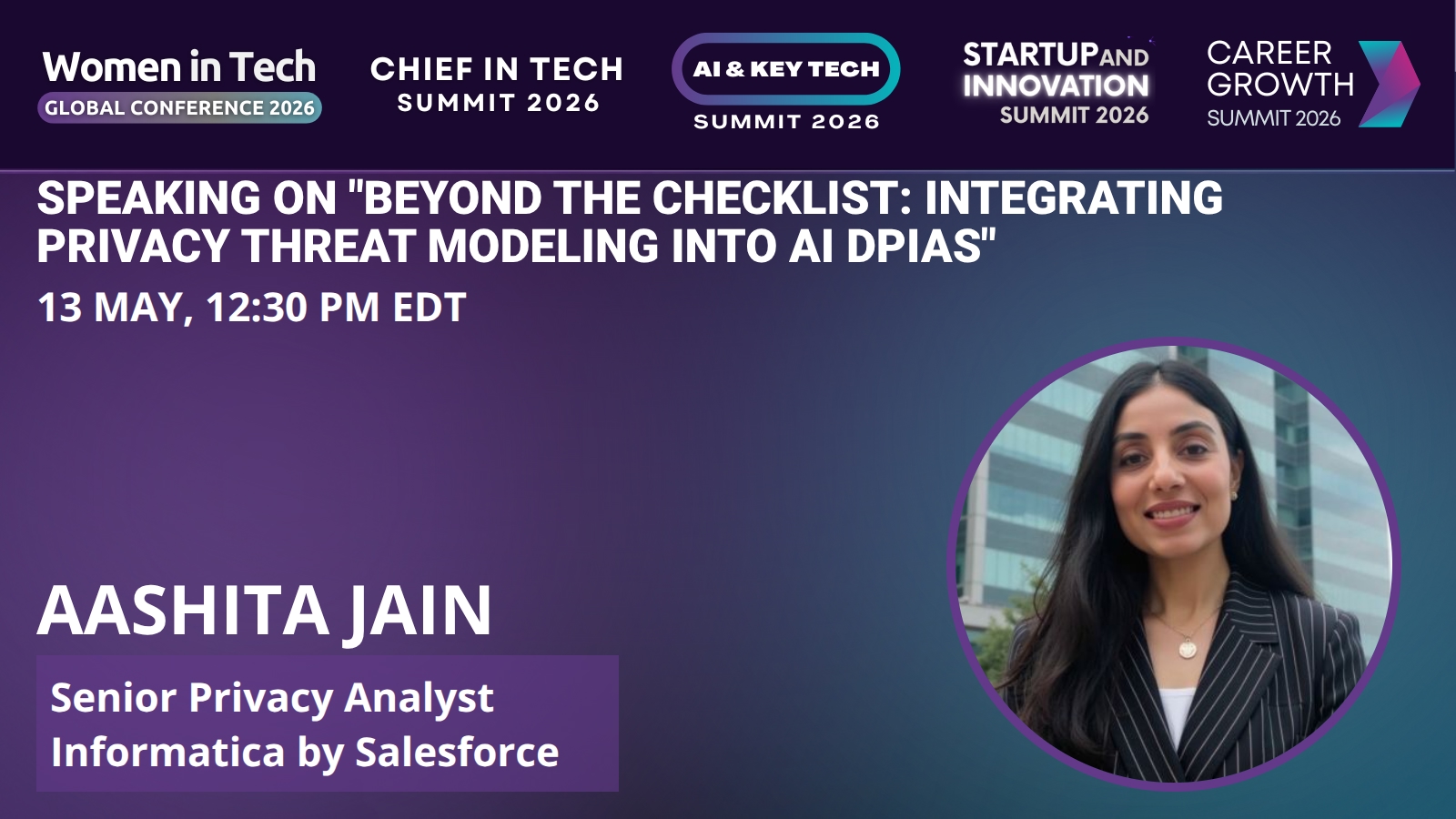
Aashita
Jain
Senior Privacy Analyst at Informatica by Salesforce

"Beyond the Checklist: Integrating Privacy Threat Modeling into AI DPIAs"
"Beyond the Checklist: Integrating Privacy Threat Modeling into AI DPIAs"
Wed May 13 - 12:30 PM EDT/New York (See in local time)
Add to Calendar
05/13/2026 12:30 PM
05/13/2026 12:50 PM
America/New_York
#WTGC2026
"Beyond the Checklist: Integrating Privacy Threat Modeling into AI DPIAs"
#WTGC2026
"Beyond the Checklist: Integrating Privacy Threat Modeling into AI DPIAs"
https://www.womentech.net/ringcentral
https://www.womentech.net/ringcentral
"Beyond the Checklist: Integrating Privacy Threat Modeling into AI DPIAs"
"Beyond the Checklist: Integrating Privacy Threat Modeling into AI DPIAs"
Don’t miss out and join visionaries, innovators, and thought leaders from all over the world at the Women in Tech Global Conference.
Vote by Sharing
Unite 100 000 Women in Tech to Drive Change with Purpose and Impact.
Do you want to see this session? Help increase the sharing count and the session visibility. Sessions with +10 votes will be available to career ticket holders.
Please note that it might take some time until your share & vote is reflected.
Session: Beyond the Checklist: Integrating Privacy Threat Modeling into AI DPIAs
As AI incidents surged 56.4% in 2024, organizations face a critical gap: translating abstract privacy risks into concrete mitigation strategies. High-level policies are no longer enough to satisfy the EU AI Act’s conformity assessments or the 1,000+ AI-related laws proposed globally in 2025 alone.This session bridges the theory-practice divide. We will explore how to integrate adversarial privacy threat modeling directly into Data Protection Impact Assessments (DPIAs) and AI risk classification frameworks—turning compliance obligations into competitive advantage. Drawing on real-world 2025 threat landscapes—including model inversion and data persistence risks—this session equips leaders with the actionable methodologies needed to identify, assess, and mitigate privacy risks in high-risk AI systems before deployment.
Why This Topic Matters Now
The regulatory momentum is undeniable, yet a massive competency gap remains:
The Regulatory Surge: Legislative mentions of AI have increased by 21.3% across 75 countries, with the EU AI Act now in its full implementation phase.
The Governance Gap: Despite the risks, organizations report that less than two-thirds are actively mitigating known AI risks.
The Acceleration of Incidents: Teams are struggling to defend against AI-specific threats like synthetic identity creation, unauthorized access in training pipelines, and proprietary information leakage through model queries.
The Competency Gap: Many privacy and security teams lack frameworks for AI-specific threat modeling, leaving DPIAs incomplete or disconnected from AI governance processes.
Key Takeaways
- Identify AI-Specific Threats: Recognize privacy risks unique to AI systems (model inversion, training data leakage, profiling, and discrimination) vs. traditional data handling risks.
- Translate Risk to Control: Learn a practical methodology for translating abstract risk ratings into specific, technical control selections.
- Bridge the Silos: Use "Privacy Threat Modeling" as a common language to align engineering, legal, and compliance teams who are currently speaking different risk languages
- Operationalize the EU AI Act: Understand how to move beyond "policy on paper" to execute practical playbooks for AI use case registers and vendor transparency.
Bio
Aashita Jain is a leading global expert at the nexus of artificial intelligence, privacy, and ethical governance. Widely cited for her strategic frameworks, she champions privacy-by-design, PETs, and inclusive AI worldwide. As a Senior Privacy Analyst at Informatica and an internationally trained lawyer, Aashita brings a unique blend of legal expertise, technical insight, and policy acumen. She empowers organizations to embed trust, transparency, and compliance, shaping responsible innovation.