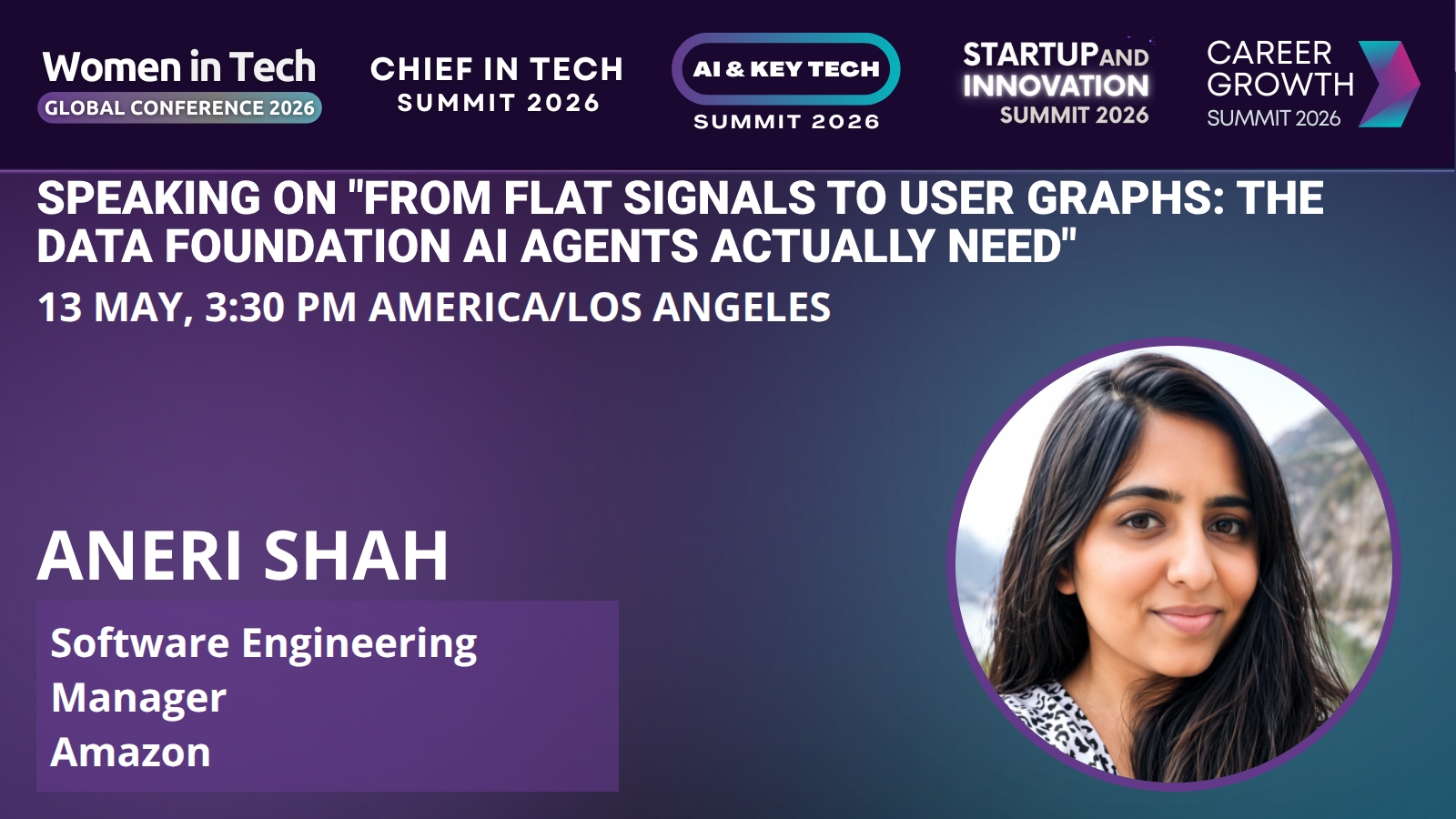
Aneri
Shah
Software Engineering Manager at Amazon

"From Flat Signals to User Graphs: The Data Foundation AI Agents Actually Need"
"From Flat Signals to User Graphs: The Data Foundation AI Agents Actually Need"
Wed May 13 - 6:30 PM EDT/New York (See in local time)
Add to Calendar
05/13/2026 6:30 PM
05/13/2026 06:50 PM
America/New_York
#WTGC2026
"From Flat Signals to User Graphs: The Data Foundation AI Agents Actually Need"
#WTGC2026
"From Flat Signals to User Graphs: The Data Foundation AI Agents Actually Need"
https://www.womentech.net/ringcentral
https://www.womentech.net/ringcentral
"From Flat Signals to User Graphs: The Data Foundation AI Agents Actually Need"
"From Flat Signals to User Graphs: The Data Foundation AI Agents Actually Need"
Don’t miss out and join visionaries, innovators, and thought leaders from all over the world at the Women in Tech Global Conference.
Vote by Sharing
Unite 100 000 Women in Tech to Drive Change with Purpose and Impact.
Do you want to see this session? Help increase the sharing count and the session visibility. Sessions with +10 votes will be available to career ticket holders.
Please note that it might take some time until your share & vote is reflected.
Session: From Flat Signals to User Graphs: The Data Foundation AI Agents Actually Need
AI agents promise intelligent, personalized experiences — but most are reading from flat, fragmented preference stores that tell them what a user did, not what it means. A user liked a post. A user followed a creator. These are data points. What an AI agent actually needs is context — the web of relationships between users, content, actions, and intent that makes autonomous decision-making meaningful.This talk bridges the gap between where production signal infrastructure is today and where it needs to go for AI agents to deliver on their promise. Drawing on peer-reviewed research published at the IEEE International Conference on Information Technology and Artificial Intelligence — which demonstrated that graph-derived user-content relationship features predict affinity with over ninety-six percent accuracy — and production experience building large-scale preference infrastructure, this session makes the case for user data graphs as the next evolution of personalization infrastructure for AI-driven systems.
We cover why flat preference stores constrain what AI agents can reason about, what a user data graph looks like architecturally, how graph-derived features outperform flat signal approaches for affinity prediction, and what a realistic adoption path looks like for teams wanting to move toward graph-based signal infrastructure.
Key Takeaways
- Why flat user preference stores are a ceiling for AI agent intelligence — and what graph-based signals unlock
- How graph-derived features improve affinity and intent prediction over flat signal approaches
- The architectural building blocks of a user data graph and how AI agents can traverse and reason over it
- A realistic adoption path for teams currently operating flat preference infrastructure who want to move toward graph-based personalization
Bio
Aneri Shah is a global engineering leader with over 10 years of experience at Amazon, where she has grown from Software Development Engineer to Engineering Manager. She has led large-scale, cross-organizational initiatives spanning mobile, web, backend infrastructure, and data platforms, building systems used by tens of millions of users worldwide.Her expertise lies in distributed systems architecture, large-scale data migrations, metadata systems, and platform reliability. Aneri focuses on designing scalable, resilient platforms and driving technical strategy across teams to support long-term product evolution. She is particularly interested in how modern architectures are evolving to incorporate event-driven design and AI-enabled capabilities.