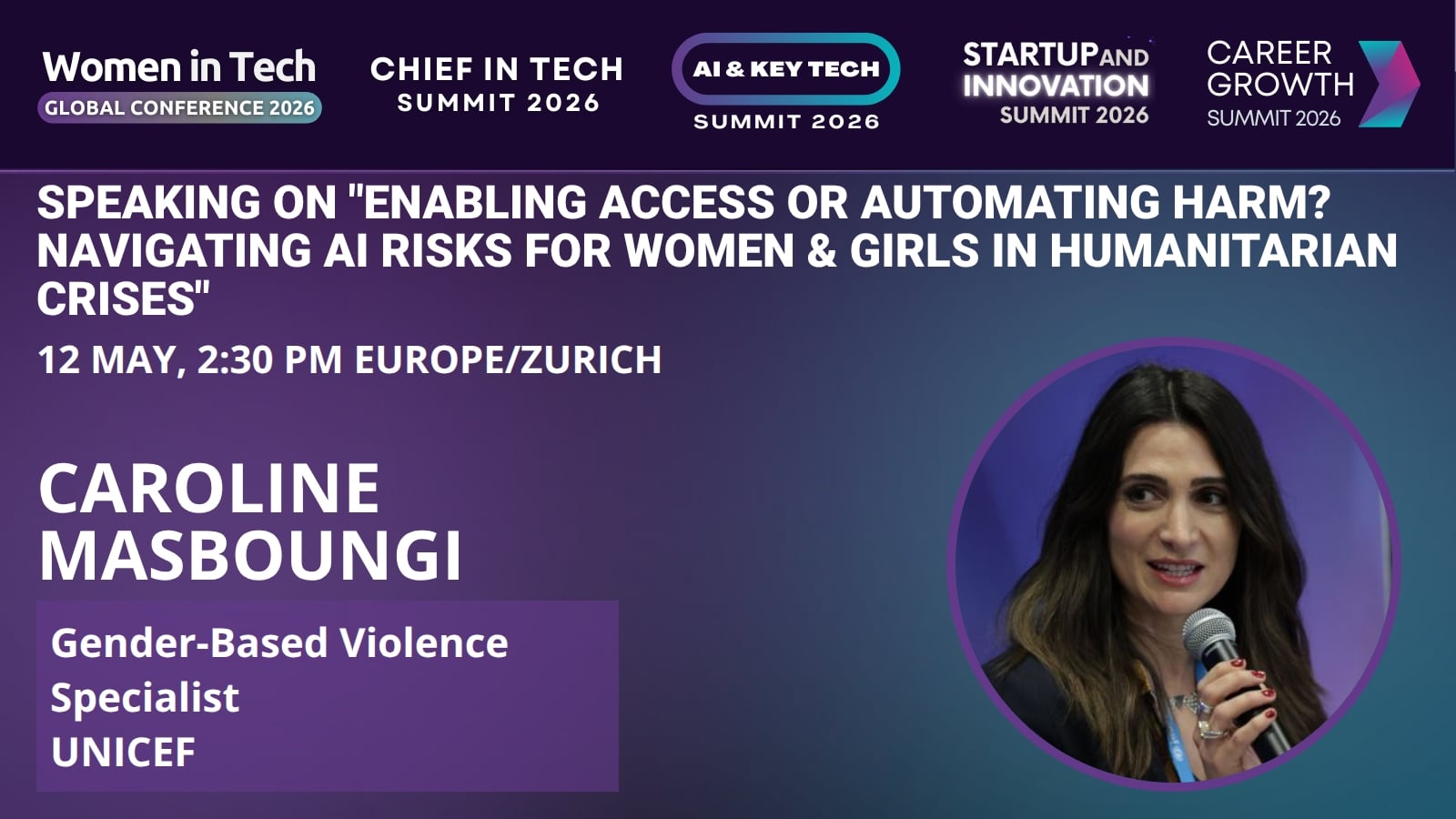
Caroline
Masboungi
Gender-Based Violence Specialist at UNICEF

"Enabling Access or Automating Harm? Navigating AI Risks for Women & Girls in Humanitarian Crises"
"Enabling Access or Automating Harm? Navigating AI Risks for Women & Girls in Humanitarian Crises"
Tue May 12 - 8:30 AM EDT/New York (See in local time)
Add to Calendar
05/12/2026 8:30 AM
05/12/2026 08:50 AM
America/New_York
#WTGC2026
"Enabling Access or Automating Harm? Navigating AI Risks for Women & Girls in Humanitarian Crises"
#WTGC2026
"Enabling Access or Automating Harm? Navigating AI Risks for Women & Girls in Humanitarian Crises"
https://www.womentech.net/ringcentral
https://www.womentech.net/ringcentral
"Enabling Access or Automating Harm? Navigating AI Risks for Women & Girls in Humanitarian Crises"
"Enabling Access or Automating Harm? Navigating AI Risks for Women & Girls in Humanitarian Crises"
Don’t miss out and join visionaries, innovators, and thought leaders from all over the world at the Women in Tech Global Conference.
Vote by Sharing
Unite 100 000 Women in Tech to Drive Change with Purpose and Impact.
Do you want to see this session? Help increase the sharing count and the session visibility. Sessions with +10 votes will be available to career ticket holders.
Please note that it might take some time until your share & vote is reflected.
Session: Enabling Access or Automating Harm? Navigating AI Risks for Women & Girls in Humanitarian Crises
As AI-powered chatbots and digital tools proliferate in humanitarian settings, the promise of "accessible mental health support anytime, anywhere" collides with the complex realities faced by women and girls in crisis—particularly survivors of gender-based violence (GBV).Drawing on field experience and recent research, this talk critically examines both the opportunities and hidden dangers of deploying AI solutions in humanitarian contexts. While chatbots could extend care to those who cannot safely access human services, they also raise urgent concerns: algorithmic errors in high-stakes crisis counseling, data privacy vulnerabilities for survivors in surveillance-heavy environments, the illusion of empathy from systems optimized for engagement rather than empowerment, and the persistent digital gender gap that leaves the most marginalized women and girls behind.This session goes beyond theoretical debate to share practical insights: What happens when a chatbot tells a GBV survivor "our servers are down"? How do we balance innovation with the humanitarian imperative to "do no harm"? And how can the tech community—particularly women in tech—help shape AI solutions that genuinely center the voices and safety of crisis-affected women and girls?Attendees will leave with a nuanced understanding of AI's dual role in humanitarian response and actionable frameworks for ethical tech development in high-stakes contexts.Key Takeaways
- AI chatbots in humanitarian contexts present a "hero use case" paradox: While they promise 24/7 access for those who cannot reach human services, the women and girls most in need often lack the digital access, literacy, and safety to benefit—and face uniq
- The gap between chatbot promises and terms of service reveals critical risks: Every major mental health chatbot disclaims liability for errors and states it is NOT designed for crisis counseling—yet GBV survivors routinely disclose violence to these tools
- Feminist AI principles and survivor-centered design are essential, not optional: Co-designing with crisis-affected women and girls, integrating trauma-informed approaches, and centering agency over engagement metrics are fundamental to developing AI that
- Data privacy and mandatory reporting create compounded dangers: In contexts with weak data protection and mandatory GBV reporting laws, chatbot use can inadvertently expose survivors to authorities, perpetrators, or data exploitation—undermining the confi
- Women in tech can drive change through informed advocacy: Understanding the real-world evidence on AI risks and opportunities positions tech professionals to ask better questions, design better safeguards, and advocate for responsible AI governance in hum
Bio
Caroline Masboungi, a French-Lebanese Gender-Based Violence (GBV) specialist based in Geneva, leads UNICEF's global GBViE technology and innovation workstream. With over 15 years of experience across Africa, Asia, and the Middle East, she focuses on leveraging technology to address GBV, bridge the gender digital divide, and tackle technology-facilitated GBV (TFGBV). A trained lawyer specialized in humanitarian law, Caroline has worked with organizations like IOM, IRC, and OHCHR, combining her humanitarian expertise with feminist research to ensure the voices of women and girls are central to digital and on-the-ground solutions. She spearheads initiatives like "Laaha," a virtual safe space empowering women and girls globally, blending innovation with advocacy to create safer environments.