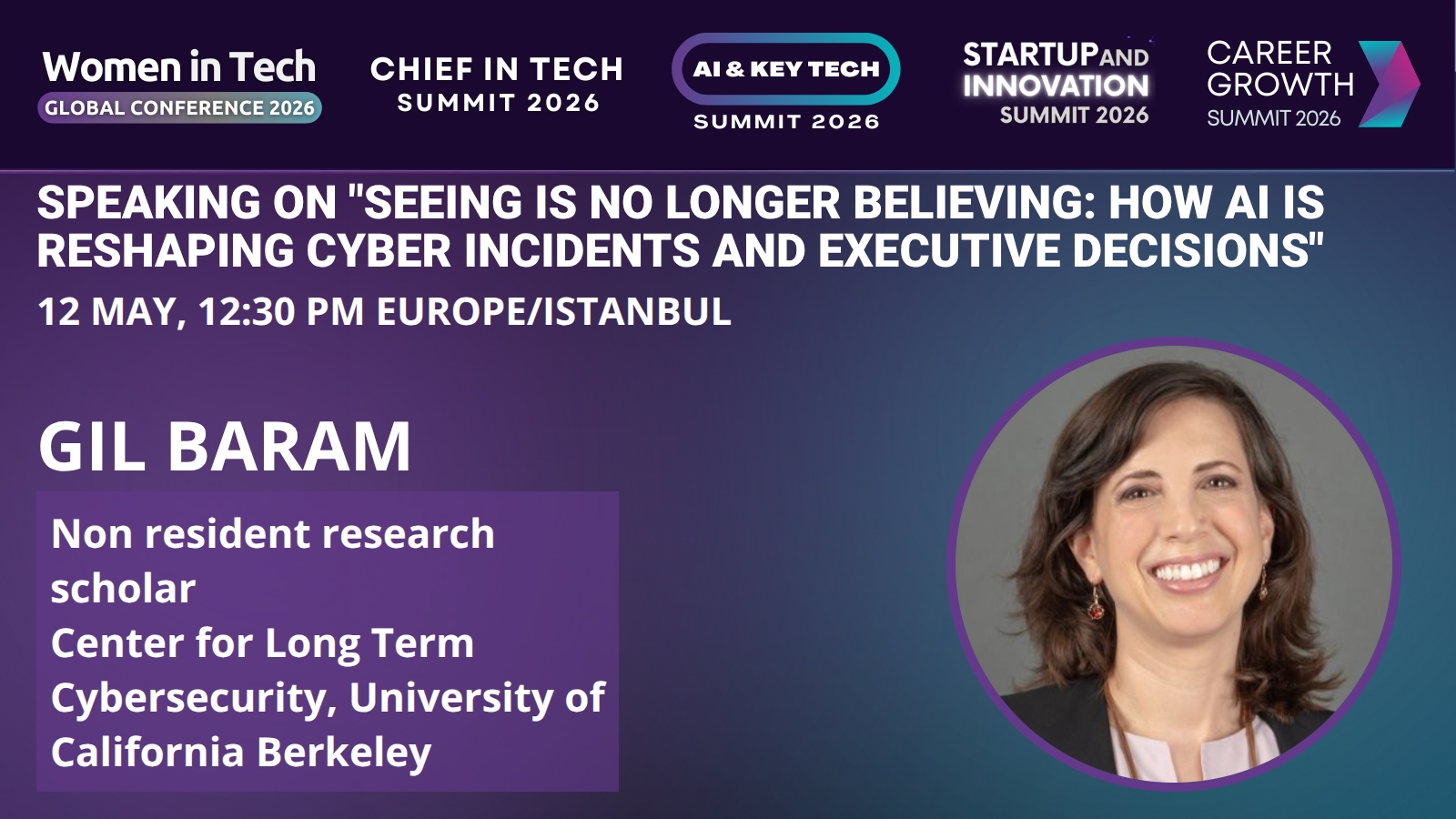

Gil
Baram
Non resident research scholar at Center for Long Term Cybersecurity, University of California Berkeley

"Seeing Is No Longer Believing: How AI Is Reshaping Cyber Incidents and Executive Decisions"
"Seeing Is No Longer Believing: How AI Is Reshaping Cyber Incidents and Executive Decisions"
Tue May 12 - 5:30 AM EDT/New York (See in local time)
Add to Calendar
05/12/2026 5:30 AM
05/12/2026 05:50 AM
America/New_York
#WTGC2026
"Seeing Is No Longer Believing: How AI Is Reshaping Cyber Incidents and Executive Decisions"
#WTGC2026
"Seeing Is No Longer Believing: How AI Is Reshaping Cyber Incidents and Executive Decisions"
https://www.womentech.net/ringcentral
https://www.womentech.net/ringcentral
"Seeing Is No Longer Believing: How AI Is Reshaping Cyber Incidents and Executive Decisions"
"Seeing Is No Longer Believing: How AI Is Reshaping Cyber Incidents and Executive Decisions"
Don’t miss out and join visionaries, innovators, and thought leaders from all over the world at the Women in Tech Global Conference.
Vote by Sharing
Unite 100 000 Women in Tech to Drive Change with Purpose and Impact.
Do you want to see this session? Help increase the sharing count and the session visibility. Sessions with +10 votes will be available to career ticket holders.
Please note that it might take some time until your share & vote is reflected.
Session: Seeing Is No Longer Believing: How AI Is Reshaping Cyber Incidents and Executive Decisions
Artificial intelligence (AI) is changing cybercrime in ways that go beyond new tools or tactics. By automating reconnaissance, generating convincing phishing and impersonation content, and enabling rapid coordination across criminal groups, AI is accelerating the speed, scale, and ambiguity of cyber incidents. For organizations, this means crises now unfold faster than traditional verification and approval processes can support, often forcing leaders to make irreversible decisions before the most critical facts are confirmed.This presentation draws on the AI-Enabled Cybercrime: Exploring Risks, Building Awareness, and Guiding Policy Responses initiative led by UC Berkeley’s Center for Long-Term Cybersecurity (CLTC) and the Berkeley Risk and Security Lab (BRSL). Through a series of international tabletop exercises involving government agencies, cybersecurity leaders, private-sector executives, and incident response professionals, the project examined how organizations respond when AI-enabled cyber incidents collide with supply-chain dependencies, public exposure, and synthetic media such as deepfake voice or video.
Across the exercises, a consistent pattern emerged: the most significant failures were not technical, but organizational. Participants struggled to verify executive communications, assess the credibility of vendor interactions, manage media narratives driven by manipulated content, and align legal, security, and communications teams under extreme time pressure. AI did not simply improve attackers' capabilities, but it compressed decision timelines and increased the cost of hesitation or misjudgment.
This session translates those findings into practical lessons for industry practitioners. It outlines how organizations can adapt incident response programs for AI-enabled threats by strengthening verification practices, clarifying decision authority, preparing executives for high-confidence deception, and redefining what “timely response” means when attackers operate at machine speed. Attendees will leave with concrete guidance on how to prepare leadership teams for a cyber threat landscape where seeing and hearing is no longer believing.
Key Takeaways
- cybercrime
- Artificial Intelligence
- Table Top Exercise
- Decision making
Bio
Dr. Gil Baram is a senior lecturer (US Associate Professor equivalent) at Bar-Ilan University and a non-resident research scholar at the Center for Long-Term Cybersecurity (CLTC), University of California, Berkeley. She is also a senior adjunct research fellow at the Centre of Excellence for National Security at Nanyang Technological University, Singapore.Her work focuses on how emerging technologies—particularly artificial intelligence—are reshaping cybercrime, cyber incidents, and executive decision-making during crises. Dr. Baram works closely with government agencies, cybersecurity practitioners, and private-sector leaders to translate research into practical guidance for incident response, risk management, and resilience planning.
She has led international scenario-based tabletop exercises examining AI-enabled cyber incidents, supply-chain compromise, and the operational impact of synthetic media. Prior to academia, Dr. Baram held roles in cyber intelligence at Israel’s National Information Security Authority and regularly advises organizations on emerging cyber risks.