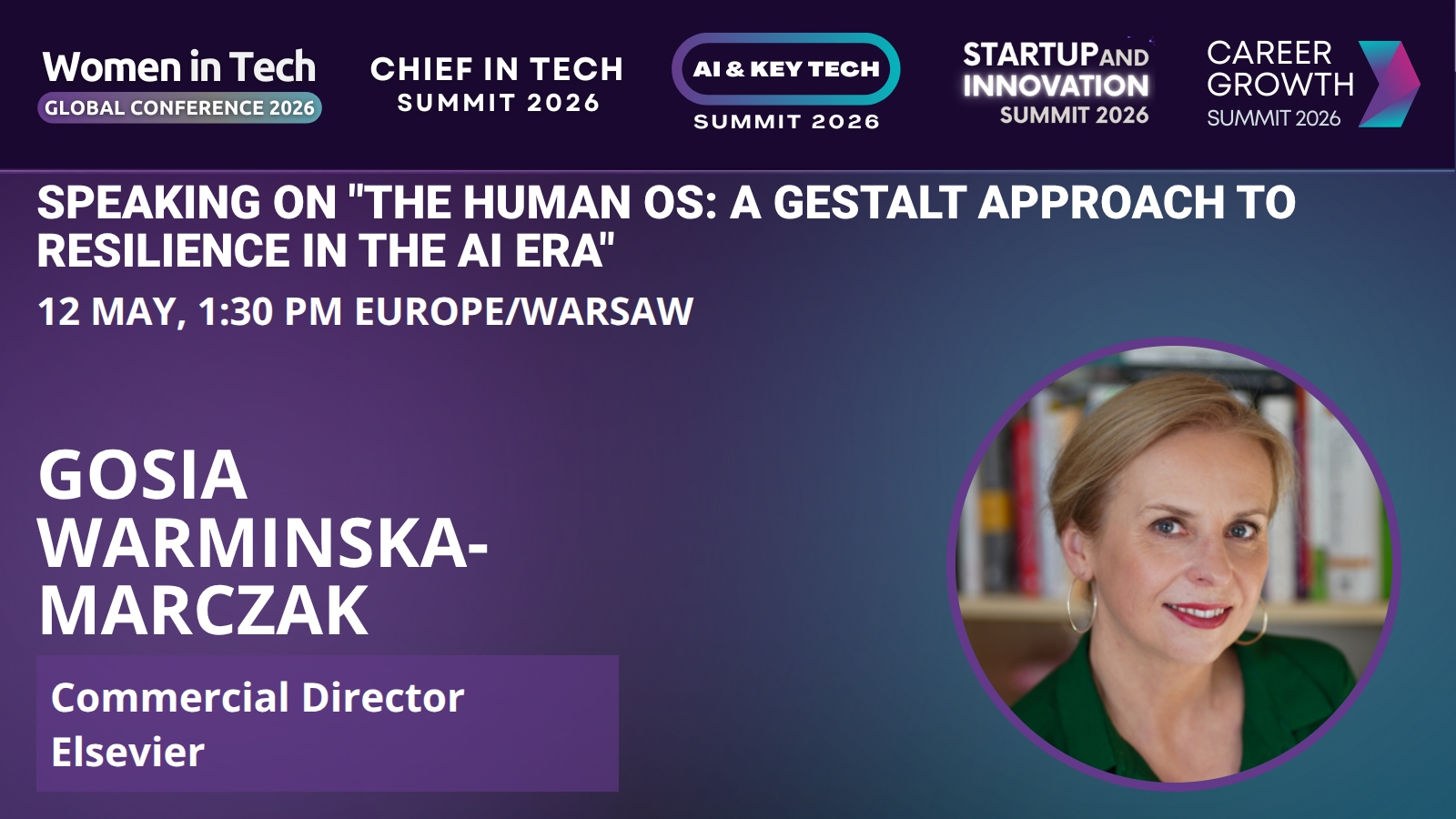

Gosia
Warminska-Marczak
Commercial Director at Elsevier

"The Human OS: A Gestalt Approach to Resilience in the AI Era"
"The Human OS: A Gestalt Approach to Resilience in the AI Era"
Tue May 12 - 7:30 AM EDT/New York (See in local time)
Add to Calendar
05/12/2026 7:30 AM
05/12/2026 07:50 AM
America/New_York
#WTGC2026
"The Human OS: A Gestalt Approach to Resilience in the AI Era"
#WTGC2026
"The Human OS: A Gestalt Approach to Resilience in the AI Era"
https://www.womentech.net/ringcentral
https://www.womentech.net/ringcentral
"The Human OS: A Gestalt Approach to Resilience in the AI Era"
"The Human OS: A Gestalt Approach to Resilience in the AI Era"
Don’t miss out and join visionaries, innovators, and thought leaders from all over the world at the Women in Tech Global Conference.
Vote by Sharing
Unite 100 000 Women in Tech to Drive Change with Purpose and Impact.
Do you want to see this session? Help increase the sharing count and the session visibility. Sessions with +10 votes will be available to career ticket holders.
Please note that it might take some time until your share & vote is reflected.
Session: The Human OS: A Gestalt Approach to Resilience in the AI Era
In the AI era, tech change isn’t just faster — it’s more constant, more ambiguous, and more personal. We treat transformation like a systems upgrade: new tools, new workflows, new metrics. But teams aren’t machines. When the pace outstrips our capacity to make meaning, people lose clarity, agency, and connection — and “resilience” turns into a demand to endure.I’ve worked at the sharp end of digital transformation where identity, access, platforms, and data must work seamlessly, and I’ve lived rapid change personally — moving from teaching into leadership roles in a highly agile tech environment, changing roles every 1–2 years. That journey taught me that what we call “resistance” is often the Human OS sending signals: uncertainty, overload, misalignment, or unspoken loss.
In this talk, I introduce a practical Gestalt-informed model for upgrading the Human OS: awareness, contact, and experimentation. You’ll learn some simple practices teams can use immediately — it’s about humans staying connected and effective while everything changes.
Key Takeaways
- Resilience isn’t a personal trait — it’s a system you can build by upgrading the “Human OS” through awareness, honest contact, and small experiments, so people stay connected and effective while change accelerates.
- Build awareness before action: pause to name what’s really happening (signals, concerns, assumptions) so decisions aren’t made on autopilot.
- Create real contact across silos: replace “surface alignment” with honest conversations that restore trust, clarity, and shared ownership.
- Adapt through micro-experiments: use small, safe-to-try moves to turn uncertainty into learning fast—without burning people out.
Bio
Gosia is Commercial Director at Elsevier Healthcare Education, partnering with universities on digital transformation. A former teacher who transitioned into leadership roles in education technology, she has navigated agile environments with frequent role changes and rapid organizational shifts. Her work focuses on making complex change adoptable by treating transformation as both a technical and human process, bringing a practical Gestalt-informed lens to resilience, communication, and learning in high-change settings.