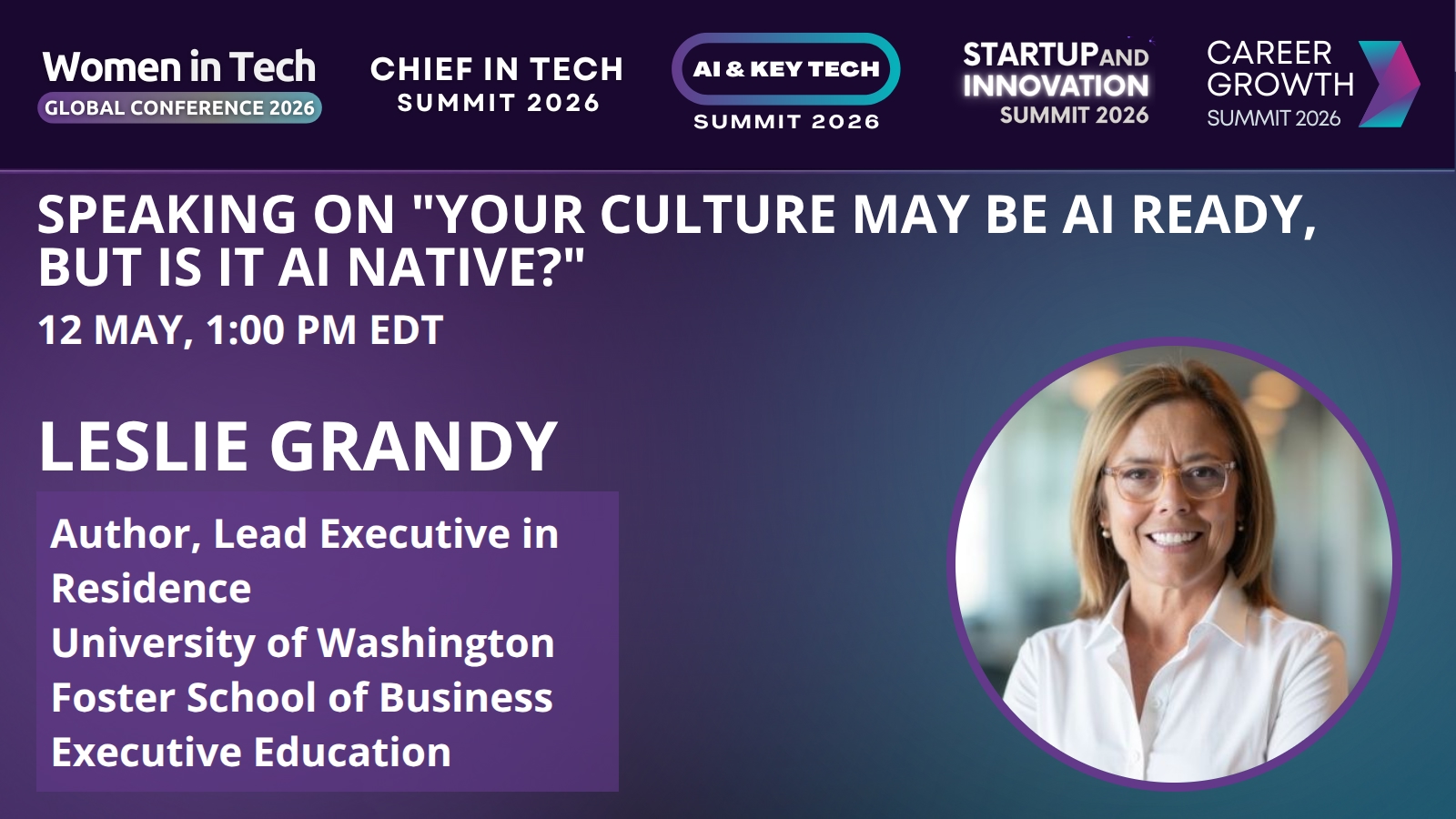

Leslie
Grandy
Author, Lead Executive in Residence at University of Washington Foster School of Business Executive Education

"Your Culture may be AI Ready, but is it AI Native?"
"Your Culture may be AI Ready, but is it AI Native?"
Tue May 12 - 1:00 PM EDT/New York (See in local time)
Add to Calendar
05/12/2026 1:00 PM
05/12/2026 01:20 PM
America/New_York
#WTGC2026
"Your Culture may be AI Ready, but is it AI Native?"
#WTGC2026
"Your Culture may be AI Ready, but is it AI Native?"
https://www.womentech.net/ringcentral
https://www.womentech.net/ringcentral
"Your Culture may be AI Ready, but is it AI Native?"
"Your Culture may be AI Ready, but is it AI Native?"
Don’t miss out and join visionaries, innovators, and thought leaders from all over the world at the Women in Tech Global Conference.
Vote by Sharing
Unite 100 000 Women in Tech to Drive Change with Purpose and Impact.
Do you want to see this session? Help increase the sharing count and the session visibility. Sessions with +10 votes will be available to career ticket holders.
Please note that it might take some time until your share & vote is reflected.
Session: Your Culture may be AI Ready, but is it AI Native?
Most organizations train people to prompt, automate, and optimize, but they leave the underlying thinking habits untouched. So they stall because they stop at readiness. Work stays structured around speed, efficiency, and known problems.Being AI-native goes further. It means redesigning how people think, challenge assumptions, manage risks, and solve problems when answers are cheap and always available. In an AI-native culture, the differentiator is no longer access to intelligence, but the ability to frame better questions, exercise judgment, and navigate ambiguity without defaulting to speed or certainty.
To become AI-native, teams have to move beyond knowing how to use AI and into knowing how to think with it. That shift requires capabilities that readiness programs rarely address.
Key Takeaways
- AI readiness can bias organizations toward speed to answer at the expense of quality of thinking.
- AI-native organizations consistently leverage AI as a thinking partner to build resilient plans and shape the future.
- Creative leadership is required to redesign AI-ready organizations into AI-native ones.
Bio
Leslie Grandy is an author, speaker, and CEO advisor who guides companies and leaders in leveraging creative thinking to accelerate growth. After a 25-year career as a global product executive at Discovery Networks, Best Buy, T-Mobile, Apple, and Amazon, she launched her consulting company, The Product Guild, to help organizations such as Oracle, Starbucks, and Red Robin Gourmet Burgers train creative leaders and build resilience against unexpected events. Leslie co-created and serves as the Lead Executive in Residence of the Product Management Leadership Accelerator at the University of Washington Foster School of Business. An accomplished creativity expert, she spent the early part of her career in the film industry as a member of the Directors Guild of America. Her new book, "Creative Velocity: Propelling Breakthrough Ideas in the Age of Generative AI” was published in May 2025 by Wiley.