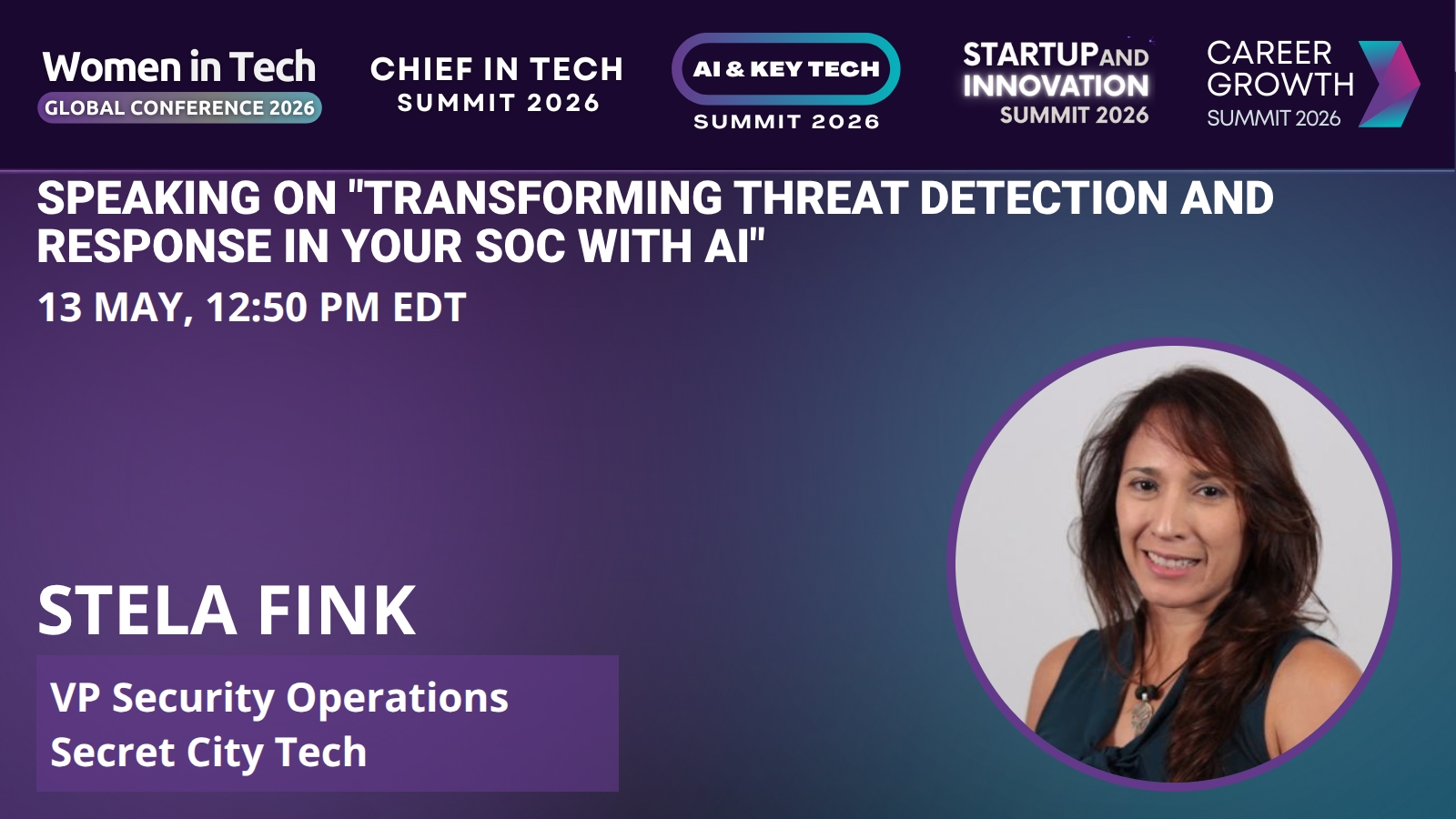

Stela
Fink
VP Security Operations at Secret City Tech

"Transforming Threat Detection and Response in your SOC with AI"
"Transforming Threat Detection and Response in your SOC with AI"
Wed May 13 - 12:50 PM EDT/New York (See in local time)
Add to Calendar
05/13/2026 12:50 PM
05/13/2026 01:10 PM
America/New_York
#WTGC2026
"Transforming Threat Detection and Response in your SOC with AI"
#WTGC2026
"Transforming Threat Detection and Response in your SOC with AI"
https://www.womentech.net/ringcentral
https://www.womentech.net/ringcentral
"Transforming Threat Detection and Response in your SOC with AI"
"Transforming Threat Detection and Response in your SOC with AI"
Don’t miss out and join visionaries, innovators, and thought leaders from all over the world at the Women in Tech Global Conference.
Vote by Sharing
Unite 100 000 Women in Tech to Drive Change with Purpose and Impact.
Do you want to see this session? Help increase the sharing count and the session visibility. Sessions with +10 votes will be available to career ticket holders.
Please note that it might take some time until your share & vote is reflected.
Session: Transforming Threat Detection and Response in your SOC with AI
AI is growing by leaps and bounds reshaping the Information Security landscape with rapid advancements in innovations, security automation, predictive analytics, and response strategies. This session will explore the benefits, challenges, and future of AI in Security.AI significantly enhances information security by improving threat detection, automating incident response, predicting potential attacks, and enabling proactive defense strategies. Its ability to analyze massive datasets, learn from patterns, and adapt to emerging threats makes AI a critical tool in today’s information security landscape. However, implementing AI must be accompanied by careful considerations of challenges like false positives, biases, and adversarial attacks. As well as balancing ethical, and transparent use of AI will be vital to its success in future information security strategies.
Key Takeaways
- AI significantly enhances Information Security by improving threat detection, automating incident response, predicting potential attacks, and enabling proactive defense strategies.
- AI-driven security presents challenges such as false positives, biases, ethical considerations, and balancing privacy concerns.
- The future of AI in Security includes innovations like AI-Augmented Threat Intelligence, Zero-Trust with AI, AI in Cloud Security, and Self-Learning AI.
Bio
My mission is to be at the forefront of information security innovation, contributing to a safer digital landscape. With over two decades of extensive experience within the technology sector, augmented by a robust and specialized foundation in critical areas such as Incident Response (IR), cloud security, and comprehensive data management and security.In my current influential position as VP Security Operations for our startup, my primary focus is on the ambitious and critical endeavor of establishing a fully operational, AI-driven Security Operations Center (SOC). This initiative represents a significant leap forward in proactive threat detection and response, leveraging cutting-edge artificial intelligence to enhance efficiency, accuracy, and overall defensive capabilities.
Prior to this role, I served as an Information Security Incident Response Manager. In this capacity, I was instrumental in a wide array of vital security functions. My responsibilities included the continuous enhancement of Incident Response protocols, policies, and procedures, ensuring that our organization was prepared to effectively mitigate and recover from security incidents. A key aspect of this work involved refining evidence collection methodologies to support thorough post-incident analysis and potential legal action. I was deeply involved in the crucial task of safeguarding digital assets against an ever-evolving threat landscape. This also encompassed strategically streamlining infrastructure to not only support security but also to meet the dynamic and increasing demands of modern security challenges, ensuring both resilience and operational efficiency.