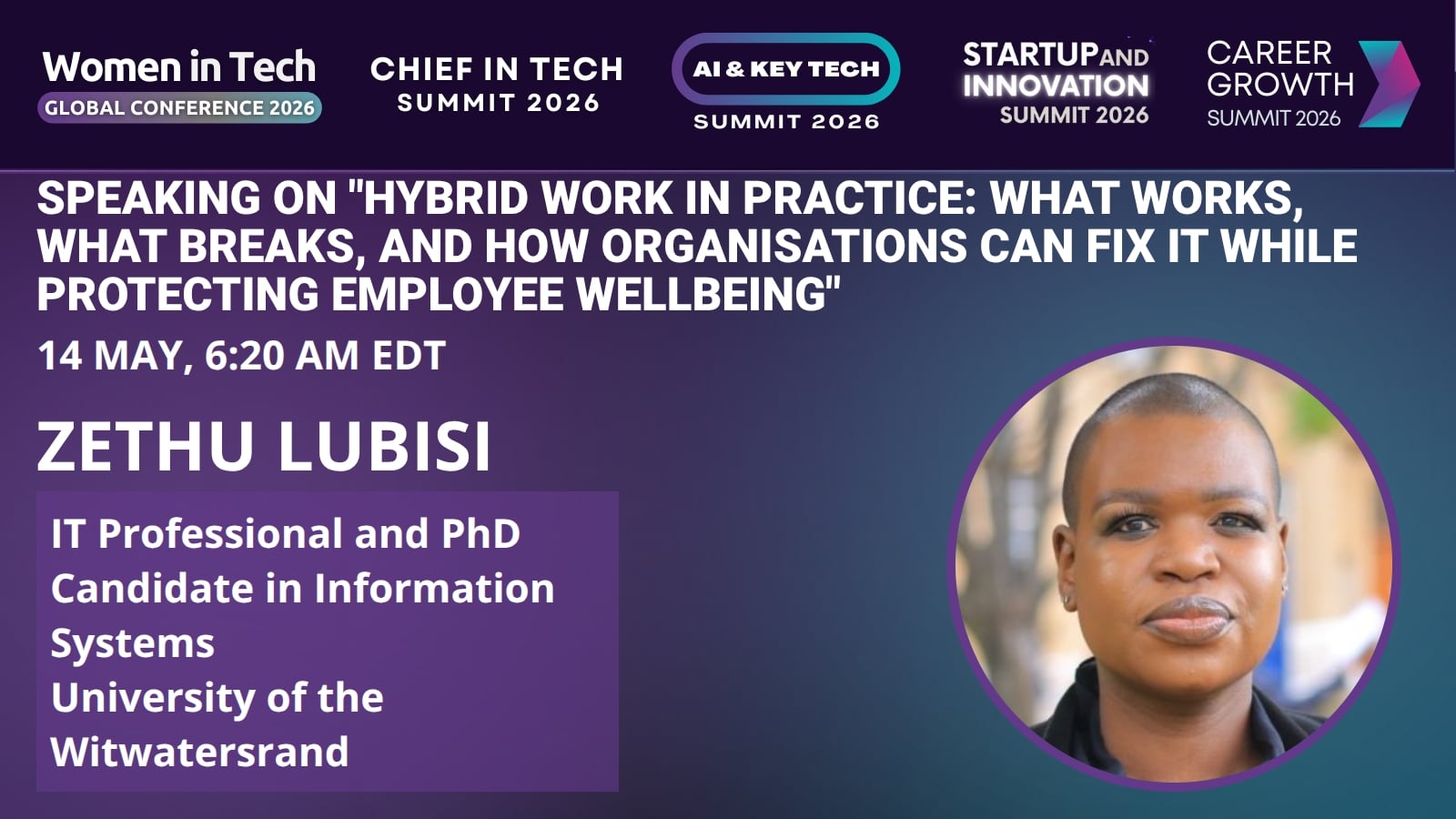

Zethu
Lubisi
IT Professional and PhD Candidate in Information Systems at University of the Witwatersrand

"Hybrid Work in Practice: What Works, What Breaks, and How Organisations Can Fix It While Protecting Employee Wellbeing"
"Hybrid Work in Practice: What Works, What Breaks, and How Organisations Can Fix It While Protecting Employee Wellbeing"
Thu May 14 - 6:20 AM EDT/New York (See in local time)
Add to Calendar
05/14/2026 6:20 AM
05/14/2026 06:40 AM
America/New_York
#WTGC2026
"Hybrid Work in Practice: What Works, What Breaks, and How Organisations Can Fix It While Protecting Employee Wellbeing"
#WTGC2026
"Hybrid Work in Practice: What Works, What Breaks, and How Organisations Can Fix It While Protecting Employee Wellbeing"
https://www.womentech.net/ringcentral
https://www.womentech.net/ringcentral
"Hybrid Work in Practice: What Works, What Breaks, and How Organisations Can Fix It While Protecting Employee Wellbeing"
"Hybrid Work in Practice: What Works, What Breaks, and How Organisations Can Fix It While Protecting Employee Wellbeing"
Don’t miss out and join visionaries, innovators, and thought leaders from all over the world at the Women in Tech Global Conference.
Vote by Sharing
Unite 100 000 Women in Tech to Drive Change with Purpose and Impact.
Do you want to see this session? Help increase the sharing count and the session visibility. Sessions with +10 votes will be available to career ticket holders.
Please note that it might take some time until your share & vote is reflected.
Session: Hybrid Work in Practice: What Works, What Breaks, and How Organisations Can Fix It While Protecting Employee Wellbeing
Hybrid work is no longer an emerging trend but a permanent feature of the modern workplace. While many organisations have embraced hybrid models for their flexibility and productivity gains, implementation in practice has revealed a more complex reality. What works well for some teams often breaks down for others, particularly when wellbeing, performance, and organisational culture are not intentionally aligned.This session explores the real-world benefits and challenges of hybrid work from both the employee and employer perspective. It examines what genuinely works in hybrid environments, such as flexibility, autonomy, and talent retention, alongside what commonly breaks, including communication gaps, blurred work boundaries, digital fatigue, burnout, and uneven access to support and resources.
A central focus of the discussion is employee wellbeing as a strategic enabler, not a secondary concern. Drawing on current research and organisational experience, the session highlights how poorly designed hybrid work models can undermine mental health, engagement, and productivity, and why organisations can no longer afford to separate wellbeing from performance.
The session concludes with practical, actionable strategies organisations can use to fix what breaks. These include redesigning hybrid work policies, supporting managers to lead distributed teams effectively, setting healthy digital boundaries, and embedding wellbeing into performance, culture, and accountability frameworks. Attendees will leave with insights they can apply immediately to create hybrid work models that are sustainable, inclusive, and supportive of both organisational goals and employee work-life harmony.
Key Takeaways
- Hybrid work works best when it is intentionally designed, not informally adopted.
- Employee wellbeing and organisational performance are deeply interconnected.
- Hybrid work challenges are fixable with the right policies, skills, and cultural shifts.
Bio
Zethu Lubisi is an ICT professional and doctoral researcher whose work focuses on hybrid working models, digital competence, and employee wellbeing within the ICT and telecommunications sector in South Africa. Her research explores how hybrid work shapes identity, performance, and wellbeing, with a particular focus on creating inclusive and sustainable work environments. She brings a practical, evidence-based perspective to conversations on the future of work, bridging research insights with real organisational challenges.