A college dropout and a Harvard contender turn out to be the same woman
A college dropout once kicked out of school, and a nationally ranked synchronized swimmer with Harvard and Stanford prospects, are the same person. RaChelle Streetman, head of Rackspace University and creator of Hulu University, uses her two biographies to show how imposter syndrome decides which story professionals lead with, and what that costs them. So which version do you introduce, and what would it take to own both?
Learn practical ways to reframe self-doubt, from values-based decisions to dropping the word just
RaChelle Streetman, Head of Rackspace University, uses two contrasting versions of her own biography to show how imposter syndrome shapes the story people lead with. She argues that ability is not tied to credentials, that belonging does not require subject matter expertise, and that values, spoken goals and refusing to say "just" help break the negative thought cycle.
“All right, y'all, you know, I'm the least technical person in the room. I would literally lead with that.”
“And it's amazing how the ability that we have isn't tied to certain credentials. It's what we've done either with those credentials or what we've done with the experience.”
What you will learn
Notice which version of your own story you lead with and whether it undersells you.
Question why you want a credential before assuming it is required to advance.
Use a personal set of values as a decision anchor when self-doubt shows up.
Apply for roles even when you do not meet every listed requirement.
Stop describing your work or yourself with the word just.
Key takeaways from the speaker
Recognize why having conversations about imposter syndrome can positively impact sense of belonging.
Explain the reality of imposter syndrome in the professional realm.
Examine how reframing negative thoughts can be a strategy for dealing with imposter syndrome.
Details
Level
Beginner
Format
Talk
Technical depth
Non-technical
For
All career stages
Length
19:22
Published
June 2023
Questions this talk answers
Do you need degrees or certifications to advance in a tech career?
RaChelle Streetman dropped out of college and built her career through experience, averaging a promotion every 1.6 years. She argues ability is not tied to credentials and encourages people to ask why they want a certification before pursuing it.
Can you belong in tech if you are not technical?
She used to open meetings by calling herself the least technical person in the room, until she realised that, as with leadership, you do not need to be the subject matter expert to belong or to accomplish something.
How can personal values help with imposter syndrome?
When she is at a crossroads or unsure, she returns to her values, such as authenticity and honesty, and asks who she is and what she believes in.
Should women apply for jobs when they do not meet all the requirements?
Yes. She says she never met all the requirements for any job she has held, yet overperformed in every one, and the worst case is simply a no.
Why avoid saying you are just in a role?
Her Hulu story about Peppa Pig keeping her connected to her daughter shows that small, everyday work can matter enormously to someone else.
About this talk
Imposter syndrome isn't something you can see. Those who experience imposter syndrome often believe they are inferior to others or have faked their way into positions despite all their accomplishments. Up to 70% of both women and men, especially high-achievers, experience imposter syndrome at some point in their career.
This conversation will bring light to this psychological phenomenon and the different types of imposter syndrome while sharing constructive ways you can begin to overcome this negative thought cycle.
All right. Waiting for some attendees here. Hi there, Jess. See that you've joined. Give it about another minute and let everybody switch over from sessions. Hope everybody's had a really great time at the conference and learning amazing things. Also as we go through, feel free to ask any questions. I will have the Q&A open and we don't need to wait to the end to have any questions as well.
Pick it off in just a couple more seconds here. Jess, we do have the chat going. I'd love to know where you're from, either in the world or company. Do we have some more joining? Welcome, Sophie. All right. Well, we'll go ahead and get started. I know we've got a short session today and I want to use our time wisely.
And I definitely want to leave time for this to be interactive and have any questions that you may have. And let's be able to just have a really great conversation today. So, again, thank you so much for joining. My name is Rochelle Streetman. And today I want to introduce you to two different people. The first, I'll just get into introducing and laying out this person.
An ex-high school partier even was kicked out of school for showing up drunk one day. College dropout. No work credentials or certifications. Single parent who announced a divorce on their second wedding anniversary. Started a career in retail and food. The second person that I want to introduce you to today was a captain of a high school golf team.
A nationally ranked synchronized swimmer. Nominated to represent their high school in Washington, D.C. for a law conference. Had Harvard and Stanford University contenders. Owned their own business at the age of 10. Importing tiles and selling to museums. And averages a promotion every 1.6 years for over a decade now. So, as you can possibly assume. But what do these people have in common?
And those people have in common is their meet, right? Both of those people are currently the global director of talent development. For Rackspace. The head of Rackspace University. Former head and creator of Hulu University. Former vice president for ATD, Association of Talent Development. Best boss in town award winner. Super proud of that. And about to move to the UK where I'm currently live streaming from today.
But about to move to the UK to live their dream life. So, I say that to say, if you and I want all of you to kind of walk away with this today. And think about the two people that you kind of introduce or you could be introducing. Right? Those two things. The two narratives that you could form.
Is it the ones of the things that maybe you're not so proud of? Or the things that maybe society wouldn't deem as the thing. Right? Or are you leading with the things that you're really proud of? Or the things that you should be really proud of? Are you letting certain things hold you back from attaining the things that you could put on a list?
And that's kind of what I want to talk about today is the different type of imposter syndromes, how it can show up in your life and kind of my lessons learned through it. And I definitely want to have this very interactive because so much of my learnings and what I've taken away is the stories and the conversations that I've held with others.
And that's really kind of inspired me to make my way through things. And I've got some great stories around them, too. So I've introduced myself to two ways and currently where I reside in San Antonio. Again, I'm right now currently in the UK, right outside London. So it's starting to become nighttime. It's beautiful right now. But I want you to take away as we talk about these things, what you can do for who you are and be proud of both sides of them.
And the reason I say be proud of both sides of them is I have been a keynote in multiple different arenas. I did a keynote at the University of St. Mary's for their School of Business. And I was invited to come speak to the faculty to give them some best practices and kind of help gear them up for the start of a new semester.
And I was sitting there. And one of the professors, the doctor asked me, where did you get your doctorate or did you start or did you stop at your master's? And I thought it was a really great question. And at one point in my life, at one point of my career, I would have really stopped and shut down.
And I may have tried to deflect or I may have felt deflated and saying, I don't have any dropped out of college, whatever that may have been. At this point in my career, and that happened a couple of years ago, I smiled and I said, none, I dropped right out of college. And I said, in fact, my my next educational goal is for university to go ahead and just give me an honorary one, rather than paying for it.
And they were floored. Right. It's it's kind of funny what we just all assume is the norm, or if somebody is in a certain position or going for something, they must have this. I've had multiple people either on my team or throughout HR or marketing or other departments that I've worked for that are that will come up and ask me, what certifications do you have?
Which ones do you think I should get? What would be the most beneficial or most helpful? And I will absolutely give them recommendations because I am clearly a huge advocate of education. I think university and colleges and certifications and all of these credentials are amazing things to have. My route took me down just getting in and going and using my education through my experiences.
That's where that's where I learned everything that I have today. So I'll absolutely give them recommendations, but I'll also ask them why. And what's really funny, very interesting when you ask somebody why they're going for the certification, the whatever it may be. It's their answers typically the same is, well, I feel like I need that to go to the next level.
I feel like that's what I'm supposed to do, what I need to have. And it always kind of takes me back and surprises me at how much we read maybe those job application forms that say must have the masters must have this must have that. I've hired and had amazing people work for me with just really brilliant individuals, some with doctorates, some with certifications, some plucked from nowhere that have just built themselves up as well.
And it's amazing how the ability that we have isn't tied to certain credentials. It's what we've done either with those credentials or what we've done with the experience. And I really, really hope that kind of resides here lately at Rackspace. I have recently created a women in tech collective, not just a women in tech group, but I really wanted this and set out for this to be a community where women could learn.
We can learn. We can learn from each other, our allies, right? I'm in a tech company. So 70% of the people there are men. And to create a group centered for women, we absolutely need our allies to be a part of that, right? It shouldn't just be us pulling. It should be our allies. They're saying, hey, let me step in and let me help because it is going to make us all better.
And we were filming a video and the video was kind of an explanation of what women in tech was going to be. And we had these amazing women throughout the business, the CIO, like so many different people, right? And they were like this and this and I love programming and this and that and I am a woman in tech.
And I really struggled. I really struggled for a minute and I really struggled when forming this group, which is why I named the session what I named it. I am a woman in tech because I had an aha moment in almost every meeting I would go into. I would lead with all right, y'all know I'm from Texas, by the way.
All right, y'all, you know, I'm the least technical person in the room. I would literally lead with that. It was almost my way of setting an expectation of I'm here. I'm great at what I do. That's not what I do. Right. And I think that narrative that I created. Did me a disservice. And when I took a step back and I realized, hey, you're responsible.
You're responsible for 7000 different employees around the world that are changing the game for technology. You absolutely belong with the title of women in tech, a woman in tech. Then it took me this this moment. And I think a lot of it growing up, I never had a sense of I couldn't do something. And maybe that's why I've been able to just keep pushing through without this or without that.
But there was still that stigma in my mind is I don't know how to put I don't know all the different technical verbiage and vernacular. I can't go in a room with developers and talk the talk and when we need technical training classes built, I need to pull in the experts so we can figure out how to do this.
Right. That's something that I'm not a subject matter expert in. And it took me a minute to realize, hey, just like certain aspects of leadership, you don't need to be the subject matter expert to belong in a certain area or to be able to accomplish something. And that was a huge, huge eye opener for me, creating this program, doing what I do, and I still felt a sense of I don't belong.
Should I be telling, am I a woman in tech? And I've had those moments along the way, right, where the parents or everybody's like, oh, are you going to go get your degree or are you going to get this? Can you get that job? Are you able to have that job with that one? Are you able to do X, Y and Z as this or that?
And I've really had to take moments in my life to kind of fire myself up and say, yeah, I can. I can't. I believe I can. So I'm going to do it. So when people have asked me, well, how have you overcome imposter syndrome, I always try to tell them that it's based on my values. I encourage everybody to have a set of values that they follow in their life.
And my values are how I want to live life when I am at a crossroads, when I am unsure, when I don't know what decision to make. I go to my values and say, OK, who are you, Michelle? What do you believe in? And let's stay true to that. Right. I believe in authenticity and honesty and being real is so important to me.
And so that's why I try to lead all of those things with that today. Right. The session. OK, what can I lead with? I want to be vulnerable. I want to be real because the people who have been vulnerable and real with me have helped me get to where I am today. And helping somebody in any sense of the way is.
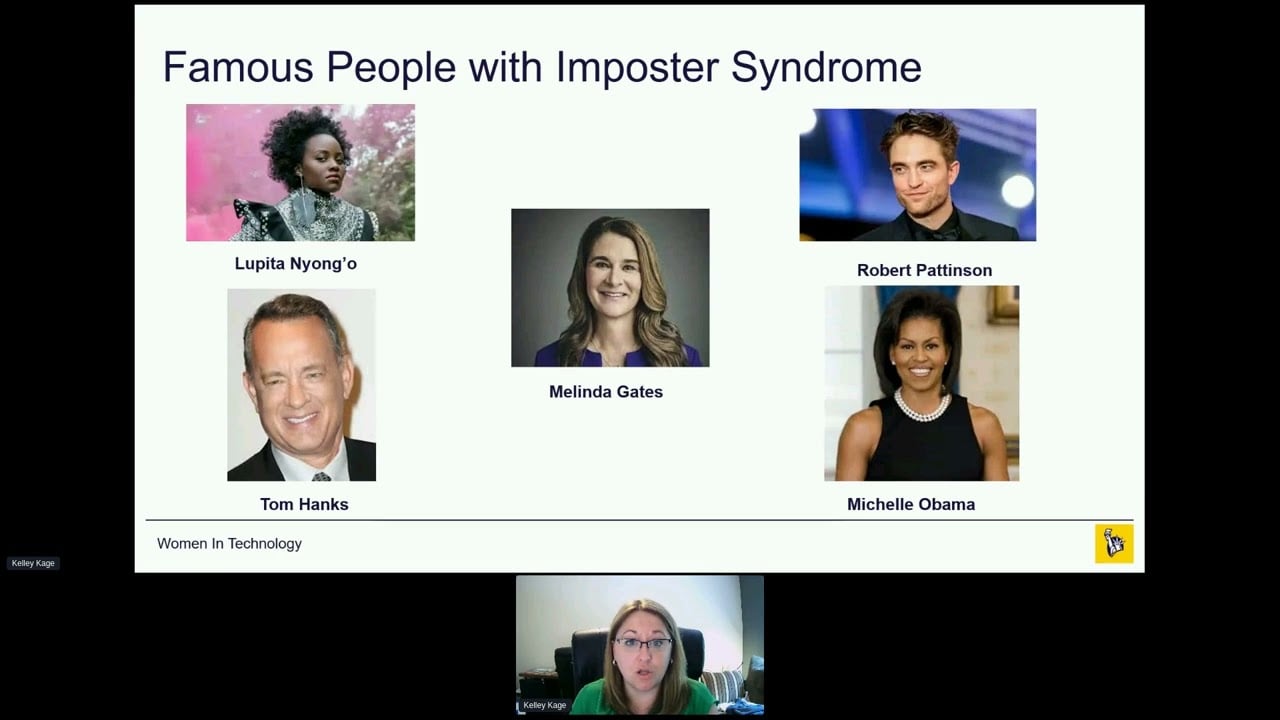
My favorite thing is my favorite feeling in the world. And so I hope, you know, sharing some of my story, it can can kind of help you get out of it. I've interviewed some amazing people, most recently the manager for Valley Sports. So overseeing everything, right, a C-suite. And I interviewed him for our entire HR department, part of our learning series and asked him if he had imposter syndrome.
And by the way, everybody says yes, no matter what their role is. And asked him, you know, how have you overcome it? And I've asked so many of these different speakers that I've interviewed. And one of the answers that I received is one of my favorite. It's the journey is always different, but the destination is always the same. Right.
You know where you're going to go and you could interact with different things and you could have different things come up, but you end up kind of in that same place. Right. You know you're going to be okay. Every job I've gone for, I have not met the requirements. So my females in the audience right now, statistically, you will not apply for a job you don't meet over 90% of the requirements for.
I need you to apply. I need you to just take a chance. Worst case scenarios, they say no. But every job I've had, I didn't meet all of the requirements. And every job I've had, I have overperformed. And I've done a really great job. And I love what I do. And I've loved everything that I've been able to do.
Um, but I would say have those values, have your goals, dream big and practice saying them out loud. And it should give you a little bit of anxiety at first to tell somebody what the goals are, because that lets you know that a little bit inside of you thinks, is this too big? That's the right goal to have.
And then you want to start gaining confidence every time you say it. And you want to just say it with more and more and more confidence every single time. So those would be some of my takeaways and some of the things that I've done to overcome imposter syndrome. And that is in all facets, not just work, but also personal life.
I remember going through a divorce thinking, I'm divorced, I'm a single mom, who's going to want to be with me or freaking out about that, right. And putting myself out there, again, was a risk. I'm moving to the UK. I was like, it's been a lifelong dream to live in Europe. And you hear about people doing it. And one day I looked up and said I homeschool my daughter, it's a single working mom, by the way, because if she wanted to do that, I was going to figure it out, because that's my mind, right.
That's my mind, right. I've never homeschooled, but I'm going to do it. And she's loving it, by the way. But my daughter's homeschooled, I have a remote global position. Hey, I have wings, too. I can go out and make this happen. And it's overwhelming, but I'm going to figure it out. So, again, imposter syndrome doesn't just start and stop in the workplace. It may feel the scariest when it's tied to your livelihood. And that's when I've been the most scared. But ultimately, it's everywhere and it's everything you do. And it's not going to go away.
The only thing that you can do is really bet on yourself. Practice putting yourself out of that comfort zone. And eventually, when that imposter syndrome comes up, you'll say, you know what, I've either faked it enough till I made it, that I know I can do it, or I believe in myself to know that I'm going to figure out how to get this done.
And that is hopefully some of my advice that I can pass along, some of the inspiration along the way. I've got billions of stories that I'd be happy to share with anybody, but I know we are at that 15-minute mark, so I do want to take a quick pause and see if anybody has any questions or any stories that you want to share. Where have you felt imposter syndrome? How have you overcome it? I'd love to learn from you just as much.
And I'm just Wisconsin. I love Wisconsin. It's beautiful. And feel free to put this in the chat. If you'd like. Just observing. It's the group of observing. While I'm waiting, if any questions are coming up, we have a few more minutes. And I'll share a quick story. I had a, I created Hulu University, right? We upramped a thousand employees in a year.
Never done that before. I've implemented new sites in India, which was the first time I had ever done that, right? All of the things that I've done were always the first time for me. I guess I just am not a fan of repetition, potentially. Or pain. But I had a group of CSRs, customer service representatives. And a common ally I see always in these roles is a sense of, oh, I'm just a CSR.
I hear people say, what do you do for a living? I'm just a CSR. And I would go in. And I told them at Hulu about a story of my daughter used to have to go on trips with her dad. And when she'd have to go on trips, she was, you know, missing home at night, talking to me on FaceTime.
She'd start tearing up. And I couldn't do anything. I couldn't stop. I couldn't get to her, hug her, make her feel like everything was fine. If there was anything that connected us, it was our show that we would watch on her iPad before bed, Peppa Pig. And I told the team of new hires, and I told every new hire classes, had that app gone down, had I not had access to that, I would have been falling very panicked.
And each of you could have taken the mentality of, why is this crazy woman flipping out about Peppa Pig? And you could have taken a lackadaisical approach, but what was going in my world was my world was falling apart. And that simple thing that you do would help make everything okay for a few minutes. And it helps them to realize how important sometimes the smallest things are.
So, for those of you in different roles around, I also suggest never use the word just when you're referring to anything you do or to yourself. Because you really don't know how living just your life or your role can impact other people. And how important the small things that you just do on a day-to-day basis can really be to somebody.
So, hopefully that helps to clarify how important you, just being you, is. And I hope you all go out there and achieve and do everything that you're wanting to do. And most definitely the most scariest of the things you're wanting to do. So, I'll leave another minute here for questions before we wrap. Other than that, thank you so much for joining today.
If you have any questions, please feel free to reach out. I'm happy to talk to anybody about it and learn from you. Thank you, Jess. Thank you, Christine. Thanks, Samantha. Have a wonderful rest of your weekend, weekend, everyone.
Transcribed automatically; names checked against the speaker record. Select a time to jump there.
Article based on this talk
Imposter syndrome lives in the story you choose to lead with
RaChelle Streetman of Rackspace explains why credentials and technical vocabulary are not the price of belonging in tech.
In short
Imposter syndrome often comes down to which version of your own story you tell first. RaChelle Streetman, Global Talent Development Executive and Head of Rackspace University, shows that the same life can read as a list of failures or a list of achievements, and argues that ability is not tied to credentials or technical vocabulary. Her remedies are practical: lean on your values, apply anyway, say big goals out loud and stop calling yourself "just" anything.
Key takeaways
Recognize why having conversations about imposter syndrome can positively impact sense of belonging.
Explain the reality of imposter syndrome in the professional realm.
Examine how reframing negative thoughts can be a strategy for dealing with imposter syndrome.
Two people, one life
Streetman opens by introducing two people. The first is a former high school partier who was kicked out of school, a college dropout with no certifications, a single parent who started in retail and food. The second captained a high school golf team, was a nationally ranked synchronized swimmer, had Harvard and Stanford prospects, ran a business at the age of 10 and has averaged a promotion every 1.6 years for over a decade. Both, she reveals, are her.
The point is the choice between narratives. She asks the audience to consider which list they lead with: "Or are you leading with the things that you're really proud of? Or the things that you should be really proud of?" (3:12). Her goal is for viewers to be proud of both sides of their story, not to hide one of them.
Credentials do not define ability
At a faculty keynote at St. Mary's University, a professor asked where she earned her doctorate. Earlier in her career, she says, she would have shut down. This time she smiled, said she had dropped out of college, and joked that her next educational goal is an honorary degree.
She is a strong advocate for education and happily recommends certifications to colleagues, but she also asks them why they want one. The usual answer is that they feel they need it to reach the next level. Having hired people with doctorates, people with certifications and people who built themselves up from nothing, she concludes: "And it's amazing how the ability that we have isn't tied to certain credentials. It's what we've done either with those credentials or what we've done with the experience." (7:21)
"I am a woman in tech"
The talk's title comes from a moment of self-recognition. While creating a Women in Tech Collective at Rackspace, a company where she notes 70% of the people are men, Streetman filmed a video in which colleagues including the CIO proudly said "I am a woman in tech." She struggled to say it herself.
She realised she had been opening almost every meeting the same way: "All right, y'all, you know, I'm the least technical person in the room. I would literally lead with that." (8:47) It was a way of setting expectations, and it did her a disservice. She was responsible for 7,000 employees around the world who are changing technology, yet she still felt she lacked the vocabulary to belong. The shift came when she connected it to leadership: "And it took me a minute to realize, hey, just like certain aspects of leadership, you don't need to be the subject matter expert to belong in a certain area or to be able to accomplish something." (10:00)
She also stresses that the collective was designed to include allies, because a group centred on women should not leave women doing all the pulling.
Values, goals and saying them out loud
Asked how she overcomes imposter syndrome, Streetman points to her values. "And my values are how I want to live life when I am at a crossroads, when I am unsure, when I don't know what decision to make." (11:16) For her, those values are authenticity, honesty and being real, which is why she chose to be vulnerable in this talk.
She draws on conversations with senior leaders she has interviewed, noting that everybody says yes when asked whether they experience imposter syndrome. She also addresses the women in the audience directly, citing the statistic that women tend not to apply for jobs unless they meet over 90% of the requirements. She has never met all the requirements for any job she has held and has overperformed in every one.
Her exercise for building confidence is to dream big and say goals out loud: "And it should give you a little bit of anxiety at first to tell somebody what the goals are, because that lets you know that a little bit inside of you thinks, is this too big? That's the right goal to have." (13:20) Each repetition should come with a little more confidence.
Beyond the workplace, and the word "just"
Streetman is clear that imposter syndrome is not confined to work. She describes going through a divorce as a single mother, deciding to homeschool her daughter and preparing to move to the UK to live a lifelong dream. Her conclusion: "The only thing that you can do is really bet on yourself. Practice putting yourself out of that comfort zone." (15:07)
She closes with a story from Hulu, where she created Hulu University and ramped up a thousand employees in a year. She told new customer service representatives how, when her daughter was away and homesick, watching Peppa Pig together was the one thing that connected them. Had the app gone down, her world would have fallen apart. The lesson for anyone who describes themselves as "just a CSR": "So, for those of you in different roles around, I also suggest never use the word just when you're referring to anything you do or to yourself." (18:15)
Watch the talk
"I AM a woman in tech!" by RaChelle Streetman (about 19 minutes): https://www.womentech.net/video/i-am-woman-in-tech
About the speaker
RaChelle Streetman is Global Talent Development Executive and Head of Rackspace University at Rackspace, where she recently created a Women in Tech Collective focused on skill building, modern mindsets and supportive active allyship. An award-winning global leader with over 20 years of experience across sales, operations, marketing and HR, she previously created and launched Hulu University as Hulu's Head of Viewer Experience Training.
Questions this talk answers
Do you need degrees or certifications to advance in a tech career?
Can you belong in tech if you are not technical?
How can personal values help with imposter syndrome?
Should women apply for jobs when they do not meet all the requirements?
Why avoid saying you are "just" in a role?
Drafted with AI from the talk transcript. Editor review pending.
Cite this talk
RaChelle Streetman. "I AM a woman in tech!." WomenTech Network, 2023. https://www.womentech.net/video/i-am-woman-in-tech