How YOU can influence change and drive equity in your organization
Kelley Kage19:142022
The more successful you become, the louder imposter feelings can get
Maya Angelou wrote 11 books and still doubted she had earned them, and Einstein called himself an involuntary swindler. Kelley Kage, CIO for Surety Technology at Liberty Mutual and a former microbiologist, felt the same in every meeting after taking a role with more direct reports than ever, and warns that such doubt stops people sharing ideas or chasing promotions. So what actually quiets it?
Get four practical tips and a control-alt-delete routine for quieting self-doubt at work
Kelley Kage, CIO for Surety Technology at Liberty Mutual Insurance, explains that imposter syndrome affects people at every level and can intensify with success. Drawing on her own move into a larger management role, she shares how a 360 survey, a learning plan and a kudos folder helped, plus a control-alt-delete routine for negative self-talk.
“And the tough part about it is the more successful you become, the stronger those feelings can be.”
“I am working hard and I've realized that I'm not faking it until I make it that I have made it.”
What you will learn
Recognize the phrases, such as "I just got lucky", that signal imposter talk.
Identify which imposter type (perfectionist, superhero or expert) shows up for you in a given situation.
Use a 360 survey and a personal learning plan to test self-doubt against evidence.
Build a kudos folder and celebrate colleagues to counter negative self-talk.
Apply control-alt-delete: control your thinking, alter your mindset and delete negative self-talk.
Key takeaways from the speaker
Think big, act small and build
Set a goal, socialize that goal, and recruit volunteers to help
Just do it. Driving change can be more impactful than you think, and easier that you would expect
Details
Level
All levels
Format
Talk
Technical depth
Non-technical
For
All career stages
Length
19:14
Published
June 2022
Questions this talk answers
What does imposter syndrome actually feel like?
It is the feeling that you have fooled everyone into thinking you are right for the job, and that when you succeed you just got lucky or were in the right place at the right time.
Does imposter syndrome go away as you become more senior?
No. Kage says it affects people at all levels and can get stronger as you become more successful, and many executives she spoke with admitted to it.
How did Kelley Kage cope after stepping into a role she felt unqualified for?
She ran a 360 survey, which showed her team saw her as a dynamic leader with a fresh perspective, and made a plan to build the knowledge she felt she lacked.
What practical steps help when self-doubt creeps in?
Know the signs, remember nobody is perfect, be compassionate and talk to a trusted mentor or friend, and keep a kudos folder of positive feedback to reread on down days.
Do women experience imposter syndrome more than men?
Kage says everyone feels it at some point, but women tend to feel it a little more at work, as do people of color and other smaller groups, which is why allies, mentors and sponsors matter.
About this talk
Are you wondering how you can make a change at your company, in society, and in the world? Not sure where to start? Or you have an idea but don't know how to scale it? Kelley Kage is going to share her story about following her passion of helping others and how she was able to drive significant organizational change with focus on equity, and how she has expanded that work nationally and globally. She will share actionable tips and tricks that you can use to do the same. Creating equity and driving change, especially in tech, is up to all of us.
Welcome to Impostor Syndrome and Fighting Those Voices Inside Your Head. We're going to talk about today how to identify and overcome Impostor Syndrome. So even after writing 11 books and winning several prestigious awards, Maya Angelou couldn't escape that doubt that she really hadn't earned her accomplishments. Albert Einstein also experienced these feelings. He actually called himself an involuntary swindler whose work didn't deserve as much attention as it was receiving.
Angelou and Einstein, they both accomplished some pretty rare things in their lifetimes, but these feelings of fraudulence that they experienced are actually extremely common. So I'm here to talk to you today about why so many of us experience these feelings of being an imposter. I'm Kelley Cage, a CIO of Surety at Liberty Mutual Insurance, and I've been with Liberty for about 15 years.
During that time I have worked in several different teams and held several different roles across the organization. But one of the fun things I like to highlight about my background is that I actually did not go to school for computer science. I didn't start in technology. I actually started my career as a microbiologist. So after transitioning from microbiology into technology, I started my career at Liberty Mutual and found my passion for tech and went back and got my masters in information technology.
So starting with imposter syndrome, I'll pause there for a minute. I mean, talk about feeling like an imposter. I got hired to work in a tech organization with software engineers without having any background in computer science. And it's something that I've actually really come to appreciate about myself and my background, because it gives me a really good advantage when we're problem solving to look at things a little bit differently than some of my peers might.
And I also think it's important to realize that we all have these type of unique experiences that really are what we should be bringing to the table. So we have a few people in the room here. I'd like everybody to take a minute and share within the chat. What is a unique experience that you feel like you bring to the table?
So if you can take a minute and just type it right in there for me. And while you're doing that and typing that in the chat, we'll start to jump right into what is imposter syndrome? So imposter syndrome, it's like that feeling that you're in the middle of something you can't get out of. You don't really know how you got there and you don't have the skills to get the work done.
But somehow you fooled everybody around you into thinking you're the right person for the job. And then when you figure it out and you do complete that task and you feel like you got away with something that you weren't really qualified to do in the first place. And you kind of feel like you just got lucky. It can kind of feel like the diagram that you actually see on the page right above me here.
So when I think about this diagram, I actually think about a few phrases and I'd love it if people just type yes in the chat. If you can relate to something that I'm going to say. So I want you to pause for a minute and think about your last big success. Really take a minute and picture it in your mind.
And now I want you to picture somebody congratulating you on a job well done. Have you ever responded to that person congratulating you or ever thought to yourself. I just got lucky. Oh, I didn't really deserve that award. Honestly, I have no idea how we got that done. I must have said something right or fooled everybody. And my favorite is I was just in the right place at the right time.
It wasn't me. And I'm seeing a ton of comments. Yes, 100% of the time. I'm always asking why. Oh, and somebody that said no, not really. And actually, that's a great thing that you haven't had those feelings, but it doesn't mean they won't come up. So a lot of people have these same experiences. And I know I've told myself these things at one point or another, too, and all of those comments.
We have in common that they are all forms of imposter syndrome talk. And all of those words are discounting the fact that you earned through your hard work to be where you are. So I want to make this a little bit more real for everybody. Usually, when we think about imposter syndrome, we think about something that impacts a specific group of people or a specific level in an organization, but not imposter syndrome.
Imposter syndrome actually impacts people at all levels. And the tough part about it is the more successful you become, the stronger those feelings can be. And I was actually sharing that I was speaking today on this topic with some of the executives that I work with, and it amazed me how many of them actually opened up about their feelings of imposter syndrome.
And it was almost like they just breathed this sigh of relief that they could talk to somebody else about these feelings that they were having about being unsure of their skills. So I want you to think about that in your leadership roles and as you progress through the organization, as you become that next C-suite leader, you're still going to have some of these feelings too.
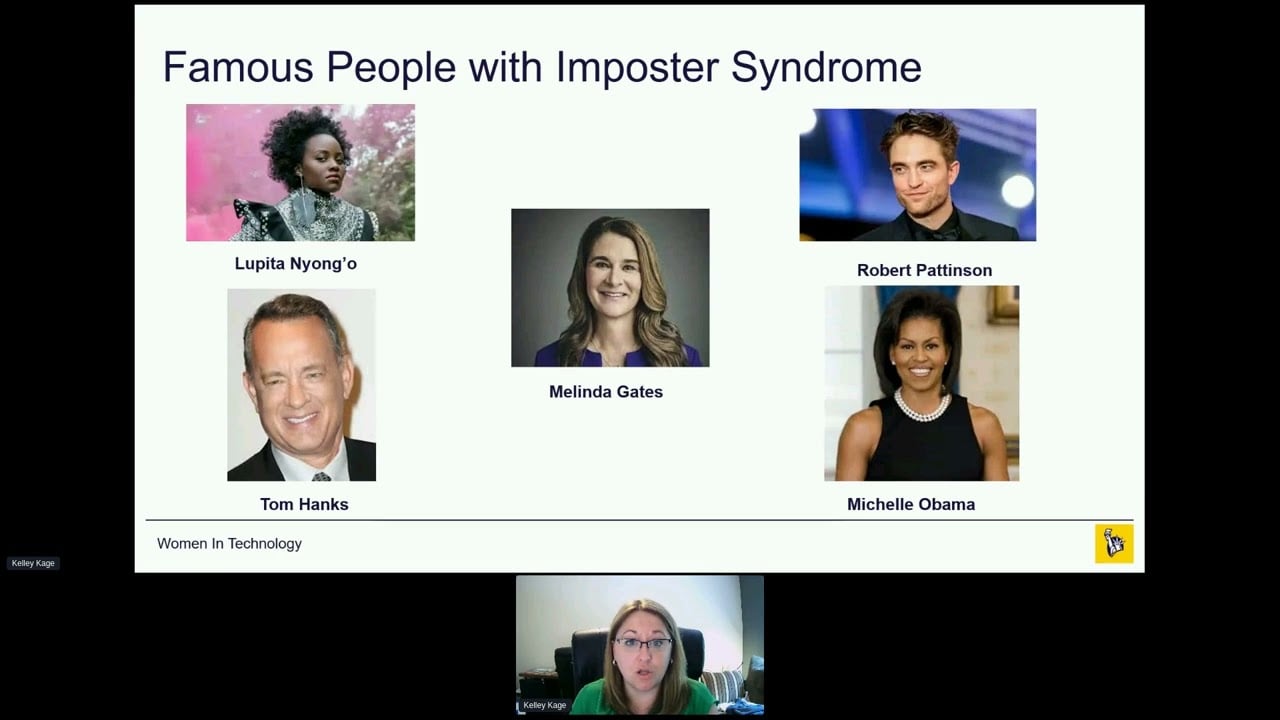
So it's going to be important for you to figure out how to work through those feelings yourself, but also how to help others work through those feelings. Even Melinda Gates admits to feeling like an imposter. In Brene Brown's book, Dare to Lead, Melinda actually admitted that she made up a story in her head that she didn't know enough about the science behind the work at her foundation.
And so she didn't want to come across as stupid. And so she sat quietly in the meetings, didn't ask any questions and wasn't fully engaging with her teams. She said she felt like a total imposter. And when she realized she needed to rewrite that story for herself. And, you know, she had to say in her mind, I am enough and I know just enough to ask these questions.
And so even when she feels like it's a seemingly stupid question, she's confident enough to ask those questions because she's learned a lot of times. Those questions are rarely stupid and they're probably the most important questions that we need to be asking. All of the celebrities that you see on this slide right here, they have all admitted to experiencing some form of imposter syndrome as well.
And if the feelings of imposter syndrome are intense enough, it can lead people to not share their ideas, to not go after that job or promotion. And it can make us limit things and not make things better for ourselves or our teams or organizations or even more broadly, not have us make the impact we could have on the world.
So it's important to combat these feelings by starting to talk about them a little bit more, which is exactly what we're doing today. We need to have these open conversations on the topic so that people can realize they're not alone and we can really figure out how to work through them together. So the important thing as we start to talk about this a little bit more is something I want you all to remember.
You are all talented, you are all capable, and you belong where you are. So let's talk about different ways that imposter syndrome is currently experienced. I love the comments in the chat. Keep those coming too. So the first step is identifying where these feelings of imposter syndrome manifest themselves for you. There are a few different types of imposter syndrome listed on the slide up here.
And whether you're the perfectionist who needs control of that final output and just feels like they can't delegate or the superhero that feels like you always have to prove yourself and push yourself to your limits to prove yourself. You can move through and be any of these based on the experience that you're going through. And for me, I know I've felt this too.
And so a little bit of a personal story for me with imposter syndrome is as I was progressing into management roles before I became a CIO, and I was working in technology in a space that I knew frontwards and backwards, inside and out. So I had been doing the job for years in a couple of different industries and I was actually extremely confident in my ability to get the work done.
And others seemed pretty confident in me as well. Well, an opportunity came up to manage a team in a new area where I really didn't have a lot of experience. And I had never had a role with this many direct reports. And so I was really terrified about the new space more than anything. And my boss reassured me, take the job, you can do this, you're going to be successful.
My colleagues believed in me, my friends and family knew I could do it, but I was terrified. I ended up taking the position and took that risk. But I had to tell myself that I was going to start that job and fake it until I made it, because I felt like the expert type of imposter syndrome. I didn't really know what I was doing, but I was going to give it a try.
So when I started the role, I immediately felt like I didn't belong. Every team meeting, every business meeting, every one on one that I had, I was so worried that it was evident that they should have picked somebody else for the job. That there were people so much more qualified to sit in that seat than I was and somebody was going to figure that out.
So I was constantly questioning myself and why I was there. Well, there are a few things that I did to help overcome those feelings of imposter syndrome. And one of those is called a 360 survey review, where I sent a survey to my direct reports, my managers, my peers. And I was really nervous to hear what people were going to say about me in this anonymous forum.
And when the results came in through email, it took me a few days to actually click the link and see what people had said. And what I found is, though, even though I felt like I lacked some of that confidence and I was questioning my abilities, that my team actually really appreciated what I was bringing to the table.
They thought I was a dynamic leader with fresh perspective and that I was really capable about bringing positive change to the organization. And one thing that I did was I put a plan in place for myself to help me build knowledge so that I felt like I could get to a level of competency where I would feel less like an imposter and less like I was faking it and more like I was armed with the knowledge that I needed to help my teams.
And just having that plan gave me more confidence. But I'll tell you, I still have days where I walk into the room and I feel like I don't belong and I feel like it's a work in progress and it's always going to be that way to some degree. And there's there might be people in those rooms that are thinking the same thing about themselves, but I have to remind myself that I am doing my best.
I am working hard and I've realized that I'm not faking it until I make it that I have made it. And then I'm here because I've earned it and I deserved it. And to me, that is the most impactful thing that we have to tell ourselves. So I'm going to repeat it. I'm not thinking it until I'm making it.
I have made it. I'm here because I earned it and I deserved it. And it's important that you tell yourself those same things, too. So this is my imposter experience, but everybody's going to experience it a little bit differently. The good news is it's really easy to start overcoming those feelings. And the way that you do that is the same regardless of the situation that you're in.
So how do you stop feeling like an imposter? Imposter. Here are some key tips and tricks that you can all take away when you start to question yourself. So number one, know the signs of what imposter syndrome can feel like, which we've just talked about. And number two, remember that nobody's perfect. People make mistakes and we're all going to have those moments where we're like, oh, my gosh, why did I do that?
Or I wish I had done something differently. Or why didn't I speak up in that meeting? Well, when those feelings start to creep up, I want you to remind yourself you did your best during that meeting. Don't dwell on that scenario. Instead, celebrate the positives. Learn from those challenges that you faced and think about what you're going to do differently in that next meeting.
So number three, be compassionate for yourself and for others. Find a mentor or a friend that you can talk to. So just like I mentioned earlier, people at all levels have these feelings. So if you can find somebody that you trust that you can talk to about this, they can help you work through some of those feelings that you're having.
And when one of your friends comes to you for help, you can help encourage them to see themselves in that seat or being successful in what they're trying to achieve. It's amazing how good it feels when you can help somebody else see in themselves what you see in them. And then number four, just embrace it. Know that imposter syndrome is a never ending battle.
So I don't want you to forget what you're good at. So when someone sends you a nice email celebrating something that you did, I call it a kudos folder that I have in my email. I save it there. And I go back and I read those emails if I'm having a down day or if I'm feeling that those imposter syndrome feelings start to creep in.
You can shed them really easily by going back and reading all of that positive feedback that you got from everybody. And then don't forget to celebrate. Even a small gesture like sending that note to one of your colleagues that does a really good job. Let's her put it in her kudos folder for when she's having those feelings too.
But yes, the brag board. I've heard a few different people call it different things, but it is so good. And I will tell you, it'll change your mood like that. So what do I want you to remember from today's session? First and foremost, you can definitely overcome imposter syndrome. And I do it and I want you to do it by focusing on control-alt-deleting those feelings.
Start by controlling the way that you're thinking. As soon as you start to have those imposter feelings, just acknowledge them, but don't engage with them. And alter that mindset to talking about all of the reasons that you are qualified for what you're doing and delete that negative self-talk. I just want you to remember, though, it takes practice and it's not going to go away overnight and it's not going to be perfect.
So have some grace, have some patience with yourself as you're working through it. And there's one thing I can confidently say about the attendees that are with us today. And I just want you to know that I believe you're not where you are today because you're lucky. You're not here today because you're choosing the easy path. You're at a conference like this today because you're strong, because you are a leader, and you're here to unlock all of that potential that you have within yourself.
So knowing what you know now, I want you to think about and write down three qualities you have that got you to where you are today. And anytime you start to have those questions about yourself, reflect back to those things and do not let that imposter syndrome hold you back from going after what you deserve. So thank you all for your time today.
We'll open it up for some questions that you have for me. I'd also love to connect with you all on LinkedIn, where I share tips on imposter syndrome and technology and women in tech issues. And for those people that I saw in the comments that felt like they didn't have a unique experience for themselves, you definitely do.
We all have personal and professional experiences that shape who we are. So I'd love to connect and help you figure out what yours is, because we all have that superpower. Any questions that I can answer? I'm just scrolling through the comments. Oh, I love that. I needed to hear that. Can't agree more. This is actually a great opportunity for you all to make connections and network and support each other and find one another through conferences like this.
So I can't wait to connect with everybody, and I hope to see you all in some of the other sessions, too. It's my mantra on LinkedIn. I'd love to post it on my laptop. Yes, I will make sure to post it out there. And thanks for the LinkedIn link. I will definitely click on that. So do you know any numbers on women and men and how often they feel imposter syndrome?
So everybody feels imposter syndrome. It's 100% of men and women at some point in their lives. It doesn't mean they feel it all the time, but women tend to feel it a little bit more, especially in the workplace than men. And that's why it's very important. And in addition to just women, it's people of color and, you know, some of the smaller groups that are out there.
So it's important to have allies that can help with some of this, that mentor, that sponsor that can be in those sessions with you and give you that feedback and help you work through some of those challenges. But every single person experiences it in one way or another. Great question. Wonderful. Any other questions? Great, another LinkedIn. Well, get ready.
Head to that next session. And it was great meeting you all. Have a great conference. Bye. We'll see you next time.
Transcribed automatically; names checked against the speaker record. Select a time to jump there.
Article based on this talk
Why imposter syndrome gets louder as you succeed, and how to quiet it
Kelley Kage, CIO for Surety Technology at Liberty Mutual Insurance, shares her own imposter story and a practical routine for treating self-doubt as something you manage, not something you defeat once.
In short
Imposter syndrome does not fade with seniority, argues Kelley Kage, CIO for Surety Technology at Liberty Mutual Insurance. It can grow stronger as people succeed. Her answer is to name the feelings, test them against real evidence such as a 360 survey and a kudos folder, and "control-alt-delete" the negative self-talk with patience and practice.
Key takeaways
Recognize the phrases, such as "I just got lucky", that signal imposter talk.
Identify which imposter type (perfectionist, superhero or expert) shows up for you in a given situation.
Use a 360 survey and a personal learning plan to test self-doubt against evidence.
Build a kudos folder and celebrate colleagues to counter negative self-talk.
Apply control-alt-delete: control your thinking, alter your mindset and delete negative self-talk.
Even famous achievers feel like frauds
Kage opens with famous examples. Maya Angelou, after 11 books and several awards, still doubted she had earned her success, and Albert Einstein called himself an "involuntary swindler". The point is not that these people were unusual but that the feeling is very common. Kage then brings in her own background: she started her career as a microbiologist and joined a technology organization with no computer science degree. Instead of treating that as a weakness, she now sees it as an advantage when solving problems.
She asks the audience to picture someone congratulating them and to notice the replies that come to mind: "I just got lucky", "I was just in the right place at the right time". Her diagnosis is direct:
"And all of those words are discounting the fact that you earned through your hard work to be where you are." (4:47)
It reaches every level, including the C-suite
Kage pushes back on the idea that imposter syndrome only affects junior staff or certain groups. When she told executives she works with about her talk, many of them opened up about their own doubts, almost with relief.
"And the tough part about it is the more successful you become, the stronger those feelings can be." (5:17)
She cites Melinda Gates, who, in Brené Brown's book Dare to Lead, describes staying quiet in meetings because she feared she did not know enough science. Gates rewrote that story and started asking questions anyway. Kage draws the lesson that such questions "are rarely stupid and they're probably the most important questions that we need to be asking." Left unchecked, she warns, these feelings stop people from sharing ideas or going after a job or promotion.
A personal story: the step up that felt like a mistake
Before becoming a CIO, Kage was offered a management role in an area where she had little experience and more direct reports than ever before. Her boss, colleagues and family believed in her. She did not.
"Every team meeting, every business meeting, every one on one that I had, I was so worried that it was evident that they should have picked somebody else for the job." (10:16)
Two things helped. First, a 360 survey review of her direct reports, managers and peers. It took her days to open the results, which described her as a dynamic leader with a fresh perspective. Second, a plan to build the knowledge she felt she lacked, which gave her confidence in itself. She is honest that the feeling has not disappeared, and she ends with a reframe she repeats to the audience:
"I am working hard and I've realized that I'm not faking it until I make it that I have made it." (12:07)
Four tips for when doubt creeps in
Kage offers a short practical list. Know the signs. Remember that nobody is perfect: after a meeting that went badly, celebrate the positives and plan what to do differently next time, rather than dwelling on it. Be compassionate with yourself and others, and find a mentor or friend you trust to talk to. Finally, accept that this is an ongoing battle and keep evidence of what you are good at.
Her favourite tool is a "kudos folder" in her email, where she saves positive notes and rereads them on down days. She also asks viewers to send those notes to colleagues:
"It's amazing how good it feels when you can help somebody else see in themselves what you see in them." (13:58)
Control-alt-delete, with grace
She closes with a simple routine. Control the way you think: acknowledge imposter feelings without engaging with them. Alter your mindset toward the reasons you are qualified. Delete the negative self-talk. She stresses that it takes practice and will not be perfect, and asks attendees to write down three qualities that got them where they are.
"You are all talented, you are all capable, and you belong where you are." (8:06)
In the short Q&A, asked about differences between men and women, Kage says everyone experiences it at some point but that, in her view, women tend to feel it a little more at work, as do people of color and other smaller groups. That makes allies, mentors and sponsors important.
Watch the talk
"How YOU can influence change and drive equity in your organization" (the recording itself covers imposter syndrome), Kelley Kage, about 19 minutes: https://www.womentech.net/video/how-you-can-influence-change-and-drive-equity-in-your-organization-kelley-kage
About the speaker
Kelley Kage is CIO, Surety Technology at Liberty Mutual Insurance, where she has held roles including Engineer, Project Manager, Portfolio Director and Department Director over 15 years in technology. A former microbiologist with a master's degree in Information Technology from Harvard University, she spends much of her free time creating programming and events for women in tech.
Questions this talk answers
What does imposter syndrome actually feel like?
Does imposter syndrome go away as you become more senior?
How did Kelley Kage cope after stepping into a role she felt unqualified for?
What practical steps help when self-doubt creeps in?
Do women experience imposter syndrome more than men?
Drafted with AI from the talk transcript. Editor review pending.
Kelley Kage. "How YOU can influence change and drive equity in your organization." WomenTech Network, 2022. https://www.womentech.net/video/how-you-can-influence-change-and-drive-equity-in-your-organization-kelley-kage