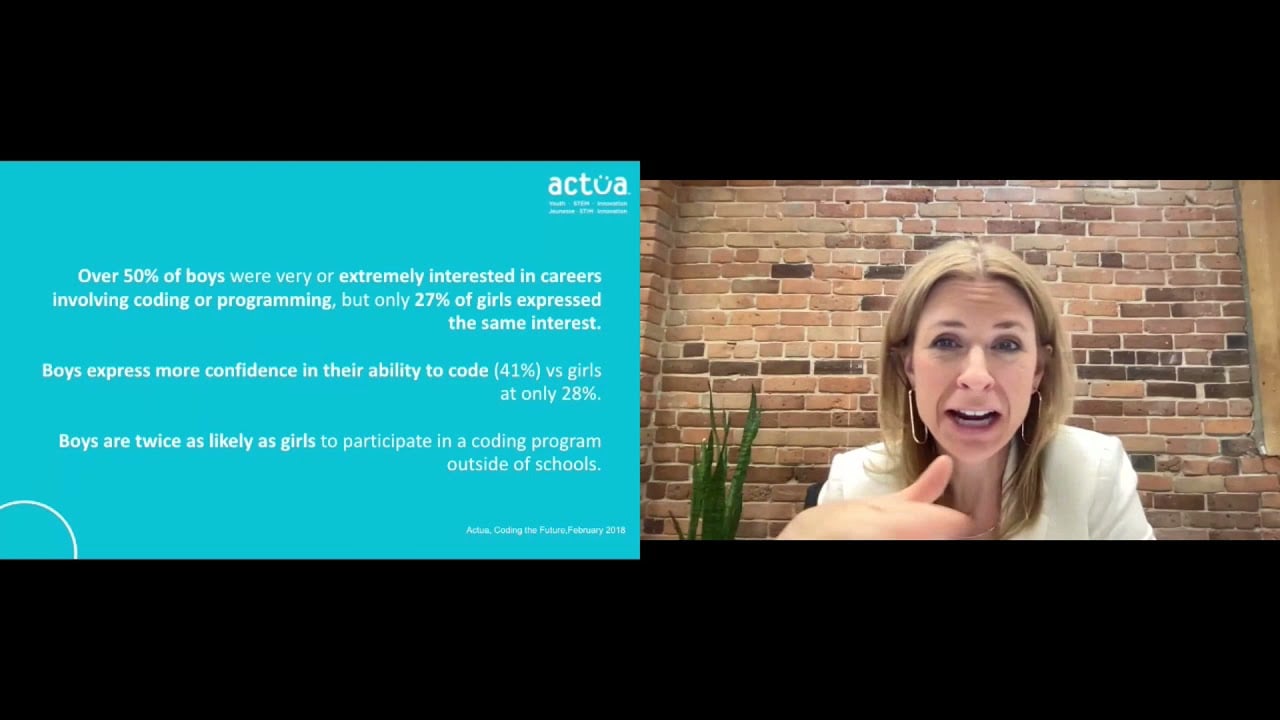
How to ensure that technology is bridging and not widening the access gap in the global south
Huguette Diakabana21:322021
If you can watch this talk, you already hold power many women lack
Joining an online tech event means having electricity, paid internet, literacy and a digital device, and many women in the world still cannot count on them. Huguette Diakabana, a member of the WHO Digital Health Technical Advisory Group, traces her own path from a girl who thought science was not for women to deploying technology across Africa. What turned it around, and what can any woman in tech do from where she stands?
Learn three concrete ways to open doors for women in low-resource areas, at any career stage
Huguette Diakabana, a WHO digital health advisor, argues that women in tech hold access many women in the global south lack, and that they can use it to bring others along. Through her own story, from a woman science teacher and a science camp to a former boss who recommended her for work across Africa, she shows how being visible, handing over opportunities and passing the mic can widen access rather than leave women behind.
“You don't even have to encourage them to do the same, but tell them what you do. And the simple fact of seeing a woman doing what you're doing can spark interest.”
“Go ahead and pass the mic, give them the opportunity to share their experiences. Because what that does is that it validates all of our experiences.”
What you will learn
Recognize the hidden access (power, internet, literacy, devices) that participation in tech assumes
Use your own visibility to show girls what women in technology actually do
Spot moments to hand an opportunity to a current or former team member who can rise to it
Recommend people who do not fit the usual mold for boards and advisory roles
Challenge your own image of who counts as a talented problem solver
Key takeaways from the speaker
Including local voices in developing new solutions leads to more effective and user friendly technologies
Local women understand the problems and are already working to solve them, it is wise to leverage their understanding
It is vital to ensure that technology is bridging the gaps and not widening them
We win when we pay attention to trends started by local developers, innovators, and technology users
Talent exists everywhere, but opportunities are scarce. Using our positions to extend opportunities will lead to the results we seek.
Details
Level
All levels
Format
Talk
Technical depth
Non-technical
For
All career stages
Length
21:32
Published
June 2021
Questions this talk answers
Why are many women in the global south at risk of being left behind by technology?
Taking part in tech assumes electricity, affordable internet, literacy and digital skills that many women in the world still lack. Diakabana says those who are well positioned need to make an effort to bring them along.
How can simply being a woman in tech inspire girls?
Diakabana did not know women could be scientists until a woman taught her science in seventh grade. She urges women to tell girls what they do, because seeing a woman in the role can spark interest.
What can a manager do to help women from low-resource areas?
Learn what team members want to do and, when an opportunity comes up, hand it to them if they can rise to it. Her former bookstore manager did this and set her on her career path.
What does 'pass the mic' mean?
Recommending people who may not fit the usual profile of a board member or advisor but have the know-how to help an organization. This validates their experience and changes the image of who is a tech person or problem solver.
Do you need to be senior to extend opportunities to other women?
No. Diakabana says whether you are a student, early in your career or advanced, you can help another woman find her way into tech.
About this talk
If we don't consider the global south context, we risk widening an access gap that will devastate women in the global south for years to come. Technology allows us to address global health gaps in ways we haven't been able to do in the past. However, to ensure that it bridges rather than limit access to conducive work conditions, quality care, and socioeconomic gaps, we must ensure diversity in developers, policymakers, and local voices in the process of defining solutions. We must ensure that we include and elevate women's voices. Women are often at the center of solving community problems at the local level but are not always visible at decision-making tables. That needs to change if we're to ensure actual progress. Proximity to the issues we're looking to solve inspires an unmatched understanding of problems that lead to developing practical and useful technologies. This talk will focus on ways emerging technology development approaches must shift to also benefit women and girls in the global south.
The woman science teacher who changed everything (54 s)
Hand your team members the opportunity (78 s)
Pass the mic to those who don't fit the mold (64 s)
Speaker 1: Thank you again everyone for joining me this evening for me. It's morning probably and maybe even late in the evening from more of you. Today I wanted to take this time and talk about what we can do as women in the tech environment to ensure that as innovation evolves and we move forward, that we don't know what we can do as women in the tech environment.
We don't leave women who are residing mostly in the global south and that's a term that we use in development. So it refers primarily to Africa, parts of Asia, to Latin America and to leave them behind. Again, my name is Huguette Diakabana. I am currently an advisor to the World Health Organization. So my work is advising at the WHO on how to find themselves, how to, where to place themselves in this fast moving environment and how to best use technology to ensure that health outcomes improve and especially involving people in marginalized communities all throughout the world. I've been introducing technology to people now for about 10 years. I worked in education. I've worked in community development in collaboration with mining companies to develop rural communities who are impacted by rural communities who are impacted by mining activities. For the last five years also, I've been working in health. Again, as I said, introducing technology in the health space so that we can best figure out, address the many issues that exist.
And the pandemic, and the pandemic, and the pandemic, and the reason I wanted to talk to you all and share some of my experiences with you all this evening is exactly because the pandemic has highlighted the dire situation that exists in some parts of the world. We see technology, for those of us who interact with it regularly, as a way to move us forward.
But I'm not sure you won't be surprised to hear that that's not the case for everyone. So if you're here, if you were able to find, to be here this evening, it means you have power, it means as in electricity, or generator, some way to generate power. You have access to internet. You're able to pay for internet. That works well enough for you to be able to join a community like this.
You're able to, you're literate, you're able to sign up and you know how to use a digital device. Many women in the world still don't know how to do it. In some small ways, the work that I'm doing and similar work that others are doing is slowly getting to that, but we really, there needs to be an effort by all of us, those of us who are well positioned, whether it's at entry level or at management level or even at the levels of founders, all of us have something that we can give to make sure that women all over the world move forward with us.
So I would like to, the talk I give about this, I call it soul sisters in tech. And the term soul sister signifies for me, people who are, who are connected in some shape or form. And I see women who utilize tech in any aspect of their lives, as people who recognize the value of it, and therefore are able to help bring others along.
And to also benefit from in the same way we have to, so I'm going to start talking from talking about some of my early experiences, how I even became, I even got into health. So until I was about 11 years old, I actually had no idea that women could be scientists. I always thought of, I had women teachers, but whenever it came to learning math or anything related to science, or I wasn't even introduced to technology until I was about 12, that it was not for women.
So in seventh grade, I had a science teacher who was a woman. And just the fact of having a woman teaching me science sparked this new interest. It was open, it opened up a whole new world for me. And so that's an example of how much just being us, just being a woman in this space, um, can be an inspiration to a little girl, a small child, um, out there in the world.
And so I encourage you in, in, in, in, in, in your daily lives, whether it's at your work in your neighborhoods, um, any opportunity that you might have to talk about who you are and what you're doing and how you're using technology and make sure that the kids around you get to hear that. Because the interest, um, the, the passion that you have for your work can spark something in a child who doesn't even know that this is a possibility.
So really introducing technology early to women and to girls, um, I, all over the world is, is key. I know in the U S there are a lot of programs for, uh, for technology throughout the world, it's still something that's not available. So if you work internationally and you work where there are communities that are not as low resource for what girls don't necessarily have access to people like us, I challenge you.
And I, I, I ask you to make an effort and find a way to go and talk to little girl, to girls and just tell them what you do. You don't even have to encourage them to do the same, but tell them what you do. And the simple fact of seeing a woman doing what you're doing can spark interest.
And so the other thing this teacher did for me, she noticed my interest and what she ended up doing, giving me a gift that propelled me into the career that I'm doing today. She, uh, sent me to a science camp. Another thing I had no idea existed that women go kids can go to a place and spend their entire summer looking at science, doing experiments, figuring out how things worked.
And so that was my first introduction to the, to how much, how exciting it can be. And at that camp, I was introduced to coding early on, and it was exciting for me to know, my goodness, I can build something. I, we used to play video games at home and I could do, you know, very beginner versions of, I think spaceship was the first game I learned to code as a 12 year old.
And it was just being able to create something. Um, it was incredible for me. And even though I was going to go back to my normal life, uh, we were, my family's from Congo and we immigrated to the U S. Um, in our lives that we were really at the beginning of figuring out life at the U S and going back to that after this camp just opened up another world to me.
I knew that at some point I had to make it through school because as an adult, there was this whole world where you can code program things and create, um, create whatever you wanted, solve problems using computers in some shape or form. So that's where my interest, um, started and as we spark. And today I'm, as I mentioned, I'm working with the world health organization that I've, uh, done many programs throughout Africa.
Uh, I worked on a program that, that led, uh, we use community surveillance program that led to the end of declaration of polio in, in Africa. And all of that would not have been possible without this teacher early in my life. One, just by being herself showed me who she was, um, to notice my interest and show me who she was and what was possible for me as a girl.
Notice my interest in science and, and, um, had me attend this camp and encourage my learning. And once I got there, it just, it opened up another world for me. And this, this, uh, fortune of meeting amazing people continued on in my life. So when I began to work, uh, my very first manager, I was only 19 and she was still in the early 20s.
So this is to show you how much at any point in our lives, we can do something that makes a difference. Uh, especially for women who aren't as fortunate or who are, uh, from low resource areas. This, uh, boss of mine, we talked, I, it was a, it was a part-time job that I had at a bookstore.
And I told her about my dream of returning and working in Africa and doing something at the time. I was really passionate about education and how much, how much it opens doors for people. And I told her I wanted to figure out a way to integrate technology and how we educate young, um, young people, uh, mainly in my own country of Congo, but throughout Africa.
Uh, I worked with her for about two years. I left the company and she remembered this. So about three years after I left the company, I get a call and it's, she, it's my boss, my former boss, who, um, I've moved on. I've, you know, I was about my mid, my early twenties. Uh, she and her in her late twenties, uh, calls me and tells me that she met the CEO who's doing a technology, who's doing a scholarship funding program in 11 countries in Africa.
They were looking for someone to go and do an assessment. And she was going, they wanted her to go do that job. And she recommended me. She was also African. She also wanted to go back home, but she knew my, my, um, my desire to do this. And she knew my passion for technology because that was one thing that they wanted to just figure out how to integrate technology into their program.
Um, so she handed me that opportunity. And that my friends is how I returned to, to Congo, um, worked in 11 countries and eventually, um, kept working and, and to be where I am today. And so that's just to say, uh, the lesson that, that experience, um, taught me was that in, within wherever we're working, um, whether it's at a fast food, whether it's at, you know, at a, at a big tech company or at a small company.
Uh, especially those of you who are in, in, whether it's in the U S or other places where, um, women are still figuring out where to go young. Women are still trying to figure out their career. Um, you can encourage, you can encourage them to explore and share their dreams. You can encourage them to figure out, um, to encourage them to figure out ways to make it happen.
And more importantly, as a manager, you might have some opportunities that they don't necessarily have. And that when they might, it might be a time where, you know, something comes up and you remember this, this either current or former employee of yours, um, do go ahead and hand them that opportunity, especially if you know that they're able to, to, um, to rise to the occasion.
Um, my, my former manager had no idea what I was able to do. She had no idea what my technology skills, uh, were, but when an opportunity showed up that could utilize most of my, my, my skills, the ones that I've demonstrated and also give me an opportunity to learn new skills. She called me, woke me up at 10 PM and set me on a path that has led me where I am today.
And so wherever you are, keep your eyes open, figure out what, what your team members want to do, whether it's within your companies or outside. And these, this idea of sponsoring each other, of turning opportunities over to those who need it is one key ways of making sure that more of us, more women from low resource areas all over the world are also able to grab some of these opportunities that they may not necessarily, um, have access to.
And the last thing I wanted to share is the last experience I'll share is that in my own work. So I'm currently in different on different boards. Um, and I call this part pass the mic and celebrate, and I call it pass the mic because the reason I'm even on this board again is because people who knew of the work that I've done and they were, you know, small projects in a village somewhere.
And then the eventually recommended to a larger project. And eventually I started doing regional projects. So deploying, um, technology in multiple countries and still in central and West Africa, those people notice my ability to manage. To build teams. And they started recommending for boards over recommending me for boards of organizations who could use that, um, the, the, the knowledge and the experience that I've acquired.
And so that's what I mean by pass the mic. So when you, when we see that, you know, there are, and I don't fit the profile of a usual board member. Um, when you, when you know of someone is, uh, especially, you know, again, all over the world, but especially those who are not, don't come across opportunities.
Or those who may not fit the mold of, you know, a board member or, um, or, or, or an advisor, but you know that they have the know-how they can help this organization as a company move forward. Go ahead and pass the mic, give them the opportunity to share their experiences. Because what that does is that it validates all of our experiences.
Um, it, it, it, it changes the image of who is a tech person or who is a manager or who is a problem solver. Um, and in doing so, we are able to ignite this inner light, um, in, in, in, in people. And the more opportunities we share, the more opportunities, uh, women in low resource areas receive.
I'm one, so I can tell you the more we learn and the more we shine. And we are, we keep on rising and we can also make contributions that are, wouldn't otherwise be made if we didn't have these opportunities. Um, I shared in my takeaways, uh, for, for, you know, for the talk, uh, several points. But what really I want to emphasize here by sharing my own experiences, by encouraging you to also, uh, take into, um, extend opportunities, no matter where you were in your career.
Uh, it's that. Recognizing that talent exists everywhere. People who are talented may not match our traditional image of who a talented person is. Uh, but if we will be, you know, it's surprising what happens when you give someone a chance, how much an opportunity, how much they might be able to surprise us. We might be overlooking current and future problem solvers ever because we, we have a certain idea who even, even among us women, a certain idea of who can be a problem solver.
Um, but you know, let, if you hear someone who has a desire to learn, who has a desire to contribute, if you're in a position in any way to give them a chance, do so because you can be, people can surprise us. And really what, what I would love for you to retain is that each of us, no matter where we are, we can be a student, um, early in our careers or advanced in our careers.
We have opportunity to extend opportunity, uh, to extend, um, to bring other women into the use and, and, um, in, of technology. No one is too, uh, it's never too early in your career or never too in your career to make sure that another sister finds her way to this tech world. Uh, I'm going to stop here and, and see if there's any question.
Uh, Winifred, thank you so much for your interaction. I, um, yes, I do agree. And my goodness, um, thank you for founding, finding this, uh, association for women in, in, in engineering. And these are the types of things that we really do need. Um, yes, talent is ubiquitous. We really do need to have, if you, if you are empowered.
And one of the things I loved about returning to Africa is that all these women are, and I was just blown away by what African women have been doing. And part of why I've made it to where I have is because of all of the examples that I found when I returned there, whether it was someone opening a school with really meager funds.
Or someone doing informal training program. I'm, I volunteer for a woman who had, um, tech under the tree. We were teaching, um, we're using pictures and teaching girls about what computers are the history, what you can do with them drawing because we know the lady who started didn't have access to computer. Her son, um, was studying them at university, also without a computer.
So she wanted to, you know, pass, uh, pass that knowledge along. So no matter where we are, we can really, we can really share what we have already learned, what we already know and transform, um, a life. And is, are there any, um, questions on your part that I can share, whether it's about my own experiences in my career.
And I mentioned that I work with, uh, the world health organization and we're figuring out how to, uh, use technology in health and really figuring out a way to make sure that more women are at the table as we're developing these solutions that we're using in the health sector. Uh, figuring out that how to ensure that more women are not just making the decisions, but also developing the programs, um, developing digital literacies is, is some of the, the key aspects.
We realized that in order to solve health problems, we need to make sure that the people who understand these issues are equipped with knowledge necessary to, uh, address these problems. Yes. Esther, will you tell us how, what led you to, um, to want to do this? Um, to want to create this association that you founded, if you're still here.
It's always interesting to find out what people's motivation, um, are. Mine is because I'm, I, I know what it's like to grow up in a place where, um, you really, there isn't, you can't even dream because the possibilities that exist are just not presented at all. Uh, and moving to the United States helped solve that for me.
It showed me how much, um, how opportunities can change, um, how many, how opportunities, how many opportunities actually exist. And I mentioned this teacher of mine and I kept meeting women who were, uh, in professional setting women, um, who were doing way more than I ever thought women could do. So. Okay. You live in, in, in Charlotte.
Yes. And, and I think you, you exemplify what I'm talking about, where you are in a position where you can, um, you can share, you can do something about the issues that women are facing all over the world. And you've decided to take a step and start this, um, organization. I will check out your, um, I'll check out your association.
If you have online presence, we are about a minute left, uh, for, for this talk, but I want to thank everyone for joining, um, for joining me today, this evening for me. And, um, wherever you are, wherever you, you, you, you, whatever you're doing, please know that you can certainly do something at this point to make sure that you open a door for another woman.
So thank you again for, um, for joining me today. I look forward to connecting with all of you, um, at some point, have a good rest of your day. And Esther, thank you so much for your engagement. Yes. Esther, please. Um, I'm making notes. Let's let's connect on LinkedIn. I'd love to hear more. And I'd love to hear more about if you came here, it means that you're, this is a, this topic is of interest to you.
So I would love to, um, to hear more about you and what you're doing and, uh, always open to collaborating and in advancing, um, each other's work. Uh, so please do connect. Okay. Well, I'm going to, uh, respect the time that I was given, uh, again, thank you so much for joining me this evening. And, uh, ah, okay.
I'm so, I'm so sorry, Winifred. I don't know. I have a good friend named Esther. So I, I, I noted, um, I searched your correct name. Don't worry. Oh, goodness. Uh, the, the name Esther stood up for me. Um, anyway, well, it's, it was good to meet all of you and enjoy the rest of the conference. All the best.
Transcribed automatically; names checked against the speaker record. Select a time to jump there.
Article based on this talk
How women in tech can make sure the global south is not left behind
Huguette Diakabana shows how visibility, sponsorship and passing the mic open doors for women in low-resource areas.
In short
Huguette Diakabana, a digital health advisor working with the World Health Organization, argues that every woman already working in tech holds access that many women in the global south still lack, and that she can use it to bring others along. Drawing on her own path from Congo to the United States and back to programs across Africa, she describes three practical ways to do this: be visible to girls, hand opportunities to people who need them, and pass the mic to those who do not fit the usual mold.
Key takeaways
Including local voices in developing new solutions leads to more effective and user-friendly technologies.
Local women understand the problems and are already working to solve them; it is wise to leverage their understanding.
It is vital to ensure that technology is bridging the gaps and not widening them.
We win when we pay attention to trends started by local developers, innovators and technology users.
Talent exists everywhere, but opportunities are scarce. Using our positions to extend opportunities will lead to the results we seek.
The access many of us take for granted
Diakabana opens by defining the global south as a development term covering primarily Africa, parts of Asia and Latin America. She explains that she has spent about ten years introducing technology to people in education, in community development alongside mining companies, and, for the last five years, in health. The pandemic, she says, highlighted how dire the situation is in some parts of the world.
She then turns to the audience itself. Simply being able to attend an online event means having electricity or a generator, paid and reliable internet, literacy and the skills to use a digital device. "You have access to internet. You're able to pay for internet." (2:12) Many women in the world, she notes, still cannot do this, and closing that gap needs an effort from everyone who is well positioned, whether at entry level, in management or as founders.
A woman at the front of the science class
Diakabana calls this talk "soul sisters in tech": women who use technology recognize its value and can help others benefit from it in the same way. Her own story starts with a surprising admission. "So until I was about 11 years old, I actually had no idea that women could be scientists." (3:44)
Everything changed in seventh grade, when a woman taught her science. "So in seventh grade, I had a science teacher who was a woman. And just the fact of having a woman teaching me science sparked this new interest." (4:24) That teacher also noticed her interest and sent her to a science camp, where at 12 she learned to code a simple spaceship game and discovered she could build something. Her family had immigrated from Congo to the United States, and the camp opened up a world she had not known existed.
The lesson for the audience is direct: talk to children, especially girls in low-resource communities, about your work. "You don't even have to encourage them to do the same, but tell them what you do. And the simple fact of seeing a woman doing what you're doing can spark interest." (5:45)
The phone call that changed a career
Her first manager, at a part-time bookstore job when Diakabana was 19, was only in her early twenties herself. Diakabana told her about her dream of returning to Africa and integrating technology into education. Years after she had left the job, that former boss called. A CEO running a scholarship funding program in 11 African countries needed someone to do an assessment, and the former manager, who was also African and also wanted to go home, recommended Diakabana instead.
"She called me, woke me up at 10 PM and set me on a path that has led me where I am today." (11:28) Diakabana stresses that her manager did not even know the full extent of her technology skills. The point for managers anywhere, from fast food to big tech, is to learn what team members want and to hand them opportunities they can rise to. She describes this kind of sponsorship as one of the key ways to make sure women from low-resource areas can reach opportunities they might not otherwise access.
Pass the mic and celebrate
Today Diakabana sits on several boards, and she credits people who noticed her work on small village projects, then larger and regional deployments across Central and West Africa, and recommended her. She acknowledges she does not fit the usual profile of a board member.
Her ask is to do the same for others who may not fit the mold of a board member or advisor but have the know-how to help. "Go ahead and pass the mic, give them the opportunity to share their experiences. Because what that does is that it validates all of our experiences." (13:35) Doing so, she argues, changes the image of who is a tech person, a manager or a problem solver.
Talent exists everywhere
Diakabana closes her prepared remarks with the idea at the heart of her takeaways. "Recognizing that talent exists everywhere. People who are talented may not match our traditional image of who a talented person is." (14:51) Even among women, she warns, a fixed idea of who can solve problems means overlooking current and future problem solvers. No one is too early or too far along in their career to help another woman into tech.
Responding to comments from the audience, she describes being blown away by what African women were already doing when she returned, from opening schools with meager funds to informal training. She volunteers with "tech under the tree," started by a woman without access to a computer, which uses pictures to teach girls what computers are and what they can do. At the WHO, she adds, the work includes making sure more women are at the table developing health technology, with digital literacy as a key aspect.
Watch the talk
"How to ensure that technology is bridging and not widening the access gap in the global south" by Huguette Diakabana, about 22 minutes: https://www.womentech.net/video/huguette-diakabana-how-ensure-technology-bridging-and-not-widening-access-gap-in-global
About the speaker
Huguette Diakabana is a Digital Health Advisor and Aspen New Voices Fellow with the WHO Digital Health Technical Advisory Group and the Aspen Institute, and a global health and digital transformation leader on Harvard Medical School's executive programs teaching team. She has managed and deployed technology-based solutions in global health, education and mining community development programs in over 20 countries in sub-Saharan Africa.
Questions this talk answers
Why are many women in the global south at risk of being left behind by technology?
How can simply being a woman in tech inspire girls?
What can a manager do to help women from low-resource areas?
What does "pass the mic" mean?
Do you need to be senior to extend opportunities to other women?
Drafted with AI from the talk transcript. Editor review pending.
Frameworks and ideas mentioned
Soul sisters in tech
Pass the mic and celebrate
Cite this talk
Huguette Diakabana. "How to ensure that technology is bridging and not widening the access gap in the global south." WomenTech Network, 2021. https://www.womentech.net/video/huguette-diakabana-how-ensure-technology-bridging-and-not-widening-access-gap-in-global