Inspiring the next generation of women as STEM Leaders
Jennifer Flanagan21:112021
Half of women in tech leave by 35, and the gap opens long before work
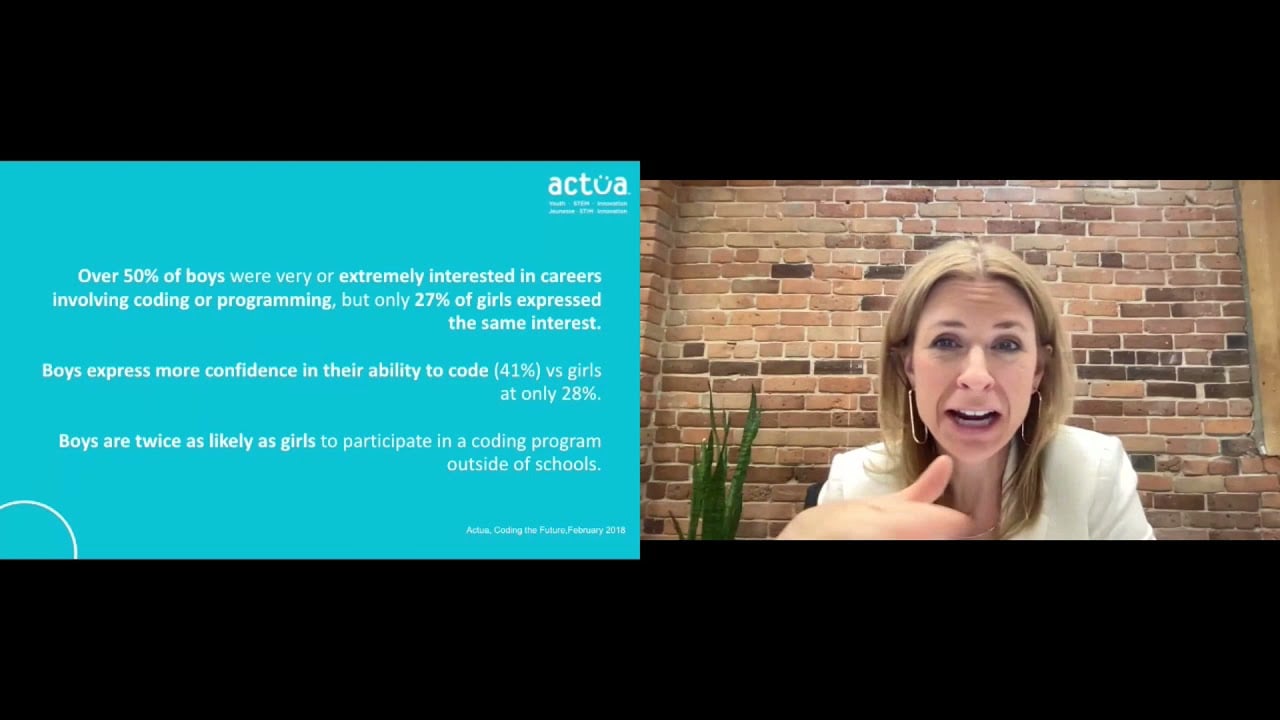
When Actua asked young Canadians about coding, boys and girls alike called tech skills vital to their future. Then the numbers split: over half of boys were extremely interested in coding careers against 27% of girls, and boys had twice the chances to practice outside school. Jennifer Flanagan, CEO of Canada's largest STEM outreach organization, asks what parents, mentors and companies must change to tip a gap that years of effort have not closed.
Learn the four levers Actua uses to build girls' confidence and opportunities in STEM
Jennifer Flanagan, President and CEO of Actua, argues that the gender gap in STEM persists despite booming tech jobs, and that it opens early: Actua's national youth survey found boys more interested, more confident and given more opportunities in coding than girls. She outlines how to inspire the next generation of women in STEM by engaging girls early and often, showing them role models, creating safe spaces online and offline, and pushing for systemic change.
“50% of women in tech roles leave by the age of 35.”
“So what we know is that, you know, progress kind of needs to hit a tipping point and we haven't hit that tipping point, despite the fact that we've been working through this for a number of years.”
What you will learn
Explain why gender diversity in STEM leads to better products, research, innovation and business results.
Spot the interest, confidence and opportunity gaps that open between boys and girls well before career choices.
Apply four levers for engaging girls: early and frequent programs, visible role models, safe spaces and systemic change.
Plan for online safety so that girls' positive STEM experiences are not undone by negative encounters online.
Key takeaways from the speaker
Diversity in STEM is critical
Women’s participation in Tech is critical.
How do we increase diversity in TECH/STEM?
Solutions to diversifying TECH/STEM
Details
Level
All levels
Format
Talk
Technical depth
Non-technical
For
All career stages
Length
21:11
Published
July 2021
Questions this talk answers
Why does gender diversity in STEM matter beyond fairness?
Flanagan says diversity leads to better products, better research and more innovation, and that more diverse companies see better bottom-line results.
What did Actua's survey of Canadian youth find?
All groups saw tech skills as important to their future, but over 50% of boys were extremely interested in coding careers versus 27% of girls. Boys were almost twice as confident and twice as many had had opportunities to learn outside school.
How can we get more girls engaged in STEM?
By engaging girls early and often through programs, offering mentors and role models who look and sound like them, creating safe spaces online and offline, and advocating for systemic change from the boardroom to government policy.
Why do so many women leave tech roles?
As the speaker cited, 50% of women in tech leave by 35, which she links largely to culture and missing support systems while women still carry most home and childcare responsibilities.
Who does Actua's girls program serve and where do its mentors come from?
It mainly works with girls aged nine to 14, with mentors drawn from universities, colleges and corporate partners, all vetted and trained.
About this talk
Many business leaders say that technology holds the key to economic recovery post-pandemic. But, while technology, and STEM more broadly, may play a critical role, there remains a significant problem threatening the potential of its workforce - the persistent and widening gender gap. For far too long, women have been underrepresented in STEM, and the ongoing pandemic has only exacerbated this gender gap. The good news? The pandemic has presented an opportunity to re-energize progress towards gender equality in STEM, which starts by making STEM more inclusive for the next generation.
Boys get twice the tech opportunities of girls (69 s)
Role models and safe spaces for girls in STEM (84 s)
Jennifer Flanagan: My name is Jennifer Flanagan, and I am going to spend the next 20 minutes with you talking about girls and young women in STEM. And because it's a smaller group, that gives us the opportunity to have more dialogue and more discussion. So I do encourage you to write comments in the chat or ask questions in the chat. There is a question period at the end. I was going to leave some time for questions. But because of the size of the group, I'm super happy to be responsive to the chat. So if there's anything that you want to share about your experience or questions that you have, please do that. And I will keep an eye to to that as well. So let's, let's get let's get started. And again, thanks for taking the time to, to
spend talking about this topic, which is such a critical topic. Globally, I certainly know in all of the countries that you're representing, this is, this is continues to be an issue. And certainly, I am coming at this from a perspective in Canada. And that is where I'm going to ground a lot of this content. But again, very applicable in a global global context. So just to give you a snapshot first of Actua. So that's the organization that I am the CEO of. And in in in Canada, we of course, province and territories, 13 provinces and territories across the country. Actua is a national organization.
So we deliver across all of those 13 provinces and territories. And our mandate is to promote confidence and skills in science, technology, engineering and math. So we do that for youth right from kindergarten. So here, that's five year olds, right through to 26 year olds, who are the people that we actually employ to deliver our programs. So to give you a sense of our model, and of course, I'm going to be talking about this topic. And then I'm going to come back and talk about what Actua does to encourage more girls in STEM. But it's helpful for you to have a little context. So I'm happy to see other people joining. Navina from Slovenia and Europe.
That's fantastic. Welcome. And people coming at this topic from lots of different angles. So as professionals in this field, it's important for us to know about this and to care deeply about this, as parents, as you know, people who have young women in our lives, but also potentially as as young women ourselves, who are still facing barriers, and needing to be aware of some of the challenges that exist to pursuing higher levels within the STEM fields. So in Canada, we are a very multi multicultural country. And that said, we are struggling right now as a country with some really horrible events of late that involve very deep ceded racism and those are involving both our Muslim community and our indigenous communities.
So this country is in a moment of deep reflection and struggle. It's customary, certainly for Actua to always recognize when we do presentations, the indigenous lands that we're speaking from. So today, I'm in Ottawa, which is the capital of the country. It's also unceded Algonquin territory. So recognizing the Algonquin people whose land we are presenting from. This topic is incredibly relevant to what's happening in Canada. And in fact, what's happening around the world. And that is the efforts to promote diversity and inclusion and inclusion and equity. We're talking about it in STEM, but it certainly has really important connections to to this topic on a whole. So to get into the STEM piece. Oops, sorry. I Thank you. So to get into the STEM piece specifically, of course, you know, STEM jobs as they are in all
the countries that you represent are incredibly important to the economic prosperity of the country. STEM, the STEM industry is a cornerstone of innovation in Canada, certainly. And we have a lot of fast growing, fast growing sort of hubs of technology development. So places like Montreal and Waterloo, who are, you know, quickly climbing to the top of fastest growing tech hubs in North America. Montreal becoming a, you know, a world center for artificial intelligence, for example. And, you know, technology has, needless to say, has become not only an imperative in our economy, but also in all of our lives as we've moved through the pandemic and, you know, really been forced to do everything we normally do online.
The other thing that is happening, of course, is the recognition of the importance of STEM skyrocketing due to the pandemic and the recognition that fighting the pandemic and dealing with the pandemic has has really been on the shoulders of a lot of scientists and healthcare professionals and, you know, technology folks who have been working on innovations to guide us and to advance us through the through the pandemic.
So all that to say that, you know, the growth of of these sectors is significant. This is in Canada, for example, and you can see that between February and 20 and October of 2020. You can see that that uptick in in STEM occupations in Canada. So an 8.7, almost a 9% increase in STEM jobs. And that represents roughly 100,000 new jobs created in that time period, well above, well above the norm. So all that to say that technology continues to play a significant role in the country and in future employment opportunities. But with that comes the the need to recognize this ongoing gap, which is in gender equity, I mean, diversity broadly. And I'll actually talk about that because actual works across the boards in terms of not only encouraging girls and
young women and people who identify with those groups, but also we work extensively with Indigenous youth and with other racialized youth, including youth who are facing other socioeconomic challenges. So the, the work to recognize that there's a massive gap, even though these fields are growing, even though there's more jobs, we're still really struggling with representation in those areas. And, you know, in Canada, at least, people that are in these jobs continue to look more like this slide, right? So we have a very very dramatically tipped science and tech field in the favor of mostly, mostly men.
: And we continue to see and experience those kind of iconic technology folks as male, the people like Bill Gates and Zuckerberg and Elon Musk, all of whom, you know, do not certainly do not reflect the kind of diversity that we know we need to see in these fields in the future. : So, um, you know, gender inequality in technology and in STEM more broadly is just still very much a reality, even though a lot of people would like to think that, you know, we've been working on this forever and, and we've made a lot of strides, but there's still, you know, massive, massive challenges.
And I'm going to talk about a couple of those. So in Canada, Canadian women are far less likely to pursue higher paying STEM fields, : Um, such as engineering and computer science. So that is, uh, still reigns true across the boards. Uh, there are certainly fields in science and in some, uh, specialties within engineering where we've made significant, um, gains, but continue to, to be, um, underrepresented. And these again are the highest paid and most plentiful jobs of the future. So this has broad economic and social impacts. Uh, this is another important one, and we'll maybe speak to some people on the call. 50% of women in tech roles leave by the age of 35. And, um, that is to me astounding still to see those numbers and
to know that, you know, a lot of that is due to the kind of culture and the support systems that lack in the tech sector for women who in Canada still, um, do maintain, um, the majority of the responsibilities in the home and with children as well. Um, and this is reflected in colleges and universities in terms of, uh, enrollment rates in first year, we do have some really bright success stories. So for example, U of T engineering, um, is coming close to hitting 50% of undergraduate students in engineering being female. So first year, I think they're in the low forties, which is, um, you know, they're leading the country. There's a few other institutions that are approaching that. So that's been years and years of hard work on, on their part. But again, across the country,
the average is still quite low. Um, this is where I want to just tell you about kind of anchored back to, uh, girls and women in STEM and what this, what, what young people in Canada anyway are thinking about. So last year, the year before last Actua went out across the country and talked to young people in Canada. And we asked them about their attitudes and their confidence about, uh, technology, about digital skills, about coding. And we were really interested to know, you know, do they recognize that these are really critical, important skills? Um, that was a really important first question. Do they see this as, as necessary for their future? And then the second, the, the, the subsequent questions were around how confident they were and whether or not they had enough opportunities to learn. So the good news
was across the boards, student or kids, parents, uh, boys, girls, they all recognized that technology skills were really important to their future, um, and would be important in whatever career they chose to pursue. And that's where the kind of good news ended with this. Um, and as you can see with some of these stats, so, uh, over 50% of the boys were very, were extremely interested in careers involving coding or programming while only 27% of girls express that same, um, interest. Boys express more confidence.
So to the tune of almost double. So boys are almost twice as confident in these areas as girls. And then the third piece is around opportunities. So we asked them, do you have, have you had opportunities to learn these skills or, um, you know, or practice them or explore them, uh, um, outside of school and twice as many boys had had those opportunities as girls. So boys are thinking about this more at this age. Um, and, uh, they're twice as confident and they've had twice the number of opportunities.
And that again, speaks to the broader issue of, you know, who's facilitating them to have these opportunities and, and why aren't girls getting the same level of, of, of opportunity. So we know, and, and I, I'm sure I don't have to, um, tell you that, you know, the diversity and, and inclusion and equity is not just for equity sake. It is all, which is important, but it's also because it leads us to better results in these fields. It leads us to better products. It leads us to better research. We're more innovative. Um, and it, it, it just has better bottom line results for companies that are more diverse. So gender equality is very linked to better economic, um, outcomes. So the, okay. The more that we invest in this, um, uh, the better it is for, for all of us. So how do we
inspire the next generation of, of women as, as STEM leaders? So what we know is that, you know, progress kind of needs to hit a tipping point and we haven't hit that tipping point, despite the fact that we've been working through this for a number of years. I think that during the pandemic, we have the opportunity to, um, there's a resurgence of interest in this area of recognition. You know, women have been disproportionately impacted and have left the field in, in vast numbers. And you know, this is, this is something that we need to take advantage of as a moment, um, in time. So a couple of things about how we do that. So how do we get more girls engaged? Um, the way we approach this is,
is by engaging girls early and often. We know that STEM education and getting them involved in STEM programming builds skills that are necessary for them to, um, be successful in these fields in the future, but also just to generally have the confidence, um, and the skills that they need to continue looking for these and taking these opportunities, um, on. So the, the programs that exist, especially outside of schools for girls to do this are really important. Mentors and role models, which we all know, and we've heard over and over and over again, but it remains to be very important.
If girls don't see anyone that looks or sounds like them, then they are continue, they're going to continue not to envision that as, um, as what they can be in the future. So that can, you know, changing how we're presenting and who we're presenting, um, in terms of who does STEM or who does, you know, computer science continues to be very, very critical. Creating safe spaces is, uh, of course, something that we work on as an organization that's working with youth, especially vulnerable youth, making sure that they have, um, a supportive environment where they can explore and create and make mistakes and learn. Um, that has now shifted for us into online spaces. Of course, kids are online more than they ever have been. And there's a whole host of issues. And I don't have
time to get into those, but girls in Canada, at least are experiencing a huge increase in online victimization and online things like trafficking and, uh, radicalization to violence, all kinds of very negative things are happening. So the importance of creating safe spaces online has also become very critical. Um, and then from a systemic change perspective, we know that this starts at the top and we need to continue to advocate for the kind of changes, um, from the boardroom to the C-suite to the way that policies are constructed by governments, all of those, uh, being incredibly important.
So putting this all into practice, I want to give you a sense of how Actua does this work very quickly. So we have a national girls program, which is a series of all girl initiatives where we, um, give girls those opportunities outside of school to, to learn about and practice coding and computer science and other digital skills where they're able to then apply those skills to real life, um, problems.
They're exposed to mentors and role models. Um, and really they have a chance to see that this, in fact, is it, is a field that they can be really good at just to highlight two other initiatives before, um, I opened things up for questions, but I mentioned the online space and I know this is an issue again, across the globally that, uh, we need to pay attention to. And that is the environment that girls are experiencing when they go online and how do we make that safe? And how do we make sure that all the good work we're doing to encourage them in these fields isn't negated by an online negative experience? So we've actually developed content, um, for, to help girls be safe online. So it does a
couple of things. One, it, it, um, sort of safety proofs them online by giving them the skills, uh, to know how to keep themselves safe online and, and how to, um, be a good digital citizen, but it's also, um, promoting careers in cybersecurity, which we know again are plentiful around the globe, um, and, and super important for us to increase the level of, of, uh, of women in those fields. So, um, that's one of the the things that we're doing. Um, and, you know, with that, I I'd love to just wrap up and see if there are, uh, any questions that anyone has. Um, and, um, I'm, I'm open to questions or comments, um, on anything that I've, I've presented and can people talk or just in the chat, in the chat. So yeah, please do,
um, share anything that you might want to share in, um, in the chat. Yes. Uh, so someone asked if they can get a copy of, uh, the slides and I believe there's, there must be some mechanism for us to do that. We'll, we'll find out about that for sure. And then someone else. Oh, that's great. I'm so happy to hear that, that you're a mentor yourself. We don't, um, we don't work anywhere else outside of Canada currently. Uh, it's such a huge, uh, area for us to, uh, to fill and there's a lot of kids we're still not even reaching here. That said, I, we're super happy to share resources. Our website, actua.ca, you can find, um, a whole bunch of this information, uh, what we're doing, how we're
engaging teachers and parents. Um, a lot of the thought leadership work that we're doing is, is there as well. So I really encourage you to check out our website. You can also, I share a lot of that through, uh, Twitter. My Twitter handle is at actua CEO. So at, um, I'm going to put it here and then you can also follow at actua Canada. Um, how do you find the mentors for them in Canada and what age group is the program for? So at the age group for girls, we typically work with girls. I mean, again, right from five-year-olds to 26 year olds, but we, we tend to work with girls in late elementary school and early middle school. So that would be girls age nine to 14. And we get the mentors, um, from a whole bunch of different places from universities
and colleges from our corporate partners. So actua has a lot of, um, companies that we work with that support our work and allow their employees to be role models and mentors. Um, so that, that works really well. And of course, there's all kinds of vetting and training that happens with those, um, with those mentors and with that, I think I don't see any other questions. So, uh, I, okay, I'll answer that quickly. Um, so how have I started? I just founded it's female. That's great. I'm so happy to see all these, um, these initiatives. Yes, please do, um, reach out and connect with me. The best way is through social media. So again, at Actua CEO, and, um, we started, we started this initiative. Um, it was
very grassroots. So, uh, groups of students really recognize the need to do this and the lack of opportunity for youth to learn about engineering and, and science at the time. So this is more than 25 years ago and, um, started an initiative that really has just grown over the past three decades. So I do encourage you to connect with us on social again, actua.ca. Um, is our website and, uh, you can reach us there to, to continue this conversation. So, uh, with that, I will wrap up our session and thank you again for, uh, attending.
Transcribed automatically; names checked against the speaker record. Select a time to jump there.
Article based on this talk
Why girls still trail boys in STEM confidence, and how to close the gap
Actua CEO Jennifer Flanagan shows where the gender gap in STEM begins and the four levers that help girls stay in the field.
In short
The gender gap in STEM is not closing on its own, even as tech jobs boom. Jennifer Flanagan, President and CEO of Actua, shows that the gap opens in childhood, when girls report less interest, less confidence and fewer chances to practice than boys. Her answer is to engage girls early and often, surround them with role models, protect them in safe spaces online and offline, and push for change at the top.
Key takeaways
Diversity in STEM is critical.
Women's participation in tech is critical.
How do we increase diversity in tech and STEM?
Solutions to diversifying tech and STEM.
Booming STEM jobs, a stubborn gap
Flanagan grounds her talk in Canada while stressing that the issue is global. She describes fast-growing tech hubs such as Montreal and Waterloo and notes that the pandemic pushed science, health care and technology to the centre of daily life. As she cited from her slides, STEM occupations in Canada grew by 8.7% between February and October 2020, roughly 100,000 new jobs.
"So all that to say that technology continues to play a significant role in the country and in future employment opportunities." (5:56)
Yet the people filling those jobs still look much the same. Flanagan points to the male icons of tech, such as Bill Gates, Mark Zuckerberg and Elon Musk, and to Canadian women's lower participation in the highest-paid fields, engineering and computer science. Retention is just as worrying. She links it to workplace culture and missing support systems at a time when women in Canada still carry most responsibilities at home and with children.
"50% of women in tech roles leave by the age of 35." (8:16)
There are bright spots: she highlights University of Toronto engineering, where first-year female enrollment is in the low forties after years of work. Across the country, however, the average remains low.
What young Canadians told Actua
To understand where the gap begins, Actua surveyed young people, parents and students across Canada about their attitudes to technology, digital skills and coding. The first finding was encouraging: everyone agreed that tech skills matter for whatever career they choose.
"And that's where the kind of good news ended with this." (10:51)
As Flanagan presented the results, over 50% of boys were extremely interested in careers involving coding or programming, compared with 27% of girls. Boys were almost twice as confident, and twice as many boys as girls had had opportunities to learn or explore these skills outside school. For Flanagan, this raises an uncomfortable question about who is creating opportunities for children, and why girls are not getting the same level of access.
Diversity is about results, not only fairness
Flanagan is clear that equity matters for its own sake, but she also makes the business case. Diverse teams are more innovative and companies that are more diverse see better bottom-line results, so investing in gender equality benefits everyone.
"It leads us to better products. It leads us to better research." (12:00)
Four levers to inspire the next generation
Flanagan argues that years of effort have not yet produced a breakthrough, but that the pandemic, which hit women disproportionately and pushed many out of the field, has renewed attention on the problem and created a moment to act.
"So what we know is that, you know, progress kind of needs to hit a tipping point and we haven't hit that tipping point, despite the fact that we've been working through this for a number of years." (12:59)
She sets out four levers:
Engage girls early and often. Programs, especially outside school, build both skills and the confidence to keep seeking opportunities.
Mentors and role models. If girls never see anyone who looks or sounds like them in STEM, they will not picture themselves there.
Safe spaces. Girls need supportive environments where they can explore, create and make mistakes. With children online more than ever, and girls in Canada facing a sharp rise in online victimization, this now includes digital spaces.
Systemic change. Change starts at the top, from the boardroom and the C-suite to the way governments write policy.
"So the importance of creating safe spaces online has also become very critical." (15:07)
Putting it into practice at Actua
Actua runs a national girls program of all-girl initiatives where girls learn coding, computer science and other digital skills outside school, apply them to real-life problems and meet mentors and role models. The organization has also built content that helps girls stay safe online and be good digital citizens, while introducing careers in cybersecurity.
"And how do we make sure that all the good work we're doing to encourage them in these fields isn't negated by an online negative experience?" (16:12)
In the Q&A, Flanagan explains that the girls program mainly serves girls aged nine to 14, that mentors come from universities, colleges and corporate partners and are vetted and trained, and that Actua began more than 25 years ago as a grassroots student initiative. She invites viewers to explore resources on actua.ca.
Watch the talk
Inspiring the next generation of women as STEM Leaders, Jennifer Flanagan, 21 minutes: https://www.womentech.net/video/jennifer-flanagan-inspiring-next-generation-women-stem-leaders
About the speaker
Jennifer Flanagan is President and CEO of Actua, Canada's largest STEM outreach organization, and a thought leader and advocate for youth STEM education in Canada. Her work focuses on programs for underserved and underrepresented youth and on closing the gender gap in STEM, and she has twice been named one of Canada's Top 100 Most Powerful Women.
Questions this talk answers
Why does gender diversity in STEM matter beyond fairness?
What did Actua's survey of Canadian youth find?
How can we get more girls engaged in STEM?
Why do so many women leave tech roles?
Who does Actua's girls program serve and where do its mentors come from?
Drafted with AI from the talk transcript. Editor review pending.
Resources mentioned
Actua website (actua.ca)
Twitter: @actuaCEO
Twitter: @actuaCanada
Actua national girls program
Actua online safety content for girls
Cite this talk
Jennifer Flanagan. "Inspiring the next generation of women as STEM Leaders." WomenTech Network, 2021. https://www.womentech.net/video/jennifer-flanagan-inspiring-next-generation-women-stem-leaders