In short
Jitka Steinmetz argues that decades of effort to inspire and encourage girls into computer science have not been enough, because the way the subject is taught at university has barely changed. Drawing on research into gender-based learning preferences and on her own first lecture at the Technical University of Munich, she suggests that teaching built around abstract rules and male-authored materials may be one reason women drop out at higher rates. Her answer is to bring inductive, concrete, visual and context-rich methods into higher education.
Key takeaways
- Gender-based learning tendencies should be applied when teaching computer science in higher education.
Why encouragement alone has not closed the gap
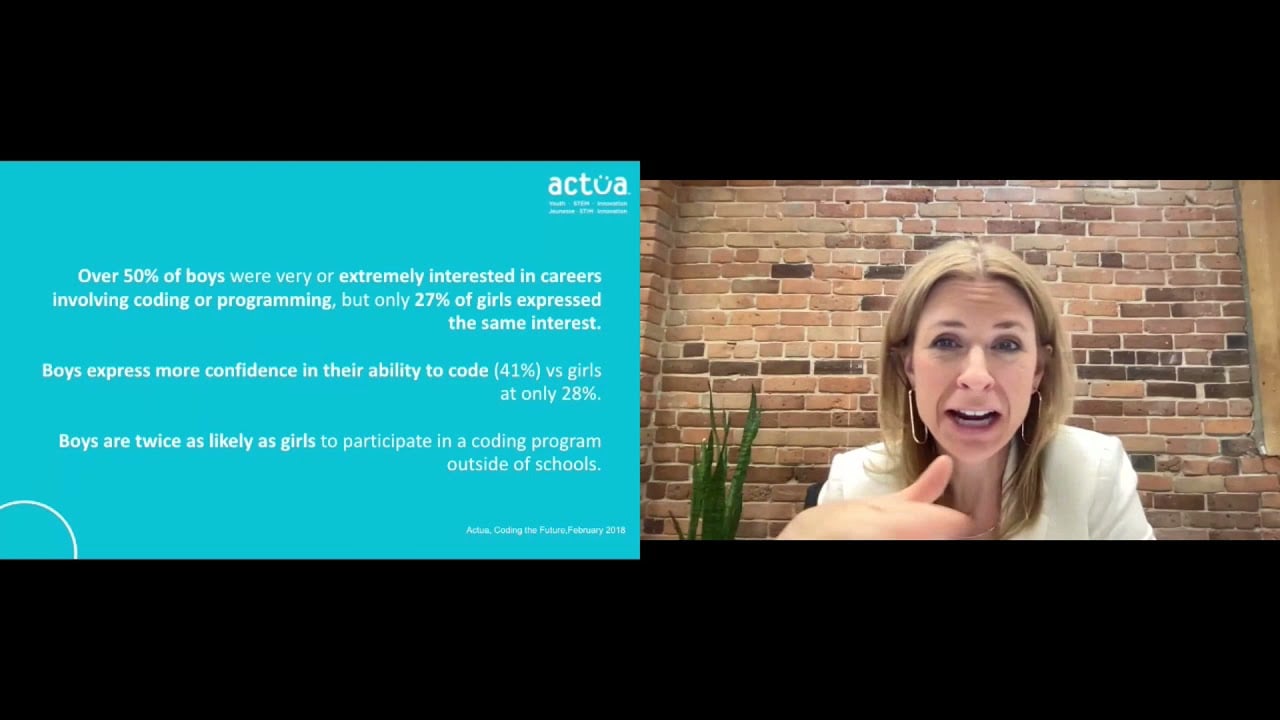
Steinmetz opens with what she calls an incredible change: the gender gap in computer science has been closing for 20 years, with record numbers of girls gaining qualifications such as the GCSE in the UK. Yet, as the speaker cited, the share of women among STEM graduates fell from 30% in 2000 to 19% in 2019, and the dropout rate of female students remains twice as high as that of men.
She lists the approaches that have dominated so far: getting girls interested young, making computing feel safe and fun, breaking gender stereotypes, female mentoring and role models, and framing computing careers as a route to family welfare. Retention initiatives at universities follow the same pattern, addressing belonging, confidence, tutoring, mentoring and funding for maternity leave. What they leave untouched, in her view, is the classroom itself. Looking at graduate programs in Germany, she sees a persistent male domination of the environment, with reading lists for the first four semesters written by men.
"Female staff among the faculty of computer science programs are very rare." (5:49)
What primary schools already know about learning
Steinmetz points to a shift already under way in elementary education, where teaching strategies increasingly take gender into account. She summarises research suggesting boys lateralize brain activity, respond well to symbols and spatial or mechanical tasks, and prefer deductive learning, while girls show more communication between brain hemispheres and tend to prefer inductive learning, discovering rules from examples and anchoring knowledge in a wider context. According to the talk, the results of adapting to this were striking.
"Schools that adapted diverse teaching tactics not only increased the number of students excelling in every subject area, but also experienced a drastic reduction in discipline problems." (5:12)
Four preferences higher education overlooks
The puzzle for Steinmetz is why this thinking stops at the university gate.
"For some to me unexplainable reason, however, this is hardly acknowledged in higher education." (7:43)
She names four female learning preferences that lecturers could address. The first is inductive learning, where the learner observes examples before the rules. The second is concrete reasoning.
"The preference of inductive or deductive reasoning also demonstrates that in problem solving males gravitate towards abstract arguments, but females excel at concrete analysis." (8:13)
The third is a visual and sensory preference, meaning multimodal teaching with more visuals alongside language. The fourth is context embedding: placing new knowledge within other sciences, society or another useful frame. Her hypothesis is careful. She presents this mismatch as one of probably many factors behind high female dropout rates, not the only one.
One woman, 500 freshmen and a Turing machine
To move from theory to practice, Steinmetz takes the audience back to 2001, when she began computer science at the Technical University of Munich as one of 10 women among 500 freshmen. After the introductory session in the historic auditorium, she only ever saw one of those women again in lectures over four semesters.
"The disproportionate number of males was overwhelming, if not intimidating." (10:41)
She was the only woman in the first lesson on the Turing machine. Two lecturers defined it as a general example of a CPU: an infinite tape of cells, a head that reads, writes and moves, states, transitions, state diagrams and a formal definition with alphabets and accept and reject states. She felt she was missing prior knowledge and could not follow.
"I had many questions, but I didn't dare be the only one to raise my hand." (12:16)
When the class split into groups to build a Turing machine that finds "101" in a string, the men around her produced solutions while she stayed silent. She describes feeling humiliated, not because of ability but because of method.
"I knew that I am at least equally intelligent as the rest of the group, but this explanation of Turing machine didn't work for me." (13:43)
Starting with a picture
Steinmetz says she was missing the "so what" of the lesson, and that other routes to the same knowledge exist.
"There are certainly other methods for developing the same knowledge within the same period." (14:15)
Her alternative opens with an image rather than a definition: a machine with a head that reads and writes and a tape of symbols that moves left or right depending on what is read. She notes that this already gives her a clear picture in her head, while leaving natural questions, such as how the machine knows how to interpret the symbols and why it matters. The recording ends here, so the full redesigned lesson is not shown, but the direction is clear: begin with something concrete and visual, then let the rules and the purpose emerge from it.
Watch the talk
"Going beyond engaging women in Computer Sciences in higher education" by Jitka Steinmetz, about 16 minutes: https://www.womentech.net/video/jitka-steinmetz-going-beyond-engaging-women-in-computer-sciences-in-higher-education
About the speaker
Jitka Steinmetz is Managing Director Germany at DXC Luxoft, based in Munich. She is a strategic, commercially minded, agile leader and a reliable partner for people and international corporations undergoing change.
Questions this talk answers
- Why do women still drop out of computer science more than men despite years of outreach?
- What learning preferences do women tend to show, according to the research she cites?
- Why has higher education not adapted its teaching the way primary education has?
- What does it feel like to learn computer science as the only woman in the room?
- How could a classic lesson like the Turing machine be taught differently?
Drafted with AI from the talk transcript. Editor review pending.