
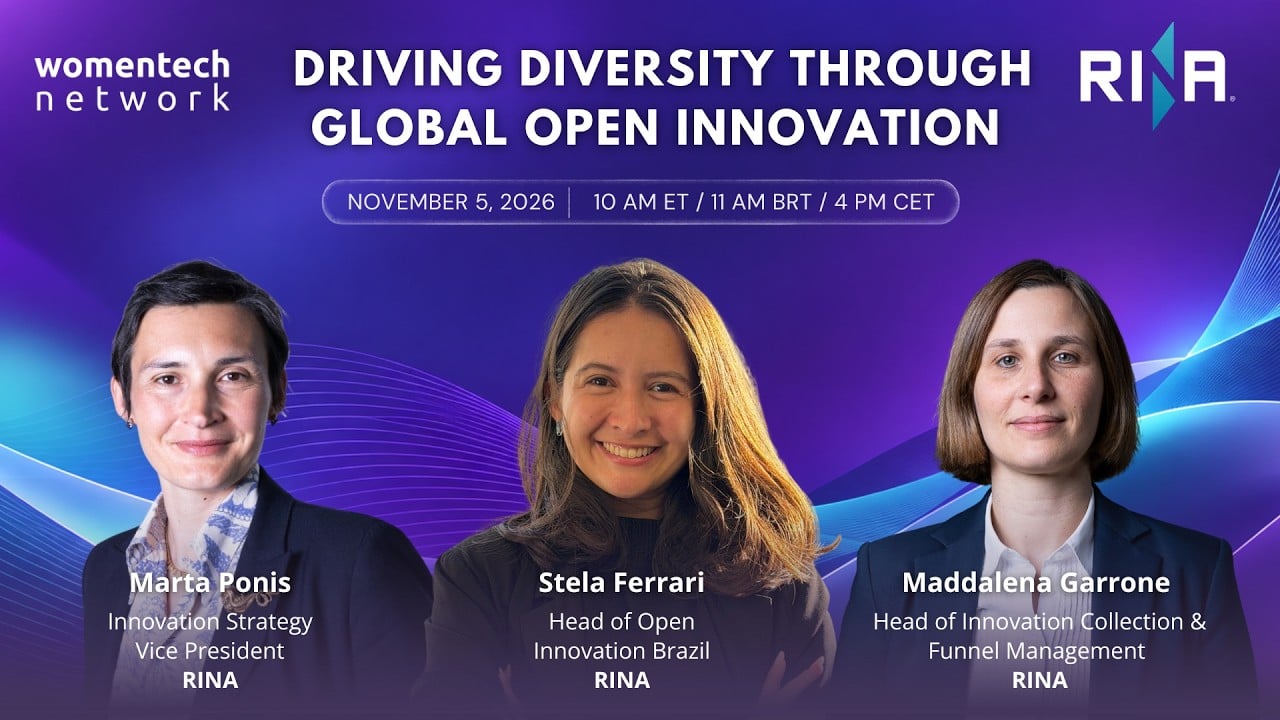
Driving Diversity Through Global Open Innovation
Innovation's harder question is who is still missing from the table
An engineering firm opens its idea platform to all 7,000 colleagues. Only about 10% actively engage, yet more than 120 ideas surface in two years. For anyone running innovation, the stake is the ideas that never reach the funnel at all. Members of RINA's global innovation team, speaking from Rotterdam to Rio, show how hubs, challenges and startup calls widen participation, and ask what it takes to make a seat at the table count.
Learn how one global firm structures idea flow, startup pilots and inclusive participation
In short
Members of the innovation team at RINA, an engineering consulting and certification company with about 7,000 people, explain how open innovation hubs, an internal idea platform and startup calls can widen who contributes to innovation. They argue that diversity, including gender diversity, improves the quality and speed of innovation, and they close by asking who is still missing from the innovation table. The session record gives no speaker names.
“We don't innovate alone. We do it through ecosystems, very ambitious global ecosystems that are made of people, of diversity and of new ideas.”
“Good ideas don't belong to a department, a geography or a job title.”
What you will learn
- Design an internal idea program around focus, flow and recognition so contributors can see what happens to their ideas.
- Use open innovation hubs to connect local industry challenges with a global network of experts and startups.
- Structure an innovation funnel that asks progressively harder questions about need, feasibility, beneficiaries and business sense.
- Plan startup proofs of concept with adoption as the goal, not just a finished pilot.
- Ask who is missing from your innovation table, not only which technology or startup comes next.
Details
- Level
- Beginner
- Format
- Talk
- Technical depth
- Non-technical
- For
- People manager, Executive, Senior individual contributor
- Length
- 27:38
- Published
- November 2026
Questions this talk answers
What is an open innovation hub in a global engineering company?
At RINA the hubs act as satellites that connect the company's engineering knowledge with local industries, startups and public bodies. They take local challenges and draw on the global network to move from proof of concept to scalable solutions.
How can a company get ideas from employees beyond asking for them?
The team built its approach on focus (meaningful business challenges), flow (transparent evaluation so contributors know what happens to their idea) and recognition (making contributions visible).
How does an idea move through an innovation funnel?
It faces increasingly challenging questions: is there a real need, is it technically feasible, who benefits, and does it make business sense. Different experts join along the way to challenge assumptions and give feedback.
Why does diversity matter for open innovation?
The speakers argue that bringing diversity increases the range of talent and ideas at the table and improves how fast and how good innovation is. They note that few women still lead startups, venture capital and AI work.
What makes a startup proof of concept worthwhile for a corporate?
The proof of concept is where technology must work with real assets, real constraints and a real business case. The real goal is to create the conditions for adoption after the pilot, not just to say a pilot was done.
Topics
Highlights
- Good ideas don't belong to a job title (69 s)
- Focus, flow and recognition for idea programs (85 s)
- Who is still missing from the innovation table? (81 s)
Thank you to everyone and welcome to this webinar. It's a great opportunity for us, for Stila Maddalene and I, to be here and share our experience. And we really hope that we can simulate also some questions at the end of the session, because we are here for this. We are here to share our experience, but also to learn from you.
So, I have a couple of slides to introduce who Rina is and who we are, even if we had already from Lori some quick intro. Let me just say that we are an engineering company. So basically engineering consulting and certification company. We grew a lot in the last four to five years, and now we are presently 7,000 colleagues around the world.
As you heard also from our CVs or short descriptions, we are almost all engineers, Stila Maddalene and I, and we, so these 7,000 colleagues, almost 4,000 are specialists, you know, engineers, divided, you know, in practices with experience. And then this is our main strength, because we are a knowledge company. Okay. So we provide engineering consultancies, you know, We are spread all around the world. I am Italian. Yes, but I'm based in Rotterdam in the Netherlands, Stila in Rio, Maddalenes in general. We are all around the world, more than 70 countries, more than 19 nationalities.
And I have to say that in the last years, Rina improved a lot in the KPIs in terms of women in STEM, women in manager position. Of course, you know, our presentation today is driving diversity through global open innovation and diversity. It's not only about gender. We know that. But today we will focus a bit on the gender because we are in this particular environment.
environment and thank you about this opportunity. So the women in STEM, in percentage is increasing quite fast and women in manager position too. Let's go to a little bit of who we are in terms of purpose, vision and mission. So as I said, as a knowledge company, we definitely look at the complexity of the engineering and what is happening around the world. And it's our purpose to, you know, to drive our lives towards a better future. And, you know, And, you know, helping also the industry to the progress towards this future. And this is when we support the business to understand better the complexity of the technologies and innovation and really supporting the market and the business in this sense.
So it's making this complexity and opportunity for us and to drive our colleagues and our customers towards a better future, trying to make all this complex a bit more easier with our consultancies. So, if we go to the next slide, if we go to the next slide, we can see the business lines where we operate. We were born as marine, marine business, but nowadays is not anymore the main business of Reno. Energy is actually one of the largest business, but still energy industry infrastructure mobility, marine and certification for all the industry and real estate are the six business units.
We work in, even if the innovation team that we work in, even if the innovation team that you see today here, which is a very small part of the innovation team are working, we are working globally cross business and cross geographies. And this is one of the, I think, and this is one of the, I think, very important aspects of making the innovation feasible and practical in a strategy of a company like ours.
And talking about energy, we have just, just a few words, very quick on what is about this business unit. Energy is all about from oil and gas to renewables, you know, from the old energy to the new energy industry is more material testing and factors and industries. And also the infrastructure mobility is large projects of infrastructure, like highways, main building, large buildings, hospital ports, marine, of course, is shipping is our DNA, but it's my DNA where I come from.
So shipping classification, but also consultancies and engineering certification is all that the ISO standards and certification standards that you might have in mind also driving the regulations. And real estate is last but not least engineering aspects that we are developing in all this, we have the innovation and the technology in terms of digitalization that is really, really going fast and bringing us to, to the need of, you know, growing in, in innovation, for sure.
Just the last few words in terms of strategy. So what we said is that for us is not a competitive advantage to, to, to push the innovation. It's really, we, we are responding to a global challenge. The challenges I said before, the complexities of the technology that we need to bring forward. It's embedded in by nature in our business, in our DNA, because we are working as knowledge company in technologies.
So we have different pillars. We put here some examples, which are the main pillars of how we embedded innovation in our business, research and development, for sure. That's where we participate. RINA is the one of the, is the first European private company in terms of awarded projects for research and development, the European level. That's where we understand that we know about new innovative technologies. And then we have competence in our, in house after the projects, open innovation up still, I will say a lot more about it. So I'm not going to focus on that, but that's the window to the business in different regions of the world.
Growth Council is an internal process on how internally define and see if we have new ideas in terms of innovation. And then the pioneer, pioneer challenges, Maddalena will talk about this much more. So I'm not going to spend more words than we would. We always like to have also a bottom up collection of ideas from anywhere. And that's where the role of Maddalena is really crucial in, in our team. So I will leave now to Stela to spend some more words on innovation apps where it's not only geographical. She's in Latam. She's in Rio, but apps are also in other countries.
She will say a bit more about that. But there is where we have also the relationship with the startups, because I think it's worth to say that research and development and startups where we have incubator and accelerator are two of the main, you know, external generation of innovation that we then manage in our innovation team. Shall I give it to you, Stela, to Rio early morning?
Yeah, talking from Rio. Thank you so much, Martha. Thank you to the Women Tech Network and thanks to everyone that is watching us. So I will move forward to present a bit what are our open innovation hubs. So what we mean for this is innovation is on our DNA, on our strategy, but how do we do innovation? And we believe that innovation is done in an open way. We don't innovate alone. We do it through ecosystems, very ambitious global ecosystems that are made of people, of diversity and of new ideas.
So this idea that our open innovation hubs were built around the world. So I will speak a bit about it and especially how this cross the gender and the diversity targets that we have as a society and how we believe that the open innovation can influence this index. So our open innovation hubs are our satellites around the world basically to connect all the knowledge that we have as a knowledge company, having in the backbone of four pillars. The first is the test is learning. Then we have demo centers that are demonstration facilities for pilot projects, testing labs where we can test the very emerging technologies, but also put things in the commercial level.
And then the services to the local ecosystems. That is basically how we connect all the knowledge, all these engineers and consultants and technicians that we have in our company with the different realities. So how we go from a global strategy and a global innovation idea to what we are doing locally. This is what we try to do locally. This is what we try to do with our hubs and to put them as the satellites in the different contexts and different industries that we can serve with innovation and technology. So these help us to turn all the ideas that we have and the different funneling ideas that we can have that Maddalena will explain later on to collect what are the real world challenge.
And turn the solutions and the solutions and the technologies in real world applications as well. So the goal to be around the world and have this worldwide open innovation strategy is to connect with the local ecosystems and different types of ideas and challenges that we have together with the local industries, local startups, public administrations, public administrations, public administrations and any other sector or a body that can support to bring challenges that we can solve with the tradition and the knowledge that Irina has. And of course, not even all the time, the solution will be at the local that the need emerge. So today we have some topics regarding energy transition, data centers, navigation ports, navigation ports, navigation ports, navigation ports, and we can find the solution in different parts of the world. So this is why we connect the real local ecosystem challenge and issues with our global network. So we can work in global solutions.
And then Rina is the body that we can work in global solutions. And then RINA is the body that do this connection. So we pick the problems, we work on them with the right approach for each industry through all the diversity that we have in terms of people, of backgrounds, of nationalities, of language, to find the best way to go from a proof of concept to a scale-up solution. So we're coming, starting from the local challenge, we do global connections.
We do global connections, and we do scalable solutions. And this is what is an ecosystem for us. It's a very ambitious idea of having a global connected team that can work in disciplines, can work in hubs, and can connect the challenge with the solutions. And of course, we do global connections. And of course, we speak about how this cross the gender equality. Each region, when you dare to work in a global strategy, cross different realities. So the same happens when we are looking to the gender parity across the regions.
So to bring some data and how open innovation can work on it, I am showing here the numbers that we have from global data. So this data is from the World Economic Forum, showing a bit for what is the gender gap closed for each region. So you see that around the world, we see that around the world, we have different levels of gender gap. And this reflects also on the open innovation, on the diversity of ideas, of equality that you can bring to the solutions and to the strategies that you are working on.
Which means that bringing diversity can also improve how different talents you bring to the table, how different ideas, and especially how fast and quality is the innovation you bring. So the global network of hubs is also crossed by different contexts and different diversity levels. And open innovation can be the key to make it improved and make it even more real and for a better future when we look to the technology, to the engineering and other innovation backgrounds.
And these can be an example of how our open innovation hubs can help to close the gender equality and to bring closer more profitable ideas and more diverse teams to the different ecosystems that we are present. So to look a bit on how we can do this crossing, we can look to the open innovation ecosystems connected to technology like AI, to venture capital and startups.
So we still have a gap to be closed when we look to these leaderships and how we can make the difference bringing this global strategy to the table. So inclusive of innovation is not only about who is entering this ecosystem, but also how we can make it more diverse and more scalable. We still have a few women leading and founding startups leading global venture capital and also leading technologies when we go to the hot topics in this open innovation ecosystem like AI and machine learning and software engineers, for example.
And in this case open innovation can support to bring inside the industry and inside the technology world, this gender equality lens. So means that we can put different topics inside the inside our ideas and to focus on these subrepresented groups like the gender, for example. And we can start scouting, co-creating funding and scaling solutions that brings women and other diversity groups to the center of the innovation.
So as Martha say, the open innovation hubs is not just about global connection in geographies, but also different people, different nationalities, different genders and different ideas. So is a way that we can show how we can connect universities, startups, and use these to cover different levels of development or diversity that we can have inside the countries and the regions that we are looking for.
So now I will pass this to Madalena so she will explain a bit more in deep how we can collect these ideas and turn this in realities coming from a different part of the world to another. So if you want to pick the floor Madalena, it's yours. It's yours. Thank you, Stella. Thank you. So, yeah, basically, we have seen how important innovation ecosystems are and why it matters to who gets the opportunity to participate in them.
So now what I would like to do is make this a little bit more concrete and show you how Rina tried to put this principle into practice. And we do this basically by looking both inside and outside the company. And for us, basically, it all starts with the Spark. So Spark is basically our innovation management platform. It's basically the place where we bring together our two approaches to innovation.
On one side, we have internal innovation where basically we involve all of our colleagues and try to capture ideas, insight and expertise from across the company. Here, for example, we will launch our Pioneer Challenges that Marta was mentioning at the beginning, but not only. We work a lot on thematic challenges also, but on free topics and so on and so on.
And the other, you know, the other half of this platform is basically the open innovation where we look outside Rina and connect our businesses, our business challenges mainly with startups, external experts and emerging technologies. Regarding the internal side, the principles are quite simple. Good ideas don't belong to a department, a geography or a job title. It happens that someone working close to a customer may spot a new need or an insight we may benefit in our future strategy.
Maybe a technical expert may see a completely different application for a specific technology. Or even someone in another country may already have experience that can help us solve problems somewhere else. So, of course, we ask people for ideas, but that is not enough for us. We need to create conditions for those ideas to emerge and move forward.
So, that's why we built our approach around three elements, focus, flow and recognition. Focus, because we want innovation to address minifun challenges, something that our business needs, something that will improve our internal processes and so on. Focus, flow, because we want basically everyone, if they contribute with an idea, they need to understand what happens to it. So, they need to have clear idea of the processes, how the ideas are evaluated.
And so, basically, transparency for us is really important, least but not least recognition, because people contribution should be visible. And also, of course, recognize. So, Spark definitely is a place where we collect ideas, but actually is even more. So, it's really the starting point of a process. And basically, this is what happens after the starting point. An idea enters our innovation funnel and then, step by step, we help it develop this idea, asking increasingly challenging questions.
For example, is there a real need? Is this technically feasible? Who would benefit from this solution? And finally, of course, is it sustainable or does it make business sense? So, as the idea progresses throughout this funnel, different people and different expertise come into the process. They challenge assumption, give feedbacks and help basically turn an initial intuition into something much more concrete.
And I must say that after just the first two years of, you know, the creation of this platform, we've already seen some encouraging results. We've invited all of our colleagues, about 7,000 users, and we've had more than 2,600 visitors. And the actually engaged users is a small percentage, about around 10%. But still, these people are the ones that comment, submit ideas, have evaluated ideas, and so on.
And another important number is that we were able, in these two years, to collect more than 120 ideas. For our relatively young platform, these numbers are very positive. We are very happy with it. And the positive thing is that they are continuing to grow. And that's actually where a lot of our focus is today, engagement. Because we've seen that engagement tends to build on engagement.
So, the more people participate, the more visible innovation becomes inside the company. But also, of course, outside. So, when people see colleagues contributing, they see ideas moving forward. They are encouraged to, you know, take part as well to this process. Of course, in general, we want all these numbers to keep growing as well. So, that's really our job now.
Keep the momentum going and make participation easier, more visible, and more rewarding. So far, I've talked a lot about ideas coming from inside the arena. But Spark, as I mentioned, also gives us a way to look outside. So, there are a lot of interesting technology out there. And the real question here is, which one can actually solve one of our problems?
So, and that's what we wanted to explore last year with our first call for startup. That was launched through our Rome open innovation app. We started from a concrete challenge. How could technologies such as IoT, AI, and remote tools like drones, could improve the monitoring and inspection of critical assets? So, we received more than 100 applications involving more than 50 arena experts in the evaluation.
Another important number was the 30% of the startups that participated were from international, from outside Italy. And this is important because the challenge was launched in Italy. So, we were able to reach a global audience. And, of course, at the end, we selected three startups that now are in the POC phase. So, the proof of concept phase.
And, actually, this is probably the most interesting phase of this process because POC phase is where the nice presentation ends. And, actually, we start to build something together with the startups. So, it's where the technology has to work with the real assets, real constraints, and real business case. And, it's basically where both sides, our arena and the startup, gain access to new technologies and entrepreneurial thinking.
And, the startups gain, basically, industrial expertise and real environment in which to validate their assumption. So, yeah, for us, the real goal here is to create a condition for adoption after the POC. And, not just saying, okay, we have done a POC. So, to conclude, to close, we would like to leave you with one question. In innovation, we spend a lot of time asking what's the next technology, what's the next idea, what's the next startup.
But, perhaps, another question we should ask more often should be who we are still missing from the innovation table. Because, innovation depends not only on which ideas we select, but also on whose ideas have the opportunity to emerge and process. So, for me, and in general, I think for all of us, that's one of the real promises of open innovation.
So, not only simply to make the table bigger, but to make participation at the table matter. So, from our side, this is one of the important messages that we wanted to pass. And, yeah, thank you all for following us.
Transcribed automatically; names checked against the speaker record. Select a time to jump there.
Frameworks and ideas mentioned
- Open innovation
- Focus, flow and recognition
- Innovation funnel
- Proof of concept (POC)
- Pioneer Challenges
- Growth Council
Cite this talk
WomenTech Network. "Driving Diversity Through Global Open Innovation." WomenTech Network, 2026. https://www.womentech.net/en-fr/video/driving-diversity-through-global-open-innovation
Related talks
Browse the library
Digital Economic Development led by Women using Cloud and AI technology
 Chaitra Vedullapalli
Co-founder and President, Women in Cloud
A billion dollars for women founders needs only 100 companies to say yes

Female Founder Roundtable: Breaking Down Barriers for Women in Tech
 Phylecia Terrell +3
Event Marketing Manager, Founder Institute
For women founders, the funding gap opens at Series A, not the angel round

From Vision to Scale: Making Innovation Operational and Fundable
 Amelia Newbury
Founder & CEO, Kaleidocent
Most scaling happens inside the company, and leaders rarely talk about it
Female Founder Roundtable: Breaking Down Barriers for Women in Tech by Phylecia Terrell
The funding gap for women founders widens after the angel round

The Business Case for Driving Representation in the Leadership Circle
 Carrie Rasmussen
CIO, Ceridian
Nearly half of workers won't seek leadership where leaders lack diversity

The Power of Open Source Collaboration in Organizations: Fostering a Transparent and Inclusive Work Culture
 Esmeralda Tijhoff
Open Source Community Manager and Product Owner, DICTU
In government she would get a no; in open source she just built it