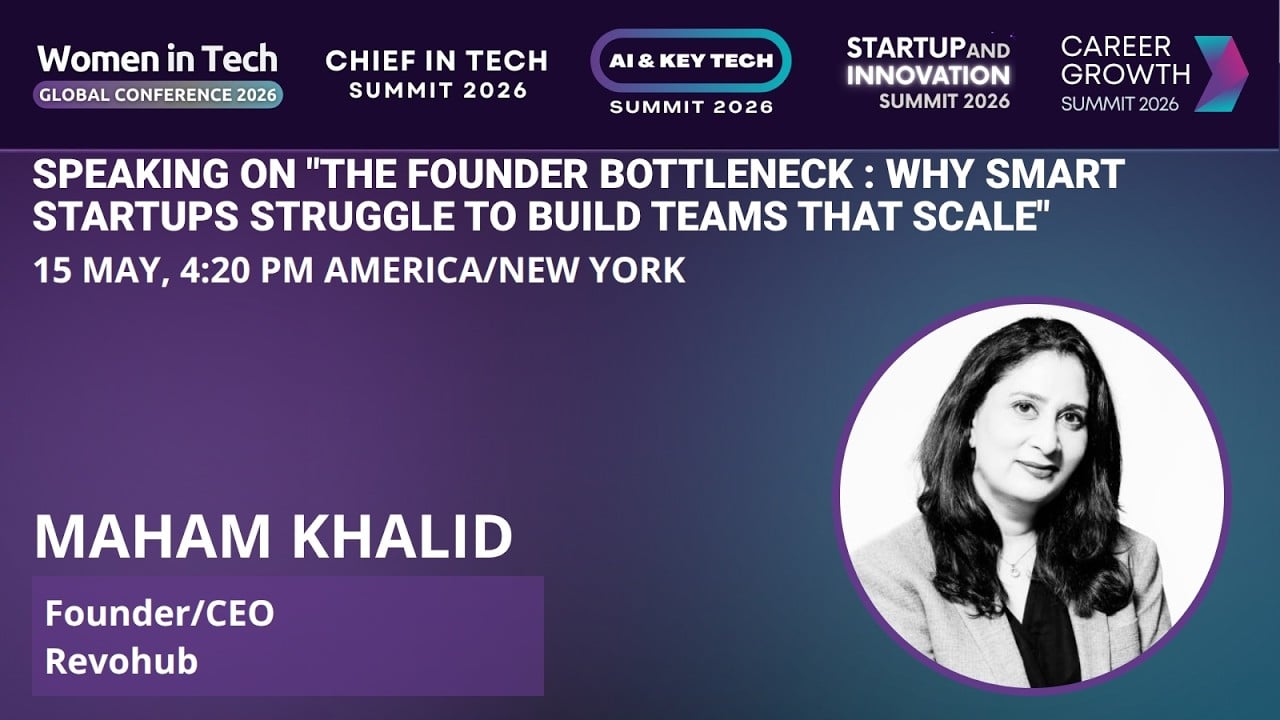
The Founder bottleneck : Why smart startups struggle to build teams that scale
Maham Khalid18:522026
A players in a B system still deliver C results, and founders are the system
Startups rarely die because the idea was wrong: Maham Khalid, a solo founder and workforce strategist who built Revohub, cites people and team issues behind most failures, and admits she recently brought on a new hire without defining a KPI for them. When every decision runs through the founder, growth stalls and early hires leave. So what does a team built to run without its founder look like?
Get a five-part team design framework and a three-question diagnostic to stop being the bottleneck
Maham Khalid, solo founder of Revohub, argues that most startups stall not because of their product or market but because the company is built around the founder instead of the work. She shares a five-part framework (roles, ownership, decisions, information and cadence) and a three-question diagnostic to help founders move from executor to architect.
“You can hire A team players into a B system, but what you end up getting is C results.”
“Investors fund operators, not heroes. A team that depends on the founder is a discount on valuation, not a premium.”
What you will learn
Redesign roles around measurable outcomes so each hire owns a result rather than a task list.
Distribute decisions by type, pushing reversible decisions down to the team and keeping irreversible ones.
Set up information to flow by default through dashboards and written updates instead of on request.
Install a weekly operating cadence that lets the team run even when the founder is absent.
Apply a three-question diagnostic to separate what only you can do from what you merely think only you can do.
Key takeaways from the speaker
Design roles around outcomes, not tasks- high-performing teams are built on clarity of ownership and impact, not activity.
The founder must evolve from executor to visionary
The goal is not to add more people, but to design teams that can operate, adapt, and deliver without constant founder intervention
Details
Level
Intermediate
Format
Talk
Technical depth
Non-technical
For
Founder, Executive, People manager
Length
18:52
Published
August 2026
Questions this talk answers
Why do startups with a working product and real market still stall?
Because the company is built around the founder, not around the work. Maham cites people and team issues, rather than product or market, as the reason behind most startup failures.
What is the difference between delegating and dumping tasks?
Handing someone tasks does not help a company scale; giving them ownership of a measurable outcome does.
Will hiring better people fix a founder bottleneck?
No. Strong hires placed in a weak system produce weak results, so the fix is the architecture of how decisions, information and outcomes flow.
Which decisions should a founder keep and which should go to the team?
Distribute decisions by type: reversible decisions go down to the team, irreversible decisions go up to the founder.
Where should a founder start redesigning their team?
Run a three-question self-evaluation of what only you can do and what staying in both columns costs, redesign one role around an outcome, and install a weekly operating cadence.
About this talk
In the early stages of building a company, founders are required to do everything, strategy, execution, hiring, operations. This creates a hidden risk: the business becomes dependent on the founder rather than built to scale. What begins as agility quickly turns into inefficiency, unclear roles, lack of task donation, reactive hiring, and teams that are busy but not effective.
This talk examines one of the most overlooked challenges in startups: task allocation and team design. Why do capable founders struggle to delegate? Why do early hires often fail to deliver expected outcomes? And why do many teams lack ownership despite strong talent?
Through a systems-focused lens, this session explores how to move from founder-led execution to structured team performance. It will unpack how to define roles around outcomes, build accountability without micromanagement, and create clarity in environments that are inherently uncertain.
The goal is not to add more people, but to design teams that can operate, adapt, and deliver without constant founder intervention.
Speaker: Good afternoon, everyone. Can you hear me just fine? Perfect. My apologies. Although I work in technology, but of course, technology has to let you down at a random moment. So, but thank you so much for your patience and for joining me today. We will be talking about something exciting that I have learned through my journey as a founder, the bottlenecks we face and why I, like from my experience and speaking to so many other founders, I have found out why smart startups struggle to build teams that scale. And I think as founders, as solopreneurs or business owners, this is something a lot of us have struggled with and continue to struggle with. So today we will work together to unpack and kind of figure out what is it
that is a kind of holding us back. So before I go into this, let me tell you a bit about myself. So my name is Maham. I started my journey, of course, I have my entire career. I have been going from biweekly paychecks, you know, just working full time in like, or as a consultant, but, and I've been very lucky. I've worked in a lot of different organizations, lots of different, you know, industries really. And then, you know, after a point comes in your life and you realize that, you know, now it's time to bet on myself. I mean, I have consistently helped so many companies gain, um, funding, gain, get business, generate revenue. But I thought now was a time that I think about myself and I bet on myself. And that's what led me to start my platform. Now, my core focus
throughout my career has been people and processes. And this is something I am very, very firm, you know, focused on. And that's what led me to create RevoHub. Now, what RevoHub is basically is a workforce intelligence platform where we are trying to solve something I have consistently seen in my career that we are developing talent, but that is not talent aligned to what the labor market's asking for. So there is a bit of a disconnect. So the goal with our platform is, and in a nutshell, what we're trying to do is we have a Coursera with Google maps built into it. So instead of you, me, all the learners that, you know, I have interacted with that instead of us randomly doing certifications, how about you bring strategy to it? So it's all based on role mapping. So when you come on the platform,
the system intuitively ask you questions, kind of identifies, okay, this is the role you're trying to get into. And it maps out a customized learning journey aligned to what the job market is asking for. So that is a little bit about what I'm trying to do. So again, it's a project, it requires a lot of my time.
And as a founder, and as a solo founder, so I do not have a co founder, I do struggle time from time to time to, you know, really kind of manage things and, you know, get things off the ground. And I feel there are not enough hours in the day. And this is me and a lot of other founders, you know, this is 65% is the share of startups who have failed. And not because the vision wasn't there, the concept wasn't there, but it was tied to people and team issues, never the product, never the market. So, you know, most finders, and I've also faced this myself, there are times when we think that we are failing on the idea, that's not what it is. Because why founders like me, or founders who have those big visions,
fail because they lack the architecture that carries it, the product works, the market is real, but the people and the people are talented, but still growth is stalled. And today, we are together going to unpack why that happens. Because why is it that, you know, why is it that, you know, fantastic ideas don't thrive? Because it is, the company is built around the founder, not around the work. And this is something I also have to pace myself a lot of times. Because founders, what happens is, you know, when you so when I started off, I, again, was coming, I've had, I've worked in large organizations. So of course, there was a marketing department, a finance department, you know, everything is like, you know, compartmentalized and done accordingly. But what happens when you become a founder is,
of course, you're bootstrapped. So what ends up happening is you become the system. And, you know, most of us, 70% of a founders week is spent on tasks below our pay grade. Because, again, I don't have that infrastructure, I don't have those departments, I don't have the resources to outsource everything. So then I am kind of, you know, that small, and there are days when I feel I am that, you know, small falcrum that everything revolves around. And this is not hustle, this is a drag. Because what happens is 82% of business failures are linked to cash flow. But underneath that, there is almost always a delegation problem. The founder is the only person closing revenue loops, hiring loops, all at once. And this is, again, a challenge that, you know, stalls the growth of the
organization. And it stalls that, you know, the company from really becoming the vision of what the founder originally had and, you know, scaling. And, you know, the people you hire to help. One in three early hires don't even make it past the 18 months. These are stats. And obviously, I would strongly suggest you have a look as well, because there is no space to do anything. Most founders accept this as the cost of doing business. But to be honest, this isn't.
Now, let's look at some of the common problems. And I think those of you who are founders here, you can relate to this, that the founder is the operating system. We talked about that. Roles are built around people, not outcomes. So what happens is that, you know, as founders, they bring in help. And instead of defining what kind of tasks they should own. So the help is there. And I have myself struggled with this. And when I earlier started my business, that I really wasn't ready to delegate. I really wasn't ready to give them ownership, because this was my baby. This is something I had created. And I just wasn't ready to give it up that easily. And what founders usually confuse delegation is with dumping tasks, because giving someone tasks is not going to help you scale.
Giving them ownership is what helps you scale. And then, of course, one of the biggest challenges I think most of us as founders have, especially the bootstrapped ones, is that everything needs your or my approval. And that, of course, kills speed and, above all, kills confidence within our teams and ownership. So again, this is a vicious cycle. The first hires are loyal, but not always scalable. We talked about this. The culture rewards responsiveness, not results. So busy teams feel productive, but no one is accountable for measurable progress. So the difference is that, yes, we are doing tasks, but how are we mapping the progress? And funny thing is, I was talking to someone today, and they said that, you know, oh, have you developed? So I got a new hire, and I was talking to the technology
team, and they were saying, like, have we developed a KPI measure for them? And I realized I haven't really. Because again, I am also so stretched thin most of the time that I'm not able to. Then I took a step back, and I was like, yes, I have to give ownership, not just tasks. I have to give them ownership.
Make them look at the bigger picture. And one of the biggest thing, I think, a challenge is that, you know, we hear this all the time, founder-led company. A founder is the brand. My marketing team constantly tells me, put yourself out there more as a founder. Because again, it works until it doesn't. Because how long can my face carry my company? The company has to become a brand of itself. And again, that's another thing that leads to which is founders fail to redesign themselves. Because then the founder kind of, you know, becomes a doer instead of actually becoming an architect. And you know, all of these challenges are further, you know, really augmented, I would say, because everything has changed now. Speed significantly in this landscape has changed. Because maybe 10 years ago, you could
absorb this. Today, you cannot. AI is compressing the runway. What took 12 months now takes three. Founders who cannot move work of themselves get lapped, not by bigger teams, but by faster ones. Because they are scaling faster. Capital is selective. Investors, I mean, what it was a couple of years ago, it's very different now. Investors fund operators, not heroes. A team that depends on the founder is a discount on valuation, not a premium. And then, of course, talent expects ownership. The best people don't want to be doers in your machine. They want to own outcomes. So this is, again, a sort of a bottleneck that we as founders face. And remember, always growth has no patience. You don't grow into clarity. You scale whatever system you have, including the chaos. So, technically, you know, what happens is bottlenecks
don't shrink with revenue. They get even more expensive. And again, as founders, I would strongly suggest to those of you in the audience to think about this. I need to hire better people. That's not it. I've heard this from every founder I've ever worked with. You can hire A team players into a B system, but what you end up getting is C results. Repeat this to yourself. A players, B system, C results. So it all boils down to architecture. Another myth is, I'll fix the organizational chart later once we scale. But you know, if your foundation isn't done right, then no matter how much you grow into clarity or scale whatever system you have, that foundation, that weak foundation is going to be challenged. So now when things are more in your control and things are not as big now, now is a
good time to really start thinking about this. And of course, a lot of the times, I also, I'm guilty of it. There are times when I'm like, you know what, nobody else can do it the way I do. But that's a problem, not the proof. Because again, you have to give ownership. You have to, whatever talent you bring into your team, you have to give them the chance to prove themselves. So in the end, it is not about delegation. It is about your design. You have, the bottleneck is not the people. It is how decisions, information and outcomes flow or don't essentially around you. So again, let's think about, you know, how do I change this. So it's decisions, you know, if before founder led, all decisions are
coming to me. But then when you talk about, you know, founder design, so you talk about the architecture, it's decision distributed. So give them, give your team a chance to really, you know, not stop relying on relying on the founder, think about it as a company, you know, you hire reactively to plug, plug files, the team is busy, but not effective. And, you know, founder designed basically, you know, is focused on measurable outcomes, information flows by default, it's not focused on you, not by request, intentional hiring against role design, team owns the problems, not the, not the, not the task. So remember, same headcount, same payroll, but the different isn't who's on the team, it's how the team is built. So now you have to actually think about, you know, that shift. And for that shift, I have a small, simple
framework I'll share with you. It's about roles, ownership, decisions, and information, and of course, cadence. So we will very briefly go into this. Of course, this is a framework that I use for myself, you're more than welcome to amend it, change it, align it to whatever works best for you. Number one, you have to think about the roles defined by outcomes, not tasks, don't hire someone to run marketing, hire someone to own it, own a measurable result, which leads us to ownership, explicit boundaries, who decides who is consulted, who is informed upfront. Nothing is negotiated when the fire is already raging, it is all mapped out. There are times, you know, I struggle if I have not laid out a plan, because at the beginning of the year, with the marketing team, we have a whole plan laid out.
Of course, things happen, things change, there's, you know, shifts in the market. But then if you have a basic foundation, a basic roadmap, just things just become a little bit more easier. And then, of course, decisions, distribute them by type, you know, reversible decisions go down, irreversible decisions go up. So again, there's a difference, you can, you can delegate to your team, you know, distribute them by prioritize, okay, which decision, which fire really, you know, saw is something that needs my attention. But then which fires can be led, dealt by with my team used. And this, again, with every choice, you stop being the bottleneck. And of course, information, information is not but is there by default, not request, you know, dashboards, written updates, we have so many tools now, and your team
should never have to wait for on you for context. And then of course, a cadence, be strict about a cadence. I every week, I have co op students working with me, I have my marketing team cadence. Yes, there are a lot of cadences in the week. But the goal is what we are trying to do is that a cadence replaces the founder in the room and your team also knows they have to meet. But and what it's all leading to is one scalable team, and that should be your goal. So again, you define the outcome, set the decisions right, you know, install the operating system. And this, of course, is going to work differently for different individuals. But the goal is that you, as a founder, should be avoiding the
bottlenecks. Don't be like the people on the screen, like, you know, the 70% of founders who identify team and people issues as the number one obstacle to scaling. But then what they really need to think about is, you know, it's people and processes. And when we have people and processes, it's the fault is never 100% the people, it's also the process that is attributing to the problem. And we don't add headcount, which we don't change anyone's pay, we redesign roles around outcomes, not tasks, we document decisions on one page, we replace standing meters with one weekly operating rhythm. So the goal is, you know, simple things, same team, different design, just give it a shot, you know, and what happens is when you stop hiring around chaos, you start designing around outcomes. So don't bring in a team member to just
do menial tasks, give them give them a structure, give them a plan and give them a process so that they can also optimize the outcome. And you know, what happens is that, you know, once the founder has a chance to go back to the vision, and be really strategic, because that's what the founder's job is, the founder's job, yes, in the beginning, you are involved, but then you slowly have to start letting go of the reins, because you, your calendar should be reflecting strategy, not survival, not day to day tasks, the goal of a founder is for you to take the vision and take the vision to the future state that the company is looking for. So again, this is a sort of a diagnostic, if I can suggest
one walk away from the like, what I take away from this session today is that, you know, think about, you know, a three question diagnostic about, you know, do a self evaluation, what can I do, what only I think I can do, and what is the cost of me staying in both columns, so kind of see long run, what is generating more revenue for yourself, and redesign one role around an outcome, and most importantly, install a weekly operating cadence, your team has to meet whether you're not there, maybe you're not able, most, sometimes I'm not able to join the cadence, but because we have a dashboard, because we have tasks designed, we, my team is able to operate alone. So again, I will, I know I'm a bit one
a minute over our time, but all I want to say is you have to stop being the hero of your business, start being the architect of it, because it's the team that you know, you might already have, or you're thinking of bringing on, remember that team is not about hiring, it's about how you are designing the work they do, how are you designing the architecture that is offered to them, and how are you designing the processes and systems that they operate within, and how are you helping them become more successful. So thank you so much for joining me today, and please feel free to connect with me on LinkedIn, follow us, that's my company logo right there, we are trying to build something, and of course, as
many allies as possible, that would be just fantastic. Thank you so much. And of course, if you have any questions, you can definitely reach out to me.
Transcribed automatically; names checked against the speaker record. Select a time to jump there.
Article based on this talk
Why startups stall when the founder is the system, and how to redesign the team
Maham Khalid argues that the fix for a founder bottleneck is not more hires but a deliberate design for roles, decisions, information and cadence.
In short
Maham Khalid, Founder/CEO of Revohub, argues that most startups do not fail on their idea, product or market but on how their teams are built. When a company is designed around its founder rather than around the work, growth stalls, hires leave and the founder drowns in tasks. Her answer is a simple five-part framework (roles, ownership, decisions, information and cadence) that lets the same team, on the same payroll, perform without constant founder intervention.
Key takeaways
Design roles around outcomes, not tasks: high-performing teams are built on clarity of ownership and impact, not activity.
The founder must evolve from executor to visionary.
The goal is not to add more people, but to design teams that can operate, adapt and deliver without constant founder intervention.
When the founder becomes the system
Khalid speaks as a solo founder. After a career spent helping organizations win funding, business and revenue, she decided to bet on herself and built Revohub, a workforce intelligence platform she describes as a Coursera with Google Maps built in: it maps a learner's target role and builds a learning journey aligned with what the job market is asking for. Running it alone, she says, regularly leaves her short of hours in the day.
She contrasts large organizations, where marketing and finance sit in their own departments, with the reality of a bootstrapped startup, where the founder absorbs everything. As the speaker cited, 70% of a founder's week goes on tasks below their pay grade, and while 82% of business failures are linked to cash flow, a delegation problem almost always sits underneath. Her verdict on this pattern is blunt: "And this is not hustle, this is a drag." (5:01)
She also cited that one in three early hires do not make it past 18 months, a cost she says most founders wrongly accept as part of doing business.
The common problems: tasks without ownership
Khalid lists the patterns founders will recognize: roles built around people rather than outcomes, every decision waiting on the founder's approval, loyal first hires who are not always scalable, and a culture that rewards responsiveness over results. She is candid about her own struggle to let go of a business she calls her baby, and about a recent new hire for whom she had not yet defined a KPI because she was stretched thin.
The lesson she drew from that moment is the core of the talk: delegation is not the same as handing out work. "Giving them ownership is what helps you scale." (7:17)
She adds that founder-led branding works until it does not, because a company eventually has to become a brand in its own right, and founders who fail to redesign their own role stay doers instead of becoming architects.
Why the stakes are higher now
According to Khalid, the landscape has changed. A decade ago a founder could absorb these inefficiencies; today AI is compressing the runway, and as the speaker cited, what took 12 months now takes three. Founders who cannot move work off themselves get lapped by faster teams, not bigger ones. Capital has also become more selective: "Investors fund operators, not heroes. A team that depends on the founder is a discount on valuation, not a premium." (9:23)
Talent expectations have shifted too. The best people, she says, want to own outcomes rather than be doers in someone else's machine, and growth simply scales whatever system exists, including the chaos.
The myths that keep founders stuck
Khalid dismantles three beliefs she hears from nearly every founder. The first is that hiring better people will fix things. "You can hire A team players into a B system, but what you end up getting is C results." (10:15) The second is that the org chart can be fixed after scaling, when a weak foundation will only be tested harder as the company grows. The third, which she admits to herself, is that nobody else can do the work as well as the founder, which she calls a problem rather than proof.
Her reframe: "So in the end, it is not about delegation. It is about your design." (11:08) The bottleneck, she argues, is how decisions, information and outcomes flow around the founder. Moving from founder-led to founder-designed means distributed decisions, measurable outcomes, information that flows by default and teams that own problems rather than tasks.
A five-part framework for team design
Khalid shares the framework she uses herself, inviting founders to adapt it:
Roles defined by outcomes, not tasks: do not hire someone to run marketing, hire someone to own a measurable result.
Ownership with explicit boundaries for who decides, who is consulted and who is informed, agreed up front. "Nothing is negotiated when the fire is already raging, it is all mapped out." (12:57)
Decisions distributed by type. "And then, of course, decisions, distribute them by type, you know, reversible decisions go down, irreversible decisions go up." (13:51)
Information available by default through dashboards and written updates, so the team never waits on the founder for context.
Cadence, kept strictly, so that a regular rhythm replaces the founder in the room.
In practice, she says, this means no extra headcount and no pay changes: roles redesigned around outcomes, decisions documented on one page and standing meetings replaced with one weekly operating rhythm. She notes that when she cannot join her own team's cadence, dashboards and designed tasks let the team operate alone.
She closes with a three-question diagnostic: what can I do, what do I only think I can do, and what does it cost me to stay in both columns. Then redesign one role around an outcome and install a weekly operating cadence. A founder's calendar, she argues, should reflect strategy, not survival.
Watch the talk
"The Founder bottleneck : Why smart startups struggle to build teams that scale" by Maham Khalid, 19 minutes: https://www.womentech.net/video/founder-bottleneck-why-smart-startups-struggle-build-teams-scale
About the speaker
Maham Khalid is the Founder/CEO of Revohub, an AI-powered workforce intelligence platform focused on aligning talent with the demands of the emerging green and digital economy. A workforce strategist, she has led and designed training and employment programs across public, private and nonprofit sectors, working with youth, newcomers and underrepresented communities.
Questions this talk answers
Why do startups with a working product and real market still stall?
What is the difference between delegating and dumping tasks?
Will hiring better people fix a founder bottleneck?
Which decisions should a founder keep and which should go to the team?
Where should a founder start redesigning their team?
Drafted with AI from the talk transcript. Editor review pending.
Frameworks and ideas mentioned
Roles, ownership, decisions, information and cadence framework
Founder-led versus founder-designed teams
A players, B system, C results
Reversible versus irreversible decisions
Three-question founder diagnostic
Cite this talk
Maham Khalid. "The Founder bottleneck : Why smart startups struggle to build teams that scale." WomenTech Network, 2026. https://www.womentech.net/en-ph/video/founder-bottleneck-why-smart-startups-struggle-build-teams-scale