
In short
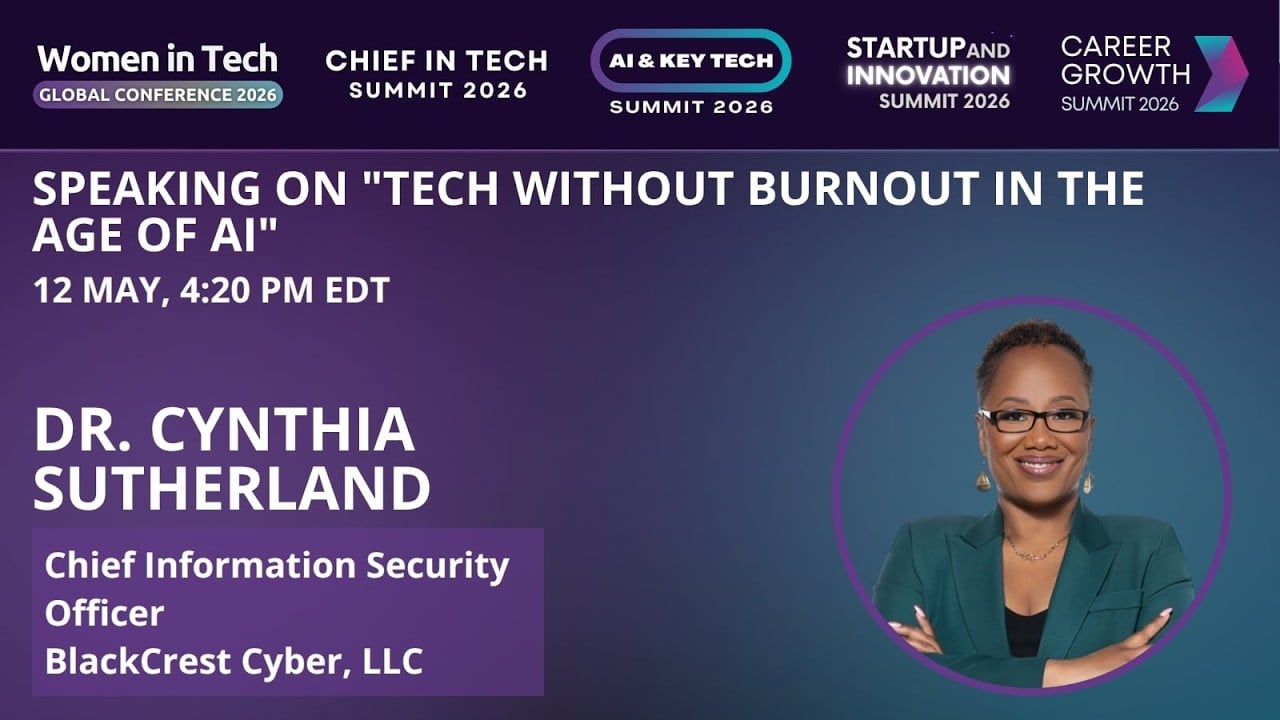
Dr. Cynthia Sutherland, Chief Information Security Officer at BlackCrest Cyber, LLC, argues that burnout in cybersecurity and AI work is not a personal weakness but an operational risk and a system design failure. Drawing on a painful loss early in her Pentagon career, she offers leaders the AIR method: align innovation with empathy, integrate with intention, and recover with permission.
Key takeaways
- Tactics to lead innovation without exhausting your teams
- Strategies to align systems, people and priorities under pressure
- A mindset shift that treats resilience as a core protocol, not a perk
A loss that became a signal
In 2013, Sutherland was the newest security operations branch chief for the Office of the Secretary of Defense, leading a security architecture effort that moved 16 networks and more than 35,000 endpoints into the Pentagon's newest IT environment. Even then, she recalls, products were being built and integrated faster than teams could fully understand them.
The colleague who kept her grounded was Matt, a former Marine, father and husband, with whom she integrated encryption across DOD systems. Over late-night troubleshooting and early-morning coffee they shared the same frustrations: outdated infrastructure, unsupported software, data silos and teams that did not talk to each other, while still being held accountable for stable, secure and scalable solutions.
One morning she learned that Matt had taken his life. He had been working under his fourth consecutive one-month contract extension after a government shutdown, with no clarity and no stability. "In that moment, I realized that Matt's life, his death was not just a tragedy. It was a signal." (3:20)
Citing Gartner (as the speaker cited), she notes that in 2023, 62% of cybersecurity leaders reported burnout and 44% reported repeated episodes. Her conclusion shaped the rest of her career: "And as we move forward in this age of AI, we can no longer build systems off the backs of exhausted minds." (4:03) She stopped asking only how to secure systems and began asking how to secure the minds of the people responsible for the data and the systems.
Align innovation with empathy
Across 16 sectors and roles at AWS, FEMA, the Joint Chiefs of Staff and a 23-nation security board with NATO, Sutherland says she has seen the same pattern: pressure to innovate without breaking stride and to integrate new technology while juggling legacy systems, with burnout and cognitive fatigue treated as background noise. Speed, she argues, is costing teams alignment, trust and clarity.
She asks leaders to look honestly at last-minute requests, late approvals, rushed compliance reviews and scans, and constant project switching. "These are mental injuries normalized as the cost of doing business and no amount of pizza parties or performance awards can help correct that." (8:22)
Aligning innovation with empathy means understanding a team's fatigue alongside its KPIs, treating secure by design as a mental health strategy, and normalizing mental health by asking whether people have the capacity with the same weight as asking whether a system is secure or functional. In her framing, burnout in the age of AI is no longer a people problem: "It is a system design failure. So let's build solutions where people aren't casualties of progress." (9:35)
Integrate with intention
On paper, integrating AI or any new solution looks like a product rollout. Sutherland describes it as a stress test that exposes operational truths: unmapped data dependencies, interoperability problems with legacy systems after institutional knowledge leaves with a departing colleague, unanticipated biases, and decisions made faster than governance can keep up. The result is controlled chaos and slipping timelines.
Her response is three practices. Document to restore focus and reduce decision fatigue. Baseline both human and system workload so leaders can track fatigue and escalations. Automate the documented processes so people are free to do what machines cannot. She presents this as a leadership requirement: "As a CISO, I don't suggest this. I require it." (11:46)
The reason is accountability. In a legal or HR investigation, or a breach, it is not only systems under scrutiny but decisions, leadership and processes. A team that cannot explain what happened, when it happened and why is operating at risk and putting the company at risk. Done well, intention turns chaos into coordination: "And that allows fire drills to now become workflows." (12:21)
Recover with permission
Once a capability is live, or a high-profile event or data breach winds down, teams still carry the decisions, the adrenaline and the mental weight. "And so let's be clear, at this point, recovery isn't a luxury, it's a protocol." (13:35) Recovering with permission means reflecting on mental load, releasing what does not serve you, resetting the nervous system and recharging by scheduling downtime for yourself and your team.
She illustrates it with a coaching client balancing a career, two children, a husband and a mother-in-law living with her. The client picked her children up at four o'clock, even though daycare closed at six. Sutherland's advice was to use those two hours, whether napping, watching a movie or eating ice cream in the car, simply to breathe and let the day go: "Take those two hours to decompress." (14:53)
Leading for tech without burnout
Sutherland closes by returning to her central claim, set against systems that move faster than people can think and decisions that carry more weight than ever: "And in this environment, burnout is no longer a personal problem. It's an operational risk." (15:20)
Whether someone is building the next AI capability, integrating systems across environments or simply trying to make it to Friday, she invites leaders to step back and breathe with AIR. If organizations get this right, she argues, they will build not just faster but stronger, clearer and more resilient, while sustaining the minds responsible for systems that never stop evolving.
Watch the talk
Watch "Tech Without Burnout in the Age of AI" by Dr. Cynthia Sutherland (about 18 minutes): https://www.womentech.net/video/tech-without-burnout-in-age-ai
About the speaker
Dr. Cynthia Sutherland is Chief Information Security Officer at BlackCrest Cyber, LLC, and a cybersecurity executive and resilience strategist with more than 28 years of experience securing defense, government, enterprise and industrial control systems across 16 industries. She has served as CISO for the Joint Chiefs of Staff and FEMA, as Global Chair for a 23-nation NATO security board and as a Global Automotive Cybersecurity Leader at AWS, and was named a "STEM Pioneer Who Rocks" by NSA.
Questions this talk answers
- Why is burnout an operational risk in cybersecurity and AI work?
- What is the AIR method?
- How can leaders align innovation with empathy?
- What does integrating AI with intention look like in practice?
- How should teams recover after a launch, incident or breach?
Drafted with AI from the talk transcript. Editor review pending.


