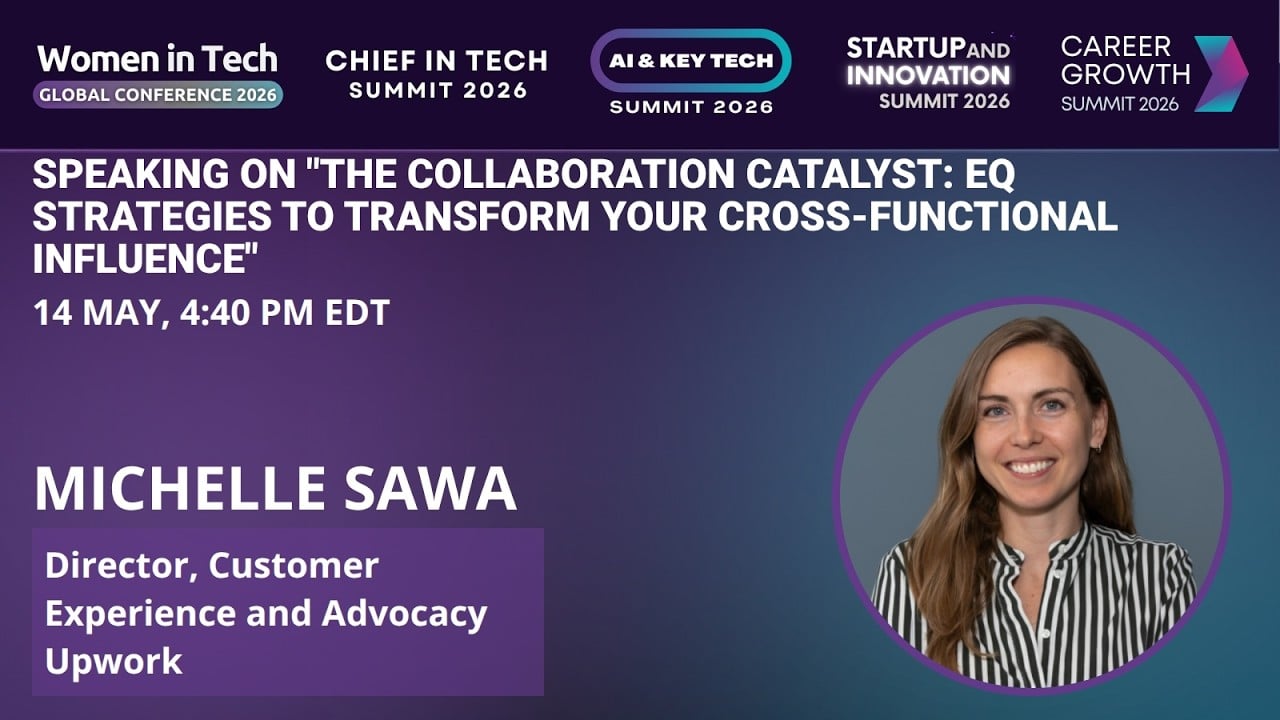
The Collaboration Catalyst: EQ Strategies to Transform Your Cross-Functional Influence
Michelle Sawa15:422026
Influence across teams starts with how you run your next meeting
A two-word feelings check-in, a way to call on a distracted colleague without putting her on the spot, and a habit of thanking executives by DM: these are the small moves that build cross-functional influence. Michelle Sawa, a former middle school teacher now leading customer experience at Upwork, argues that the people who connect are the ones who get elevated. So what turns a status meeting into an engine of collaboration?
Get a ready-to-use playbook of check-ins, questions and follow-ups for your next meeting
Michelle Sawa, a former middle school teacher who now leads customer experience at Upwork, argues that connection comes before influence and that meetings are the everyday unit of influence. She teaches concrete facilitation tactics: a two-word feelings check-in, agreeing goals and respecting the clock, calling on people by name and context, open-ended question types and follow-up DMs.
“Now as the facilitator, it is your duty to make space for every voice. I believe if you are an attendee of a meeting, your voice should be heard in that meeting.”
“So instead, what you want to do is you want to state their name, context, and repeat the question.”
What you will learn
Run a two-word emotion check-in that connects a team in a minute, verbally for small groups or in the chat for larger ones.
Open every meeting by agreeing the goal and outcomes, then keep the discussion tight to respect the clock.
Invite contributions by stating a person's name, the context and the question, so nobody is cold-called.
Use hypothetical, devil's advocate, best and worst scenario and diving deeper questions to surface what people really think.
Follow up after meetings with DMs that thank contributors, ask for advice and recognize leaders at any level.
Key takeaways from the speaker
Facilitate high-impact meetings that align teams on goals and individual stakes
Apply actionable EQ exercises to foster psychological safety and team connection
Lead with confidence and ensure all voices are heard, seen, and valued across functions
Integrate communication strategies daily to build connected teams and deliver successful projects
Details
Level
All levels
Format
Talk
Technical depth
Non-technical
For
Early career, Mid-career, People manager
Length
15:42
Published
August 2026
Questions this talk answers
How can a team connect quickly at the start of a meeting?
Ask everyone for two words describing how they feel right now, using an emotion wheel for inspiration. With six people or fewer each person unmutes to share; with more, people post their words in the chat.
How do you call on someone without putting them on the spot?
State their name, give context about why you are asking them, then repeat the question. This gives them time to tune in and contribute as a valued member.
How do you hear from every voice in a large group?
Take notes in a visible shared space such as a screen-shared Google Doc, and use virtual whiteboards like Miro where people add named post-it notes.
Which questions help a cross-functional discussion move forward?
Hypothetical questions, devil's advocate questions, best and worst scenario questions, and diving deeper prompts such as asking for an example or asking someone to say more.
Is it appropriate to message senior executives directly?
Sawa DMs leaders at every level, for example to praise a presentation, and says every one has responded kindly, because it can be lonely at the top.
About this talk
In the fast-paced world of technology, project success hinges on more than just technical skill—it requires bold leadership and high Emotional Intelligence (EQ), especially across diverse, cross-functional teams. This session provides a roadmap for women who are ready to move beyond tedious status updates to host deeply connected, high-impact meetings. You'll learn how to master communication strategies that ensure every attendee, regardless of role or level, feels seen, heard, and aligned on the project's goal and their personal stake (the "what's-in-it-for-me"). Discover actionable exercises and proven frameworks to transform internal and external team meetings into powerful engines of collaboration, driving projects forward with confidence and clarity. Walk away ready to integrate these practices and lead more successful, connected teams.
All right. So it is start time here. Welcome Raji. Welcome everyone. We are putting in the chat where we are calling in from today. So if you are just joining us, feel free to put in the chat where you are coming from. We only have 20 minutes today and this is a recorded session. So I am going to dive into content and it's going to be collaborative. So I would love to hear from you in the chat. We have a small group here, so let's make the most out of it. Today, we're going to be talking about collaboration catalysts, EQ strategies for cross-functional influence. My name is Michelle Sawa and I am a passionate people leader. I will tell you more about my background here, but first here's the reality connection carries influence. The people
who can connect and lead others are the ones who get elevated in organizations on teams and cross-functional projects. So today we are going to be diving in really deeply understanding connection. How do we connect deeply with the people that we are working with? What are strategies that we can use in our meetings tomorrow to start really deeply understanding the people around us and leaning into that? All right. So let's go ahead and keep going. So as I mentioned, my name is Michelle Sawa. Here's my background. I am a former middle school teacher. As a teacher, you get hundreds of reps working in with groups, in front of groups, trying to bring everyone along with you. And that has been just a foundational experience that I now am using in the business
world. So I spent four years building a startup from the ground up, and now I'm a people leader at a Silicon Valley tech company. So I'm going to share the strategies today that I have learned through my years as a teacher, as a leader, as a startup builder. And I hope that you all walk away with something tactical that you can try. Okay. So here's what we're going to cover today.
First, we're going to cover how to facilitate high impact meetings that align teams on shared goals and stakes. We're going to learn how to apply EQ driven strategies to foster psychological safety and collaboration. I want all of you to lean in, to learn how to lead with confidence, to ensure all voices are heard and valued. And it's all about building connected, high performing teams.
How do we do that? Through effective communication and connection. All right. So here we go. Today in this time here, we're going to be talking about meetings as the unit of influence. Okay. We are all, if you are working at a company right now, you likely have meetings on your calendar that can be used to influence. Maybe there's projects that you're working on and maybe you're a team leader, but maybe you're not. If you're not a team leader, if you are typically a contributor, I want you going through these lessons. And at the end of this, I want you getting the courage and the bravery to go ask your manager and say, Hey, I would love to lead a meeting. Can I take this next meeting that we have
on our calendar? All right. I have a beautiful team of women that I led and some were very timid and they didn't like leading meetings, but they would do it and they would show up and they were always so proud after they did it. So that is my goal for you is that by the end of this meeting, you know how to lead a meeting that is worth everyone's time. All right. So here we go. Okay. So this is a, we're going to start with a question here. Um, so this is an emotion wheel and this is a strategy that I use in my meetings and all of my team meetings. And here is what I'm going to ask you to do. I want you to think about two words for how you're feeling right now. This emotion wheel is
just some inspiration. So I'm going to give you all a minute and I want you to think about two words. Maybe it's tired. Maybe it's inspired. So I will start the timer. Um, I'm, we're going to do one minute. I want you to write these two words down and we're not going to throw them in the chat yet.
We will throw them in the chat at the end of this timer. So go ahead and begin in your notebook. You're writing two words or something next to you for how you're feeling right now in this moment. Okay. This is about 30 seconds. Now what I'm going to have you do is I want you to type your two words and put them in the chat. So this is kind of a round Robin check-in. I want a hundred percent of the people in this meeting writing their two words and sharing the two words that I wrote down. We're excited and curious. What are your two words? Inspired and overwhelmed. Oh, Christine, I would love to learn more about what is making you feel overwhelmed. Cat is curious and tired. I feel that
in my bones. It's Thursday. It's, it's late for some of you. What else? What are two words for how you're feeling in this moment? Now, the reason that I'm doing this exercise is this is an exercise I do each week with my team. And it's a way to more deeply connect with the people that you're working with. So this is a really simple exercise you can use in any team meeting. Okay. We have some more curious, curious and overwhelmed, Sherry content and optimistic. We love it. So typically what I do with this, um, two word exercise, when I am in smaller groups, so typically six people or less, I have every person on mute to speak at the start and share. Maybe it's two words. Maybe it's just a
different check-in. Maybe it's, what are you doing this weekend? So when I'm in small groups, this is what I use at the start of all of my meetings, no matter what the meat of the, the subject of the meeting is, it's really about connection at the start. This is really important in remote work environments. When there are more than six people, I do a word fall in the chat, as you just saw as a way to, to round rob and check in. I might follow up with some of the people who said they were overwhelmed like Christine and Sherry after this meeting to say, Hey, what's going on? Tell me more about, you know, um, what's going on in your life. Okay. So the goal is you want to connect, but you
want to keep the time tight. And this is a really important lesson that I learned as a full-time classroom teacher is like, you must respect the clock no matter what you do. So at the top of every meeting, whether you're hosting it, you're an attendee, you want to get really clear on what the goal is. So as we did at the top of this meeting, we said, boom, here's what we're going to cover. When I'm hosting a meeting, that's a little more interactive than this one. I would open the floor and say, what else should, is there anything else that we want on the agenda? When people feel psychologically safe, they will often say, do we really need to talk about X? I think one of the outcomes should be Y. And so then we go and we have these
typically in a note sheet and we'll edit and iterate those outcomes of the meeting. All right. So that way then everyone knows in this 20 minutes, here's what we're getting through. And then we have to keep it tight to get there. Now as the facilitator, it is your duty to make space for every voice. I believe if you are an attendee of a meeting, your voice should be heard in that meeting. There are so many meetings that we go to in the corporate world where it is like 30 people, you're listening, you're multitasking. And so this is all about, if you want influence and you want to, you know, make change happen in your organization, you need to give space for every voice. So how do you do
that? Okay. This is one of my favorite tactics that I learned from a communications coach that my company had hired during COVID times. And so he said, all right, you want to make sure you hear from every voice in the room and you need to set people up for success. So you don't want to cold call and say, Anna, what do you think about that? And Anna's like, oh no, I'm tired. I was like doing something else. Like, can you repeat the question? Right? We don't want to throw Anna off like that.
So instead, what you want to do is you want to state their name, context, and repeat the question. So an example would be like, Anna, based on your experience running marketing, I would love to hear how you're thinking about this. Could you share more about how you think we should approach this project? And so what you want to do is basically give them time. So now Anna's heard her name, she's heard the context, she's heard the question, and now she can go ahead and weigh in the conversation as a valued member, right? And so you want to make sure that you can go around and make sure whatever you're discussing that every person has a chance to weigh in, whether in the chat or verbally. Now, take notes in a visible space so that everyone can follow along. This is really
important, because it's a way for you to bring people and doing a Google Doc screen sharing. And if you don't have a note taker, be the note taker. I love being the note taker when, when it's a small group, because then you have control and you can really guide the discussion. What I also love are virtual whiteboards. Virtual whiteboards are incredible for larger groups. So like, for instance, for this group, being able to have people go and do post-it notes is a way for you to hear from every voice in the room.
These are great when you have like a large initiative, you need to bring everyone on board, but you can't possibly have every person on mute to speak. You can, however, see all their post-it notes. You can see the contributors in whiteboards like mirror where you can see names. And that is a beautiful thing. So lean on these remote tools that can make collaboration easier, that can make all, make sure that all voices are heard. Now, this is something that I learned. I took an IDEO leadership course and it's this concept called leading alongside the team. And I love that this was like a structured content in a leadership course because the essence of leading alongside your team is you modeling excellence as the facilitator, as the person who's trying to drive change. Every person in this room is a
leader can be a leader and can show up like a leader. So what does modeling excellence mean? It means showing up for every meeting, volunteering to take action items and completing them as you would want others to. So basically you want to set a high bar for excellence and it starts with you and it starts with how you show up and how you engage. And what's so fascinating about this is when there is someone leading that sets a high bar, it inspires other to go and follow suit and to say, whoa, okay, if this person's leading and they're doing this, I want to be doing that as well. All right. So this is key for cross-functional influence and showing people what is expected of them when they're working with you on
projects. Get curious and ask questions. This is one of the most important tools in your tool belt for cross-functional influence because it's not just about what you have in your mind, in your heart. It is about what other people have in their minds and hearts and how you can all come together. So this is my open-ended question guide. I'm going to talk through these. Feel free to grab a screenshot here. These are some of my favorite questions to ask in, you know, when discussing a project. So hypothetical, hypothetical questions. What if we don't have those resources? Suppose if dot, dot, dot, dot, dot, dot, whatever, you know, think about these hypothetical scenarios and see how your team would react, how that changes the dynamic. What I love also are devil's advocate
questions. So some people might say X, what would you say to them? So for instance, this is how you can say something without really saying it. Like some people might say that's an awful idea because X, Y, Z, like, what would you say to them? Do you think that this is like, you think there's merit here? And in a way it kind of like disarms people because it's not like me saying that's a terrible idea. Yes. You love these, Jesse. Great. Use them. Screenshot and use them. But it's a way to get the conversation going. Now this next one, best, worst scenario. I just did this in a facilitation group two weeks ago and it was incredible. So like you're going to talk about a project, like what's the worst
possible outcome? What's the worst way we could solve this problem? And this is like a way to bring people together because it'd be like, oh, well, obviously the worst thing we could do is X, Y, Z. And everyone would be like, that's so bad. And like people just like immediately bond, connect. There's like humor there and thinking about like what's the absolute worst. And then you can kind of put a pin in that and say, all right, well, if that's the worst, well, then what's the best possible outcome of this? So keep this one in mind as well, especially when you're doing kind of like blue sky thinking you have a big project or at the start of it and you need to think about how you want
to approach it. Diving deeper questions. So give me an example of, so maybe someone says like, oh, I would love to do, you know, X, Y, Z. Okay. Give me an example of that. Like, what would that look like? Okay. Can you tell me more about that? And so the goal as the facilitator, as someone who is trying to drive change is like, how can you tease out from people what it is they're really thinking and then have a discussion where there's radical candor and you're able to, you know, have healthy debate there. So these open-ended questions are great. You want to keep them in your back pocket.
And again, remember your goal as someone who is trying to influence change is to have every person who's participating in your project, in your meeting, having their voice heard, contributing and feeling like they are part of it. And they're not just like on the meeting invite list and just like, do I have an action item? No. Okay. I'm going to tune this out. Right. That's not what we want to do. And that's not how we drive change in our organizations. Follow up via DMs. Okay. This is one of my favorite strategies for large groups. And I'm going to give you some examples here.
So there is power in a simple check-in. So anytime I'm facilitating groups or there's large projects, if it's, you know, like maybe there's people that are contributing that I wasn't expecting to join or, you know, they like really showed up, I would like send them a DM and say like, thank you so much for showing up, for speaking up. I might ask for advice. Like, what do you think we should do differently next time? Or, you know, here's something I'm struggling with. Any ideas for what we can do? And being able to like ask that question and transparently share, here's what I'm struggling with, then helps the other person think like, oh, well, maybe I have the ability to change this. Right? Like every meeting is an opportunity to learn, to grow. And
even as someone who facilitates a ton of meetings, I am constantly learning and thinking about things that I could be doing better. All right. Now, the other thing that I love doing, and this is, I am a people leader in a tech company, but I'm like pretty far down the chain. But what I love doing is like reaching out to any level of leader up to like our executives and just sending them a DM, right? After, you know, they have a big presentation or they like presented something and just saying like, you did a great job. Like that looked really hard. And you know, this was like, I was really impressed with that. And what I found is that, you know, oftentimes there's this phrase that like,
it's lonely at the top, right? Once you get up to a certain level, people think like, oh, I can't, that would be crazy. I cannot DM that person. And as someone who's very bold, who's like DM to every level at our company, I can say that every person has reacted with such like kind responses and graciousness and just like, thank you so much for reaching out. So keep this in mind that as you're trying to think about how can I influence change in my organization and the people around me, it's what you do in meetings and that, you know, unit of influence, but it's also what you do after and how you connect with the people around you that are in your circle that are involved. All right.
Now remember connection first influence second. So everyone's trying to think about how can this project that I'm leading, how can I get people to care about it? And the most important thing is if you make it your goal to connect deeply with the people in your room to try to understand what's going on, how are they feeling, what's on their heart and mind, where are their worries, then you will be better off and you will be one step closer to actually influencing and driving the change that you seek to make with your project, with your initiative, whatever it is, because people go to bat for the people that care deeply about them, for the people that are real humans. And that's what this work is all about. That's what leading people and influencing change is all about is connecting
deeply with the people around you. All right. Yes. Understand first then understood.
Transcribed automatically; names checked against the speaker record. Select a time to jump there.
Article based on this talk
How do you build cross-functional influence? Start by connecting in your meetings
Michelle Sawa turns lessons from the classroom into practical meeting tactics that make every voice heard and every project easier to move.
In short
Influence across teams is built in ordinary meetings, and it starts with connection rather than persuasion. Michelle Sawa, Director, Customer Experience and Advocacy at Upwork and a former middle school teacher, shares a set of simple, repeatable tactics: a two-word feelings check-in, clear goals with a tight clock, inviting people in by name and context, open-ended questions, and follow-up messages after the meeting. Her core message is that people go to bat for those who genuinely care about them.
Key takeaways
Facilitate high-impact meetings that align teams on goals and individual stakes.
Apply actionable EQ exercises to foster psychological safety and team connection.
Lead with confidence and ensure all voices are heard, seen and valued across functions.
Integrate communication strategies daily to build connected teams and deliver successful projects.
Meetings are the unit of influence
Sawa opens with a simple premise: the people who can connect with and lead others are the ones who get elevated on teams and cross-functional projects. Most people already have meetings on their calendars, and each one is an opportunity to influence. She speaks directly to individual contributors who do not usually run meetings, encouraging them to ask their manager for the chance to lead the next one. She recalls a team of women she led, some of them timid about facilitating, who always felt proud after they did it.
"So that is my goal for you is that by the end of this meeting, you know how to lead a meeting that is worth everyone's time." (2:48)
Her background explains the approach. As a teacher she got hundreds of repetitions bringing groups along with her, then spent four years building a startup before becoming a people leader at a Silicon Valley tech company.
Start with feelings, then the goal
Sawa demonstrates her favourite opener live: an emotion wheel. Attendees take a minute to write down two words for how they feel, then share them. Responses in the session ranged from "inspired and overwhelmed" to "content and optimistic". In groups of six or fewer, she asks each person to unmute and share; in larger groups, everyone posts in the chat. She then follows up privately with anyone who said they were overwhelmed.
"So this is a really simple exercise you can use in any team meeting." (4:40)
Connection should not cost the agenda, though. Sawa stresses agreeing the goal at the top of every meeting and, in interactive sessions, inviting people to add to or challenge the agenda in a shared note sheet. When people feel psychologically safe, they will say when a topic is unnecessary or suggest a better outcome.
"And this is a really important lesson that I learned as a full-time classroom teacher is like, you must respect the clock no matter what you do." (5:58)
Make space for every voice
Sawa believes every attendee should be heard, in contrast to large corporate meetings where people listen while multitasking. A communications coach her company hired during COVID taught her a technique to avoid cold-calling: instead of springing a question on a colleague who may be distracted, give her the cue first.
"So instead, what you want to do is you want to state their name, context, and repeat the question." (7:30)
Her example: name the colleague, reference her experience running marketing, then ask how she would approach the project. By the time the question lands, she has had time to tune in. Sawa also recommends taking notes in a visible space, such as a screen-shared Google Doc, and volunteering as note taker in small groups because it lets you guide the discussion. For larger initiatives, virtual whiteboards like Miro let everyone contribute named post-it notes when not everyone can speak.
Model excellence and get curious
From an IDEO leadership course, Sawa borrows the idea of leading alongside the team: the facilitator models excellence by showing up, volunteering for action items and completing them. When someone sets a high bar, others follow.
"So basically you want to set a high bar for excellence and it starts with you and it starts with how you show up and how you engage." (9:31)
Curiosity is the other essential tool. Sawa shares her guide to open-ended questions: hypothetical questions (what if we do not have those resources?), devil's advocate questions that let you raise an objection without owning it, best and worst scenario questions that bring humor and bonding to blue-sky planning, and diving deeper prompts such as "give me an example" or "tell me more". The aim is to draw out what people really think and allow candid, healthy debate.
"This is one of the most important tools in your tool belt for cross-functional influence because it's not just about what you have in your mind, in your heart." (10:09)
Follow up, and put connection first
Influence continues after the meeting ends. Sawa sends direct messages to people who showed up or spoke up, thanking them, asking what to do differently next time, or openly sharing what she is struggling with. That transparency helps others feel they can change things. She also messages leaders all the way up to executives after a big presentation, and reports that every one has responded with kindness.
She closes by reframing the goal of any project leader. Rather than asking how to make people care about your project, aim to understand how your colleagues feel, what is on their minds and what worries them.
"Now remember connection first influence second." (14:49)
Watch the talk
"The Collaboration Catalyst: EQ Strategies to Transform Your Cross-Functional Influence" by Michelle Sawa, 16 minutes: https://www.womentech.net/video/collaboration-catalyst-eq-strategies-transform-your-cross-functional-influence
About the speaker
Michelle Sawa is Director, Customer Experience and Advocacy at Upwork, which describes itself as the world's AI + human marketplace. A former classroom teacher with experience in product marketing, market research and stand-up comedy, she holds a master's degree in Integrated Design, Technology, and Business from the University of Southern California, where her research centered on cross-functional collaboration strategies for high-performing, diverse teams.
Questions this talk answers
How can a team connect quickly at the start of a meeting?
How do you call on someone without putting them on the spot?
How do you hear from every voice in a large group?
Which questions help a cross-functional discussion move forward?
Is it appropriate to message senior executives directly?
Drafted with AI from the talk transcript. Editor review pending.
Frameworks and ideas mentioned
Emotion wheel
Name, context and question technique
Leading alongside the team (IDEO)
Radical candor
Best and worst scenario questions
Devil's advocate questions
Resources mentioned
IDEO leadership course
Open-ended question guide (slide)
Google Docs
Miro
Cite this talk
Michelle Sawa. "The Collaboration Catalyst: EQ Strategies to Transform Your Cross-Functional Influence." WomenTech Network, 2026. https://www.womentech.net/en-fr/video/collaboration-catalyst-eq-strategies-transform-your-cross-functional-influence