Consumers are less loyal online, yet they still buy from people
In 2020, one in four people buying clothes online bought from a brand they had never used before, and shoppers over 35 moved online in large numbers, according to figures the speaker cites. Loyalty is suddenly up for grabs. Digital marketing strategist and trainer Irma Karsten, with over 20 years of experience, asks what it takes to win those customers: how does a brand prove there are real humans behind it?
Get practical steps and free research tools to market like a human brand
Digital marketing strategist and trainer Irma Karsten explains how consumer behavior changed during the 2020 pandemic and which trends are expected to last. She argues that even in a fast digital transformation, people still buy from people, and shows marketers how to win customers by being authentic, speaking their language and showing the humans behind the brand.
“What is very important is behind every like, comment, click, share, or website visitor is a real person.”
“The secret is to be real, to show that there are humans behind the brand. Admit your mistakes.”
What you will learn
Identify the consumer behaviors from 2020 that are predicted to last, from online research before buying to dynamic demand.
Recognize the non-linear 'messy middle' where shoppers loop between exploration and evaluation before they buy.
Apply concrete actions such as clear product information, visible local ties, loyalty rewards and safe delivery options.
Show the human side of a brand by admitting mistakes, calming customers' fears and speaking their language.
Use free tools like Think with Google, Google Trends, Answer the Public and Ubersuggest to learn how your audience searches.
Key takeaways from the speaker
Understand current trends and online behaviours of consumers
Best practices of authentic brand building in digital marketing
Learn how to reach the hearts and minds of your ideal customers
Communicate to your ideal customers in a way that matters to them
Details
Level
Intermediate
Format
Talk
Technical depth
Non-technical
For
Early career, Mid-career, Founder
Length
18:43
Published
June 2021
Questions this talk answers
How did consumer behavior change online during the pandemic?
Changes expected over three to five years happened in six months, with more people researching online, older shoppers buying online, and rising interest in sustainability, DIY and wellness.
Which online shopping trends are expected to stay?
Consumers will keep researching online before buying, choose brands carefully beyond price, expect better value, want extensive delivery options and keep demand dynamic.
Is the customer journey still a linear funnel?
No. Shoppers cycle through exploration and evaluation and decide somewhere in what Google researchers call the messy middle.
What matters most to consumers right now, whatever the industry?
Wellness and health, ethical and sustainable brands, equality, convenience, safe home-based solutions, and privacy and data protection.
How can a brand reach customers' hearts and minds?
Be real and show the humans behind the brand, admit mistakes, speak customers' language, calm their fears, reward loyalty and show up on the channels they use.
About this talk
The digital marketing landscape has changed dramatically over the last year - and subsequently the online behaviour of consumers. Even in this digital era that we are living in, people still buy from people. Online competition is fierce for brands. Discover how to stay relevant, authentic and real in a noisy place while leveraging off the current trends.
Speaker 1: Right. Hi, everybody. My name is Irma Karsten. Hi. Thank you for joining my session and welcome to the session. It's good morning where I am from. I'm based in South Africa, Johannesburg in South Africa. I'm a digital marketing strategist and a digital marketing trainer by profession. And so that's what I do full time. Right. So let's kick off then. Welcome to the session. Thank you for joining.
And we are going to talk about how people are still people in a digital world, even though we are in the middle of a major digital transformation everywhere over the world. So, yes, what we're going to talk about briefly is what are the current trends and online behaviors of consumers? How do we build authentic brands in our digital marketing? How to reach the hearts and minds of your ideal customers? And then also how to communicate to your ideal customers in a way that really matches to them.
Speaker 1: Right. So what the quote you'll see on the screen is from Susie Gehring. She's the Global Chief Marketing Officer at Ford Motor Company. And what happened in the last year, since 2020, when the unknown happened to all of us, is that what should have taken three years to three to five years actually took six months during the whole pandemic, where the whole world changed and online behavior changed dramatically. And I'm sure all of you have experienced this. And I'm sure all of you have experienced this. And I'm sure all of you have experienced this.
three to five years actually took six months during the whole pandemic where the whole world changed and online behavior changed dramatically. And I'm sure all of you have experienced that in your countries and in your digital marketing efforts. So we were thrown into digital transformation and we had to adjust very quickly in all industries, in all countries globally, right? So what we found is, and there are many different online behaviors that have taken place globally, but if we just focus on the United Kingdom as an example, so I chose a European region just so that it's a little bit more central for all of us, but I'm sure in the countries where you are in, we have people from Slovenia and I'm from South Africa and India and all over the globe that the
search behavior were kind of similar or online behavior was kind of similar. But in the UK specifically, the search terms that were more globally or the increase in search terms in the UK were typically in terms of recyclable plastics and recycling in general, living green in the UK specifically, how people searched how to grow local produce, how to live sustainable lifestyles, and then also, you know, the global search interest for ideas, paired with things like home decor, DIY actually really peaked during 2020. And consumers are continuing to browse online for looking for inspiration and the online behavior has changed more to be geared towards slow living, because we were forced to spend more times in our homes and forced to relook at our lives, right, because our health is being affected and everybody has been affected by the situation that we are in.
And also wellness is a global trend. People are focusing on their general wellness and their, you know, mind in terms of their mind, being healthy in terms of their minds and bodies. And the biggest increase in those switching to online retail or online buying is also that the people aged from 35 upwards have seen a major increase.
So where previously online shoppers were younger, now we've seen a huge increase, specifically in the UK, in consumers aged above 35 years of age. Also then in the past year, since 2020, one in every four people who buy clothes online have bought from a new brand or retailer, which they haven't bought from before. And we've seen globally that the trends were 75% were women's wear, and interestingly enough, 82% men's wear.
So these shoppers have also said that they will continue to use these new retailers that they've bought from in the coming months. So some of the online behaviors were temporary, others are yet to stay. So we know that things come and go, trends come and go, but the five trends that are staying or that have been predicted to stay after 2020 and even longer is that consumers are now browsing online, looking for the information online before they make the purchasing decision more than ever.
Because we're homebound, right? We all stay safe, we all stay home, so that's why consumers are getting the information they need, well, all of the information they need, and the research is done online. And they are also carefully considering who they are buying from, not just in terms of price, but there are so many other things that now have become important to consumers.
If we look at the previous slide, what is important to consumers is now things like sustainable living, sustainable brands who are environmentally responsible. So I think what happened during 2020 is that people, consumers, our consumers, our clients, your clients, started to think differently about life, their lives, and their spending patterns. Now consumers are also expecting a better value than ever, and that's one of the trends that will definitely stay.
And they need extensive delivery options for everything. Think about your own use. Those of you who are online at the moment, how have your behaviors changed in the last year? And also, one of the trends that will stay is that consumer demand will now remain dynamic. Dynamic means they want to be able to make fast-paced decisions, and they need to be able to change their decisions fast and, you know, explore different types of options that are available.
Right, so it will be good in the chat. If you want to, at any time, ask questions or feedback, you're welcome, or share your experiences. Please feel free to do that in the chat. So what do these behaviors now mean? That online-based experiences are here to stay. It means that the attitudes of our shoppers have changed across demographics.
We've seen all the demographics now engaging in online shopping. We've seen how the search terms and the search behaviors have changed. But it's not only the pandemic that caused people to shop online. It is all about convenience. It's about saving time. It's about being responsible, environmentally responsible. And as the aspirations then move online of these consumers, then new brand loyalties have been formed.
But also, consumers are not as loyal as they used to be a few years ago. So loyalty has kind of shifted. People are more open to move towards brands which they've never engaged with before. So all of these elements together have really shaped the way that consumers are behaving online and how we should communicate to our consumers.
And also, those businesses and companies in the retail environment would have noticed that the strategic role of the actual stores, their brick-and-mortar buildings, have completely evolved in terms of how do we get feet through the door and where do we actually make contact with our consumers. So just as an example, and a lot of this research was from Think with Google.
You may have seen some of this research before. But many of the – if you just look at the beauty industry online, we will see in terms of the different age categories of 18 to 34-year-olds versus 35 to 54-year-olds and people 55 and older, what are the reasons that they shop for beauty products online, as an example.
So we'll see for the younger generations, it's about ease, right? It's about convenience. It's about, you know, being – it's about things being easy for them. It makes it easy for them to find stuff. Where the 34 to – 35 to 54-year-olds, it's also about convenience, but it's also about finding new products, right? So they are open to exploring new brands, new products, new experiences online now.
And then people 55 years and older is all – you will see that there's a golden thread throughout the age categories that it's all about people wanting to stay home, not wanting to go to shops and being exposed to many people in confined spaces. And, you know, the convenience of having deliveries done at home. But the priority levels change for the different age categories.
So this is just the beauty industry. I don't know which industries you are in. It will be great if you can tell me in the chat which industries you represent. It will be good to just see that. How you – and think about your consumers and how you have seen different behaviors and changes in your consumers and how they make their decisions.
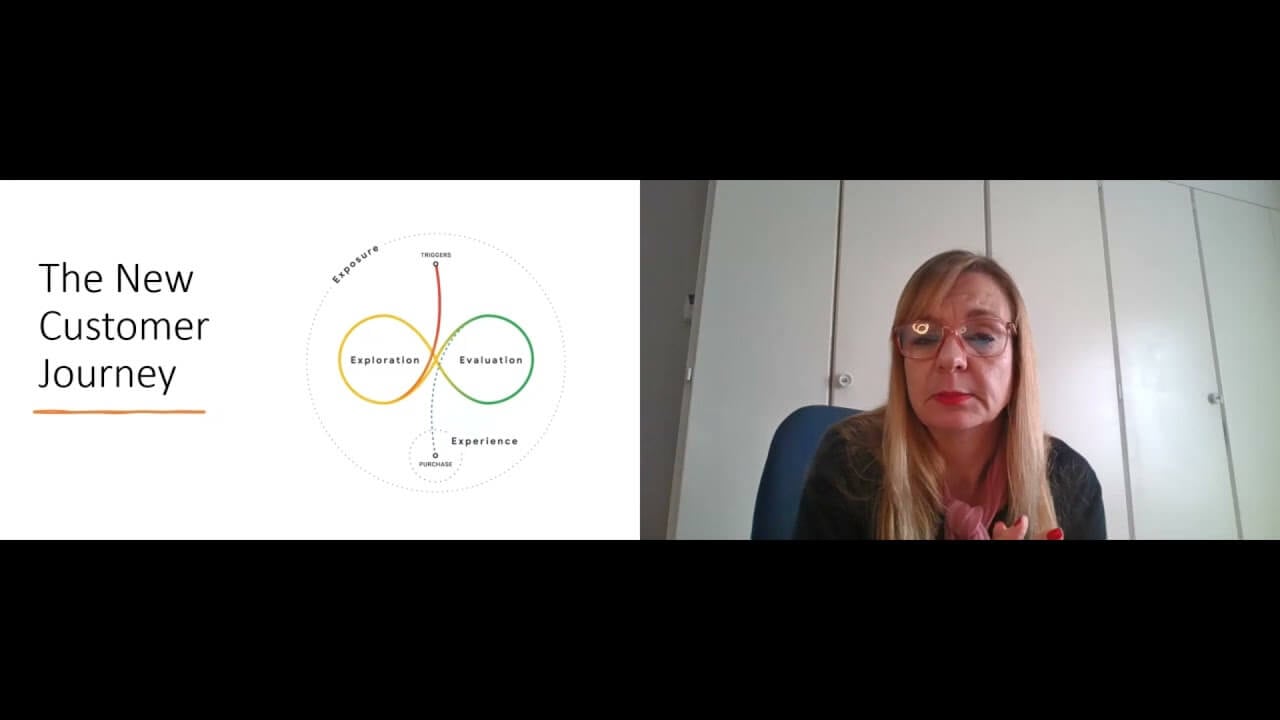
Now, in textbooks, the customer journey is a linear process, but we know in real life that it's not, right? The customer journey is not linear. Shoppers cycle through, you know, stages of exploration and evaluation. And then kind of in the middle, and the Google researchers call it the messy middle, that's where they make the purchasing decision, right?
So as they explore and evaluate in that messy middle, and they seek inspiration and they research products, and they look at product details and they look at reviews to get social proof from their peers and compare prices. You know, it's a never-ending cycle of the consumer journey, and our consumers now in the new digital era that we are in come and go in different stages of the customer journey.
Where typically previously we would focus on the linear process in the buying journey, it has completely now evolved in a fluid process where people, you know, kind of make their decisions somewhere between exploration and evaluation in terms of where to buy and who to support. But now having said that, remember that we are still marketing to people, right?
And we need to figure out what matters to people and what matters to our audience, our specific target audience in our industry and our business. Now I can tell you what matters to people in general, globally, all over the world, all industries, and what matters to people is their wellness, their health, their well-being, right? Mental health, physical health.
I think that is one of the top discussion points at the moment globally. What matters to people is that brands are ethical and that they, you know, portray sustainable habits and that they want to support sustainable brands and live sustainably at the moment. Equality matters to people. Age, gender, race, all of those equalities are really important to people globally at the moment.
What also matters to your consumers right now is convenience and then the safety of home-based solutions where their shopping is delivered to them and they're not exposed, as I said earlier, to crowded spaces and moving out of their homes. Also, privacy and data protection is majorly important for your consumers right now. So, it doesn't matter which industry you are in or which business you are in or what products you are selling or what services you are representing.
This is what matters to your audience right now. So, what does it mean? What does this mean for us as marketers? Which action do we need to take and how do we get to the hearts and minds then of our consumers? So, according to Think with Google again, show throughout the purchase journey that give your consumers the right information so that they can make the purchasing decision with your brand.
Give them the right information about the features and benefits of your products in terms of solving their problem, in terms of how available your products and services are, and reward them with special offers, right? Give them a reason to support you and also by, you know, taking a stance about how your brand is sustainable. How does it support a sustainable environment at the moment?
Make your local ties clear because local search is even more important than ever at the moment. Consumers have moved to supporting local businesses, right? And then be authentic and real in terms of following through on what you promise your consumers in terms of your brand. Then nudge your consumers, giving them extra value. Thank them for their loyalty.
Incentivize them. Be thankful for their following. Be thankful for their support. So, give them special offers. Offer them something extra in terms of value. Then also make sure that your delivery and collection options are convenient for your consumers because it's all about their safety. It's all about them keeping safe and you showing that you care for your consumers by keeping them safe and offering them these delivery options that will keep them safe in their homes and not expose them to other people unnecessarily.
Then what we've seen, what happened during the last year is that short-term shifts can happen in demand, right? Something happens in the news. There is some announcement that is made in terms of new lockdown rules. And then there may be a sharp rise in demand for certain products, automation tools. But also focus on the longer terms. And, you know, what is your overall digital strategy in terms of supporting your consumers in their behaviors?
A few other actions that we should focus on as marketers is make sure that your creative formats in terms of your messaging enables smart shopping so that you can make it easy for your consumers to also act on their real-time behaviors. If you have a brick-and-mortar business, an actual physical location, how can you complement the buyer's journey with the online experience and still keep them entertained and help them to experience your brand?
Be where your consumers are. Be present where they are spending their time online, where they are discovering and exploring your products and services. And also just understand, in the case of physical businesses, how your store is actually set up to support and reach your audience in terms of their online moments. What is very important is behind every like, comment, click, share, or website visitor is a real person.
We are still marketing to real people even in this digital age. So how do we reach the hearts and minds of our consumers then? The secret is to be real, to show that there are humans behind the brand. Admit your mistakes. Show the human element of your brand. Show them you care. Speak your consumer's language. Do you know what are the words and the terms they use to look for the solution that you have to offer?
Speak their language. Calm their fears. People are afraid for their health. People are anxious and nervous about their mental health. They are scared. So reassure them. Speak to their concerns. Give them the assurance that your brand is there, that your solution is absolutely tailored to solve their problem. It doesn't matter which industry you are in or which product or service you offer your consumers, but make sure that you show them that you care.
And reward them for their loyalty. Give them special offers. Give them reasons to come back to your brand and re-engage with your brand. Most importantly, I mentioned this earlier, but show up where they are hanging out online. Right? So where are your consumers? Which channels are they using? Which are they using more than others? And be present, but speak the language of your consumers on that specific channel.
Few tools you can use to understand the behaviors of your audience and also to give them the right content and messaging to support your brand promises. Definitely think with Google. I don't know if you are using any of these tools, but think with Google. It's really investing in a lot of consumer insights, marketing tools, trends to support brands in terms of really showing up and giving the audience the right information that they need.
Google Trends will help you to understand what the online search behavior and buying behavior is of your consumers in the different locations where they are based. And Answer the Public is a fantastic tool to show you what people are talking about or asking search engines about your topic or your solution that you offer. directmarketer.com It's a handy tool to let you know as a digital marketer every day what's happening in the digital landscape, what is changing, what you need to know, which algorithms are changing, which updates are happening.
And Uber suggests in terms of the keywords that your consumers use because you need to speak consumer language. Right? Speak the language of your consumers so that you are clear that you understand what their needs are and that you understand them as real humans. And then don't forget every year in January the We Are Social Hootsuite Global Digital Report will give you up-to-date up-to-date trends and topics in terms of what's happening in the world of your consumers.
So that brings me to the end of our session today. We have a minute or so. Are there any questions? Let me know if you have any questions in the chat. Any questions or comments? It would be great to hear from you. If not, thank you for your time. Thank you for joining my session and I hope you enjoyed it.
And embrace your brand. Embrace your consumers. Appreciate them. Speak their language and show them that you are a real human brand behind your promises. So thank you very much. Thank you for the comments. I don't see any questions. I can definitely send you the slides. Absolutely. If you can connect with me on LinkedIn and send me a LinkedIn connection request, then I will send it to you in a LinkedIn message.
Right. Thank you very much. Thank you, everybody, for joining and keep in touch. Thank you.
Transcribed automatically; names checked against the speaker record. Select a time to jump there.
Article based on this talk
Why people still buy from people, even after the digital shift
Irma Karsten explains how consumer behavior changed during the pandemic and how brands can stay human, authentic and relevant online.
In short
Consumers moved online faster than anyone expected, became less loyal and started caring about sustainability, wellness, safety and privacy. Digital marketing strategist and trainer Irma Karsten argues that the brands that win in this noisy space are the ones that remember they are still marketing to real people: they give useful information, speak their customers' language and show the humans behind the brand.
Key takeaways
Understand current trends and online behaviors of consumers.
Best practices of authentic brand building in digital marketing.
Learn how to reach the hearts and minds of your ideal customers.
Communicate to your ideal customers in a way that matters to them.
The pandemic compressed years of change into months
Karsten, speaking from Johannesburg, opens with a quote she attributes to the Global Chief Marketing Officer of Ford Motor Company: changes that should have taken three to five years happened in six months during the pandemic. Online behavior shifted dramatically everywhere, and businesses had no time to prepare.
"So we were thrown into digital transformation and we had to adjust very quickly in all industries, in all countries globally, right?" (1:17)
Using the United Kingdom as an example, she describes, as the speaker cited, rising searches for recyclable plastics, living green, growing local produce and sustainable lifestyles, alongside a peak in interest in home decor and DIY during 2020. Wellness became a global trend. Online shopping also spread beyond younger buyers, with a major increase among consumers aged 35 and over. She adds that one in every four people buying clothes online had bought from a brand or retailer they had never used before, and that many of these shoppers planned to keep using those new retailers.
Five trends that are here to stay
Some behaviors were temporary, but Karsten highlights five that are predicted to last: consumers research online before they buy, they choose carefully who they buy from (not only on price), they expect better value than ever, they want extensive delivery options, and their demand stays dynamic, meaning they make fast decisions and change them just as fast.
The pandemic is only part of the story. "But it's not only the pandemic that caused people to shop online. It is all about convenience." (6:12) Time saving and environmental responsibility matter too, and as consumers' aspirations moved online, new brand relationships formed. The flip side is that loyalty has weakened.
"But also, consumers are not as loyal as they used to be a few years ago." (6:39)
For retailers, this also changes the strategic role of physical stores: where and how a brand actually makes contact with customers has evolved. Drawing on research she credits to Think with Google, Karsten shows how reasons for buying beauty products online differ by age group, from ease for younger buyers to product discovery for the middle group and staying safely at home for those over 55.
The customer journey is a messy middle
Marketing textbooks still draw a straight line from awareness to purchase. Karsten pushes back on that picture.
"Now, in textbooks, the customer journey is a linear process, but we know in real life that it's not, right?" (9:04)
Shoppers cycle through exploration and evaluation, seeking inspiration, researching products, reading reviews for social proof and comparing prices. Google researchers call this the messy middle, and it is where the purchase decision is made. The practical point for marketers is that customers come and go at different stages, so a brand has to be useful at every one of them. Yet she reminds the audience of the constant underneath the complexity: "But now having said that, remember that we are still marketing to people, right?" (9:58)
What matters to people, and what marketers should do about it
Across industries and countries, Karsten lists what consumers care about: their wellness and mental and physical health, ethical and sustainable brands, equality of age, gender and race, convenience and safe home-based solutions, and privacy and data protection.
From there she turns to action. Give customers the right information about features, benefits and availability throughout the journey. Take a clear stance on sustainability. Reward loyalty with special offers and extra value, and thank customers for their support. Offer convenient, safe delivery and collection options. Watch for short-term spikes in demand triggered by news, while keeping a longer-term digital strategy in view. And emphasize where you are.
"Make your local ties clear because local search is even more important than ever at the moment." (12:30)
She also urges marketers to use creative formats that enable smart shopping, to connect physical locations with the online experience, and to be present wherever customers are discovering products.
Show the humans behind the brand
The heart of the talk is a simple reminder. "What is very important is behind every like, comment, click, share, or website visitor is a real person." (14:25)
To reach those people, Karsten's advice is to be authentic. "The secret is to be real, to show that there are humans behind the brand. Admit your mistakes." (14:55) That means learning the words customers use when they search for a solution, calming fears about health and safety, showing that you care, rewarding loyalty and speaking the language of each channel where your audience spends time.
She closes with tools that help: Think with Google for consumer insights, Google Trends for search and buying behavior by location, Answer the Public for the questions people ask about a topic, Ubersuggest for the keywords customers use, a daily digital marketing news source, and the annual We Are Social and Hootsuite Global Digital Report published each January.
Watch the talk
"People are people - even in a digital world" by Irma Karsten (19 minutes): https://www.womentech.net/video/people-are-people-even-in-digital-world
About the speaker
Irma Karsten is a Digital Marketing Strategist and Trainer at Lacuna Education, with over 20 years of work experience as a digital marketing strategist, consultant and full stack digital trainer. She trains everyone from entry level to advanced learners, including entrepreneurs, marketing managers, university professors and executives, and believes that "if you are not having fun while you are doing it, then you are doing it wrong".
Questions this talk answers
How did consumer behavior change online during the pandemic?
Which online shopping trends are expected to stay?
Is the customer journey still a linear funnel?
What matters most to consumers right now, whatever the industry?
How can a brand reach customers' hearts and minds?
Drafted with AI from the talk transcript. Editor review pending.
Frameworks and ideas mentioned
Messy middle (customer journey)
Resources mentioned
Think with Google
Google Trends
Answer the Public
directmarketer.com
Ubersuggest
We Are Social Hootsuite Global Digital Report
Cite this talk
Irma Karsten. "People are people - even in a digital world." WomenTech Network, 2021. https://www.womentech.net/video/people-are-people-even-in-digital-world