

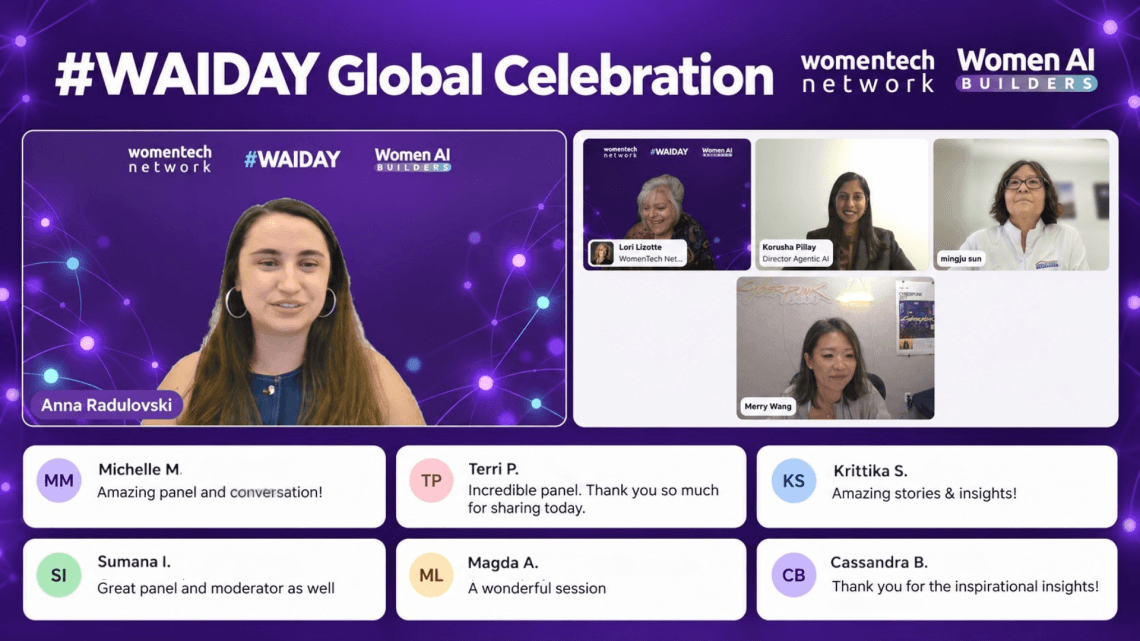
On October 1, Women AI Builders and WomenTech Network brought the global community together for Women in AI Day 2026, celebrating the women already building, leading and shaping the future of artificial intelligence.
The celebration opened with a keynote from Anna Radulovski, Founder & CEO of WomenTech Network and Women AI Builders, who shared new findings from the State of Women in AI 2026. Based on responses from 2,918 women in tech and AI across 64 countries, the study offered a timely picture of how women are working with AI today, where progress is happening and where gaps remain.
The keynote was followed by the panel “Women in AI: Leadership, Influence and Collective Impact,” featuring:
Korusha Pillay, Director, AI & Agentic Leader at EY LLP
Mingju Sun, Vice President, Data and AI at American Family
Merry Wang, Sr Principal, AI Strategy at Autodesk
Lori Lizotte, Head of Strategic Partnerships at WomenTech Network, as moderator
From career pivots and adaptability to judgment, sponsorship and the changing value of human leadership, the conversation explored what it takes not simply to keep pace with AI, but to have a voice in where it goes next.
Women Are Already Building With AI
One of the strongest messages of the day emerged before the panel even began: women are not waiting to become part of the AI economy.
The State of Women in AI 2026 findings shared by Anna showed that 84% of respondents use AI every day at work, more than half have built or prototyped a tool or agent, nearly one in three has shipped an AI feature, and 54% have trained others to use AI. As Anna put it, this is “not a community asking for permission. That is a community already building.”
Yet building does not automatically translate into recognition. While 53% of respondents said their AI skills had brought them new projects and responsibilities, only 19% said those skills had resulted in a promotion, raise or new role. That contrast led to one of the central questions of the celebration: as women take on more of the work created by AI, will they also gain greater influence over the decisions surrounding it?
For Anna, the answer begins with being present before those decisions are settled. Women, she argued, “cannot be invited in after those choices have been made.” They need to be in the rooms where the choices themselves are being shaped.
A Career in AI Does Not Have to Begin in AI
The careers represented on the panel offered a compelling reminder that there is no single route into AI leadership.
Merry Wang's career began in stem cell biology. Moving from science into software and eventually AI strategy might appear to be a dramatic change, but Merry sees a strong connection between those chapters of her career. Scientific research had taught her how to approach difficult questions without obvious answers, work through uncertainty and challenge assumptions. Those habits became valuable in a field where both the technology and the questions surrounding it are constantly evolving. She described the connection as “taking ambiguity, asking good questions and challenging assumptions and formulating a point of view when the answer is not so obvious.”
For Korusha Pillay, the realization that earlier experience could remain valuable came after a major career change of her own. She started in electronic engineering and control and instrumentation in the petrochemical industry before moving into consulting.
At the time, she assumed she was starting from zero. She accepted a 40% pay cut to make the transition. Only later did she recognize that she had brought far more into her new career than she initially gave herself credit for. The systems thinking, process mindset and ability to understand how a change in one part of a system affects another became, she said, “the springboard to my career.” Her advice for people looking at AI and wondering whether their background still has a place in it was direct: “Don't underestimate the skills you've already built because these skills are transferable and you are worth way more than you realize.”
In a field changing as quickly as AI, it is easy to assume that relevance requires starting again. Their experiences suggest something different. New technical skills can be learned, but the ability to think critically, understand complex systems, ask better questions and bring years of domain experience into a new problem can be just as important.
Building Influence and Stepping Into Leadership
For Mingju Sun, recognizing her own influence did not begin with a dramatic career milestone. It appeared gradually in the way people around her behaved. During meetings, colleagues would message her privately to ask what she thought. If she had been quiet, someone would ask for her perspective. After a meeting, people would seek her out because they wanted to continue the conversation.
Over time, those small moments began to mean something. “You realize your opinion counts in other people's eyes,” she said. “Your thoughts, your opinions, your ideas have been taken seriously.” Her advice was to notice those signals rather than dismiss them: “Don't underestimate those kind of subtle signs. They're there.”
Korusha's defining experience with leadership came in a very different form. She was relatively new to consulting when she found herself working on a troubled project. The senior manager responsible for it was unexpectedly hospitalized, leaving the team without the person who would normally take control.
Korusha remembers realizing that she had two options: “I could either step away and just let it keep burning or I could almost like pretend that I had the authority, step up and take control of the project.” She chose to step in. That meant difficult conversations with the client, replanning and rebaselining the work, and taking responsibility for getting the project back on track. The experience changed her understanding of what it means to lead before the title necessarily catches up. “Step up and just believe you have the authority,” she said.
As AI Becomes More Capable, Judgment Becomes More Important
The conversation took on a different dimension when Lori asked what leadership looks like when people are increasingly working alongside AI agents.
Korusha emphasized the importance of direction and strategic thinking. Before delegating work to people or technology, leaders still need to understand the problem, consider possible courses of action and decide what should happen next. AI can accelerate execution, but it cannot remove the need for clarity about where that execution should lead.
Merry focused on another quality that becomes more consequential as AI systems take on greater responsibility: judgment. AI can generate ideas, make recommendations and increasingly take actions on behalf of people. Yet, as Merry pointed out, “someone has to have the judgment on whether or not that action is appropriate or accountable.”
That responsibility also changes the way organizations should think about AI adoption. The opportunity is not simply to add AI to every existing workflow. It is to ask whether the workflow itself should change, how roles should evolve and where human expertise remains essential.
Mingju, who works on operationalizing AI across areas including claims, underwriting, sales and servicing, brought the discussion firmly into the realities of implementation. One of the biggest challenges, she explained, is often not building the technology at all. It is change management. If a new system does not understand the friction people experience in their daily work, adoption becomes difficult. Leaders also have to resist overselling what AI can do and remain honest about its limitations. And despite all the attention on what AI will transform, Mingju offered an important reminder: “A lot is changing on the job, but not everything.” Creative problem solving and curiosity remain some of the “rocks” people can continue to rely on.
Learning to Work With AI Without Chasing Everything
Even for leaders working closely with AI, keeping pace with the field can feel impossible.
Mingju spoke openly about the volume of information arriving every day and the feeling that there is always something else to read or learn. “Those feelings are common. They are real,” she told the audience. “You're not alone.”
Merry's approach is deliberately selective. She believes people need to use the tools themselves and experiment enough to understand what they can do. But that does not mean following every development. “We need to be okay with not keeping up with everything,” she said. Instead, she focuses on what connects to a useful problem: “Skip the things that don't connect to a real problem that you're trying to solve.”
Korusha offered similarly practical advice for anyone overwhelmed by the growing number of AI tools. “If you're stuck, choose something because no matter what you choose, there's going to be something better tomorrow.” Start with a simple tool, understand what it can do, and experiment. “Don't get bogged down on what tool's the best. Just start playing.”
That willingness to learn may prove more durable than expertise in any particular platform. When asked which skill women should develop today to lead in an AI-driven organization three years from now, Merry chose learning agility, while Korusha emphasized adaptability and the ability to make decisions without having every piece of information.
The Skills That May Matter More, Not Less
When the conversation turned to where professionals should invest their development, the answers moved beyond AI tools altogether.
For Mingju, one of the strongest investments is business acumen and domain knowledge. Understanding the business, the process and the customer gives people the context needed to decide what AI should do in the first place. Without that knowledge, it becomes difficult to distinguish between something that is technically possible and something that is actually valuable.
Merry made a similar point through the lens of outcomes. The important questions are not simply whether an organization deployed AI, but what changed because of it. Did it improve a decision? Reduce a risk? Create a better outcome?
Korusha then turned the discussion toward something distinctly human. “My strong belief is that people's skills is going to be invaluable in the future.” Difficult conversations, negotiation and storytelling may become particularly important as more routine interactions are mediated through technology. And when increasingly capable AI becomes available to everyone, access to the technology itself may no longer be what differentiates people. “Everyone's going to have agents and then they're going to pay a premium for those people who are thinking differently,” she said.
Creating More Pathways for Women to Shape AI
Individual preparation matters, but the conversation also challenged organizations to examine who receives the opportunities created by AI.
Merry pointed to the women already inside companies who understand their customers, industries, workflows and businesses deeply but may not yet have extensive AI experience. “Some of them may not have the AI experience yet, but that is often at this day and age much easier to build than all of the domain knowledge that they already have.” Instead of limiting new AI opportunities to the people who already appear to fit the profile, she encouraged leaders to ask: “Who do we have in the organization that can grow into this if we gave them the opportunity, the training, and the room to grow and learn?” Sponsorship and allyship can be equally important.
When Korusha moved from South Africa to the UK in 2020, the transition affected her confidence more than she expected. She found herself questioning whether she belonged and becoming quieter in situations where she previously would have spoken. An ally helped her recognize what was happening and, more importantly, reminded her what she was bringing into the room. “My voice, my opinions, those are the things that are of value.”
That experience changed not only her own trajectory but how she now supports others. She shares frameworks, opens up processes that are often invisible and helps the people she mentors understand how to navigate opportunities she once had to figure out herself. “The best thing you can do is pay it forward,” she said.
Mingju emphasized another part of that process: relationships. Attend the internal conference. Join the hackathon. Meet people outside the team you work with every day. Pitch the idea. Those interactions may seem small at the time, but they expand the number of people who know what you can contribute. Creating more women leaders in AI will require both sides of that equation: women prepared to step into opportunities and organizations willing to widen where they look for the people capable of taking them.
We’ve made the full conversation available for our community so you can explore the insights, share them with your network, and continue the dialogue.
Continue the Conversation
Women in AI Day is one moment in a much bigger conversation about who builds AI, who leads with it and who helps shape what comes next.
To go deeper, pre-order the State of Women in AI 2026 Report for the full findings and perspectives behind the study shared during the opening keynote.
Join us at the AI Builders Global Conference (October 14–16, Virtual), bringing together AI builders, founders, executives and technology leaders for three days of conversations, practical insights and new ideas shaping the future of AI.
And stay connected beyond the event. Follow WomenTech Network and Women AI Builders on LinkedIn for more stories, research, opportunities and conversations with women building and leading in AI.