

Image credit: AI-generated using OpenAI (ChatGPT / DALL·E)
Women founders are accustomed to building ambitious businesses with limited resources. According to PitchBook's All In: Female Founders report, companies founded solely by women received just 1% of U.S. venture capital funding in 2024, continuing a long-standing funding gap women in tech have faced for years. Yet research from Boston Consulting Group and MassChallenge shows that startups founded or co-founded by women generate significantly higher revenue per dollar invested than male-founded companies.
For many founders, that efficiency means every marketing investment needs to deliver lasting value. Professional brand photography is one of those investments. Whether you're preparing for a product launch, updating your website, speaking at industry events, applying for accelerator programs, or strengthening your LinkedIn presence, authentic, high-quality visuals help establish credibility and communicate your brand story.
The encouraging news is that creating professional brand imagery no longer requires hiring a full-service creative agency. Today, founders have several practical options that fit different budgets, timelines, and production needs.
This guide explores:
what professional brand photography actually costs;
different ways to source professional models;
how to prepare for a successful shoot;
common first-time mistakes to avoid; and
how to maximize the value of every photography session.
What Does Professional Brand Photography Actually Cost?
Brand photography involves more than hiring a photographer. Understanding the full budget before booking anyone helps founders prioritize spending and avoid unexpected costs later.
Typical expenses include:
Model fees: usually charged by half-day or full-day, depending on experience, location, and licensing.
Photography: often the largest expense, with rates varying based on expertise and commercial experience.
Location or studio: this may include your office, a rented studio, co-working space, or outdoor permit.
Styling and props: wardrobe, hair and makeup, products, and supporting accessories.
Post-production: editing and retouching, which many first-time founders underestimate.
Planning these costs early makes budgeting easier and helps identify where investing more can improve the final result. For many startups, prioritizing an experienced photographer and professional editing often provides greater long-term value than spending heavily on elaborate locations or set design.
Just as importantly, think beyond a single campaign. A thoughtfully planned photo session can produce website banners, speaker headshots, LinkedIn content, media kits, investor presentations, recruitment materials, and social media assets for months to come.
Where Can Founders Find Professional Models?
There isn't one universal solution. The right sourcing approach depends on your budget, production complexity, timeline, and how much coordination you prefer to manage yourself.
Here are five common options.
1. Traditional Modeling Agencies
Agencies handle casting, scheduling, contracts, and coordination. They can be an excellent fit for larger campaigns involving multiple models or more complex productions. Their additional support often comes with higher fees and longer booking timelines.
2. Freelance and Creative Marketplaces
Freelance platforms provide access to a broad range of creative professionals with flexible pricing. They are often suitable for startups that have clear creative direction but are comfortable managing communication, scheduling, and vetting independently.
3. Creator and UGC Communities
Many brands now collaborate with content creators and user-generated content (UGC) creators who combine authentic storytelling with photography experience. This approach works particularly well for social-first campaigns where relatability is more important than polished studio imagery.
4. Direct Model Booking Platforms (The New Modeling Agencies)
Direct booking platforms enable businesses to connect with verified professional models without working through a traditional agency. Depending on the platform, founders can browse profiles by location, experience, and category while managing bookings directly.
For example, Zodel is one platform that offers direct access to professional models while using a transparent platform-fee model. For founders managing smaller campaigns, platforms like these may provide additional flexibility alongside lower administrative costs. As with any provider, it's important to review verification processes, licensing terms, cancellation policies, and client reviews before confirming a booking.
5. Local Creative Communities
Universities, photography clubs, fashion schools, entrepreneur communities, and local creative networks can also be valuable sources of talent. Collaborating with local professionals often creates opportunities to build long-term creative relationships while supporting your regional community.
Rather than asking which sourcing option is "best," consider which one aligns with your campaign's goals. Larger commercial productions may benefit from agency support, while smaller founder-led shoots can often be managed successfully through direct booking, freelance talent, or trusted local referrals.
Why Authentic Photography Matters for Women Founders
Brand photography is about much more than attractive images.
For women founders, professional visuals often shape first impressions with investors, customers, conference organizers, media outlets, mentors, and future employees. Consistent imagery helps communicate professionalism while allowing founders to present themselves authentically.
Equally important is representation. Consider creating imagery that reflects your company's values by showcasing inclusive teams, accessible workplaces, diverse perspectives, and genuine customer experiences. Authentic representation strengthens both employer branding and customer trust while reinforcing the inclusive culture many women-led businesses strive to build.
How Do You Define a Visual Identity Before You Book Anyone?
Before reaching out to photographers or models, take time to define what you want your brand to communicate visually. A clear creative direction makes it easier to hire the right people, stay within budget, and produce images that remain useful well beyond a single campaign.
Start by documenting four essentials:
Brand attributes: Choose three to five words that describe your brand, such as innovative, approachable, confident, or collaborative.
Visual inspiration: Gather six to ten reference images that reflect the mood, lighting, composition, and overall style you're aiming for.
Color palette and styling: Decide on wardrobe colors, backgrounds, props, and whether your product, service, or founder should be the focal point.
Where the images will be used: Consider your website, social media, press kit, conference speaker profile, investor deck, recruitment pages, newsletters, and digital advertising.
Creating this simple creative brief saves time throughout the project. Models understand the expectations before accepting the booking, photographers can provide more accurate quotes, and everyone involved works toward the same visual goal.
For women founders building their visibility, consistency is particularly valuable. A cohesive visual identity across professional channels helps strengthen recognition and communicates confidence at every stage of business growth.
How Do You Choose the Right Photographer?
A photographer's portfolio may be impressive, but the best choice depends on whether their experience matches your objectives.
For example, someone who specializes in product photography may not be the best fit for founder portraits, while a lifestyle photographer may excel at storytelling but have limited experience with detailed product imagery.
When evaluating photographers, consider three key factors.
Relevant Experience
Look beyond beautiful images. Search for work that reflects the type of photography you need, including similar lighting styles, industries, and commercial applications.
Licensing and Usage Rights
Before booking, clarify exactly how the finished images may be used.
Ask questions such as:
Are commercial usage rights included?
Can the images be used in paid advertising?
Are there restrictions on print or packaging?
Is there an expiration period on the license?
Having these discussions early helps prevent unexpected licensing fees later.
Deliverables and Timeline
Confirm expectations before the shoot begins.
Discuss:
the number of edited images;
editing style;
delivery formats;
turnaround time;
whether additional revisions are included.
A photographer who clearly defines deliverables often creates a smoother experience than one who offers vague estimates.
Rather than selecting purely on price, evaluate which photographer best understands your brand and can consistently produce the style of imagery your business needs.
What Should You Prepare Before the Shoot?
Preparation often has a greater impact on the final outcome than purchasing additional equipment or booking a more expensive location.
Before the shoot, prepare:
a concise creative brief;
your shot list;
wardrobe selections;
product samples or props;
branding guidelines;
image usage requirements; and
a realistic production schedule.
Many founders underestimate the importance of a shot list.
List every image you expect to capture, including:
founder portraits;
team photos;
workspace images;
product close-ups;
lifestyle scenarios;
horizontal website banners;
vertical social media content;
square advertising formats.
Planning these shots in advance reduces stress during the session and helps ensure that important content isn't forgotten.
Why Usage Rights Matter
Usage rights are one of the most commonly overlooked aspects of commercial photography.
A beautiful image only creates long-term value if your business has permission to use it where needed.
Before the shoot, agree in writing whether the photographs will be used for:
company websites;
paid advertising;
social media;
conference materials;
printed marketing;
packaging;
media interviews;
investor presentations.
Expanding usage after a campaign has finished often requires renegotiating licenses, which can increase costs unexpectedly.
Clarifying expectations from the beginning protects both the creator and the business.
How Long Does Sourcing Usually Take?
The timeline depends largely on how talent is sourced.
While every project is different, founders can generally expect:
Traditional agencies: approximately one to three weeks, allowing time for casting, scheduling, and contract management.
Direct booking platforms: often a few hours to several days, depending on talent availability.
Freelance marketplaces: typically several days, although responsiveness varies.
Local referrals: timelines depend on existing relationships and scheduling flexibility.
If your business is preparing for a product launch, seasonal campaign, conference, or media opportunity, begin planning earlier than you think you'll need. Creative schedules often fill quickly, particularly during holiday seasons and major industry events.
How Do You Reduce Risk When Hiring Creative Talent?
Every sourcing method has strengths, but founders can reduce uncertainty by following a consistent evaluation process.
Before confirming a booking, consider whether the provider offers:
identity or professional verification;
transparent contracts;
client reviews or references;
secure payment processes;
clear cancellation policies.
If these protections are unavailable, request references, use written agreements, and document licensing terms before work begins.
Building strong relationships with photographers, models, stylists, and other creative professionals also pays dividends over time. Returning to trusted collaborators often results in smoother productions, stronger creative consistency, and a growing visual library that evolves alongside your business.
Ultimately, the goal isn't simply to complete one successful photoshoot—it's to establish a reliable creative process that supports your brand as it grows
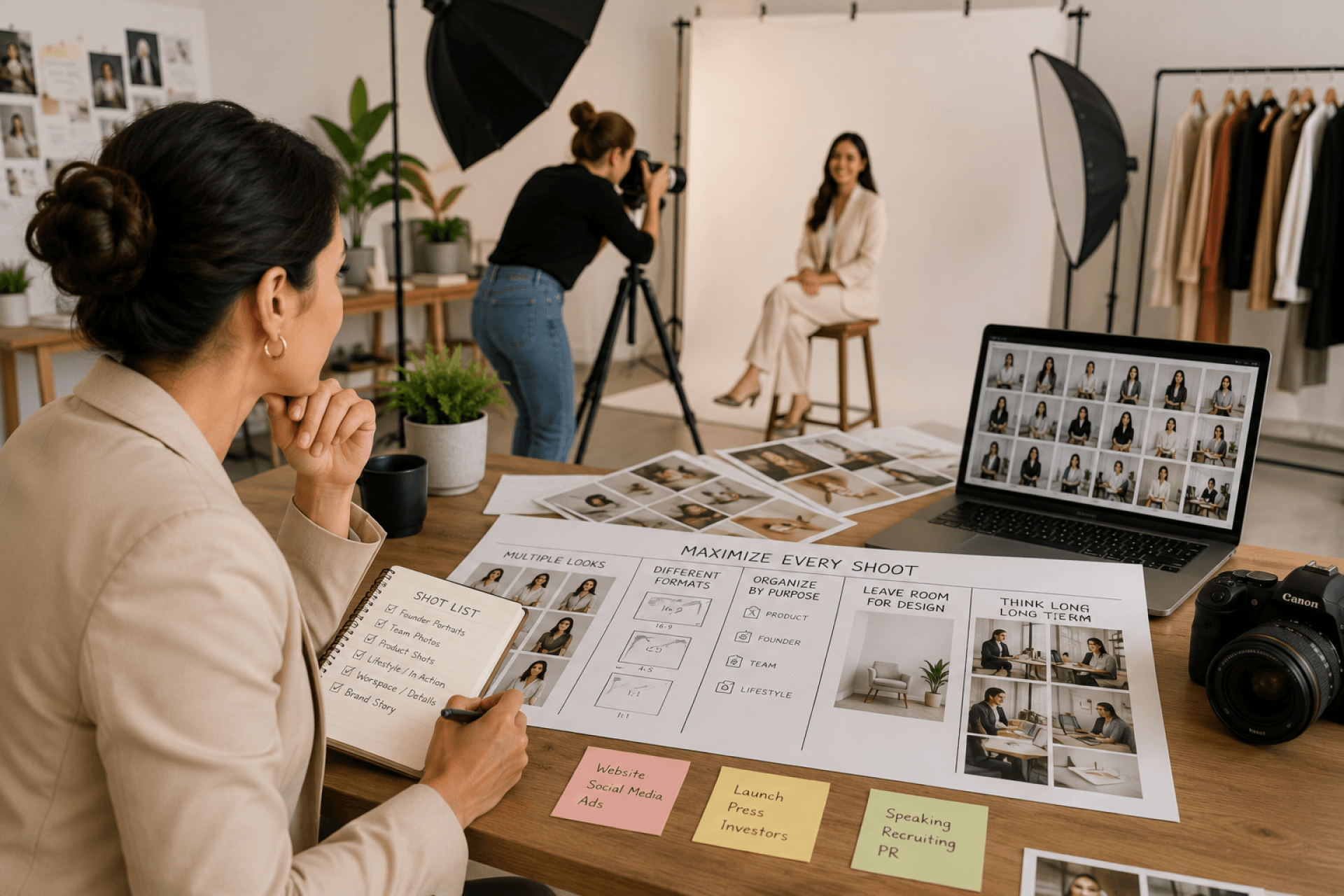
Image credit: AI-generated using OpenAI (ChatGPT / DALL·E)
How Do You Get the Most Out of a Single Shoot?
A thoughtfully planned photo session can provide marketing assets that support your business for months, making it one of the most cost-effective investments for an early-stage company.
To maximize the value of each session:
Plan multiple looks. Simple wardrobe changes, different backgrounds, or alternative workspaces can create a wider variety of images without significantly increasing production time.
Capture different formats. Photograph scenes in horizontal, vertical, and square compositions so they work across websites, social platforms, presentations, and advertising.
Organize by purpose. Schedule product photography, founder portraits, team photos, and lifestyle content in separate blocks to keep the shoot efficient.
Leave room for design. Include images with negative space where headlines, product information, or calls to action can be added later.
Think beyond today's campaign. Capture evergreen content that can support future announcements, speaking engagements, recruiting efforts, and media opportunities.
Approaching photography as a long-term content library rather than a one-time expense increases the return on every creative investment.
Sourcing Options at a Glance
Factor | Traditional Agency | Direct Booking Platform | Freelance or Creator Marketplace | Local Creative Network |
Typical cost | Agency commission plus production fees | Platform fee in addition to model rates | Varies by professional | Often the most flexible pricing |
Booking timeline | Approximately 1–3 weeks | Often hours to several days | Usually several days | Depends on availability |
Production support | Full-service coordination | Founder-managed | Founder-managed | Founder-managed |
Talent verification | Agency screening | Platform verification varies | Founder verifies | Founder verifies |
Best suited for | Larger commercial campaigns | Lean startups seeking flexibility | Social-first content and smaller projects | Community collaborations and one-off shoots |
Every approach offers advantages. The right choice depends on your budget, timeline, internal resources, and the complexity of the campaign rather than one option being universally better than another.
A Lean Launch: One Practical Example
Imagine a skincare startup preparing to launch a new product in two weeks.
The founder wants professional images for the company website, social media, digital advertising, and an upcoming conference presentation. After defining the visual direction—warm natural lighting, clean product photography, and authentic lifestyle imagery—the next step is selecting the right creative team.
Several sourcing approaches are available.
A traditional agency may provide end-to-end project management, which can be valuable for campaigns involving numerous models, multiple locations, or highly detailed production requirements. However, for a smaller launch with only a few models, founders may decide that a more direct approach better aligns with their timeline and available budget.
Using a direct booking platform such as Zodel is one example of how founders can connect with professional models while independently managing scheduling, creative direction, and logistics. Other founders may instead choose freelance marketplaces or trusted local referrals, depending on their experience and project needs.
The key takeaway is not which sourcing channel is "best," but understanding the trade-offs.
Higher-touch production support often comes with additional fees, while founder-managed approaches can reduce costs but require more planning and coordination. Evaluating those trade-offs before booking helps businesses choose the option that fits both their launch schedule and available resources.
Common Mistakes First-Time Founders Make
Even experienced entrepreneurs can overlook details when organizing their first commercial photo shoot. Fortunately, most common challenges are preventable with thoughtful planning.
1. Overlooking Usage Rights
Many founders discover too late that their license only covers website use and not paid advertising, packaging, or printed materials.
Clarify usage rights before the shoot begins.
2. Starting Without a Clear Brief
An unclear creative direction often leads to inconsistent imagery, unnecessary revisions, and additional production costs.
A concise creative brief keeps everyone aligned.
3. Underestimating Editing Time
Professional photography rarely ends when the shoot finishes.
Budget both time and resources for image selection, color correction, retouching, and exporting files in multiple formats.
4. Forgetting a Backup Plan
Unexpected illnesses, weather conditions, or scheduling conflicts can disrupt even carefully planned sessions.
Whenever possible, identify backup dates or alternative talent before production begins.
5. Choosing Only on Price
Lower pricing does not always produce better value.
Experience, communication, reliability, licensing, and creative compatibility often have a greater impact on the final outcome than small differences in cost.
6. Photographing for Only One Platform
Images designed exclusively for a website often require awkward cropping for social media or advertising later.
Planning multiple formats during the shoot saves significant editing time and preserves image quality.
Most first-time photography challenges stem from preparation rather than budget.
A clear creative brief, realistic production schedule, written agreements, and thoughtful planning allow founders to create professional visual assets that continue supporting their businesses long after launch day.
The Bottom Line for Women Founders Building Lean
Professional brand photography is no longer reserved for companies with large marketing budgets. Today, women founders have more flexibility than ever to create high-quality visual content that supports business growth while staying mindful of limited resources.
Whether you're launching your first product, preparing for investor meetings, building your personal brand, or expanding your company's online presence, professional imagery helps communicate credibility and tell your story with confidence.
The most successful photo shoots don't necessarily have the biggest budgets—they have the clearest objectives.
By defining your visual identity early, understanding licensing requirements, planning a versatile shot list, and choosing the sourcing approach that best fits your business, you can build a library of images that supports your website, social media, recruitment efforts, speaking opportunities, and marketing campaigns for months to come.
Equally important, remember that your photography should reflect the values behind your business. Authentic, inclusive imagery helps customers, partners, employees, and investors connect with the people behind the brand.
As your company grows, continue refining your visual identity alongside your products, services, and leadership journey. Professional photography is not simply a marketing expense—it's an investment in visibility, trust, and long-term brand recognition.
For founders looking to continue developing their careers, expanding their professional network, and exploring additional resources for women in technology, the WomenTech Network offers valuable learning opportunities, mentoring programs, career resources, and research that can support every stage of the entrepreneurial journey.
Frequently Asked Questions
How much does it cost to hire a model without an agency?
Costs vary depending on experience, location, licensing requirements, and project scope. Booking directly often means paying the model's agreed rate together with any applicable platform fee rather than an agency commission. Before confirming a booking, review both pricing and usage rights to understand the total investment.
Do you need a modeling agency to hire a model for a brand shoot?
No.
Many startups and small businesses successfully work with professional models through direct booking platforms, freelance marketplaces, creator communities, or trusted local referrals. Traditional agencies continue to be an excellent choice for larger productions that require extensive casting and project management.
Where can founders find verified professional models?
Several sourcing options are available, including traditional agencies, freelance marketplaces, creator communities, local creative networks, and direct booking platforms.
Platforms such as Zodel are one example of services that allow businesses to browse professional model profiles and manage bookings directly. Regardless of the sourcing method, founders should review verification processes, client feedback, contracts, and licensing terms before making a decision.
How long does booking usually take?
Booking timelines vary depending on the sourcing method and project complexity.
Agency-managed productions often require one to three weeks for casting and coordination, while direct bookings or local referrals may be completed within a few days if suitable talent is available.
Planning ahead is recommended whenever photography supports an important launch, event, or marketing campaign.
How can founders reduce the risk of no-shows or unexpected issues?
Choose providers that offer clear contracts, identity verification where available, secure payment methods, and client reviews.
If you're working independently with freelancers or local talent, written agreements, references, and clear communication help establish expectations and reduce misunderstandings before the shoot.