

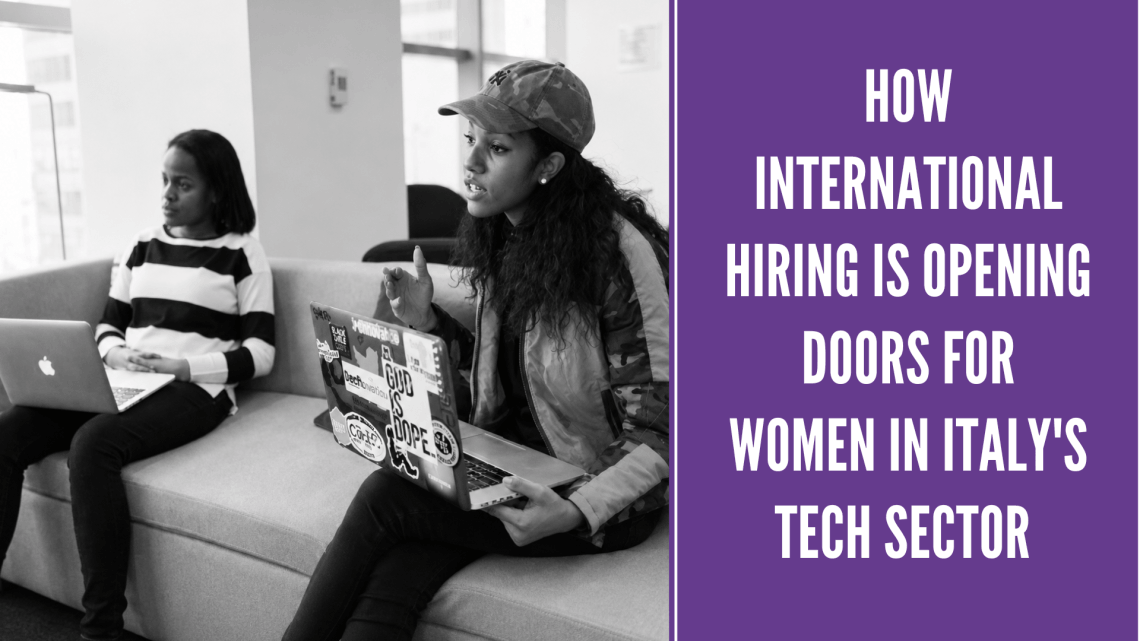
Photo by Christina Morillo on Pexels
Women in tech in Italy remain a minority within a minority: across the EU, women held just 19.5% of ICT specialist roles in 2025, and Italy sits below even that average at around 17% (Source: Eurostat).
Behind those percentages are tens of thousands of skilled women engineers, data scientists, and product specialists competing for opportunities in a domestic market that has historically offered them fewer paths upward.
Something is shifting, though. International companies are now hiring Italian tech talent remotely, without opening a Milan office or registering a local subsidiary. For women in Italy's tech ecosystem, that shift matters far more than it might first appear. When the pool of potential employers expands from local firms to companies anywhere in the world, the rules about who gets hired, promoted, and paid fairly start to change too.
Why Italy's Women In Tech Deserve A Closer Look
Italy rarely gets mentioned alongside the usual tech talent hubs, and its women technologists get overlooked twice: once because of geography, once because of gender. That double blind spot is exactly why the opportunity is real.
The numbers tell an interesting story. Italy is one of only a handful of EU countries with more than 100,000 women employed as ICT specialists, roughly 150,000 at the latest count. The country's National Recovery and Resilience Plan has poured billions into digitisation, producing more computer science graduates, more cloud and cybersecurity training, and more women entering technical degree programmes than a decade ago.
Yet the domestic market absorbs this talent unevenly. Tech employment clusters heavily around Milan, Rome, and Turin. A brilliant developer in Bari or Palermo often faces a choice between relocating, settling for a role beneath her skills, or leaving the industry.
Women feel this squeeze hardest, since relocation is more complicated for primary caregivers and career breaks are punished more severely in rigid, seniority-driven hiring cultures.
For international employers, this is not charity. It is arbitrage on overlooked talent. And the case for looking beyond your home market keeps strengthening - the reasons tech companies hire globally to overcome local talent shortages apply with particular force in markets where skilled women are underemployed.
What A Foreign Employer Changes For Women In Italian Tech
A remote role with an international company is not automatically better than a local one. But it changes several variables that matter disproportionately to women.
Flexibility stops being a favour. In many traditional workplaces, flexible hours are treated as a concession that quietly costs you credibility. Remote-first international teams build flexibility into how work happens. That distinction matters: the women in tech statistics compiled by WomenTech Network show that 48% of women executives rank flexibility among their top three considerations when joining or staying with a company, well ahead of their male peers at 34%.
Geography stops deciding careers. A senior engineer in Sicily can now hold the same role, at the same level, as one in Milan. For women who cannot or will not relocate, whether because of family, partner careers, or simple preference, this removes one of the oldest structural filters in tech hiring.
Pay gets benchmarked differently. International employers often anchor salaries to global or regional bands rather than local norms. That does not erase pay gaps, but it introduces competition into a market where women have had little bargaining power.
Career ceilings get renegotiated. Companies hiring across borders tend to promote on output rather than tenure or office presence. For women who have watched less qualified colleagues advance through proximity and after-hours networking, output-based evaluation is not a perk. It is the whole game.
None of this happens by default. It happens when companies hire internationally with intention, which brings us to the practical question: how does a company abroad actually employ someone in Italy?
Three Ways To Hire In Italy Without Opening An Office
The mechanics matter, because a poorly structured arrangement pushes risk onto the very people you are trying to hire. Three routes dominate.
Independent contracting is the fastest, and the most misused. Italian labour authorities look at how work actually happens, not what the contract says. Fixed hours, one client, daily direction, and company equipment all point toward employment. Misclassification hurts the worker most: no maternity protections, no severance accrual, no social contributions. For women weighing a role, an offer structured this way deserves scepticism.
An employer of record solves this by having a provider with an existing Italian legal entity formally employ the person on the company's behalf, handling the local contract, payroll, tax, and social contributions. Several providers operate this model in Italy - Native Teams employer of record services in Italy are one notable example, and alternatives exist at various price points. What matters for the employee is the outcome: a proper Italian employment contract with full statutory protections, including parental leave and severance, while working day-to-day for the foreign company.
Opening a local entity still makes sense for companies planning dozens of hires, but the months of setup and ongoing administration are hard to justify for a first handful of roles.
For a woman evaluating an offer from a foreign employer, the structure is worth asking about directly. Full employment through a local entity or a record-of-employment arrangement means Italy's protections, some of the strongest in Europe for working mothers, actually apply to you.

Photo by Mert Coşkun on Pexels
Hiring Is The Start, Inclusion Is The Work
Getting someone compliantly on payroll is plumbing. What determines whether a distributed team keeps its women is everything that happens after.
Mentorship is the single highest-impact investment. The mentorship statistics gathered by WomenTech Network make the case bluntly: women in tech with mentors are 77% more likely to still be in the industry three years later, and 65% report greater confidence in their ability to succeed. For remote hires, who miss the casual desk-side guidance that office workers absorb passively, structured mentoring is not optional. Companies without internal capacity can point new hires toward external options like the WomenTech Network Mentoring Program, which pairs women with experienced mentors across the industry at no cost to community members.
Guard against proximity bias deliberately. Remote work reduces exposure to office microaggressions, but it creates a new risk: out of sight, out of the promotion conversation. Teams that default to written documentation, rotate meeting times across time zones, and evaluate on documented output protect their remote women from becoming invisible.
Make sponsorship visible. Mentors advise, sponsors advocate in rooms you are not in. Distributed teams should name who sponsors whom, because informal sponsorship networks reliably route around women, especially remote ones.
The business logic is well documented. McKinsey's research across 1,265 companies found that organisations in the top quartile for gender diversity on executive teams had a 39% greater likelihood of financial outperformance than those in the bottom quartile.
Widening your hiring map is one of the few diversity interventions that expands both the talent pool and candidate quality at the same time.
What This Looks Like In Practice
Consider the situations international hiring actually unlocks, because they recur constantly in Italy's market.
A developer in Bologna returns from maternity leave to find her old employer expects full office presence again. Locally, her options are thin. A remote role with a Dutch or American company lets her keep seniority, keep her home, and keep the statutory protections of an Italian contract if the employer structures the hire properly.
A senior data engineer in Naples has hit the ceiling at the region's largest employer, where leadership turnover is measured in decades. A UK scale-up hiring remotely does not care that she is 200 kilometres from the nearest tech hub. It cares that she can build their pipeline.
A mid-career woman re-entering tech after four years away faces Italian hiring processes that treat the gap as disqualifying. International remote employers, competing hard for talent, increasingly assess a portfolio and a technical interview instead of an unbroken CV.
Multiply these stories across roughly 150,000 women, and the pattern is clear: every foreign company that hires into Italy compliantly adds another employer to the market, and every added employer erodes the take-it-or-leave-it dynamics that have held women's pay and progression down.
Conclusion
International hiring will not fix the gender gap in Italian tech on its own. But it attacks the problem from an angle local initiatives cannot: it multiplies the number of employers competing for women's skills, rewards output over office politics, and makes flexibility a structural feature rather than a negotiated favour.
If you lead hiring at an international company, the takeaway is practical. Italy holds a deep, underpriced pool of women technologists. Hire them properly, through structures that preserve their full employment protections, invest in mentorship and visible sponsorship from day one, and you gain engineers your competitors never thought to look for. If you are a woman in Italian tech, the takeaway is simpler still: your job market is no longer bounded by your train line.
Frequently Asked Questions
How does international hiring help women in tech in Italy?
International hiring helps women in tech in Italy by expanding the number of employers competing for their skills beyond the domestic market. Remote roles remove relocation as a job requirement, introduce global salary benchmarks, and reward measurable output over office presence, all of which counter the structural barriers women face in traditional local hiring.
Do women hired remotely by foreign companies keep Italian employment protections?
Yes, provided the hire is structured as genuine employment rather than disguised contracting. When a foreign company employs someone through its own Italian entity or an employer of record arrangement, the worker receives a full Italian contract, including maternity leave, severance accrual, and social security contributions.
What should women in tech in Italy ask before accepting a remote offer from abroad?
Ask how the employment will be structured, whether you will receive an Italian employment contract, and who the legal employer will be. Also ask about mentorship, how promotions are decided for remote staff, and whether the company has women in senior technical roles you can speak with before signing.
Is remote work alone enough to close the gender gap in tech?
No. Remote work reduces some barriers, such as geographic constraints and daily office bias, but it can introduce proximity bias if companies promote the people they physically see. Closing the gap requires deliberate mentorship, visible sponsorship, and output-based evaluation alongside flexible work.