

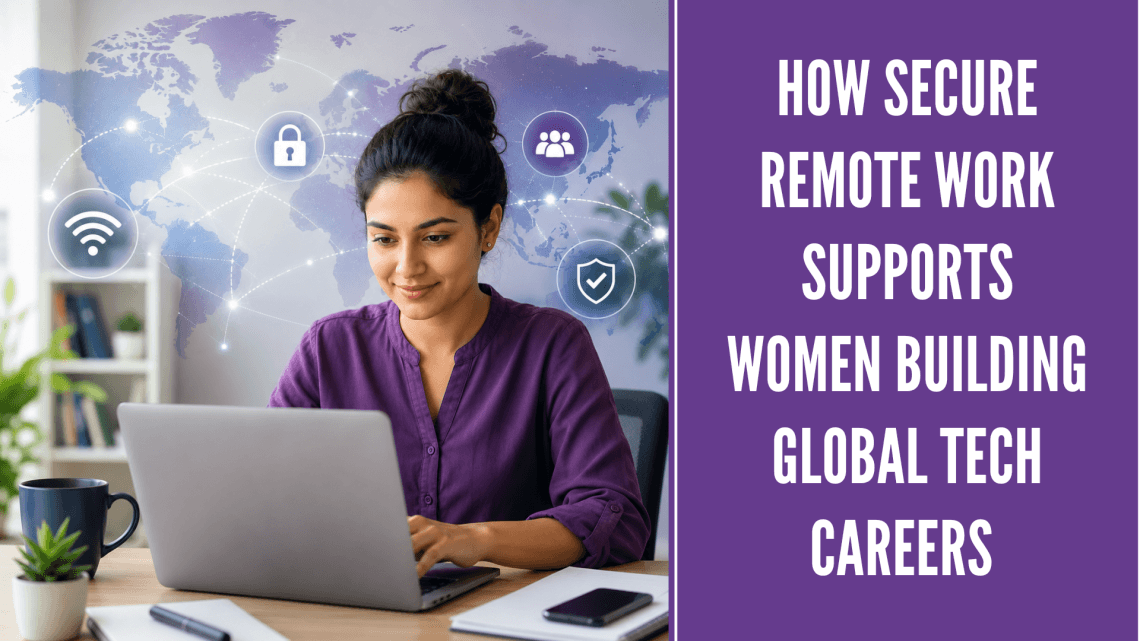
Image credit: AI-generated using OpenAI (ChatGPT / DALL·E)
This massive shift in the global tech scene is driving a major digital transformation. Previously, building a high-impact technology career often required living near major tech hubs like Silicon Valley, London, or Bangalore. Physical distance served as a major barrier to inclusion, particularly for women who frequently juggle career ambitions with domestic duties, a dynamic highlighted in the World Economic Forum’s Global Gender Gap Report.
In recent years, the widespread adoption of remote work has transformed this paradigm. For many women in technology, this shift has created new opportunities to build global careers without relocating, making it easier to balance professional growth with personal responsibilities while collaborating with international teams across time zones.
However, remote flexibility alone is not enough. Secure remote work is a fundamental driver of career equity. By establishing robust digital frameworks, companies enable diverse talent—especially women—to scale and lead global tech careers without compromising personal privacy or enterprise data integrity.
Overcoming Geographic and Cultural Barriers
Traditional office setups and rigid nine-to-five schedules can present significant hurdles for female technology professionals. Long daily commutes, disproportionate domestic duties, and lingering biases within conservative office cultures often hamper long-term career progression. Remote work offers the autonomy needed to manage flexible schedules, directly supporting sustainable work-life integration.
Beyond flexibility, remote work expands access to international roles that may have previously been unavailable because of geographic limitations or caregiving responsibilities. This creates more opportunities for women to participate in global projects, develop leadership experience, and build careers based on skills and expertise rather than physical location.
Achieving a healthy work-life balance depends heavily on secure, reliable technology. When employees know their connections are private and protected, they can focus entirely on delivering high-impact technical results without concerns over data vulnerability.
When organizations establish trust through reliable communication channels, remote workers can highlight their contributions through transparent collaboration, clear documentation, and measurable impact. Professionals seeking to advance their careers while working remotely can explore dedicated global opportunities through the WomenTech Jobs portal, which connects talent worldwide with inclusive, forward-thinking employers.
Managing Cyber Threats in Distributed Environments
Operating outside protected corporate networks exposes distributed employees to unique cybersecurity risks. Connecting to sensitive enterprise applications and proprietary codebases via home networks or public Wi-Fi leaves remote workers vulnerable to phishing, credential-stuffing, and network interception attacks.
These security challenges vary significantly depending on regional infrastructure. In developing regions, home internet setups may lack enterprise-grade security protocols, leaving local connections vulnerable to interception. To better understand these global infrastructure vulnerabilities, security professionals frequently turn to VPNOverview research to analyze emerging trends in digital privacy, network exposure, and home network encryption.
Understanding these external threats enables remote workers to proactively secure their personal workspaces. Implementing virtual private networks (VPNs), enforcing strong Wi-Fi encryption, and regularly updating router firmware help prevent unauthorized access to sensitive company data, keeping productivity high and risks low.
Safeguarding Identity and Personal Privacy
For women navigating online-first careers, digital security is directly linked to personal safety. Professionals who regularly speak at conferences, mentor others, contribute to open-source projects, or maintain an active online presence may face increased risks of harassment, impersonation, or unwanted exposure. Secure remote work practices help reduce these risks while enabling women to participate confidently in global technology communities.
A secure remote work setup serves as an effective personal privacy barrier. Using enterprise virtual networks hides employee IP addresses and real-time physical locations, keeping sensitive home details private.
Furthermore, encrypted communication platforms allow female professionals to speak at virtual conferences, publish technical insights, and participate in industry forums without exposing private contact information. These protections ensure women can build prominent public brands, author technical content, and establish thought leadership safely.

Image credit: Lenovo / Tom's Hardware
Fostering Autonomy and Technical Leadership
Understanding data protection and network safety is an invaluable career asset. Security is no longer solely the responsibility of an on-site IT department; individual remote professionals play an important role in protecting organizational data, turning digital hygiene into a key leadership quality.
Employees who demonstrate strong cybersecurity practices build immediate credibility within distributed teams. Those who master safe cloud deployments, manage access permissions, and minimize data leaks prove their reliability in complex distributed work environments.
To achieve this level of technical independence, remote professionals benefit from mastering three core capabilities:
Maintaining Endpoint Security Solutions: Ensuring personal devices, firewalls, and operating systems are continuously updated with the latest security patches to defend against malware.
Managing Identity and Access Controls: Utilizing enterprise password managers and multi-factor authentication (MFA) to prevent unauthorized credential access.
Executing Secure Information Exchange: Adhering to strict protocol standards when sharing sensitive files, database keys, or proprietary project drafts across public-facing networks.
Developing these skills transforms remote professionals from passive platform users into proactive protectors of organizational assets.
Overcoming the Remote Visibility Challenge
A common challenge for distributed professionals is gaining proper recognition for their contributions when working across different time zones. Without physical presence in an office, remote staff risk experiencing proximity bias, a phenomenon detailed in Harvard Business Review research on remote visibility. Individuals must rely heavily on asynchronous channels to showcase their achievements to leadership.
Secure collaboration tools directly solve this visibility gap. When organizations utilize encrypted project management suites and structured documentation platforms, every code commit, strategy document, and workflow milestone is automatically logged, credited, and searchable.
Structured digital workflows ensure project contributions are recorded objectively, reducing proximity bias during performance reviews and supporting merit-based career advancement. Additionally, secure, encrypted video conferencing and messaging channels foster open strategic discussions, encouraging remote team members to advocate for new initiatives and contribute to executive decision-making without privacy concerns.
This transparency can be particularly valuable for women working across distributed teams, helping ensure their contributions are recognized based on measurable outcomes rather than physical presence in the office.
How Inclusive Companies Support Secure Remote Teams
Building a diverse global team requires an infrastructure that actively protects remote staff.
Investing in secure remote work environments also demonstrates a commitment to inclusion by ensuring employees, regardless of location or background, have equal opportunities to contribute, collaborate, and grow their careers.
Forward-thinking companies embed remote cybersecurity directly into their diversity, equity, and inclusion (DEI) policies, ensuring employees have the tools and security needed to succeed anywhere.
Leading organizations support their distributed workforces through practical, user-friendly security practices:
Deploying Pre-Configured Enterprise Hardware: Providing corporate laptops pre-loaded with endpoint protection, disk encryption, and automated security patches to eliminate complex user setups.
Implementing Single Sign-On (SSO): Streamlining tool access using a centralized, secure identity management system that eliminates password fatigue while maintaining strict access control.
Conducting Interactive Security Training: Replacing passive compliance sessions with practical workshops that teach real-world data privacy and personal threat mitigation.
By actively addressing remote security challenges, companies build long-term business resilience while establishing a culture of trust, psychological safety, and mutual accountability.
Summary
A secure remote work environment does far more than mitigate digital threats—it serves as a crucial foundation for women building global tech careers. By removing geographic, cultural, and safety barriers, robust digital frameworks empower women to step into leadership roles, drive innovation, and scale their influence across the global tech landscape.
When digital security and inclusive collaboration become part of organizational culture, women are better positioned to pursue leadership opportunities, contribute to global innovation, and thrive in distributed teams. By investing in secure remote work environments, organizations not only protect their people and data but also help build a more inclusive and resilient technology industry.