

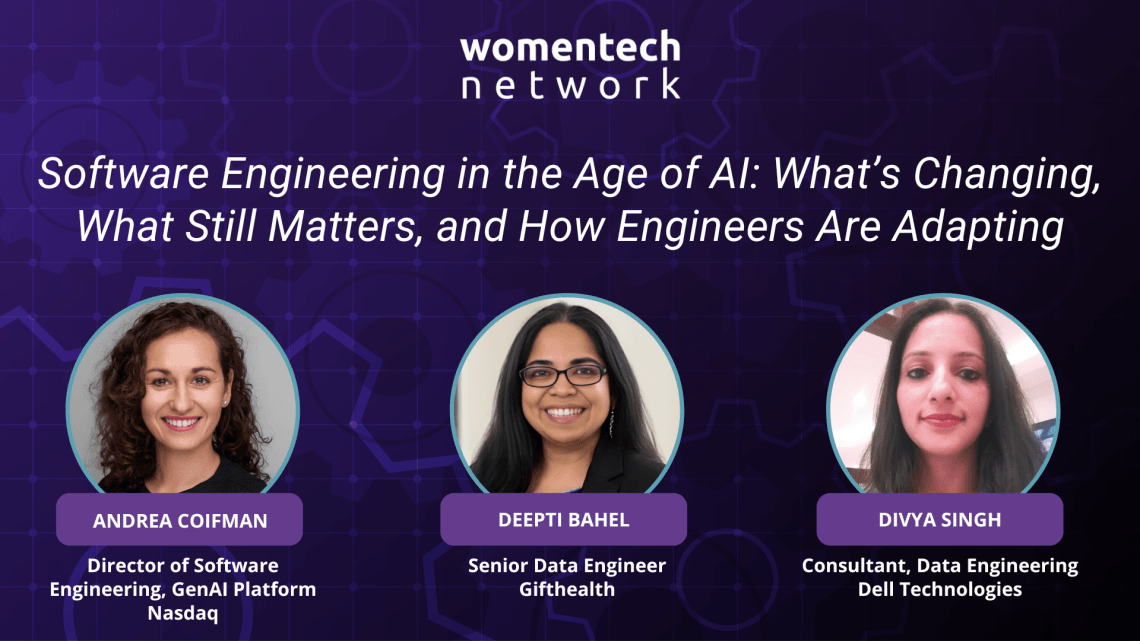
Software engineering is entering one of its fastest shifts in decades. AI coding assistants, agentic workflows, automated testing, and AI-assisted debugging are changing not just how engineers write code, but how they think about architecture, risk, reliability, business context, and what it means to stay valuable.
The timing matters. Women remain underrepresented in engineering globally, accounting for only 28% of engineering graduates worldwide, according to UNESCO. As AI reshapes software engineering roles and raises the bar for both junior and experienced engineers, visibility and practical guidance from women in the field are more important than ever.
This is not a conversation about whether AI will replace engineers. It is about how engineers adapt before the role is defined for them.
For International Women in Engineering Day, WomenTech Network sat down with several Professional Members to ask what this shift looks like from inside the workplace:
- Andrea Coifman, Director of Software Engineering, GenAI Platform at Nasdaq
- Deepti Bahel, Senior Data Engineer at Gifthealth
- Divya Singh, Consultant, Data Engineering at Dell Technologies
Their reflections offer a practical and motivating look at what is changing, what still matters, and how women engineers are adapting in real time.
1. Take us back to the first moment AI changed your work in a way you could not ignore. Was there a skill, habit, or task you had spent years building that suddenly took on a different value — and how did you process that shift?

"Honestly, it was when ChatGPT launched. Not because of the technology itself — but because of what happened in every meeting afterward. Leadership suddenly saw AI differently. The conversation shifted from “this is interesting” to “how fast can we move on this?” For me personally, a big chunk of my work at the time was data labeling — building the annotated datasets we needed to train and augment our models. It was slow, careful work. And it was also one of the first things we identified as a clear automation target. So we automated our labeling pipelines, and what used to take us weeks started happening much faster. It was exciting, but it also made something obvious: anything that could be systematized would be. That pushed me to think harder about what I couldn’t."
Andrea Coifman, Director of Software Engineering, GenAI Platform at Nasdaq

"The moment I could no longer ignore AI was when I realized I could build a working application in days instead of months.
As a data engineer, I spent years learning how to write production-quality code, debug complex pipelines, and navigate technical implementation details. Those skills still matter, but AI changed their relative value. Suddenly, the bottleneck was no longer writing code—it was understanding the problem deeply enough to ask the right questions and guide the solution.
I initially felt what many engineers feel: a mix of excitement and discomfort. But I quickly realized AI wasn't replacing expertise; it was amplifying it. The engineers who understand systems, users, trade-offs, and business outcomes now have even greater leverage."
Deepti Bahel, Senior Data Engineer at Gifthealth

"For me it wasn't a single dramatic event — it was the morning I watched an assistant scaffold a data pipeline and a set of Kubernetes manifests in minutes, work that used to cost me an afternoon of careful, hard-won effort. I'd spent fifteen years getting fast and clean at exactly that kind of plumbing, and suddenly the typing was the cheap part. My first reaction was honestly a little defensive. Then it clicked: the value was never in writing the pipeline, it was in knowing which pipeline to build, why, and what it would cost when it ran at scale. AI didn't take my job — it took my keyboard. The judgment stayed mine. Once I reframed it that way, the shift stopped feeling like a threat and started feeling like leverage."
Divya Singh, Consultant, Data Engineering at Dell Technologies
2. AI agents are starting to act less like tools and more like teammates. Where do they fit into your team’s workflow now, and what has that changed about your role as an engineer?
"We’re actually on the platform side — we build the infrastructure that lets everyone else in the company use AI agents. So I get to see adoption happening across the whole organization, which is pretty fascinating. You watch teams realize they’ve been doing something manually for years that an agent could just… handle. For me personally, I’ve been using AI a lot for the communication overhead — drafting emails, summarizing threads, the stuff that eats into your day before you’ve even started the real work. It doesn’t sound glamorous, but it genuinely frees up mental space for the decisions that actually need my judgment. I think that’s the real value for someone in a leadership role — not replacing your thinking, but protecting time for it."
Andrea Coifman, Director of Software Engineering, GenAI Platform at Nasdaq
"Today I regularly work with AI agents as thought partners, reviewers, researchers, and rapid prototyping assistants. When building healthcare applications through my nonprofit, MediMate Foundation, AI helps me move from idea to prototype dramatically faster. It can generate code, challenge assumptions, draft product requirements, review architecture decisions, and help me explore multiple approaches before I commit to one.
This has shifted my role from primarily creating solutions to orchestrating them. My value increasingly comes from defining the problem, validating outcomes, ensuring reliability, and making judgment calls that require human context and empathy.
AI can generate options. Engineers still decide which option deserves to exist."
Deepti Bahel, Senior Data Engineer at Gifthealth
"In my world — deployments, infrastructure, AI operations — agents have moved into the workflow as a tireless junior engineer. They triage failing pipelines, draft Terraform and Helm changes when they detect drift, propose remediation, and write first-pass runbooks. What they don't do is merge anything unsupervised. I treat them the way I'd treat a sharp new hire: fast, occasionally wrong in confident ways, and in need of real guardrails. The biggest change to my role is where my time goes. I write far less boilerplate and spend far more time defining the boundaries — what an agent is allowed to touch, how we evaluate its output, and where a human has to sign off. I've become less of an implementer and more of an orchestrator and reviewer."
Divya Singh, Consultant, Data Engineering at Dell Technologies
3. The software engineer’s scope has expanded quickly: architecture, business trade-offs, risk, reliability, and user impact now sit closer to the day-to-day work. How are you navigating that wider responsibility, and how are you helping your team adapt?
"Working in a regulated industry changes the nature of this question quite a bit. Technical decisions at our level don’t stay neatly technical — they touch compliance, risk, audit requirements, sometimes regulatory implications we won’t fully see for months. So the scope was always going to be wide. What I’ve had to get better at is holding both the technical and the organizational question at the same time. “Can we build this?” is usually straightforward. “Should we, and what are we responsible for if something breaks?” — that one takes longer, and it involves a lot more people. I try to make sure my team feels comfortable asking the second question without being seen as slowing things down. That cultural piece is honestly harder than any technical challenge I’ve dealt with."
Andrea Coifman, Director of Software Engineering, GenAI Platform at Nasdaq
"I embrace it because it aligns with how technology should be built. My healthcare journey taught me that the most elegant technical solution is useless if it doesn't solve a real human problem. When building AI-powered tools for kidney patients, I spend as much time thinking about patient trust, accessibility, safety, and adoption as I do about technology.
I encourage teams to move beyond asking "Can we build it?" and start asking "Should we build it?" and "Who benefits if we do?"
The engineers who thrive in the AI era will be those who understand technology, business outcomes, and human impact simultaneously."
Deepti Bahel, Senior Data Engineer at Gifthealth
"In data engineering and infrastructure, reliability and cost were always near my day-to-day — but now those conversations start earlier and include people who don't write code. Navigating it means making trade-offs explicit instead of implicit: cost versus latency versus reliability, said out loud, with the business impact attached. Knowledge graphs have been a real help here, because lineage and impact become legible to people who'd never read a config file. For my team, I push ownership down. I want every engineer reasoning about blast radius and cost before they ship, not just whether the build is green. We run blameless reviews and I work hard to make the why of a decision as visible as the how. Wider responsibility only scales if more people can carry it."
Divya Singh, Consultant, Data Engineering at Dell Technologies
4. Has AI changed your definition of a great engineer, or simply made the deeper parts of engineering more visible?
"My honest view is that the great engineers were always the ones who could think past the obvious answer. AI just makes that more visible now. These tools are genuinely impressive at synthesizing existing knowledge — they’ll give you a solid answer to a well-formed question faster than any human could. But they work within what’s already known. The edge cases, the genuinely novel problems, the moment where the technically correct solution is the wrong one for this team, this context, this constraint — that’s still human territory. That’s where real engineering judgment shows up. I use AI constantly, and I think every engineer should. But I see it as something that sharpens your thinking, not something that replaces it. The engineers who will stand out are the ones who can look at the AI’s answer and ask a better question."
Andrea Coifman, Director of Software Engineering, GenAI Platform at Nasdaq
"I believe AI has made the deeper parts of engineering more visible.
The best engineers were never defined solely by how quickly they could write code. They were defined by their ability to solve meaningful problems, make sound decisions under uncertainty, communicate clearly, and build systems people could trust.
AI has simply exposed that reality. As code generation becomes easier, qualities like judgment, curiosity, empathy, systems thinking, and domain expertise become even more important. Those were always valuable—they're just harder to ignore now."
Deepti Bahel, Senior Data Engineer at Gifthealth
"It made them visible. A great engineer was never the fastest typist — but for years, fluency with syntax was a convincing disguise for actual judgment. AI stripped that disguise away. When anyone can generate plausible code, the differentiator becomes the things that were always the real work: system thinking, knowing what not to build, reading failure before it happens, and explaining a decision to someone who'll live with its consequences. AI didn't redefine greatness. It just removed the proxy we kept mistaking for it."
Divya Singh, Consultant, Data Engineering at Dell Technologies
5. For junior engineers, the old entry path into software engineering is changing fast. Fewer roles feel truly entry-level, and many companies now expect new talent to arrive comfortable with AI tools. What should early-career engineers focus on if they want to stay relevant and stand out?
"Get genuinely good at using AI coding tools — not just familiar with them, actually fluent. There’s a real difference, and it shows. But here’s what I think matters even more: make sure you actually understand what the tool is producing. Using AI to write code you can’t explain is a risk, not an advantage. At some point someone will ask you to defend it, debug it, or extend it. The other thing I’d focus on is learning to define problems, not just solve them. That might sound abstract, but as AI handles more implementation work, the valuable skill is figuring out what to build and why — and that requires you to understand the business context, talk to stakeholders, and make judgment calls that don’t have a clean technical answer. The engineers who develop that early are going to have a real edge."
Andrea Coifman, Director of Software Engineering, GenAI Platform at Nasdaq
"Focus on becoming exceptional at learning. Tools will change. Models will change. Frameworks will change.
What lasts is the ability to understand a problem, break it into components, learn what you don't know, and deliver results.
Use AI aggressively, but don't outsource your thinking. Learn why solutions work. Learn how systems fail. Learn how business decisions are made.
The engineers who thrive won't be the ones who use AI the most. They'll be the ones who combine AI with strong fundamentals and sound judgment."
Deepti Bahel, Senior Data Engineer at Gifthealth
"Learn the things AI can't fake on your behalf: how systems fail, how data actually moves, and how to reason about a problem before you reach for a tool. The market no longer rewards people who can only generate output — it rewards people who can verify and direct it. So become the person who can look at AI-written code or infra and say, with confidence, "this is wrong, and here's why." In data specifically: understand the data, not just the pipeline. The engineers who'll thrive are the ones developing taste — the judgment to tell good output from output that merely looks good."
Divya Singh, Consultant, Data Engineering at Dell Technologies
6. New grads and junior engineers are entering a market where technical fundamentals, AI fluency, and evidence of real problem-solving all matter. What is one thing they should build, practice, or demonstrate to stand out and stay relevant?
"Because these three things together are what actually make you useful in a world where anyone can generate code. AI fluency means you know how to use the tools. Critical thinking means you don’t just accept what they produce. And problem-solving is what happens when the AI gives you something technically correct that completely misses the point. What I see employers — and honestly, collaborators — respond to is evidence that someone can think, not just output. Projects where you made a real decision, hit a real constraint, had to change direction. That’s what separates someone who worked with AI from someone who let AI work for them."
Andrea Coifman, Director of Software Engineering, GenAI Platform at Nasdaq
"Build something that solves a real problem for a real person. Not a tutorial. Not a clone.
Find a challenge in your community, workplace, family, or industry and create a solution. Then put it in front of users and improve it based on feedback.
Many of the healthcare applications I've built started with challenges I experienced personally as a kidney patient and transplant recipient. That experience taught me that the strongest portfolio is not a collection of technologies—it's a collection of problems you've solved."
Deepti Bahel, Senior Data Engineer at Gifthealth
"Ship one real thing, end to end, and be able to defend every trade-off in it. Not a tutorial clone — a project where you took an ambiguous problem, made real decisions, instrumented it so you can see it working, and can explain what broke and what you'd do differently. Evidence of judgment beats evidence of syntax every time. When you can walk someone through why you chose this architecture over that one, and what it would cost at ten times the load, you've shown the one thing AI can't show on your résumé for you."
Divya Singh, Consultant, Data Engineering at Dell Technologies
To close the conversation, we asked each member to finish one sentence: “AI may change the engineer’s job description, but it will not replace…
...the one who can see past the answer — to the question that actually needed asking.
...human curiosity, judgment, empathy, and the ability to understand what people truly need.
…the judgment to decide what's worth building, and the accountability for what happens when it ships.
The engineers who grow in this era will be defined not only by how quickly they use new tools, but by how well they understand systems, validate outputs, communicate trade-offs, protect quality, and connect technology to real-world needs.
For the WomenTech Network community, this is both practical and motivating. Staying relevant in the age of AI is not about chasing every new tool. It is about strengthening the fundamentals, learning how to work with AI thoughtfully, and stepping confidently into a broader engineering role.
Ready to keep learning and building? Join the Women in AI Builders Community on LinkedIn and explore the AI Builders Global Conference (October 14-15, 2026) to connect with peers, learn from practitioners, and grow your role in the future of AI and software engineering.
Know a software engineering leader shaping the future of technology? Nominate yourself or someone inspiring for the Software Engineering Leader category, or explore all award categories to recognize women making an impact across AI, engineering, and tech.