

Image credit: AI-generated using OpenAI (ChatGPT / DALL·E)
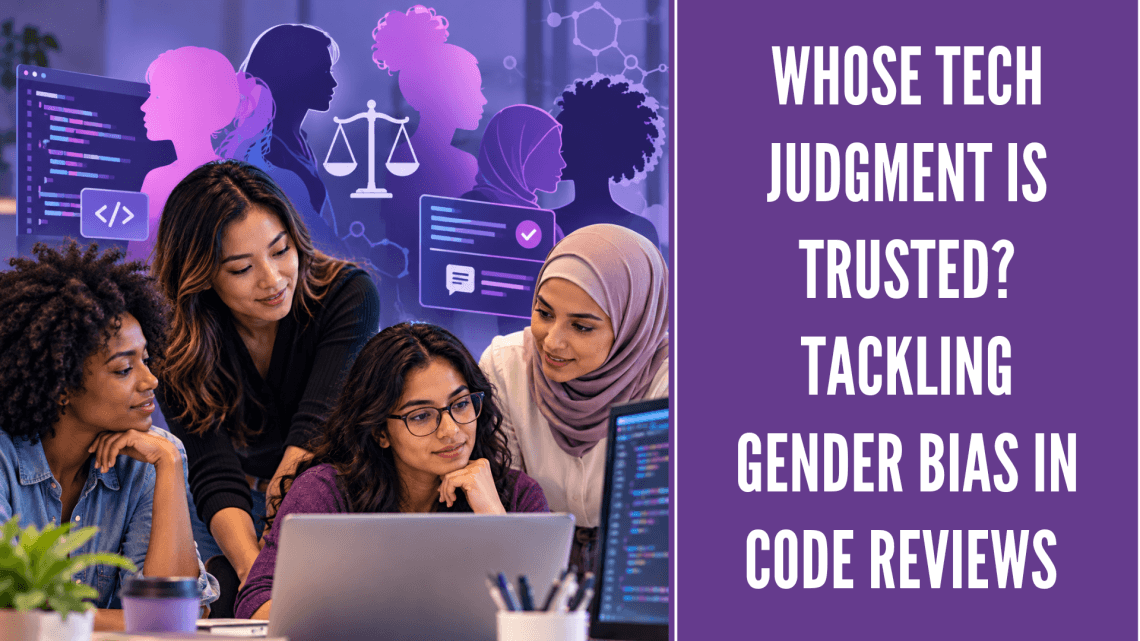
Code reviews form an essential component of daily operations in a tech firm. They help teams maintain coding standards, identify issues, share knowledge, and improve software quality, ultimately supporting better products and stronger business outcomes. With many women now part of tech workforces, code reviews are also a regular part of their professional experience.
In this context, an important question has emerged in some organizations: are women developers sometimes subjected to greater scrutiny than their male counterparts?
Not every critical comment or requested revision reflects gender bias. Code reviews are intended to identify problems and improve technical work. However, research into software development, open-source participation, and technical careers suggests that gender can sometimes influence perceptions, participation, and professional outcomes.
If such differences exist, organizations need ways to recognize and address them before they become obstacles to the career progression of capable employees.
Examining the Existence of Gender Bias in Code Reviews
If you work in technology, you may have encountered assumptions about differences in technical ability between men and women. In a code-review environment, such assumptions can potentially influence how developers' work is perceived, particularly when evaluation criteria are subjective or inconsistently applied.
As a result, some developers may receive long series of comments or instructions to revise their work. While many of these comments may be technically justified, others can reflect inconsistent standards, stylistic preferences, or unconscious assumptions rather than measurable improvements to the product or service.
Research offers useful context.
A study in the Journal of Computer-Mediated Communication examined activity and interactions on GitHub and explored gender differences in programming. Importantly, the research distinguishes differences in coding style from differences in code quality. Differences in style alone do not establish inferior technical performance.
Some researchers have also examined gender bias during code acceptance, including patterns in participation and outcomes in code-review environments. These findings suggest that gender-related differences can appear in some projects and communities, although their form and magnitude can vary.
Gender disparities may also extend beyond individual code reviews. In 2024, a study published in the Journal of Systems and Software examined academic advancement in software engineering and identified differences affecting the best performers among women.
The study also examined differences in collaboration and professional networks. These patterns can influence multiple aspects of an academic environment, including visibility, promotion, and access to leadership opportunities.
Of course, this does not mean that all feedback on women's code stems from gender bias.
Research discussed by Natalia Emanuel, Labor Economist, provides an important counterpoint. In the study discussed, engineers evaluated anonymized code-review comments for qualities such as helpfulness, actionability, and rudeness. Emanuel explained that the comments were found to be similarly actionable and were not differentially nitpicky toward women engineers.
The challenge lies in recognizing genuine bias where evidence supports it without treating every critical review as discriminatory.
The objective is not to reduce scrutiny for women. It is to ensure that comparable technical work is evaluated according to comparable standards.
The Impact of Mistaken Beliefs and Bias
The consequences of continued bias can extend beyond an individual code review.
Repeated experiences of inconsistent assessment can affect confidence, career progression, workplace satisfaction, and employee retention. These concerns are particularly relevant in fields where women remain underrepresented.
Recent data suggests that the STEM workforce in the United States included approximately 37 million workers in 2024, with men representing 64% of that workforce.
This illustrates the continuing gender imbalance across STEM fields. For future generations of women interested in science and technology, recruitment alone is therefore not enough. Organizations also need workplace systems that support fair evaluation, development, and retention.
Over time, inconsistent evaluation practices can contribute to wider disparities in recruitment, advancement, and employee retention.
There is also growing interest in how human-generated technical information may interact with AI-assisted development. Claims that gender differences in code-review behavior will directly influence generative coding models require further evidence. However, maintaining accurate, objective, and well-documented technical feedback remains valuable as AI becomes more integrated into software development workflows.
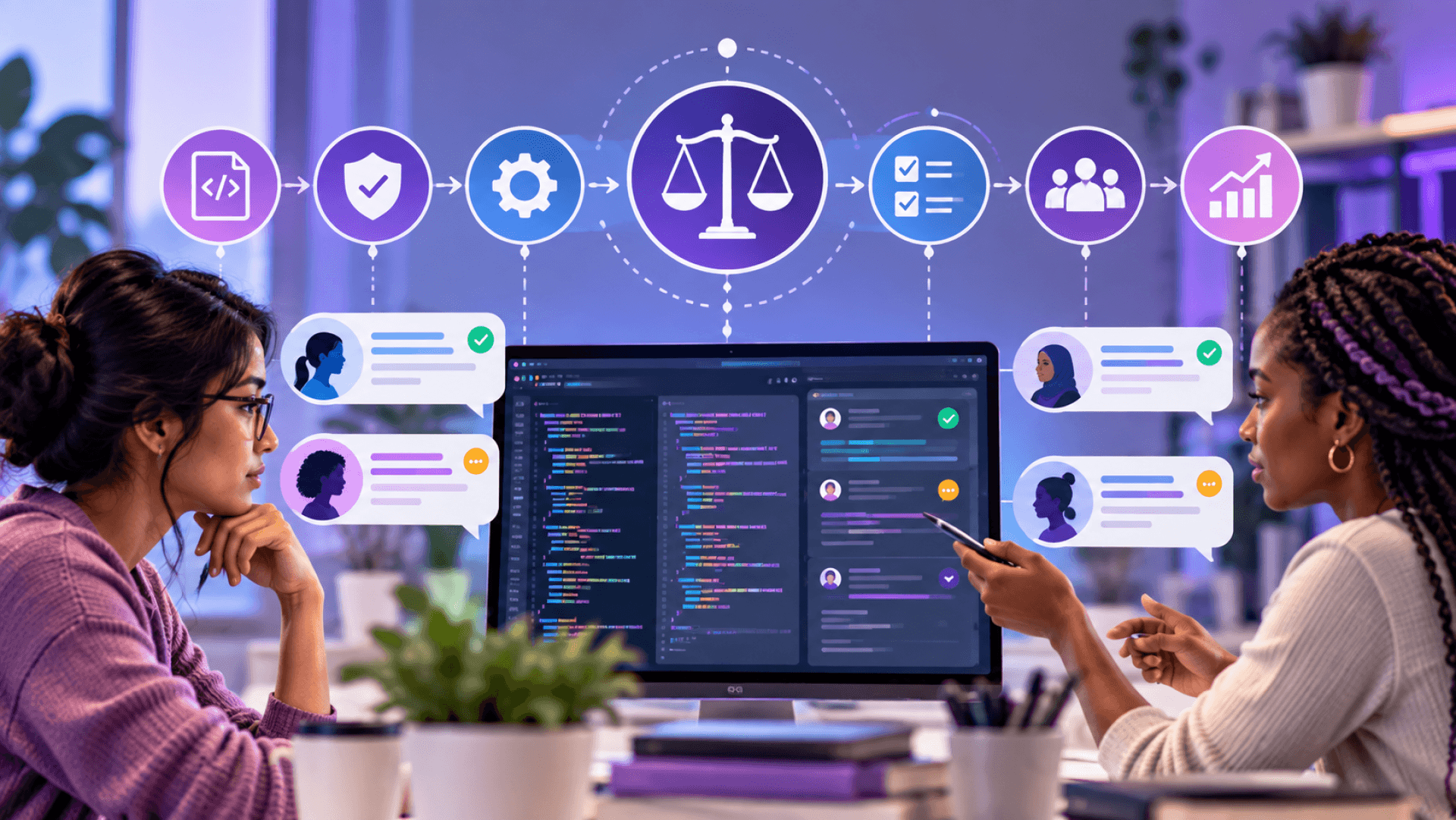
Image credit: AI-generated using OpenAI (ChatGPT / DALL·E)
Reviewing Code for What It's Worth
Eliminating gender bias in code reviews requires organizations to move from acknowledging that bias can exist to creating systems that make technical evaluation more consistent.
Addressing it requires effort across different levels of an organization, from leadership and middle management to engineering managers and individual reviewers. Here are several practical approaches technology organizations can implement to reduce opportunities for bias in code reviews.
● Standardized review criteria and reviewer calibration
Firms that establish clear guidelines and objective review standards are better positioned to reduce inconsistent evaluation.
Reviewers can comment on quality issues using specific technical evidence rather than relying primarily on individual stylistic preferences. At the same time, code needs to conform to accepted architectural patterns, security requirements, design standards, and team conventions.
Reviewer calibration can also help align expectations around key factors such as severity ratings, maintainability, testing requirements, architectural decisions, and business context.
Documented review standards reduce ambiguity and give developers and reviewers a shared reference point for evaluating work.
● Leadership education and manager training
From a leadership and managerial perspective, addressing deep-seated bias may require education in inclusive leadership, ethical decision-making, cultural intelligence, and organizational change.
Many technology firms provide training designed to help managers recognize how workplace assumptions can affect hiring, performance evaluation, promotion, and team culture.
Some professionals also develop broader organizational leadership expertise through advanced business education. Programs such as an online DBA (Doctor of Business Administration) can develop skills related to leadership, organizational strategy, and purpose-driven consulting.
Within technology organizations, the value of leadership development lies in applying those skills to measurable workplace practices, including establishing consistent expectations, identifying disparities, resolving concerns fairly, and maintaining accountability.
● Bias-awareness initiatives
Before addressing bias, organizations benefit from developing awareness of where it may occur.
Although women have become increasingly visible across technology roles, behavioral patterns and assumptions can still influence perceptions of technical expertise, communication, leadership, and professional credibility.
A 2025 study published in Empirical Software Engineering examined gender and participation in open-source software projects. The research found that women represented less than 10% of active developers in the projects studied and that leadership positions in many projects remain male-dominated.
Bias-awareness initiatives can help start conversations about these patterns and encourage teams to examine how technical contributions, leadership opportunities, and professional recognition are distributed.
Their value is strongest when awareness is connected to observable workplace practices rather than treated as a standalone exercise.
● Mentorship and organizational accountability
Another useful strategy is to strengthen tech empowerment for women through mentorship, professional networks, and inclusive development opportunities.
Mentorship and professional communities can provide guidance, peer support, technical knowledge, and access to career-development opportunities.
Technology firms can also benefit from monitoring patterns in code-review outcomes. Relevant indicators may include review turnaround time, number and severity of requested changes, participation in reviews, acceptance outcomes, and escalation patterns.
Differences in these measures do not automatically demonstrate discrimination. However, repeated disparities can provide a reason for closer examination.
When credible concerns arise, organizations also need appropriate escalation and resolution mechanisms. This demonstrates that the organization is willing to examine potential bias while maintaining clear and consistent technical standards.
Gender Bias in Code Reviews: At a Glance
Metric | Finding | Implication |
Disproportionate scrutiny | Women developers may encounter differences in how their technical work is assessed | Inconsistent evaluation can affect confidence, career progression, and retention |
Perception of code quality | Research has identified gender-related perceptions and differences in programming style without establishing that stylistic differences mean lower code quality | Technical judgments need to distinguish measurable quality from stylistic preference |
Academic advancement | Research identified gender differences in advancement among high-performing software-engineering academics | Gender disparities can persist even among strong performers |
Code-review feedback | One study found that anonymized review comments were equally actionable and not differentially nitpicky for women engineers | Critical feedback alone is not evidence of gender bias |
U.S. STEM workforce | Approximately 37 million STEM workers in 2024 | STEM represents a substantial segment of the U.S. workforce |
Male share of STEM workforce | Men represented 64% of the STEM workforce in 2024 | Women remain underrepresented across STEM |
Open-source participation and leadership imbalance | Women represented less than 10% of active developers in the OSS projects examined, while leadership remained predominantly male | Participation and leadership remain important areas for greater inclusion |
Keeping Code Reviews About the Code
Ultimately, effective code reviews evaluate the code rather than assumptions about the person writing it.
Separating technical standards for acceptance or revision from gender-linked assumptions can help organizations create more consistent and transparent engineering environments.
This does not require teams to make reviews less rigorous. Greater consistency can make reviews more rigorous by ensuring that comments, requested changes, and acceptance decisions are tied to documented technical expectations.
Research on gender and software development also highlights the importance of nuance. Evidence of gender disparities deserves serious attention, while critical feedback cannot automatically be interpreted as discrimination.
Standardized review criteria, reviewer calibration, leadership development, bias-awareness initiatives, mentorship, monitoring, and organizational accountability can all contribute to a more consistent review environment.
In a fast-changing technology landscape, organizations benefit from making full use of the expertise available across their workforce. Evaluating technical work with consistency, fairness, and transparency is an important part of that strategy.