

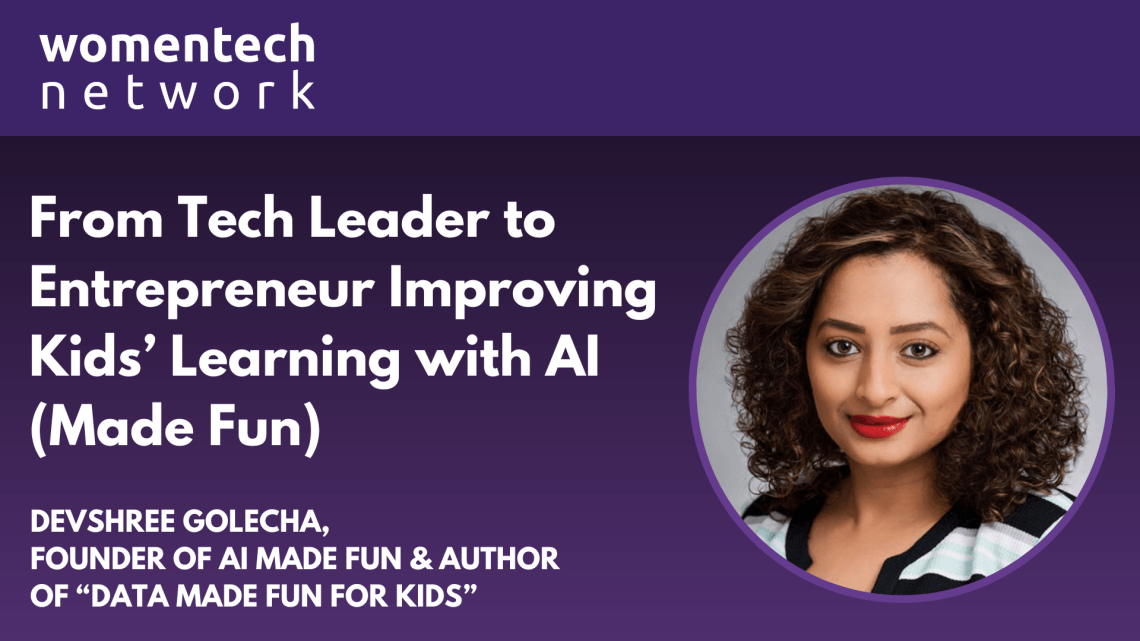
Devshree Golecha is recognized globally as a trailblazer in data and technology leadership. Her 17-year career spans executive roles, including Head of Data and Technology Operations at Voice AI start-up and Head of Enterprise Data at Step Up for Students, a statewide scholarship funding organization.
She has led enterprise analytics, governance, and modernization initiatives serving millions of students and families, and has been recognized with numerous honors, such as Top 100 Global Data Power Women, Responsible AI Leader – Women in AI, Extraordinary Women in Tech – Texas 2024, Houston Business Journal 40 Under 40 and Multiple leadership awards for innovation and impact in analytics and data governance.
Beyond her corporate and academic achievements, Devshree is a university professor and speaker, sharing insights on data ethics, emerging technologies, and women in tech at national conferences and government events — including the U.S. Department of Veterans Affairs Emerging Concepts Summit.
1. You spent over 17 years leading data and analytics initiatives across industries before founding AI Made Fun. What did that experience inside organizations teach you about the gaps in how we prepare the next generation for an AI-driven world?
Sitting inside boardrooms and data teams for nearly two decades, I watched the same pattern repeat itself: companies would invest millions in AI and data transformation, then realize their biggest bottleneck wasn't the technology — it was the people. Not because they weren't smart, but because nobody had ever taught them to think in systems, question data, or understand how algorithms make decisions that affect their lives.
The gap wasn't technical. It was foundational. And it started way before the workforce — it started in childhood. I kept thinking: if we wait until someone is 22 and sitting in a corporate training, we've already waited too long. AI literacy needs to start at the same time we teach reading and math. That realization is what eventually became AI Made Fun.
2. AI Made Fun began as a project with your daughter and evolved into a platform used by schools and families, alongside your book Data Made Fun for Kids. When a personal idea becomes a public mission, how does it change the way you think about impact and responsibility?
When I started this with Kiara, it was just a mom trying to explain AI to her daughter in a way that actually made sense. The moment schools started using it — the moment a teacher told me a kid came home and explained machine learning to their parents at dinner — everything shifted.
Responsibility gets very real, very fast. You're no longer just making something for your own child. You're shaping how thousands of kids first understand a technology that will define their entire lives. That weight is something I carry into every curriculum decision, every character interaction, every module we build. I want kids to come away not just knowing what AI is, but feeling confident enough to question it, shape it, and one day build it responsibly.

3. In many conversations about AI, the focus is on productivity or disruption. When you talk with children about artificial intelligence, what questions do they ask that adults rarely do?
Kids ask the most honest questions. They don't have the professional filters we develop over years of being in rooms where you're not supposed to sound naive.
They ask things like: "Does AI have feelings?" "Can AI make a mistake and not know it?" "If AI learns from people, does it learn the bad stuff too?" "Who decides what's fair?"
Adults are often focused on what AI can do. Kids instinctively ask what AI is — and whether it can be trusted. Those are actually the most important questions in the entire field right now. I think we have a lot to learn from how children approach this.
4. When you think about the children learning AI concepts today, what kind of values or instincts do you hope they carry into the technologies they eventually build?
I hope they carry curiosity without fear — the ability to look at a system and ask "why does it work this way, and should it?" I hope they carry empathy, because the most dangerous AI isn't the most powerful AI, it's AI built without consideration for the humans on the other side of it. And I hope they carry agency — the deep belief that they are not just consumers of technology, they are its future architects.
If a kid grows up understanding that AI reflects human choices — and that they get to be one of the humans making those choices — that's the mindset that builds a better world.
5. You’ve worked as a data leader, professor, and now founder. Looking back, which moments in your career most shaped your belief that technology education should start with curiosity rather than code?
Two moments stand out. The first was early in my career, watching brilliant colleagues freeze the moment a conversation moved from data to "how does the model actually work." The intimidation wasn't about intelligence — it was about never having been invited into that conversation before.
The second was sitting with Kiara, trying to explain AI, and watching her eyes light up the moment I stopped using technical language and started telling her a story. She didn't need the syntax. She needed the idea — and once she had the idea, she wanted everything else. Curiosity is the door. Code is what's behind it. We've spent years teaching kids to knock on the door without ever showing them it's open.
6. What advice would you give women who are considering building a startup in tech but are waiting for the “right moment” to start?
The right moment is a myth we tell ourselves when we're afraid. I know because I told it to myself too.
I left a stable, well-paying career. I liquidated another business. I started building AI Made Fun while raising a daughter, teaching as a professor, and pursuing my doctorate. There was no perfect window — there never is. What there was was a problem I couldn't stop thinking about and a daughter I was building it for.
My advice: don't wait until you're ready. Start while you're still scared. The clarity comes from building, not from waiting. And find your people — rooms like WomenTech exist because none of us were meant to figure this out alone.
Taking Ideas Further
Devshree Golecha will continue this conversation at the Startup & Innovation Summit on May 15, joining founders, investors, and innovators who are actively shaping how technology is built, taught, and experienced. Join here.