


Image generated by ChatGPT (AI) for illustrative purposes
How Simulation Training Improves Decision-Making Under Pressure
Gone are the days when employee training meant sitting through boring lectures. Over the past few years, employee training has undergone significant evolution, becoming more engaging and hands-on. The philosophy of “learning by doing” has been embraced by organizations worldwide.
One of the technologies that has supported this philosophy is simulation learning. It is one of the most powerful tools that provides employees with a real-life experience. It also significantly empowers women employees by creating a gender-neutral training environment where they can focus on their competencies without fear of judgment. This improves their decision-making skills by making individuals aware of the consequences of different actions. But how? We will discuss it in the article below:
What Is Simulation Training?
Simulation-based training offers employees immersive, “close to real-life” scenarios that replicate the pressures and challenges of real work environments. Unlike traditional training, which can often feel abstract or disconnected, simulation training requires active decision-making and critical thinking, fostering deeper learning and engagement.
While conventional training methods introduce foundational concepts—typically through lectures or readings—simulation training enables employees to apply those concepts in practical, hands-on settings. These approaches are most effective when used in tandem, supporting a variety of learning preferences: visual, auditory, and experiential.
Importantly, simulation training also provides a bias-free, psychologically safe space for women and underrepresented groups. By emphasizing measurable performance over subjective evaluation, it minimizes the influence of unconscious bias and helps foster confidence in high-stakes scenarios.
For further insights into how immersive tools are shaping corporate learning, you can explore this case study on simulation-based training.
How Does Simulation Training Work?
Simulation training combines some of the most high-tech tools, such as Augmented Reality, Virtual Reality, and Mixed Reality, with live simulation through role-playing and interactivity throughout the learning process.
These technologies are used to create scenarios that closely resemble real-life situations, requiring problem-solving skills and instant decision-making. In this learning module, the employees' actions are monitored, and they receive real-time feedback. This allows the learner to understand the consequences of their decisions and provides them with the opportunity to rectify their mistakes immediately. This form of training deepens their understanding of a topic and develops essential skills.
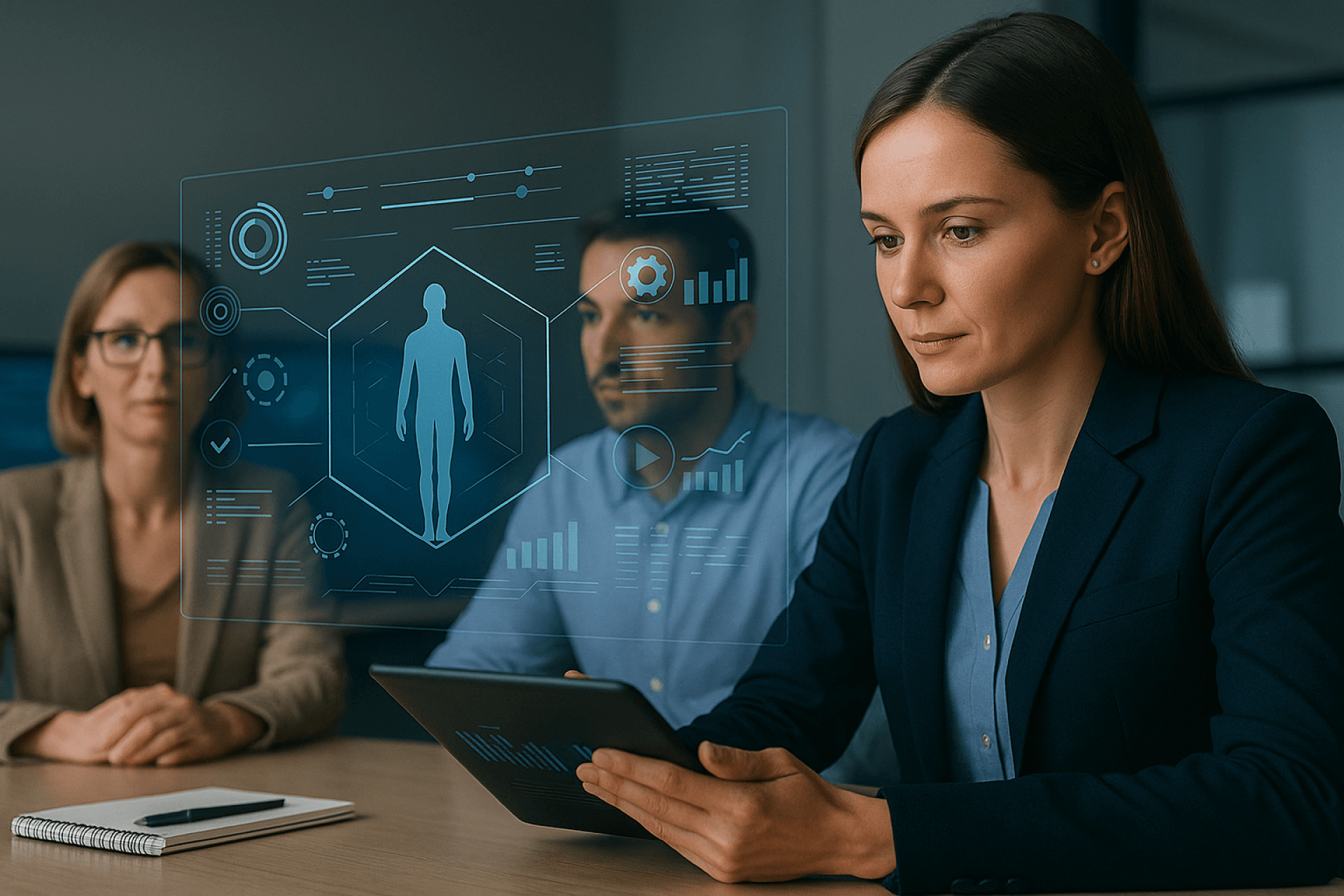
Image generated by ChatGPT (AI) for illustrative purposes
Advantages Of Simulation Training
Including simulation training in an organization's learning and development program has excellent benefits. It enhances engagement, knowledge retention, skill development, and informed decision-making.
Enhanced Knowledge Retention
One of the significant problems that traditional training sessions faced was a lack of knowledge retention. In this digital age, every individual is bombarded with a lot of information every day.
Now, retaining everything a person has learned is almost impossible, making it pointless to provide these training sessions. However, simulation training captures the complete attention of the employees, enhancing knowledge retention.
Improved Skill Development
The skills required for various job roles change every day. Hence, you need a solution that helps your employees stay updated with the latest skills and knowledge. For instance, with several software updates introduced, IT professionals must be well-versed in the latest versions of these tools. Providing these professionals with traditional training can become monotonous and boring. Therefore, simulation training is a better and more effective solution.
A Safe Learning Environment
Now, there are certain industries, such as healthcare and aviation, where even a single mistake could put the lives of many at risk. There is no room for error, and professionals must be well-versed in their respective job roles. Simulation training provides employees with a safe environment in which they can practice their skills without incurring any real-life risks.
However, it’s important to remember that simulation training is not limited to only high-risk industries. It can also be used in numerous other sectors, such as customer relations, to enhance the soft skills of the customer care executives.
Bias-Free Learning Environment
Traditional training is sometimes biased. Industries, specifically tech industries, are male-dominated, and often, women feel their training needs and queries are ignored. But this is not the case with simulation training. This approach doesn’t take into account your gender and provides a neutral learning environment. Moreover, since the training outcome evaluation is based on measurable results in the form of data and technical analysis, there is no fear of gender stereotyping.
Measurable Results
Through simulation training, stakeholders can measure the learning outcomes. One of the unique aspects of simulation training is that employees receive real-time feedback through advanced technologies, such as AI. This allows them to correct their mistakes immediately. With this feature, stakeholders can also assess the performance of employees and the effectiveness of these training programs. AI also significantly helps women in tech by providing them with unbiased, gender-neutral results. Additionally, organizations can gather accurate data on their employees' progress through AR and VR.
How Does Simulation Training Improve Decision-Making
By now, you know that simulation training is an effective tool for teaching employees new skills. There are other advantages, such as enhancing employees' decision-making capabilities. Here is how:
Enhances The Cognitive Aspect Of Decision Making
One aspect where employees struggle a lot while making a decision is their brains juggling several choices. This mostly happens because they are either facing a completely new situation or they aren’t sure of the outcome.
Fortunately, decision-making is quicker and more efficient with the help of simulation training. When employees are repeatedly exposed to similar situations, they learn to identify patterns, assisting in their career growth. Moreover, they are also able to recognize their cognitive biases and make more informed decisions. Unbiased decision-making leads to better results and more efficiency.
Enhances Decision Making By Exploring Multiple Scenarios
Through simulation training, employees are exposed to a variety of scenarios. They also get to experience the consequences of their experience, without any risks involved. This helps employees test different scenarios and compare their outcomes.
When a real-life situation occurs, the employee is already well aware of the several outcomes their actions will bring. Hence, they are more confident while making a decision.
Decisions Are Supported By Data
Simulation training incorporates real-time feedback and accurate data to provide a realistic experience. Employees participate in training programs, make mistakes, and receive feedback.
It captures key metrics, including reaction time, accuracy, error rates, and task completion speed. This reduces the reliance on probabilistic decision-making and enables employers to make more informed decisions.
Conclusion
As more employers, especially women in tech, understand the importance of “learning by doing,” the future of simulation training looks bright. In the coming years, this learning approach is expected to significantly increase the involvement of personalization and the use of technologies such as Augmented Reality (AR), Virtual Reality (VR), and Artificial Intelligence (AI) to refine the analytics and outcomes. It will also create a more inclusive learning environment, where every participant, irrespective of their gender, feels valued.
Moreover, by incorporating elements such as gamification, employers can make learning more enjoyable and engaging, thereby enhancing the overall experience and impact of their Learning and Development (L&D) programs.