


Image generated using ChatGPT (OpenAI)
ReactJS continues to dominate frontend development in 2026. It powers everything from startups to enterprise platforms. As demand for React developers grows, there is a significant opportunity to build teams that are technically strong, diverse, inclusive, and reflective of the communities they serve.
For hiring managers, technical founders, and talent leaders, finding qualified ReactJS developers involves more than just technical assessments. It also requires inclusive hiring practices, strategies to reduce bias, and partnerships with platforms that support equitable recruitment. In this guide, we explore five leading hiring platforms. We evaluate not only the quality of their talent but also how they promote inclusive hiring.
The State of React Hiring in 2026
Before we dive into the list, it is crucial to understand the current landscape. React has matured significantly. We are no longer just looking for developers who understand components and state. We need engineers who master server-side rendering with Next.js, understand complex state management beyond Redux, and can integrate AI-driven interfaces seamlessly.
The challenge for most hiring managers is not a lack of applicants but a lack of qualified applicants. The platforms below solve this specific bottleneck by pre-vetting talent, saving you the dozens of hours you would typically spend on technical interviews.
Key Skills to Look For
When evaluating candidates from these companies, I always recommend checking for a specific set of modern competencies. A senior React developer in 2026 should possess the following:
Advanced State Management: Proficiency in modern tools like Zustand, Jotai, or Redux Toolkit.
Performance Optimization: Deep understanding of memoization, lazy loading, and code splitting to ensure high Core Web Vitals scores.
Server-Side Rendering (SSR): Experience with Next.js or Remix is now a standard requirement rather than a nice-to-have.
Testing Suites: Ability to write robust tests using Jest, React Testing Library, or Cypress.
Soft Skills: High-level communication abilities to translate business requirements into technical execution.
Top 5 Companies to Hire ReactJS Developers
Here are the top organizations that consistently deliver high-quality React talent.
1. Litslink
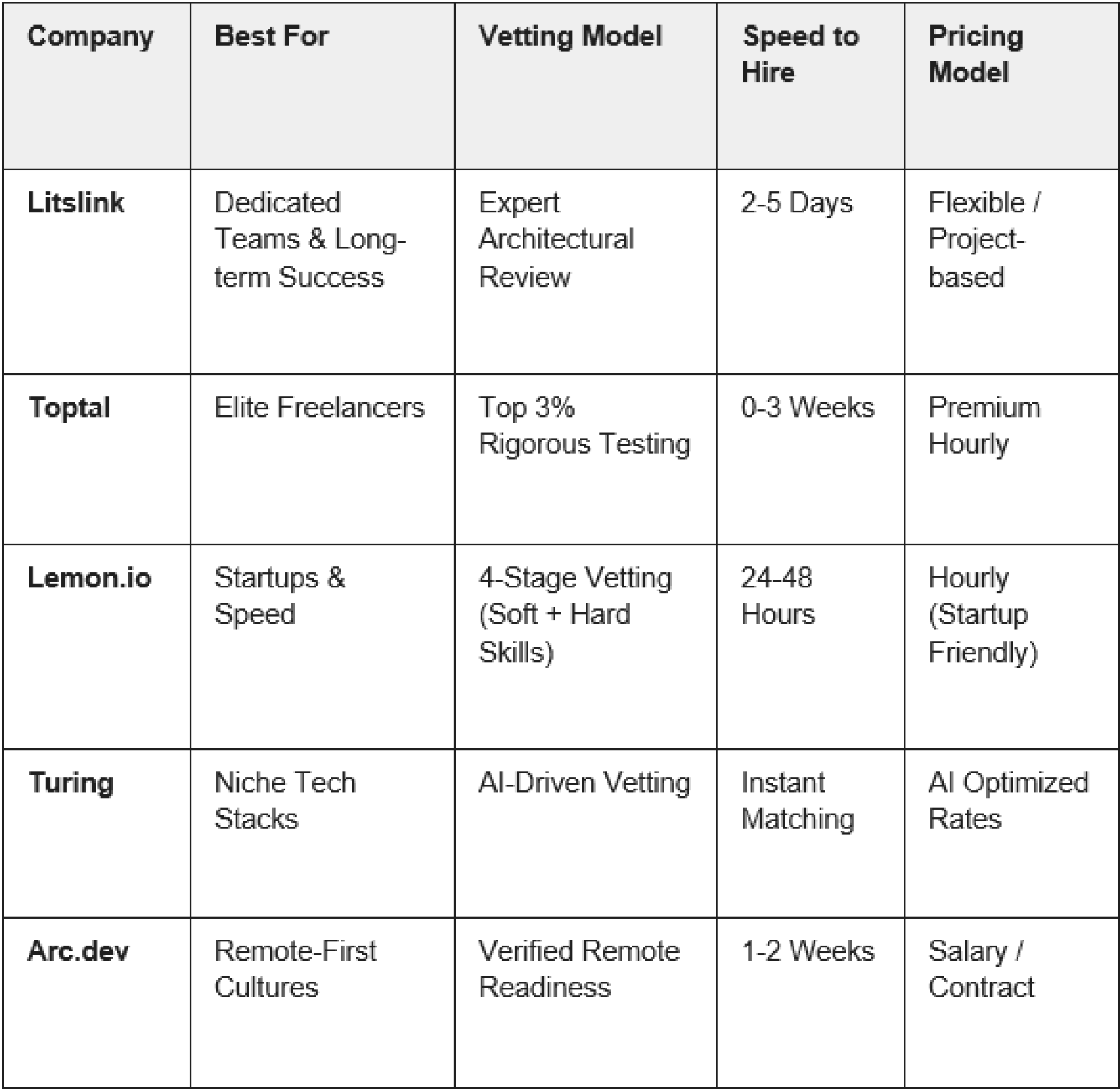
Litslink is a software development partner offering both dedicated teams and individual React developers with a product-oriented mindset. Unlike freelance platforms where clients manage talent independently, Litslink provides support throughout the hiring and onboarding lifecycle. Their vetting process emphasizes not only technical proficiency but also architectural decision-making — a critical skill set for minimizing long-term technical debt in React-based projects.
For companies seeking a structured and collaborative hiring model, Litslink offers flexibility and alignment with modern development practices, particularly in projects involving AI integrations and complex front-end architecture. You can hire ReactJS developers on Litslink through their staff augmentation services designed to streamline team scaling and delivery.
2. Toptal
Toptal has built its reputation on a straightforward promise. They claim to offer the top 3% of freelance talent. They are a strong option if you need a specific, high-level expert for a short-term engagement or a critical fix. Their vetting process is famously difficult, involving language tests, algorithmic challenges, and live coding sessions.
The primary advantage of Toptal is the speed of quality. You are unlikely to find a "bad" developer here. However, this premium quality comes with a premium price tag. I find Toptal to be best suited for well-funded startups or enterprise teams that need to plug a skills gap immediately and cannot afford a single day of ramp-up time. They are less about building a "team culture" and more about injecting high-octane talent into an existing workflow.
3. Lemon.io
Sitting comfortably at the third spot is Lemon.io. I find their model refreshing for startups that need speed and affordability without sacrificing quality. Lemon.io focuses heavily on the startup ecosystem, matching companies with vetted developers from Eastern Europe.
Their vetting process is robust. It includes a combination of automated testing and human interviews to verify English proficiency and technical capability. What makes Lemon.io interesting is their matching speed. They can often introduce you to a candidate within 24 to 48 hours.
For a seed-stage or Series A startup, Lemon.io offers a sweet spot. You get access to senior talent at rates that are often more competitive than US-based hires or premium agencies. They also offer a "no-risk" trial period, which lowers the barrier to entry for founders who are hesitant about remote hiring. They are a fantastic bridge between the chaos of Upwork and the high costs of big consultancies.
4. Turing
Turing takes a technology-first approach to hiring. They utilize an AI-driven "Intelligent Talent Cloud" to vet and match developers from a global pool of over a million candidates. The premise is that their AI can match the right developer to your specific tech stack faster than a human recruiter can.
I include Turing on this list because of their sheer scale. If you have a very niche requirement within the React ecosystem, such as experience with a specific legacy library or a unique combination of React and Python, Turing's massive database is likely to find a match. Their developers are vetted for remote work readiness, which is a crucial, often overlooked soft skill. While the AI matching is impressive, I always advise hiring managers to conduct a final personal interview to ensure the cultural fit aligns with their team's values.
5. Arc.dev
Rounding out the top five is Arc.dev. This platform creates a middle ground between a job board and a recruitment agency. They specialize in remote developer jobs and have a strict vetting process for their "Arc-verified" developers.
Arc shines in its community-driven approach. They focus heavily on the remote work experience, ensuring their developers are equipped with the right tools and mindset for distributed teams. For companies that are building a permanently remote culture, Arc.dev provides candidates who are already comfortable with asynchronous communication and self-management. They also offer a "HireAI" tool to speed up the search process, helping you filter through candidates based on timezone overlap and specific technical constraints.

Image generated using ChatGPT (OpenAI)
Why Inclusive Hiring Matters in React Development
The tech industry continues to evolve, and inclusive hiring is no longer optional. It is essential. Diverse development teams consistently deliver better results, including increased innovation and improved product usability. In frontend development using frameworks like ReactJS, inclusivity has a direct impact because the people building digital experiences shape how millions of users interact with technology.
Expanding your hiring strategy to include developers from underrepresented backgrounds, especially women and gender minorities in tech, leads to stronger, more innovative teams. It also helps address systemic inequality in the industry.
Consider these best practices for inclusive hiring:
Choose platforms with global reach and strong support for remote work. This removes geographic and caregiving barriers.
Look for services that use standardized, bias-free technical assessments.
Partner with companies that support underrepresented developers through mentorship, education, or community programs.
WomenTech Network promotes inclusive hiring through initiatives like the Women in Tech Mentoring Program and the Women in Tech Membership. Hiring through platforms that share these values helps advance gender equity and elevate voices that have historically been underrepresented in technology.
Comparison of Hiring Platforms
To help you visualize the differences, I have broken down the key attributes of these five options in the table below.
How to Choose the Right Partner
Selecting the right partner depends entirely on your project stage and internal capabilities.
If you are a non-technical founder or a CTO looking to offload the management burden, Litslink is the logical choice. Their managed approach ensures that code quality remains high without you needing to review every pull request.
If you are a hiring manager at a large corporation needing a temporary "mercenary" to kill a backlog of features, Toptal fits the bill perfectly.
If you are a bootstrapped or venture-backed startup needing to iterate fast and watch your burn rate, Lemon.io provides the best balance of cost and competence.
Conclusion
Hiring ReactJS developers in 2026 no longer needs to be a matter of trial and error. The hiring landscape has matured, and there are now specialized platforms designed to match companies with the right talent quickly and effectively.
More importantly, this moment presents a chance to build teams with purpose. By prioritizing inclusion in your hiring decisions, you help shape a tech industry that values diversity, equity, and innovation. Whether you are a startup founder or a corporate hiring manager, your choices in recruitment can influence who gets a seat at the table.
Start by defining your technical needs. Then go a step further and consider how your hiring strategy supports long-term inclusion. From platforms like Litslink that focus on long-term success to services like Lemon.io that make hiring accessible for startups, there are options that meet both technical and cultural goals.