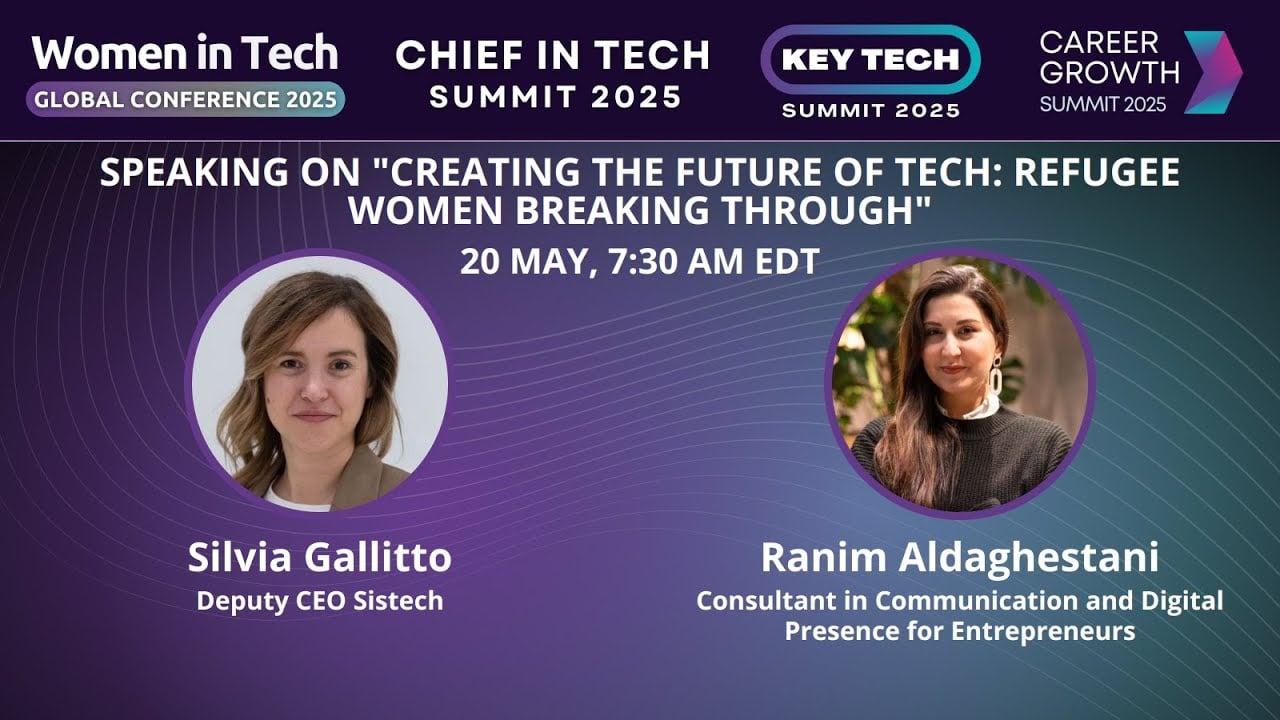
Creating the Future of Tech: Refugee Women Breaking Through
Silvia Gallitto17:552025
Her manager introduced her as a refugee, not as the journalist she was
A 45-minute struggle to get an online refund sent a former Syrian radio presenter and Euronews journalist into UX design, and later into digital project management at BNP Paribas. Sistech Deputy CEO Silvia Gallitto draws out Ranim Aldaghestani's journey from displacement to a tech career. The stake for leaders is plain: are companies hiring refugee talent, or just collecting a good story for their CSR reports?
Learn what leaders can do now to stop missing the talent of refugee women in tech
In this fireside chat, Sistech Deputy CEO Silvia Gallitto interviews former Sistech Fellow Ranim Aldaghestani about rebuilding a career in tech after fleeing Syria. They argue that refugee women bring resilience and fresh perspectives, and that companies must move beyond CSR image-building to offer fair hiring, training, mentorship and inclusive products.
“So it made me realize that sometimes companies care more about the image than the real value that we bring to their company.”
“And it's also important to stop thinking that tech is only for certain people, even if someone didn't go to big name schools, so they can still do a great job in tech.”
What you will learn
Spot how labelling a colleague only as "a refugee" erases her professional experience and signals image over value.
Design digital services for displaced users with multiple languages, local information, simpler forms and mobile-first access.
Build hiring pathways for refugee women that combine technical training, mentorship and community support.
Recognise the adaptability, problem solving and motivation refugee women bring to tech teams.
Partner with organizations such as Sistech to reach and support displaced women talent.
Key takeaways from the speaker
Actionable strategies for fostering inclusion in tech careers.
Creating opportunities for underrepresented groups in tech
Harnessing different perspectives for stronger, more innovative solutions
Details
Level
All levels
Format
Fireside chat
Technical depth
Non-technical
For
Executive, People manager, Career changer
Length
17:55
Published
June 2025
Questions this talk answers
How did Ranim move from journalism into tech?
A 45-minute struggle to get an online refund made her wonder who designed such a bad user experience, so she discovered UX design and took Sistech's UX training after finding the organization on Facebook.
How can tech products better support people navigating migration or displacement?
By offering different languages, local information and easier official forms, and by being mobile-first, since many refugees only have smartphones.
Do companies really want refugee talent or just a good story for their CSR reports?
Ranim says some companies care more about image, recalling a manager who introduced her only as a refugee, but others genuinely believe in diversity and see refugees as a real benefit.
How can a refugee woman build trust with colleagues who have already judged her?
By doing the job well, being someone people can count on and connecting with colleagues as people, which over time turned some of Ranim's coworkers into friends.
What can leaders do to avoid missing refugee talent?
Make hiring fairer and more inclusive, give refugee women training, mentorship and real growth opportunities, collaborate with organizations like Sistech and believe in the potential they bring.
About this talk
This session offers insights into how organizations can create inclusive pathways for refugees and how individuals can contribute to a more diverse and equitable tech workforce.
We’ll explore the impact of targeted skills training, mentorship, and community support in helping these women overcome barriers to employment. A Fellow will share her personal journey into tech, highlighting the transformative power of opportunity and resilience.
Hello, everyone. Like I said before, good evening or good morning, depending on where you're joining. I am Silvia Gallitto, Deputy CEO at CISTECH. We are an organization that supports refugee women to build sustainable careers in tech across Europe. We are in Italy, we are in France, we are in Greece. And at CISTECH, everything we do is grounded in the belief that talent is everywhere, but opportunity is not sometimes. Our programs combine digital upskilling, career mentorship, and job matching to support refugee women access the tech industry and get sustainable jobs of their choice. This session today, and thanks again for joining us, is a fireside chat. It's going to be me and Ranim. It's going to be informal, honest, and hopefully inspiring for all of you.
We'll be talking about how tech can be a tool for inclusion, especially for women from displaced refugee backgrounds, and how to overcome stereotypes and barriers, and actually also what companies and leaders like you can practically do to build inclusive workplaces. But let me now introduce the guest star today. I first met Ranim Aldagistani, it was April 2024, during systech networking event in paris this event it's a celebration of the women in our programs where they pitch their skills in front of companies and connect directly with recruiters we asked at that time ranim who's also proud systech alumna she was part of our programs we asked her in 2024 to be the emcee the presenter of the night and from the moment she stepped on stage I was impressed by not only her confidence but especially her generosity in making others
shine. Ranim, thanks a lot for being with us today. Are you ready to jump in? Thank you, Sylvia. Thank you very much. And yes, let's do it. So I'm Ranim, originally from Syria, and I've been living in France since 2017. I'm honored to be here today as a speaker in this important event. So my My background includes working as a radio presenter and producer in Jordan and later as a journalist at Euronews and digital project manager later at Bimpe Paribas Bank.
I am also passionate about helping entrepreneurs improve their digital presence and have had the privilege of being part of SISTEK membership program. And I'm excited really to share my journey with you today. Thank you, Rani. Since we are attending and we're hosted by a global conference, which is about women in tech, my first question to you is, did you always want to work in the digital and tech space?
Not at all. Actually, when I moved to France and during COVID time also, I was actually thinking about changing my career and learning something new. So one day I was shopping online in a big, big platform, in a really big platform, and I didn't receive my order. So I spent about 45 minutes trying just to ask for a refund.
Normally, it has to be one click in less than five minutes and you ask for your refund. So it was really complicated that I gave up and did that up. Calling the company, which has cost me really money. So I set myself like one hour to ask for a refund. That's huge. That's when I start wondering that who created this user experience?
And it was really bad user experience. So I looked it up. I Googled it and I discovered UX design. Then I found C-Stick at Facebook and I applied and then I followed UX design training with them, with USO. And that's how my journey into tech started. Okay, awesome. And what are the tech skills that open real doors for you, Ranee?
To be honest, for me, the most useful skills were in digital communication and marketing. And thanks to my background in journalism, I was already comfortable creating content and adapting to different platforms. But once I learned how to use social media more strategically and I could really connect with people in a better way. And later at BNP Bariba Bank, I worked as, as I mentioned, regional digital project manager, where I supported teams and helped promote digital tools.
And that hands-on experience really opened a lot of doors for me, sure. Okay, okay, okay. You've mentioned in your first introduction and experience using a platform and having issues with accessibility, which is quite common sometimes. In your opinion, how can tech products and services be designed to better support people which are navigating migration or displacement? What's your opinion on that?
TECAN really helps migrants and refugees if it's designed to be inclusive. That means offering different languages, giving local information and making it easier to fill out official forms of paperwork, you know. So, for example, my mom lives here in France and it seems like almost seven years also. And whenever she needs to see a doctor, she asks me to make an appointment for her because we use an application to take an appointment with the doctors.
So it's on my telephone, so I have to do that for her because she doesn't speak French well enough to do this on her own. So since many refugees only have access to smartphones, mobile-first solutions are very, very, very important. The tools need to be easy to use, quick to access, and really adapted to people who are often in really stressful and unfamiliar situations.
situation in the end um the the take of it should not only help us connect uh but also empower us and honestly when you make a product easier to to someone with a migrant background you're actually making it better for everyone sure sure thanks rani uh technology can be indeed inclusive uh And I'd like to focus now on what happens when we shift the focus from products to workplaces.
And I'm going to ask you a bit of a provocative question. Do companies really want refugee talent or do they want just a good story for their CSR reports? At first, I wonder if the companies really were interested in the skills of refugee or just looking for a good story for their SSR reports. So I had an experience and I would like to share it with you that made me think about this.
One of my previous managers introduced me to our director as a refugee. So this label, I didn't appreciate how she introduced me and she didn't focus really on the fact that about my professional experience, about my previous work, about anything. You know, I was a journalist also before this, and I was a radio presenter, you know, so she didn't mention anything about that.
She said just a refugee woman. So it made me realize that sometimes companies care more about the image than the real value that we bring to their company. Of course, it's just one example. You know, I'm not saying all the companies are doing the same. So some companies using this for their image, but monetarily believe in diversity and see refugee as a real benefit.
And hopefully. Okay, okay, okay. Thanks for sharing this, Ranim. What are the barriers that underrepresented women face when they're entering the tech industry? And especially, how can companies create truly inclusive pathways? Actually, refugee women often don't have the right support. I mean, they might not know the right people, don't have mentors, and sometimes they treat it differently just because they are women.
And how do you think when we are women and refugee? You know, to really help, I think companies should give them training, mentoring, and create a place where we can feel welcome to grow. And it's also important to stop thinking that tech is only for certain people, even if someone didn't go to big name schools, so they can still do a great job in tech.
So give them a chance. You know what I mean? Yeah, yeah, yeah, yeah. Your message is very clear, Ranim. And I was thinking about, we talked about tech skills and products and workplaces, and then you get hired. And I was thinking that getting hired is one thing, is one next step. But being truly seen and trusted once you're in the room, once you get the job, it might be another challenge maybe.
So in your experience, how do you build trust with co-workers, with colleagues who might have already made up their minds about you as a refugee, as you said, as a label or as a woman? Yeah. But actually, as you said, it's a real challenge. It's not easy. It's always not easy. But I try, from my part, I try to do my job well and to be someone people can count on. When they see that, I think little by little, their opinions start to change also. I also take time to connect with them as a people, not just as a colleague.
You know, so when they see you, who you really are, the trust starts to grow. Actually, nowadays, also, where I work today with the company, I have good professional relationship with them. At the second hand, I also made friends, you know, so sometimes we go out, sometimes you go to some resto. So we chat together even during the weekend.
And so I built this trust between me and my colleague. Okay, okay, sure, sure. And indeed, relationship matters. And so do practical skills. So let's talk about the tech side. What tech tools does any woman need to advance her careers, especially if she's navigating a new environment like it happened to you in the past? Actually, the right tech tools can make a bit difference.
So tools like LinkedIn as number one professional platform for networking and building your profile, sure, are really important. Project management tools help you to stay organized, especially when you're working with remote teams also. Nowadays, you know, since the COVID time, we start to discover how to work in remote. So on learning platform like Coursera are create, create for learning new skills.
I think for women who are navigating new environments, especially these from marginalized communities, I think organization like SysTech can can offer an incredible support because for me, SysTech, it was the first door for me, especially to work and to start to work with the French company and with the French people. it was like the light you know in front of me it was the light because when i arrived here yes i want to change my job as a journalist and i start to find some ideas about the tech job because i was really interested about marketing design but i was lost so i have so many ideas in my head and since i discovered this tech i i found that someone take my hand i will give you example like
this someone take my hand and show me the way you know okay okay okay and I'm curious to know more running about this what did you found the most helpful was it the technical training the mentorship the community peer support for me it's really a mix between both technical training helped me to learn the tools I needed but mentorship made big difference also because having someone professional to support me and to share their experience really helped me to grow and they give you an advices when we come up when I come here to France also like I don't know how to communicate with the people you know in which way how to apply which kind of platform that I can to apply to find a job and being part of community where people understand that what it means to be a woman and
the refugee at the same time, that gives me a lot of support. Also networking, networking, networking, you know, so has been, I think, very important. And it opens the door to help me to feel more confident and to find my place here. Yeah, yeah, yeah. I like this message, Hanim, that you're giving, because actually, behind every success story, there's always support, there's always a community. But there's also, I would say, natural talent and drive and motivation, Which brings me now to the core talent we're talking about today, refugee women.
What makes them natural candidates for tech roles? Actually, refugee women are strong and flexible. They've had to adapt to big life differences, changes, and that helps them solve problems in a creative way. As I mentioned before, I moved, I was born in Syria. So after that, because of the war, I will share my personal story with you a little bit.
So I moved to Jordan and Jordan, I start, I restart my life from zero, you know. I don't know if it's correct in English or not, but I really have to start my, I didn't have difficulty with the language because we speak Arabic in the two countries, but I have to start, I'm a single mother, so I have to start my life with my kids, find department find a job put my kids at school the doctors so i found solution solution everyone for everything so when i moved to france also in 2017 it was even harder because the culture is not the same the food is not the same for my kids it was really a real big change they at the beginning they said to me we don't know how to eat what to eat you know so the language um the paper that we
have to do we have to find the apartment we have to i have to find job so i found always a solution for everything and i think refugee women often see uh things differently uh which is bring fresh ideas to many teams and many companies and many of them are are also really motivated to succeed them not just for themselves but as i mentioned also for their family too i want i want for myself personally i want really my kids to be proud of of their mother also that she really did something in a new country in the third country you know where she she's she's still young and she moved in the new country and she had a good job so so i think that drive makes uh refugee one and and me
to be focused hard working and ready to learn okay okay thank you for this message we have a few me a couple of minutes left so i'd like you to send a call to action in the end and my last question to you is what can leaders listening to you now the people in this room what can they do starting from now to build a tech sector that doesn't miss out talents like you if i could ask one thing from leaders it's to take action i mean start by making hiring more fair and inclusive giving refugee women access to training, mentorship and real opportunities to grow, collaborate with organizations that already support us, like CISTEK, and take the time to learn from them.
Most of all, believe in the potential we bring. When you truly open the doors, you don't just help us, you help your teams, your company also to become stronger and more diverse and more creative. So this is my message. Thank you, Anin. Thanks a lot. So, Ranim, thanks a lot. I'm very grateful to have been here with you.
Thanks a lot for sharing your journey, your insight with such honesty, generosity, like I said at the beginning. And thanks to everyone in this room for listening to Ranim and to our chat today, for being part of this conversation. We hope it left you with some reflections and some concrete ideas, maybe. If you want to stay connected, you can find both SysTech and Ranim on LinkedIn.
I've copy-pasted the LinkedIn profile here in the chat. I'm doing this again, and this is the profile of Ranim. We'd love to stay in touch with you and to continue the conversation on this topic. Sure. Thank you, Sylvia. Thank you, Ranim. Thanks again. Thank you, and thank you all for taking time to listen today for my story.
It was a real pleasure. Thank you. Bye, everyone, and thanks.
Transcribed automatically; names checked against the speaker record. Select a time to jump there.
Article based on this talk
What do refugee women need from tech employers to truly break through?
Sistech's Silvia Gallitto and former Fellow Ranim Aldaghestani explain why training, mentorship and genuine belief matter more than a good CSR story.
In short
Refugee women bring adaptability, problem solving and strong motivation to tech, but they often lack networks, mentors and fair access to hiring. In a fireside chat, Silvia Gallitto, Deputy CEO of Sistech, talks with former Sistech Fellow Ranim Aldaghestani about her move from journalism into digital roles in France. Together they set out what companies must change so refugee talent is valued for its skills, not used as a story for a CSR report.
Key takeaways
Actionable strategies for fostering inclusion in tech careers.
Creating opportunities for underrepresented groups in tech.
Harnessing different perspectives for stronger, more innovative solutions.
A broken refund page that opened a career
Silvia Gallitto opens by describing Sistech, an organization that supports refugee women to build sustainable tech careers in Italy, France and Greece by combining digital upskilling, career mentorship and job matching. She first met Ranim in April 2024 at a Sistech networking event in Paris, where women from the programs pitch their skills to recruiters and Ranim served as the emcee.
Ranim, originally from Syria and living in France since 2017, worked as a radio presenter and producer in Jordan, then as a journalist at Euronews and later as a digital project manager at BNP Paribas. Tech was never the plan. During the COVID period, an online order never arrived and she spent about 45 minutes trying to get a refund that should have taken one click. "That's when I start wondering that who created this user experience?" (3:20). Curiosity did the rest: "So I looked it up. I Googled it and I discovered UX design." (3:40). She found Sistech on Facebook and took its UX design training.
The skills that opened the most doors, she says, were in digital communication and marketing, where her journalism background gave her a head start and strategic use of social media helped her connect with people.
Designing for people navigating displacement
Silvia then asks how products and services could better support people living through migration. Ranim's answer is practical: offer different languages, give local information and make official forms easier to complete. Her own mother, who has lived in France for about seven years, still asks Ranim to book her doctor's appointments through an app because she does not speak French well enough to do it alone.
"So since many refugees only have access to smartphones, mobile-first solutions are very, very, very important." (5:37). Tools need to be quick and simple for people under stress in unfamiliar situations, and Ranim notes that making a product easier for someone with a migrant background makes it better for everyone.
Talent or a good story for the CSR report?
Silvia poses a deliberately provocative question: do companies really want refugee talent, or just a good story for their CSR reports? Ranim answers with an experience that stayed with her. "One of my previous managers introduced me to our director as a refugee." (7:05). No mention of her years as a journalist or radio presenter, only the label. "So it made me realize that sometimes companies care more about the image than the real value that we bring to their company." (7:32). She is careful to add that this is one example, and that some companies genuinely believe in diversity.
The barriers are familiar but compounded. Refugee women often lack the right support, do not know the right people, have no mentors and may be treated differently as women, and more so as refugee women. Companies can help with training, mentoring and a welcoming place to grow, and by dropping the assumption that only graduates of big-name schools can succeed in tech.
Earning trust and finding the right support
Getting hired is one step; being seen and trusted is another. Ranim's approach is to do her job well, be reliable and connect with colleagues as people. "You know, so when they see you, who you really are, the trust starts to grow." (10:01). At her current company, some colleagues have become friends she meets on weekends.
On tools, she points to LinkedIn for networking and building a profile, project management tools for remote teamwork and learning platforms such as Coursera. But the biggest difference came from a mix of technical training, mentorship and a community of people who understand what it means to be both a woman and a refugee. She describes Sistech as her first door into working with French companies, the moment when someone took her hand and showed her the way.
Why refugee women make strong candidates, and what leaders can do
Ranim argues that refugee women are strong and flexible because they have had to adapt to huge life changes. As a single mother, she restarted from zero in Jordan, then again in France in 2017, where language, culture, paperwork, housing and even food were new for her children. Each time she found solutions. That experience, she says, brings fresh ideas to teams, and many refugee women are driven to succeed for their families as well as themselves. She wants her children to be proud of what their mother achieved in a third country.
Her call to action for leaders is direct: make hiring fairer and more inclusive, give refugee women access to training, mentorship and real opportunities to grow, collaborate with organizations like Sistech and learn from them. "Most of all, believe in the potential we bring. When you truly open the doors, you don't just help us, you help your teams, your company also to become stronger and more diverse and more creative." (16:32).
Watch the talk
Creating the Future of Tech: Refugee Women Breaking Through, Silvia Gallitto, 18 minutes: https://www.womentech.net/video/creating-future-tech-refugee-women-breaking-through-silvia-gallitto
About the speaker
Silvia Gallitto is the Deputy CEO of Sistech, the leading European non-profit supporting displaced women in accessing tech and digital opportunities, where she oversees initiatives that empower refugee women to access and thrive in tech careers. She was joined by Ranim Aldaghestani, a Syrian-born digital project manager and former media professional based in France, and a proud former Sistech Fellow.
Questions this talk answers
How did Ranim move from journalism into tech?
How can tech products better support people navigating migration or displacement?
Do companies really want refugee talent or just a good story for their CSR reports?
How can a refugee woman build trust with colleagues who have already judged her?
What can leaders do to avoid missing refugee talent?
Drafted with AI from the talk transcript. Editor review pending.
Silvia Gallitto. "Creating the Future of Tech: Refugee Women Breaking Through." WomenTech Network, 2025. https://www.womentech.net/video/creating-future-tech-refugee-women-breaking-through-silvia-gallitto