Your dashboards show you the churn only after the customer has left
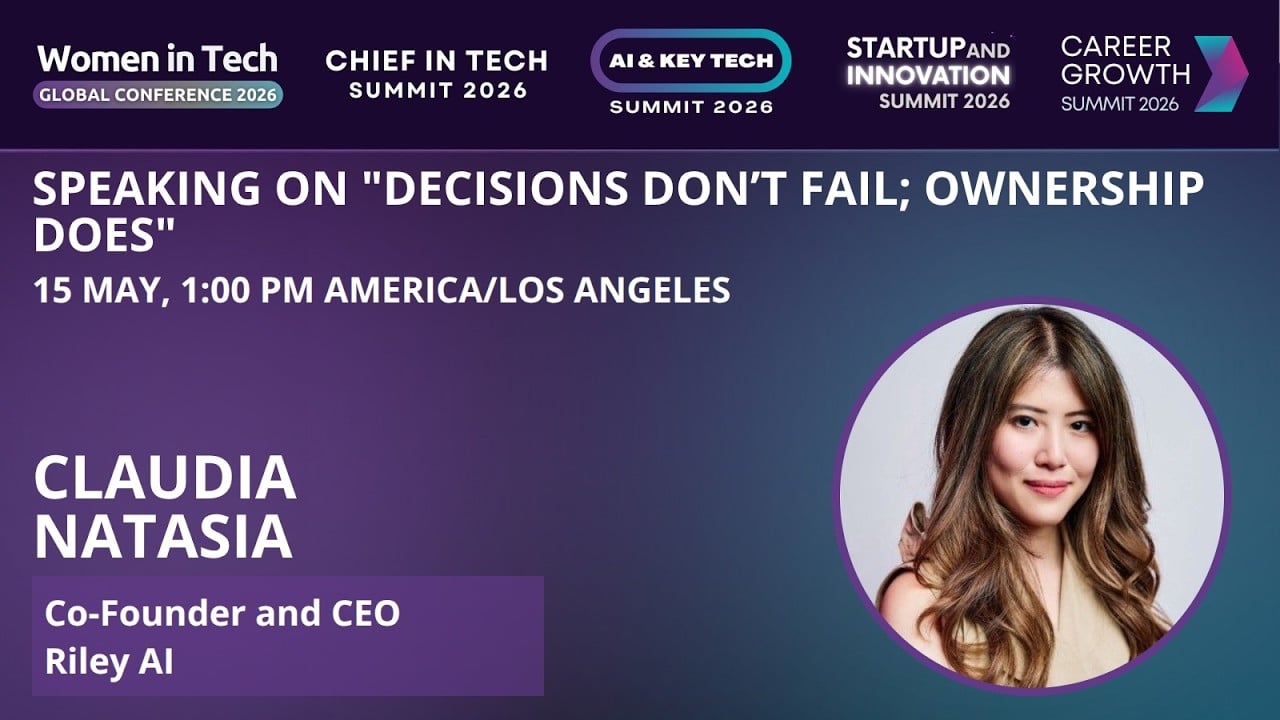
Driving through an Icelandic snowstorm with almost no visibility, Claudia Natasia trusted a GPS detour and got home safely; the next day she learned about 50 cars had been stuck in an accident. The co-founder and CEO of Riley, who has led product, research and data science teams, sees leaders driving blind behind dashboards that report churn too late. What would a GPS for business decisions actually need?
Learn a three-step method that turns data into timely, owned action across teams
Claudia Natasia, co-founder and CEO of Riley, argues that organizations rarely lack the will or the data to decide well; what fails is ownership, because dashboards report problems after they happen and no one shares one view of reality. Using a GPS analogy, she proposes a decision intelligence approach: pick three early signals, define when it is too late to act, and automate the action that follows.
“Because for the visibility that we get, we're actually looking in the rearview mirror.”
“Making decisions is not enough. We need to catch deviations.”
What you will learn
Recognize why dashboards create a feeling of control while showing only what has already happened.
Diagnose the three traps that stop action: too much data, data that arrives too late and unclear accountability.
Pick three signals that show up early, are specific enough to act on and repeat across customers.
Define the moment when it is too late for each signal and automate an intervention when that threshold is met.
Build a shared reality across product, marketing, engineering and finance so someone owns the next move.
Key takeaways from the speaker
Why most “data-driven” organizations still make late or reactive decisions
The difference between analytics systems and decision intelligence systems
How timing—not accuracy—is the real failure mode of modern data stacks
A practical framework to assess whether your data supports decisions or just reporting
How to create clearer ownership and accountability for cross-functional decisions
Details
Level
Intermediate
Format
Talk
Technical depth
Introductory technical
For
Executive, People manager, Founder
Length
23:00
Published
August 2026
Questions this talk answers
Why do data-driven organizations still make late or reactive decisions?
Dashboards look in the rearview mirror: by the time a metric such as churn shows a problem, it has already happened and little can be done.
If people want to make good decisions, what actually fails?
Ownership fails. There is too much data, it arrives too late and the action often depends on another team, so no one clearly owns it.
Why do cross-functional teams disagree on what action to take?
Each team has its own data and dashboards but there is no shared reality across the organization about how to act.
How many signals should a team track, and how should it choose them?
Exactly three, chosen because they show up early, are specific enough to act on and repeat across customers.
Does automating the action require building AI agents?
Not necessarily. It can be an agent sending a help message, but also a simple alert listing at-risk customers and naming who must act.
About this talk
Why No One Is Accountable for the Hardest Calls in Modern Companies
When a decision goes wrong, companies blame the data, the forecast, or the market, but rarely the system that produced the decision. This talk argues that most organizations have no clear ownership over decisions that span Product, CX, and Revenue, leaving critical calls to be negotiated rather than made. Claudia introduces decision intelligence as a way to encode ownership, assumptions, and tradeoffs directly into the system—not into meetings. The result is faster action, fewer reversals, and decisions that don’t unravel the moment someone asks “but what if…?”
All right. It's about 1:00 PM Pacific time. So I'll get started. Lovely meeting everyone. I'm Claudia and I am the co-founder and CEO of a company called Riley. We've been in existence for about two and a half years now, and we're building the revenue intelligence platform for modern teams. So really excited to talk to you about what you're doing.
I'm going to talk a little bit about Riley, just a little bit towards the end, but mainly about my experience with decisions and where I see decisions heading in this age of AI. I'd love to answer questions as I do my presentation. So feel free to ask them on the chat. And if I can't get to every single one of them, feel free to add me on LinkedIn. Also happy to do a coffee chat or even stay a little bit after and answer the rest of the questions.
Great. All right. I hope everyone can see my screen. So ever since I was in college, I've always been obsessed with the idea of decisions. I actually was in a financial engineering, I was a statistics major, but I was in a financial engineering lab. And what we did was we spent time essentially trying to figure out bounded rationality. When people feel pressured under extreme time crunch with limited resources, resources, they tend to make poor decisions. And what essentially causes them to make poor decisions. So I've always been obsessed with the idea of decisions. Little did I know that my work, my entire life work, whether I was a data scientist, eventually, and banking product, eventually, like all of that would ultimately lead me to start a company that helps people make better decisions. So let's get started.
So I remember a few months ago, I remember a few months ago, I was actually in Iceland. And my husband and I drove to the southeast part of Iceland about like an eight hour drive from Reykjavik. It was super beautiful. We saw the most beautiful things, tons and tons of waterfalls. But what was frustrating was on the way on the drive back, we were actually stuck in the snowstorm. And we couldn't see anything in front of us or anything behind us. This is actually one of the better, one of the better photos where we could actually see a car in front of us. But for the majority of the drive, we couldn't see anything in front of us and anything behind us. And this was at about 2pm. So you can imagine how scary it was.
And because of that, we were very nervous. The wind was about 50 miles per hour, we could actually feel our SUV shaking. And my husband heavily relied on the GPS. And the GPS actually told us to take this side route instead and go through this mountain that had nothing. And if anything, the mountain actually felt like it was a completely different planet because the sky started turning red, even though it was a snowstorm. And I just I felt zero confidence that we would get back to Reykjavik, though the GPS did say that, that we would.
And actually, we did. A few hours later, we got back safely to Reykjavik. The weather was fantastic there. And it was it was amazing. And the GPS was right. We couldn't really see anything on the drive back home. But the GPS really was what saved us and let us be able to get to our destination safer. Now, the next day, we found out that about 50 cars taking the same route as us were stuck in an accident. And they were unable to, to, like, I think they had to call the National Service hotline or something. But essentially, they were unable to travel further.
So when they were able to travel further, their windows got pulled out. And by the way, if everyone here is going to Iceland during the winter, you'd very soon learn that you actually need someone's help opening your window, because the wind's so strong that if you open it yourself, it would just flung. It happened to be once, luckily, the window or the door did not come off. But yeah, so these cars were driving and they did not take the GPS route. I'm not sure if they had their GPS turned on, unclear.
But anyways, the car was totally broken and it happened to 50 of them. We were lucky that the GPS told us blindly, when we couldn't see anything, when we didn't know where to go, this was a completely new country for us. We were so lucky that the GPS told us where to go and we were able to trust it. And the GPS not only brought us back to Reykjavik safer, but it also helped us go on this detour.
And the snow wasn't too bad on this detour. So as adventurous people, we are. We did a little hike and we saw this beautiful waterfall with just like a snowfall. And that was the added bonus, right? Because not only did the GPS help us get to our destination safely, we were also able to see something extra special on the way there.
And I contrast that to my experience growing up in Indonesia as a child, where Jakarta is very famous for its traffic and also its storms. And my parents and I were actually stuck. This is a photo of our car. We were actually stuck in a storm and we didn't know where to go. And we ended up, our car fell into a ditch. Everyone was fine after.
But when we called our cousin the next day, who was in a different car, their dad actually knew of a secret route that we didn't know instead. This was pre-GPS. So they were able to take that secret route instead. And we didn't know that. And we ended up getting stuck. And that's how I think about decisions nowadays, especially having both started a company now and being a leader at a few different companies, a smaller company, a larger tech company.
This story of having a GPS reminds me so much about how we operate as a organization. Why is it that we have GPS that tells us where to go? If I were to drive to San Jose right now, I'm based in the Bay Area. If I were to drive to San Jose right now, the GPS would tell me which route to take to save 10 minutes extra.
Why do we have that for something as basic as driving and traveling? But we don't have that for the most important decisions we make every single day at work, which is the strategy that we take at work. If you're a revenue professional, like if you work in sales, revenue or marketing, why don't you have a GPS that tells you this is a campaign that you should run today because consumer behavior is changing so much.
And this campaign will help you achieve your conversion goals faster. If you're in research or product, why don't we have something that immediately alerts us today that our users are churning, our engagement is declining with this aspect of this feature. Therefore, you need to optimize your A-B test a certain way or launch a different feature or optimize your UX a certain way.
Why are things not as automated? At the end of the day, it's the same thing, right? GPS takes into account GPS does all of these live analysis of satellite data from hundreds of thousands, millions, billions of traffic signals around the world. And we also have so much data about our organizations from from sales data, sales calls, product analytics, all of that.
We have that readily available to us. But why is it that we don't have this GPS system essentially helping us, empowering us to make better, more resilient decisions for our business? So that's that's what my talk is about today. Decisions don't fail. Ownership does. We want to make better decisions for our business, but our systems failing us, causing us to not essentially be able to take ownership of our decisions, even though we want to.
And my talk will essentially cover four phases, hopefully much better than my journey in Iceland. But we'll start with discussing the lie we bought. Then we'll talk a little bit about something I like to call the trap. So why this lie is trapping us, the shift and the new world. And I'll try to move fast so that there's a little bit of time for a Q&A.
All right, let's start with the lie we bought. I started my career in data science and product analytics. And I used to be so obsessed with dashboards. The first dashboard I built as a 20-year-old intern at Pinterest, I was just so happy with it. And as I'm reflecting back, I realized that why was I happy with dashboards?
Why are the execs that I built dashboards for happy with dashboards? And why do I now, as a CEO, sometimes still feel like I want to see a dashboard? Dashboards make us feel like we're in control. We feel like we have visibility, right? We can see all of those charts in real time, all of those metrics available.
Sometimes we bookmark it, we click it, and they're all available for us. We feel like we can review it regularly, and we feel like we can track the right metric. It just gives us visibility into what's happening. But time and time again, I realized that this is all actually a little bit of a lie, because how often have you opened a dashboard with 20 different cuts of charts like this?
It's essentially the same data. It's cut in 20 different ways. And you wonder, should I pay attention to this chart? Should I pay attention to this one? Should I do this one? And then even further, every single team has their own dashboard. And if you work in a role that's a little bit more cross-functional, you'd often wonder, then do you work off of this team's dashboard or this team or this other team's dashboard?
So I think that's essentially the lie that we bought. We often want to make sure that we make better decisions with data and we are able to act very quickly. But we get stuck in analysis paralysis of having so many dashboards, so many different touch points to pay attention to. So do dashboards actually make you feel in control?
From my experience, especially as a leader at other organizations in the past, eventually they actually don't. Because for the visibility that we get, we're actually looking in the rearview mirror. How many times have you looked at a chart and realized a particular metric is not doing as well as you hope? And it turns out when you connect with the person who is in charge of it, or maybe it's even yourself, that you realize it no longer is relevant.
You can't do anything anymore. The churn already happened, for example. And then dashboards might allow you to review data and charts regularly. But again, the problem already happened usually, right? That's why it's recorded as a data point on a dashboard. And then you track the right metrics. But is it at the most impactful time where it's during the moment that it actually changes?
So these are the questions that I've been asking myself for the last few years. And I came to a conclusion that we actually don't have a decision problem. Everyone here, wherever, whether we work for ourselves, whether we have our own company, or we work at another company, whether we're consultants, doesn't matter the role. Everyone wants to make the best decision they can for what they're working on, for who they're working for.
So our intent is there. We want to make great decisions. We're ready to take ownership and make great decisions. But often, we have an ownership problem. Because even though we want to make a good decision, and we want to rally a team behind us to make that great decision, often the data comes way too late that it's just impossible to find people that'll take ownership and be able to act on it in a way that's most effective.
So let's talk a little bit about why that's the case, the trap. Why do actions often don't follow decisions? We have the intent of making decisions. We say things. We do retros and say things like, we wish we had done A, we wish we had done B. But why do actions not follow it easily? Similar to like, if you're driving on a GPS, the GPS shows you the data.
Take this route instead. Take the I-180 instead, and it'll save you 15 minutes. It never does. The other one saves me 15 minutes. But yeah, take that route instead, and it'll save you 15 minutes. Why do we immediately take action on that insight? But for the stuff we do daily in business, we often fall into a trap of not being able to act.
So the first trap is too much. There's way too much data. You saw on the dashboard example earlier. Often we get stuck with just a variety of different dashboards, not knowing which one is the most important signal to act on. In addition to too much data, often the data comes too late. If you act right now, there's nothing you can do because the churn already happened.
You see that churn increase by 30%. I'm using a sales example. In this case, a churn increased by 30% last quarter. And by the time that was recorded, the customer's already churned. And finally, who's accountable? Sometimes we feel like the insights that we discover, it's contingent on the action of another team. And this would need to involve someone else, and it would take a long time because that team sits at a different office, or I know that that team's prioritizing something different.
So often it's just a lot of different variables that are coming at play to essentially make it very difficult for us to follow an insight or a decision that we want to make with actual action. We decided, but action doesn't follow. That's essentially what happens time and time again. We want to make the right decision, but the action doesn't follow.
So now, how do we get around this? How do we make sure that our intent of making better decisions for our business, for ourselves, are actually followed by actions? How can we build a better GPS or intelligence system for businesses in order for us to be able to just essentially make more resilient decisions for our work? We know, as a first principle, we know that the data is there.
I don't think any organizations have ever complained about the lack of data. Maybe here and there, sometimes you want to do more research, that's fine. But very so often, there is at least one data, right? Like, the data already exists. What we will focus on today is designing the system around the data to enable more of these faster actions.
And what I'm going to argue in the solution that I'd love to suggest to everyone is often it's not too late to act. We just need to make sure that we feel comfortable getting interrupted. And then, again, the third issue that we discussed earlier of why it's impossible to actually act on something, ownership. We often think that no one is really acting, but no one really acts because there's no shared reality across an organization.
And this happened last week. I was doing a panel, or I moderated a panel with a VC and a few other revenue leaders. And it was very fascinating to hear everyone say that it doesn't matter what organization or what industry they're in. Obviously, the VCs and investments and startups, but the other revenue leaders, they came from prop tech, real estate tech, B2B, B2C.
It doesn't matter the industry. Every single person has had the experience of marketing, disagreeing with product, disagreeing with engineering, disagreeing with finance on what decision to make and what action to take because there is no shared reality. And everyone has all of these data, but no shared reality on how to act. Making decisions is not enough. We need to catch deviations.
We need to catch deviations as they happen. We need to catch the changes in, back to the GPS example, the changes in the traffic signal as it happens and immediately act on it. And it's very, very possible to do that now, especially with all of the technology that we have available. So let's discuss essentially what replaces it.
How can we be better at taking ownership, taking action on our decisions really quickly and building this intelligent engine? I'm going to share an example from a revenue perspective. One of our customers actually was able to create a revenue intelligence platform that immediately transformed their goals within, I think, just one quarter, actually. They were able to drive $5 million increase in revenue, which doubled their revenue.
They were a smaller startup and essentially get them to their next fundraising milestone. So super successful story. And they were able to do that because they essentially built this system for revenue ownership, this like intelligence system, like a GPS that constantly alerts them, interrupts them with the most important insight and helps them get ahead of their competition.
And the way they do this is actually translatable to whatever industry you're in. So if you're in CPG or if you have an SMB, I'm happy to talk to you separately about examples from those industries or those verticals, just because this is super translatable to essentially whatever you do. So the first advice is to build a revenue intelligence system, a GPS that helps you drive stronger business success.
The first thing you want to do is minimize your signals, right? Because you want to make sure that you capture the actual important signals and not the noise. So the first thing you should do is pick three signals and it must be three, not three and a half, not four. So just make sure that it's three. And I'm laughing because I saw someone just popped on my LinkedIn saying, can it be six?
No, let's just keep it at three. But the whole point of this is if everything matters, nothing triggers action, then you're back to a dashboard. And the way you want to pick these three signals, because sometimes it's really hard to narrow things down to just a few amount, is one, make sure that the signals show up early.
Whoops. One, make sure that the signals show up early. So if you have an app, make sure that they actually appear early. Two, make sure that they're specific enough to act on. So, for example, usage drop in a particular feature, that's core for a metric, that's something that you definitely want to pay attention to. And then finally, that it repeats across customers.
And then you want to make sure that you define an action when it's too late. So if you can't name the moment of when you'll act on it, you'll essentially miss it, right? Or when I was in a payment software company, if someone didn't check out after 10 clicks, then they're not going to check out at all.
You would be able to know from past data what essentially this trigger, what this threshold is. And then when the trigger is met, you want to make sure that you capture when that trigger is met. And then automate some sort of intervention. So in our case, when that happened, we were able to automate a little pop-up that tells users, we saw that you're struggling with checking out.
This is what you should do instead. And then finally, make sure that the action is actually automated. So after the trigger is met, make sure that there are actions that happen automatically so you could act on it automatically. And this doesn't necessarily mean, you know, building an AI agent that automates an email. Sometimes it can be like that, like building an AI agent that automates a help bot message or like the example I gave earlier of the pop-up that appears to guide customers to where they need to go.
But it could also be as simple as it automating a message to let you know that you need to act on this right now by giving you a list of customers that are at risk of churning and making you the person in charge of acting on it. And when you build essentially an intelligence system like this, a GPS like this, you will automate all of the hard parts of looking and interpreting the data, and it will leave you time to essentially act.
You'll get the most important insights that you can now focus on the so what and be more effective that way. One of our customers is a prop tech company that implemented this and was able to drive 80% of their expansion just from three signals alone. And then they were also able to recover 500K installed pipeline that would have been lost from a sales perspective and reduce movement from closing those deals.
It used to take three months or two months to close those deals. They were able to reduce it to three weeks. So, again, they were able to detect risk early and move really fast to the so what and to act on it. And that's why I think it's really important for us in order to take more ownership of our decisions to move away from dashboards into a revenue intelligence system.
And just a recap for everyone, to build your own revenue intelligence system, we're here for you in Riley. But at the end of the day, the work also sits with you. Riley can help you automate all these decisions, but the work and the mindset needs to sit with everyone in the organization. Make sure that you pick three signals that are most important to your organization, define when it's too late, and build a way to automate those actions after so that you can essentially focus on the so what.
Thank you, everyone, for your time today. I know I rushed a little bit at the end. Happy to talk more and share more specific examples for your use case. And also, this is something that I feel very deeply passionate about, helping everyone make better decisions with your data. So, I'm happy to talk further with anyone about this.
Thank you.
Transcribed automatically; names checked against the speaker record. Select a time to jump there.
Article based on this talk
Why data-driven teams still act too late, and how to fix ownership
Claudia Natasia argues that the missing piece is not better data but a system that tells people what to do while there is still time.
In short
Most organizations do not have a decision problem; they have an ownership problem. Claudia Natasia, co-founder and CEO of Riley, argues that dashboards report what already happened, data arrives too late and accountability is unclear, so action rarely follows intent. Her answer is a decision intelligence system that works like a GPS: three early signals, a defined point where it becomes too late and an automated action when that point is reached.
Key takeaways
Why most "data-driven" organizations still make late or reactive decisions
The difference between analytics systems and decision intelligence systems
How timing, not accuracy, is the real failure mode of modern data stacks
A practical framework to assess whether your data supports decisions or just reporting
How to create clearer ownership and accountability for cross-functional decisions
A GPS for the business
Natasia opens with two storms. In Iceland, she and her husband drove back to Reykjavik in a snowstorm where they could see almost nothing in front of or behind them. The GPS sent them on a side route over a mountain, and although she felt zero confidence in it, they made it home safely. The next day they learned that about 50 cars caught in the storm had been stuck in an accident. As a child in Jakarta, by contrast, her family's car slid into a ditch during a storm, while a relative who knew a secret route got through. That was before GPS.
The contrast frames her whole argument. Drivers get live guidance built on huge volumes of signals, yet companies with plenty of sales, product and customer data get nothing comparable for strategy. "Why do we have that for something as basic as driving and traveling? But we don't have that for the most important decisions we make every single day at work, which is the strategy that we take at work." (6:27)
The lie of the dashboard
Natasia started her career in data science and product analytics and remembers how proud she was of the first dashboard she built as an intern at Pinterest. She understands the appeal: "Dashboards make us feel like we're in control." (8:47) Yet she calls this the lie we bought. The same data is cut 20 different ways, every team has its own dashboard, and people who work across functions are left wondering which one to trust. The result is analysis paralysis.
The deeper issue is timing. By the time a metric drops on a chart, the event behind it, such as a customer churning, has already happened. "Because for the visibility that we get, we're actually looking in the rearview mirror." (10:16)
An ownership problem, not a decision problem
After years of asking why decisions go wrong, Natasia concluded that intent is not the issue. "So our intent is there. We want to make great decisions." (11:44) What breaks down is the step from decision to action, and she names three traps. There is too much data, so no signal stands out as the one to act on. The data comes too late, so acting changes nothing. And no one is clearly accountable, because the fix depends on another team that sits elsewhere or has other priorities. Retrospectives fill with statements about what the team wishes it had done. "We decided, but action doesn't follow." (13:57)
Catching deviations as they happen
Natasia's starting principle is that the data already exists; the work is designing a system around it that makes fast action possible. That means accepting interruptions while there is still time to act, and building a shared reality. At a panel she recently moderated with a venture capitalist and revenue leaders from sectors such as property tech, B2B and B2C, every participant described marketing, product, engineering and finance disagreeing on what to do. "We often think that no one is really acting, but no one really acts because there's no shared reality across an organization." (15:16)
Her conclusion is direct: "Making decisions is not enough. We need to catch deviations." (16:16) As with live traffic, the point is to notice a change as it happens and respond immediately.
Three signals, one threshold, one automated action
The practical core of the talk is a three-step method, illustrated with Riley customers. As the speaker cited, one smaller startup drove a 5 million dollar revenue increase in about a quarter, doubling its revenue, and a property tech company drove 80 percent of its expansion from three signals alone while cutting deal cycles from two or three months to three weeks.
First, pick three signals, not four or six. "But the whole point of this is if everything matters, nothing triggers action, then you're back to a dashboard." (18:47) Good signals show up early, are specific enough to act on (such as a usage drop in a core feature) and repeat across customers.
Second, define when it is too late. "So if you can't name the moment of when you'll act on it, you'll essentially miss it, right?" (19:31) At a payments company she worked at, past data showed that a user who had not checked out after 10 clicks would not check out at all, so the team triggered a pop-up offering help at that point.
Third, automate the action. This might be an AI agent sending a help message, or simply an alert that lists customers at risk of churning and names who must act. Automation takes over the hard work of finding and interpreting data, leaving people free to focus on the "so what". Natasia closes by stressing that tools are only half the answer: "Riley can help you automate all these decisions, but the work and the mindset needs to sit with everyone in the organization." (22:10)
Claudia Natasia is the Co-Founder and CEO of Riley AI, a decision intelligence platform that turns fragmented customer data into shared, trusted decisions. Before founding Riley, she led product, research and data science teams across enterprise software and financial technology, and she holds an MBA from the Haas School of Business and Bachelor's degrees from the University of California, Berkeley.
Questions this talk answers
Why do data-driven organizations still make late or reactive decisions?
If people want to make good decisions, what actually fails?
Why do cross-functional teams disagree on what action to take?
How many signals should a team track, and how should it choose them?
Does automating the action require building AI agents?
Drafted with AI from the talk transcript. Editor review pending.
Frameworks and ideas mentioned
Decision intelligence
Bounded rationality
Revenue intelligence system (pick three signals, define when it's too late, automate the action)