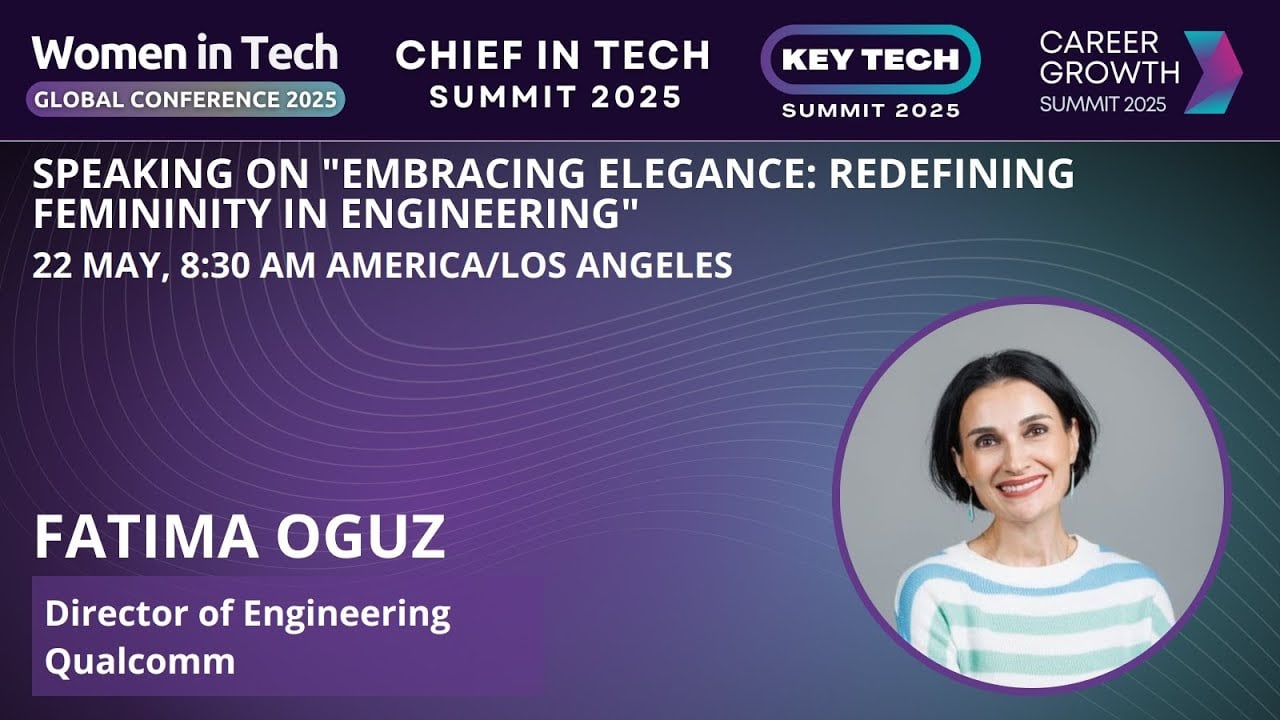
Embracing Elegance: Redefining Femininity in Engineering
Fatima Oguz20:472025
She wore hoodies and lowered her voice to fit in at work, then she stopped
Hoodies, chapstick and a lowered voice: Fatima Oguz recalls how she tried to blend in at work, until a fierce, fashionable woman VP showed her she could stop hiding. Now Director of Engineering at Qualcomm and winner of its 2024 Global Inclusion Champion award, she argues that women engineers are often seen as women but overlooked as technical experts. So what does it take to be respected because of who you are, not despite it?
See the four practices she uses to show up fully, and how she ended the comments on her outfits
Fatima Oguz, Director of Engineering at Qualcomm, argues that women in engineering do not have to choose between being feminine and being taken seriously as technical experts. Drawing on her own shift from blending in to showing up fully as herself, and on the women she has mentored, she shares four practices: define your own dress code, lead by example, create inclusive spaces and never apologize for your elegance.
“You do not have to choose between being powerful and being feminine. You can do both.”
“And elegance isn't about appearance. It's about presence.”
What you will learn
Recognize the visibility paradox, where women engineers are seen as women but overlooked as technical experts.
Define a personal dress code that reflects your confidence rather than conformity.
Defuse passing remarks about your appearance with calm humor instead of shrinking.
Model authentic leadership so that junior colleagues feel permission to be themselves.
Build inclusive team spaces that welcome diverse expressions of professionalism.
Key takeaways from the speaker
How to confidently balance professionalism with personal style
The importance of representation and visibility in inspiring the next generation of women engineers
Practical tips for maintaining elegance and femininity in a technical environment
Details
Level
All levels
Format
Talk
Technical depth
Non-technical
For
All career stages
Length
20:47
Published
July 2025
Questions this talk answers
Do women engineers have to choose between femininity and being taken seriously?
No. Oguz argues that femininity is not the opposite of technical excellence and can enhance it, through traits like empathy, collaboration, intuition and creativity.
What does elegance mean in an engineering workplace?
For Oguz, elegance is not about appearance but presence: the grace with which you navigate challenges, communicate and lead under pressure.
How can you balance professionalism with personal style?
Define your own dress code and stop asking whether people will take you seriously in an outfit; ask instead whether you feel like the leader you are when you wear it.
How should you respond when a colleague comments on your outfit?
Oguz responded with a smile and suggested turning it into a daily game of rating her outfit, and the comments stopped.
Why does visible representation matter for women in engineering?
Seeing a confident woman VP gave Oguz permission to stop hiding, and her own visibility later gave younger women, including an aerospace engineer, the same permission.
About this talk
As a Director of Engineering with undergraduate degree in Computer Science and graduate degree in Software Engineering, I have navigated the tech industry for 20 years with a unique blend of technical expertise and personal style. In this talk, I will share my journey of embracing femininity in a traditionally male-dominated field, challenging stereotypes, and redefining what it means to be an engineer.
I will discuss how embracing my femininity has not only empowered me but also inspired others. From breaking down misconceptions about what an engineer should look like to offering practical advice on integrating personal style into professional life, this session aims to encourage women to bring their whole selves to work.
Hello, everyone. I am Fatima Oguz. I'm a director of engineering at Qualcomm. Whether you're joining from your home office or a cozy coffee shop or somewhere in between, thank you all for being here. I am truly honored to be part of Women in the Tech Global Conference and really grateful for the opportunity to present today's very exciting topic: Embracing Elegance: Redefining Femininity in Engineering. It is really a joy to connect with so many brilliant, passionate women in tech from all around the world. So I want to kick off with a powerful truth. You do not have to choose between being powerful and being feminine. You can do both. You can be a master of machine learning and a lover of makeup. You can debug code and dazzle in color. You can lead engineering teams
with confidence and really still rock your signature style. For too long, femininity has been seen as something to tone down in technical spaces. As if the softness and really the strength can't coexist together. But I'm here to tell you they absolutely can. And when they do, we just don't fit into industry. We actually help reshape it. So I spent over 25 years in tech with a computer science degree and a master's degree in software engineering and a very deep love for both programming and aesthetics. And let me tell you, it hasn't always been easy. There were moments where I really felt I had to shrink to be taken seriously.
But over time, I really discovered that the more I embraced who I truly am, the more powerful I became. And I am not alone in this experience. So let me tell you a little bit more about that. Research shows that women in engineering face a unique paradox of visibility. According to a study that was published in Harvard Business Review, women engineers are often hyper-visible as women, but invisible as technical experts. Isn't that interesting?
So this duality creates a constant tension being seen, but not always for the right reasons. It really affects how women are perceived, how they are included in the decision-making process, and how they advance in their careers too. So to navigate this, women adopt a range of different strategies. Some conform to unchallenging gender stereotypes. Others simply downplay their femininity or try to blend in like being one of the boys. And some, like many of us here, choose to embrace their femininity as a strength, not a liability. So today, I am just not here to share my story.
I am really here to invite you into a movement, a rather mindset shift. One where we can stop asking women to fit into outdated molds and really start celebrating the full spectrum of what it means to be an engineer. So this session is about redefining femininity in engineering, not as a limitation, but as a superpower. And by the end of our time together today, I hope you'll feel not only empowered, but excited to bring your whole selves to the table. Because when we do that, when we lead with authenticity, elegance, confidence, and confidence, and confidence, we don't just change perceptions, we change future.
So what does the mindset shift really include? So redefining femininity in engineering really means that femininity is not the opposite of technical excellence. It can enhance it. Traits like empathy, collaboration, intuition, intuition, and creativity. They're all powerful tools in problem solving and leadership. We must move beyond the binary of professionalism versus personal and allow space for engineers to be whole, multi-dimensional people. We really have to start celebrating the full spectrum of being an engineer.
There is really no single way to look or act like an engineer. Whether you are an analytical or artistic, introverted or expressive, structured or spontaneous, there is room for you in the field. Representation matters. When we show up as ourselves, we expand the definition of who belongs in engineering. Lastly, we must lead with authenticity, our elegance, and confidence.
Authenticity builds trust. When you lead as yourself, you give others permission to do the same. And elegance isn't about appearance. It's about presence. It's the grace with which you navigate challenges and uplift others to do the same. So, confidence doesn't mean having all the answers. It means knowing your worth and standing firm in your values. So, when I started out with a degree in computer science, I was one of the few women in my classes.
I remember walking into lecture halls filled with rows of students and realizing that I could count the number of women on one hand. Later on, as I pursued my graduate degree in software engineering, I hoped things would be different. But the numbers did not change much. That ratio stayed the same. And so did the unspoken message. This space wasn't built with us in mind.
And then came the workplace. I entered the tech industry with excitement, ambition, and a deep love for solving problems. But I quickly realized that the world I was stepping into had a very narrow image of what an engineer should look like. That image didn't include someone like me. I was often the only woman in the room. And I was certainly the only one wearing a pink dress shirt.
At first, I tried to adapt. I wore the neutral tones, the hoodies, the sneakers. I swapped out my bright lipstick for chapstick. I lowered my voice in the meetings. I really tried hard to just blend in, thinking that if I looked like everyone else, I would be taken more seriously. I thought professionalism meant invisibility. That to be respected, I had to erase the parts of myself that didn't fit the mold.
But everything began to shift when I joined an organization where the VP of engineering was a woman. She was fierce and fashionable, smart and elegant. She walked into every room with confidence and grace, commanding attention, not by conforming, but by being unapologetically herself. She wore bold colors, spoke with clarity and conviction and led with both strength and empathy. Watching her lead was like seeing a future version of myself I hadn't realized was possible. She didn't just inspire me. She gave me permission.
Permission to stop hiding. Permission to believe that femininity and leadership weren't mutually exclusive. But I didn't have to choose between being technical and being true to myself. So I stopped hiding. I started showing up as myself fully and apologetically. "I wore the pink dress shirt and pink blazer. I brought back the lipstick. I let my personality shine in the meetings. I spoke up, not just with technical insights, but with empathy, creativity and confidence.
I embraced my femininity, my style, my voice. And something amazing happened." "Not only did I feel more confident, I felt more powerful. I wasn't just contributing to projects. I was shaping culture. I wasn't just leading teams. I was modeling a new kind of leadership. One that didn't require sacrificing identity for influence. And I wasn't alone. As I leaned into my authenticity, I noticed others around me doing the same.
Younger women on my employee network started showing up with more confidence. They told me that they felt seen. They told me that they felt like they finally had permission to be themselves, too. One story in particular touched my heart. A woman from Mexico who is an aerospace engineer shared how she had never seen women's group in her field back home.
In school, she was one of just three women in a class of 45. She had always dreamed of becoming a manager. But in a hyper-masculine environment, that dream fell distant. Even after moving here, she faced doubt. One of her peers told her that she would never make it because he was more technical and experienced. And then something shifted. She attended an event where I spoke about the importance of allyship and the power of representation.
That same colleague who doubted her apologized. He said he finally understood. And from that moment on, he committed to supporting her growth. Instead of competing with her, he told her that for the first time in her life, she told me that for the first time in her life, she felt represented. She saw someone who looked like her, who led like her, who loved fashion just like her.
It gave her permission to stop hiding. She gave her permission to stop hiding. She started wearing heels and fun blazers to work. She embraced her femininity and the look and the world girl boss took a whole new meaning. And that's when I realized this is not just about me. This is truly about all of us. This is truly about all of us. Because when we show up as our full selves, we don't just change how we feel. We change how others feel.
We create space. We challenge norms. We expand the definition of what an engineer can look like, sound like, and lead like. So let me be clear. Embracing femininity in tech isn't about fashion or makeup. It's about freedom. The freedom to express yourself without fear of being dismissed. The freedom to lead with bold strength and softness. The freedom to be respected, not in spite of your identity, but because of it. Today, I lead engineering teams with the same technical rigor I always have.
But now, I do it with a sense of wholeness. I've learned that elegance and excellence are not mutually exclusive. That you can be detail-oriented and design-conscious. That you can be analytical and artistic. That you can be a woman in tech and be entirely gloriously yourself. And that's my message I want to share with every woman listening today. You do not have to choose.
You do not have to choose between being brilliant and being bold. Between being respected and being radiant. Between being technical and being true to yourself. You can be all of it. You already are. So wear that pink blazer. Speak with your full voice. Lead with your full heart. Because when you do, you're not just succeeding. You're actually redefining success for everyone who comes after you.
And that, to me, is the most powerful kind of engineering there is. So how do we do this in practice? How do we balance professionalism with personal style in a way that feels authentic, confident, and empowering? Especially in an environment where the norm has been anything but expressive. Here is what I have learned over the years. Not just from my journey, but from the incredible women I worked with, mentored, and learned from along the way.
Number one, define your own dress code. Style is personal. It's not about trends or fitting into someone else's mold. It's about discovering what makes you more powerful, polished, and present. For some, that might mean bold colors, statement jewelry, or signature hairstyles. For others, it might be sleek neutrals, minimalist silhouettes, or a favorite pair of glasses that feel like armor.
Whatever works for you. When I first started embracing my own style, I realized that my wardrobe could be a form of self-expression and self-respect. I wasn't dressing to impress. I was dressing to reflect who I am. And that shift changed everything. I stopped asking, "Will they take me seriously if I wear this?" And started asking, "Do I feel like the leader I am when I wear this?"
Let your wardrobe reflect your confidence, not your conformity. Because when you feel like yourself, you show up like yourself. And that's when your presence becomes truly powerful. One moment still lingers in my memory. A colleague made a passing remark about my outfit. Instead of brushing it off, I responded with a smile and said, "Maybe we should turn this into a game. Rate my outfit each day."
The tone shifted immediately. The comments stopped. And I encourage you to try doing the same next time. This experience reminded me that self-expression is powerful. It's not about seeking approval. It's about honoring who we are. We don't need to conform to outdated norms to be taken seriously. By embracing your individuality, we create space for others to do the same.
And in doing so, we help redefine what professionalism can look like. Number two, lead by example. Visibility matters. When others see you showing up authentically, it gives them permission to do the same. You never know who is watching. So, who you are might be inspiring many around you. So, please make sure you are being yourself. I'll never forget a moment in my leadership journey when a junior engineer pulled me aside after a team meeting.
She said, "I've never seen someone in tech dress like you and lead like you. It makes me feel I can do it too." That moment stuck with me, not because of the compliment, but because of the impact. Number three, create inclusive spaces. If you're in a leadership role or if you're just starting out, you have the power to shape the culture.
And one of the most powerful ways to do that is by fostering a space where individuality celebrated, not suppressed. Encourage everyone to be themselves, because we have to all do our best to have individuality celebrated. You need to encourage diverse expressions of professionalism. Make room for different voices, styles, and stories. Challenge the idea that there is only one right way of showing up at work.
Number four, don't apologize for your elegance. Whether it's a soft voice, a floral dress, or a nurturing leadership style, own it. There are no liabilities. They are assets. For too long, we've been taught that femininity is something to downplay in professional setting. That being warm and expressive or stylish somehow makes us less competent. But the truth is, elegance is not the opposite of strength.
It is a form of it. Elegance is about intentionality. It's about how you carry yourself, how you communicate, how you lead with grace under pressure. So, don't apologize for being yourself. For every woman tuning in today, and to every ally joining us from across the screen, don't dim your lights to fit in. Shine brighter to lead the way.
Even in a virtual space, your presence is powerful. Your voice matters. Your story matters. And yes, your style, your energy, your authenticity, they all matter too. Embrace your femininity. Redefine what engineering looks like. Not by shrinking to fit the outdated expressions, but by expanding the definition of what leadership, innovation, and excellence can truly be. When we bring our whole selves to work, even through a webcam, we don't just change the culture.
We elevate it. We create space for others to feel seen, heard, and valued. We show the next generation that they don't have to choose between being technical and being true to themselves. So, whether you are in heels or house slippers, in a hoodie or a blazer, show up as you. Speak with confidence, lead with heart, and never forget, you belong in this industry.
Not in spite of who you are, but because of it. I thank you all for showing up today. Thank you for being bold. And thank you for helping build a future where we all rise together. you
Transcribed automatically; names checked against the speaker record. Select a time to jump there.
Article based on this talk
Do Women Engineers Have to Choose Between Femininity and Credibility?
Qualcomm's Fatima Oguz explains why showing up as your full self is a source of strength in technical work, and how to do it in practice.
In short
Fatima Oguz, Director of Engineering at Qualcomm, argues that women in engineering do not have to choose between being feminine and being respected as technical experts. After years of trying to blend in, she found that the more she embraced who she is, the more powerful she became. Her talk combines that personal story with four practical habits for bringing personal style and elegance into technical environments.
Key takeaways
How to confidently balance professionalism with personal style
The importance of representation and visibility in inspiring the next generation of women engineers
Practical tips for maintaining elegance and femininity in a technical environment
The visibility paradox and a new mindset
Oguz opens with a direct message: power and femininity are not opposites. She notes that femininity has long been treated as something to tone down in technical spaces, and she points to research on how women engineers are perceived. As the speaker cited: "According to a study that was published in Harvard Business Review, women engineers are often hyper-visible as women, but invisible as technical experts." (2:06)
She describes the strategies women use to cope with that tension: some conform to gender stereotypes, others downplay their femininity to become "one of the boys," and some choose to treat it as a strength. Oguz invites the audience into the third option as a mindset shift. "So redefining femininity in engineering really means that femininity is not the opposite of technical excellence. It can enhance it." (4:35)
She frames this shift around three ideas: celebrate the full spectrum of what an engineer can be, recognize that representation matters, and lead with authenticity, elegance and confidence. Elegance, in her definition, is about presence and grace under challenge rather than appearance, and confidence means knowing your worth rather than having every answer.
From blending in to being seen
Oguz recalls being one of the few women in her computer science classes and finding the same ratio in her graduate software engineering program. When she entered the workplace, she was often the only woman in the room. Her first response was to adapt: neutral tones, hoodies, sneakers, chapstick instead of bright lipstick and a lowered voice in meetings. "I thought professionalism meant invisibility. That to be respected, I had to erase the parts of myself that didn't fit the mold." (7:44)
The turning point came when she joined an organization led by a woman VP of engineering who was, in her words, fierce and fashionable, smart and elegant, and who led with both strength and empathy. Watching her felt like seeing a future version of herself. "She didn't just inspire me. She gave me permission." (8:21)
From then on Oguz wore the pink blazer, brought back the lipstick and spoke up with empathy and creativity as well as technical insight. She describes feeling not only more confident but more powerful, shaping culture rather than only contributing to projects.
Representation that ripples outward
As Oguz leaned into authenticity, she noticed younger women in her employee network doing the same. She shares the story of an aerospace engineer from Mexico who had been one of three women in a class of 45 and was told by a peer that she would never become a manager. After attending an event where Oguz spoke about allyship and representation, that colleague apologized and committed to supporting her growth, and the engineer told Oguz she felt represented for the first time. For Oguz, this was the moment the message became collective. "Because when we show up as our full selves, we don't just change how we feel. We change how others feel." (12:00)
She is careful to clarify that this is not about clothing for its own sake. Embracing femininity, she says, is about freedom: the freedom to express yourself without fear of being dismissed and to be respected because of your identity, not in spite of it.
Four practices for elegance at work
Oguz closes with lessons drawn from her own journey and from the women she has worked with and mentored.
Define your own dress code. Style is personal, whether that means bold colors and statement jewelry or sleek neutrals and a favorite pair of glasses. The key change for her was the question she asked herself. "I stopped asking, "Will they take me seriously if I wear this?" And started asking, "Do I feel like the leader I am when I wear this?"" (15:24) When a colleague once made a passing remark about her outfit, she smiled and suggested making a game of rating her outfit each day. The tone shifted and the comments stopped.
Lead by example. Visibility gives others permission, and you never know who is watching. A junior engineer once told her: "I've never seen someone in tech dress like you and lead like you. It makes me feel I can do it too." (17:22)
Create inclusive spaces. Whether you are a leader or just starting out, you can shape culture by encouraging diverse expressions of professionalism and challenging the idea that there is only one right way to show up at work.
Don't apologize for your elegance. A soft voice, a floral dress or a nurturing leadership style are assets, not liabilities. "Elegance is about intentionality. It's about how you carry yourself, how you communicate, how you lead with grace under pressure." (18:57)
She ends with an invitation that applies whether viewers are in heels or house slippers, a hoodie or a blazer: show up as yourself, speak with confidence, lead with heart and remember that you belong in the industry.
Watch the talk
"Embracing Elegance: Redefining Femininity in Engineering" by Fatima Oguz, 21 minutes: https://www.womentech.net/video/embracing-elegance-redefining-femininity-in-engineering-fatima-oguz
About the speaker
Fatima Oguz is the Director of Engineering within Qualcomm's Core Technology business unit, where she leads the team responsible for generating Qualcomm software on both cloud and on-premises platforms. She is President of the Qualcomm Women San Diego Employee Network, serves on Athena's STEM Women Board and received Qualcomm's 2024 Global Inclusion Champion award.
Questions this talk answers
Do women engineers have to choose between femininity and being taken seriously?
What does elegance mean in an engineering workplace?
How can you balance professionalism with personal style?
How should you respond when a colleague comments on your outfit?
Why does visible representation matter for women in engineering?
Drafted with AI from the talk transcript. Editor review pending.