In short
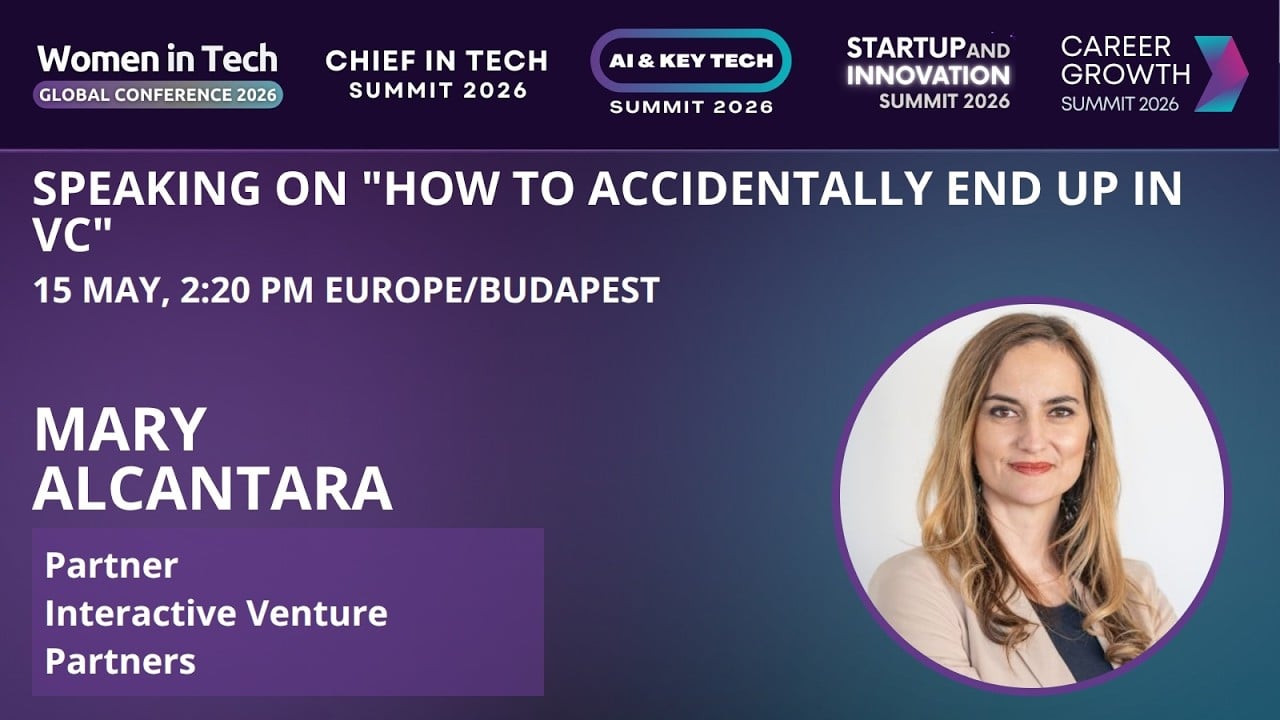
Mary Alcantara never pictured herself as a venture capitalist, yet she is now a partner at Interactive Venture Partners, backing founders in Hungary and the wider region. In this lightning talk she shows that her route there was not a plan but a series of sideways moves, each done well. Her central message: good work compounds, people notice, and you can say yes to a role even if you do not fit its mold.
Key takeaways
- Good compounds to great, every time. And eventually it will be noticed.
The venture capitalist she never wanted to be
Alcantara opens with the image many people carry of investors: someone in a suit in the financial district, driven by deals and money, living a fast and aggressive lifestyle. She never thought that world would suit her. She frames her story for people early in their careers, because hearing other people's paths helped her when she was starting out.
Her view of careers is deliberately untidy. "I think it's kind of a jungle gym where we climb up a little and then over and then down to get over here." (1:29)
From New York consulting to a life in Budapest
After graduating from a prestigious college, Alcantara saw two options for ambitious graduates: investment banking or consulting. Not wanting to become a "finance bro", she chose a boutique consultancy in New York City and spent two years there. She learned a great deal but felt the city was not for her.
When her maternal grandfather died, she decided life was too short to keep following the typical track. She joined a one-year gap program in Budapest, in the country her mother comes from, leaving her job, apartment and relationship behind. That was 2010. The single year turned into sixteen, during which she married and started a family.
A failed startup that built empathy
Looking for reasons to stay, she enrolled in a one-year MBA at Central European University. There she first encountered entrepreneurship and read The Lean Startup by Eric Ries, which changed how she thought about risk. "I'm actually a quite risk averse person, but this book helped give me a framework for understanding risk and dealing with uncertainty." (4:35)
She co-founded a startup with a classmate. It ran for about a year before what she calls a failure to launch. She does not hide the outcome, but she values what it taught her: "So I would say it was not a big success story, but it gave me a lot of empathy and understanding of what founders are going through." (4:35)
Consulting, mentoring and an unexpected offer
Alcantara and her co-founder pivoted into a consulting practice for startups, aiming to act as the first key hire for the next big company coming out of Hungary. As startup culture took off in the country, they mentored many early companies, handled sales and helped them reach the US market, with her partner in New York and Alcantara on the ground in Budapest. Over time they were invited to run workshops and mentor in incubator programs, and she ended up running an incubator for a Hungarian bank, pairing the bank's finance knowledge with her understanding of startups.
Through that work she shared a company with her future partner at Interactive Venture Partners. He contacted her while she was on maternity leave with her third baby and asked her to run a new fund with him. Her first reaction was an identity crisis. "It felt a little bit like going to the dark side, I will say." (7:07) Instead of reshaping herself to the stereotype, she chose another approach: "But what I tried to do is bring my authentic self and be a really empathetic venture capitalist who really is on the side of the founders." (7:07)
The arc of her ambition has come full circle. Where she once wanted to be a key hire at the next big Hungarian company, she now backs those companies as an investor.
Why good work still gets noticed
Alcantara's closing advice is to do your best even when a task does not seem to make sense at the time. "Even in small rooms, somebody will notice and people talk and that word gets around." (8:01) Her consultancy had what she calls a pretty terrible website and never advertised, yet it always had a full book through word of mouth. Even in the age of AI, she believes that doing great work, building relationships and acting with integrity create future opportunities.
Her final encouragement is aimed at anyone who feels they do not belong in a field: "And don't be afraid to say yes to something, even if it doesn't feel like you're the right mold for that, because you can break the mold and do your own thing." (8:27)
Watch the talk
How to Accidentally End up in VC, Mary Alcantara, about 9 minutes: https://www.womentech.net/video/how-accidentally-end-in-vc
About the speaker
Mary Alcantara is a Partner at Interactive Venture Partners and a trusted mentor, startup advisor and investor with significant experience in North America and Europe. Before joining, she was a founding partner of tandemLEAP, an innovation and business development firm with offices in Budapest and New York, and she holds a BA from Harvard University and an MBA from Central European University.
Questions this talk answers
- Do you need to fit the Wall Street stereotype to become a venture capitalist?
- How can a failed startup help your career?
- How did she get the offer to become a VC partner?
- What helped a risk-averse person start a company?
- Does doing good work still matter in the age of AI?
Drafted with AI from the talk transcript. Editor review pending.