Less Stress, More Ease: Using Self-Care and Boundaries at Work
Woodrie Burich38:112021
Większość z nas wyznacza granice dopiero po wybuchu, a w pracy to ryzykowne
Zapytani, czy ich lista sposobów dbania o siebie jest dłuższa w domu, czy w pracy, większość słuchaczy odpowiada: w domu. Ludzie spieszą się, by odpocząć, odkładając regenerację na piątkowy wieczór, podczas gdy dyżury, strefy czasowe i ciągłe podnoszenie kwalifikacji po cichu zwiększają obciążenie w branży technologicznej. Coachka kadry zarządzającej Woodrie Burich, łącząca 10 lat doświadczenia w zarządzaniu stresem z 20 latami w sprzedaży korporacyjnej i doradztwie, odróżnia limit od granicy i pyta, czego trzeba, by wyznaczyć granicę, zanim dojdzie się do limitu.
Poznaj podejście oparte na dbaniu o siebie, które pomaga rozpoznać własne limity i wyznaczyć granice w pracy, zanim zostaną przekroczone
Coachka kadry zarządzającej Woodrie Burich wyjaśnia, dlaczego specjaliści z branży technologicznej popadają w wypalenie i dlaczego benefity oraz programy wellbeingowe nie rozwiązują problemu zbyt dużego obciążenia pracą. Odróżnia limit (punkt, poza który nie możemy wyjść) od granicy (tego, co jest w porządku, a co nie) i przekonuje, że dbanie o siebie praktykowane przez cały dzień pracy buduje świadomość potrzebną do wyznaczania granic, zanim dojdziemy do limitu.
“Wszystko to jest świetne, ale nie rozwiązuje sedna problemu, którym jest to, że już robimy za dużo.”
“Moja osobista definicja dbania o siebie to łagodne zaspokajanie naszych potrzeb.”
What you will learn
Odróżniać granicę (to, co jest w porządku, a co nie) od limitu (punktu, poza który nie można wyjść).
Określić, gdzie dbają Państwo o siebie, w pracy czy w domu, i jak często faktycznie to robią.
Rozpoznawać sygnały ostrzegawcze limitów fizycznych, emocjonalnych i psychicznych, zanim zostaną osiągnięte.
Nazwać presje typowe dla branży technologicznej, takie jak dyżury, globalne strefy czasowe i ciągłe podnoszenie kwalifikacji, które podnoszą bazowe obciążenie.
Stosować drobne praktyki wyznaczania granic, takie jak opóźnione wysyłanie e-maili, bufory między spotkaniami i zapowiedziane przerwy na rozciąganie.
Details
Level
All levels
Format
Workshop
Technical depth
Non-technical
For
All career stages
Length
38:11
Published
June 2021
Questions this talk answers
Czym różni się granica od limitu?
Granica to linia wyznaczająca, co jest w porządku, a co nie, natomiast limit to punkt, poza który coś nie może wyjść. Limity nie są ani dobre, ani złe, a ich znajomość pomaga wyznaczyć granicę.
Dlaczego siłownie, elastyczne godziny pracy i programy wellbeingowe nie rozwiązują problemu wypalenia?
Burich twierdzi, że są przydatne, ale nie rozwiązują sedna problemu, czyli tego, że ludzie już robią za dużo. Bez zajęcia się tym są jedynie plastrem naklejonym na sytuację.
Dlaczego o siebie należy dbać w trakcie dnia pracy, a nie po nim?
Większość ludzi czeka i spieszy się, by odpocząć później, więc kończy dzień wyczerpana. Dbanie o siebie w ciągu dnia daje energię potrzebną do świadomości, a granice naturalnie wyłaniają się z tej jasności.
Dlaczego wyznaczanie granic w pracy jest trudniejsze niż gdzie indziej?
W pracy chodzi o przetrwanie, stabilność finansową, reputację i cele zawodowe, a w zawodach opiekuńczych potrzeba nie znika, gdy powie się „nie”. Burich zaleca, by najpierw ćwiczyć wyznaczanie granic w bezpieczniejszych sytuacjach.
Jakie proste praktyki wyznaczania granic mogą wprowadzić zespoły?
Korzystanie z opóźnionego wysyłania, by e-maile nie wychodziły późno w nocy, planowanie spotkań następujących jedno po drugim tak, by zaczynały się 5 lub 15 minut po pełnej godzinie, oraz robienie przerw na rozciąganie z wyjaśnieniem współpracownikom, dlaczego.
Dlaczego benefity wellbeingowe nie leczą wypalenia (85 s)
Przestań spieszyć się, by odpocząć (70 s)
Limit przed granicą (84 s)
So what are we going to talk about today? So we're going to talk about less stress, more ease, how to utilize self-care and boundaries in the workplace. Now, what I always do in all of my presentations is I always start with a very short breathing exercise. And I do this for a couple of different reasons. One has to do with all of the research coming out on the physiological changes and positive impacts that the breathwork has for us. Harvard Medical School, for example, recently wrote an article talking about just breathwork can quell and alleviate the stress response in our bodies. So just breathwork on its own. The second reason why I always start with a breathing exercise has to do with some of the nuances and the benefits that they're starting
to find with meditation and mindfulness. And I'm curious in the chat bar, does anybody have any experience with meditation or mindfulness or breathing exercises? Any of those? Yes, no's? So I'd be curious on that. So when we start with this, some of the neuroscience coming out with mindfulness and meditation has to do with better sleep patterns, reduced stress responses, lower blood pressure, lower blood pressure. There's a lot going on, especially within the brain as well.
So those are the two reasons why I always start with a very short breathing exercise. And then the third reason why I do it is because oftentimes it feels good. And as one of my teacher, Maggie Clifford had told me, it kind of moves us from getting here to being here. So we'll just sit for just one moment to kind of center ourselves and then we'll dive into the presentation. So I invite you to find your feet flat on the floor, knees hip distance apart and hands.
You can either put them palm up, palm down. I oftentimes will put one over the other in the middle of my lap. You can choose to either close your eyes or you can choose to keep them open for just a moment. And we'll just breathe for a little bit less than a minute just to bring ourselves here.
And if you'd like to keep your eyes open during this exercise, you can find a spot about two to three feet in front of your knees, maybe towards the desk or the table that you're at and just relax your gaze. And once we're here, we'll just kind of check in with our bodies for a moment. We'll check in to see where's our breath sitting for this moment. Is it sitting high up in our chest, perhaps? Is it sitting low in the belly? Maybe it's hanging out for us in our diaphragm area, just below the rib cage. There's no right or wrong. Just checking it out. Just seeing where it is.
You don't have to change the breath. You can just witness it. And while we're here, perhaps there's a noise. Perhaps there's a thought. Perhaps there's some kind of external sensation which is grabbing our attention. And that happens. We just bring our mind back very gently to our body. Perhaps our feet on the floor. Anchored. Steady. Sit bones in the chair. Weighted. Supported.
And our breath. Which is always there. Always available. And when we're ready, we can wiggle our fingers. Wiggle our toes and open our eyes and welcome ourselves back. Hi. Again. All right. So thanks for joining me with that. So what are we going to explore today? So we're going to deep dive into modern work environments and kind of the challenges that we find ourselves in, specifically in the tech space, right? I really want to deep dive into some of the specific nuances of the challenges that we and the tech industry have. And then I want to talk about the solution, how to support ourselves deeply in the workplace, specifically high, fast-paced work environments, right? How we support ourselves in those environments. And then I want to dive into boundaries and
limits and the difference between those two. What that looks like. Some definitions so that we all are working from the same page. And then we're going to also work a little bit on why boundaries in the workplace are so challenging. Both the challenges and the opportunities there. And throughout this presentation, I really love engagement. So I've got the chat bar over here. By all means use that.
Yeses and nos. I see all of those. That's great. We had some folks in earlier telling us where they were from. So from time to time, I'm going to ask you yeses and no questions because it'll make it really easy for me to engage with you guys and still stay present to my presentation. And you'll find that we'll have some awareness builders throughout this presentation. So we'll have a couple exercises that you guys will do individually as well. All right. Okay. You guys ready? Okay. So let's look at modern work worlds. So this is a little reflection of our modern work worlds. A lot of times what we end up thinking is we end up thinking that we have kind of these highs and lows with work, right? Highs and lows. And we have these
times where we're really busy. And then we have these times where, oh, we can take an exhale and we can take a breath, right? And that's what we think work looks like. The challenge with this is I find that that's actually not what happens for the vast majority of us. So the majority of us, what happens is over the trajectory of our career, we start getting more responsibility and we start getting more requirements and more demands of our time, whether that's just in the workplace or whether that's outside of the workplace as well, right? Including family obligations, caregiving obligations, all of these other things.
So what happens over time is our work and our responsibility actually increases. So what you start to see is you start to see these highs and lows, but all of a sudden they're on a completely different trend line. And because of this, what ends up happening for a lot of us is it kind of hits us unawares, right? All of a sudden one day we wake up, we're exhausted and we're burnt out and we aren't sure why, right? Because in our minds we were thinking things were up and down and up and down pretty normal. Can anybody relate to this? Some yeses and nos? Anybody know where I'm going with this? Anybody see some connections here? Yes. Yeah. So one of the things that we also see is we don't necessarily realize the
chronicness of it, right? We don't recognize the fatigue, the sleep issues until we start really starting to see this come out in relationships or come out with our body aches and pains or different things, stress levels that really get get ramped up, right? Okay, great. Thanks for the communication. Okay, so add to this, right? Add to this the reality of tech, right? So tech has this whole other world and whole other realm that we have to add on to this too. Within tech we see this sense of urgency, right?
For a lot of us, for example, there's this constancy of zero downtime. I read this great article recently on specifically security and tech security and how there's this urgency and levels of stress within the tech security industry specifically that are so high because there's always that on-call aspect of work. And if you're on-call, no matter what level you're in within the hierarchy of the corporate corporate tech world, right?
If you're at this level and you have on-call phone calls, but even if you're up here and you're in a supervisory level, you still have to take those calls, right? So there's this constancy of it. Also that global connection. So tech, which is fabulous, right? We have people I was seeing from all over the place, right? And I've oftentimes worked with multiple time zones. So whether that means we have early morning phone calls or we have late evening phone calls, many of us are really used to this global aspect that comes with tech or so than say, you know, a different type of industry, depending upon where you're from.
There's also this depth and breadth the technology has, right? Tech has, it spans all the industries, right? We're all over the place. So what we also see is, especially if you're in a consulting role, oftentimes we will not only have to understand all the nuances of tech, but we also have to understand the specific industry that we're in, whether that's healthcare, education, government, military, oil and gas, whatever that is, right? We have to understand all those nuances, especially business analysts, right? Business analysts need requirements. Program managers need to understand how things link. I mean, there's so many nuances that go into tech and understanding oftentimes, not just one industry, but multiple all at the same time. And then on top of that, you have that constant
change within tech, right? Anybody who's been in the tech industry knows we are constantly having to relearn and re-upskill ourselves just because tech is changing so rapidly, right? So, and then you add this whole subject matter expert piece, right? You add this role embedded knowledge, which oftentimes will happen on projects where only a handful of people really understand the nuances of that particular technology. Let's say it's a really large rollout of, you know, a go live maybe that spans like a huge ERP system or something like that, right? You've got this very, very role embedded enmeshed component there, which is very unique. You don't see. So, so what I'm painting here, I'm painting a picture so that we can all see and by the way, yes, I see some yeses. Thank you. So, you know, I'm painting this picture to really see our
reality. Because if we don't see our reality, we can't change our reality, right? So until we come to terms with understanding the situation that we find ourselves in, we're not going to be able to do anything about it. Now, there's a couple books that I want to reference here too, that I would highly recommend it for those of you who are interested. I'll stay afterwards and we can chat back and forth if anybody has questions. The three books that I would highly recommend if you're interested in really seeing some of the data and some of the studies behind how stressed out a lot of our work worlds are. Um, one of my favorite is written by Dr. Jeffrey Pfeffer. He's out of Stanford University, organizational behavioral professor, and he wrote a book called Dying for a Paycheck. And again, I'll write this in the chat bar
after this presentation if you want to stick around. But Dying for a Paycheck is fantastic. I love it because he actually points to the quantitative data on this, right? A lot of times when you look at research, it just kind of talks about like what I'm doing, right? The qualitative side, the feeling side of it. But I love, he really backs it up with a lot of healthcare insurance, insurance data, which I love. Um, the other book that I'd highly recommend is a book by Bridget Schulte. And she is a journalist and she writes a book called Overwhelmed. I love her work. The back of it, she has this really thick section of all of her sources, which I love. And the third one for any women out there, I know we
have women and men in this conference, which is fabulous. But for any women who are specifically caregivers, um, and specifically have children, there's a fabulous book out there called Making Motherhood Work. Um, and that one's by Caitlin Collins. Love that book as well. So those are three good resources where you can also start to kind of paint a picture and see what's going on. All right. Okay.
So enough about that, right? Okay. So how do we approach this? So what have we found, right? How have we, we've gone about this over the years? So we've gone about this by using time management skills, focusing on effectiveness and efficiencies. We've used exercise. You see organizations, some of the really big global organizations will sometimes bring in masseuses, they'll have gyms at the office, right?
You see us as individuals going and exercising us as individuals going and getting support for ourselves, whether that's physical therapy for a shoulder or some neck pain or carpal tunnel tunnel or something like that, right? We also see this approach by, oh, let's have more flex hours. Let's have more vacations. Some organizations or some individuals will take time between their, their, their, their, their careers as they shift careers or as they not shift careers, but as they shift jobs, they'll take extended periods of time for themselves to unwind, right? These are all ways we're trying to address this. We also try to address it with work-life balance and wellness programs, which are pretty, pretty abundant in a lot of corporate spaces. And then also we've been doing a lot of mindfulness and meditation,
which is you notice we started off this presentation with. All of these are great, but they don't address the root issue, which is that we are doing too much already. Until we address that piece, the other is only going to kind of put a bandaid over the situation. So what we approach and our approach with this is really this concept of a combination of self-care and boundary work and awareness wraps around the whole thing. Okay. And let me explain why. Self-care is really what changes. I call it changing the space. Okay. Self-care and all of those beautiful practices, meditation and mindfulness is really big, right? So all of those beautiful practices internally, self-care is what gives us the energy to support ourselves. It's really critical. So the self-care piece is what gives us the energy
actually to go and do all the really hard work of the introspection and the reflective exercises and the brainstorming. It's almost like you need to kind of charge your battery before you apply it to the awareness before you apply it to the introspection. That's why that self-care piece is so big. Then with the self-care and awareness, what you'll start to find is boundaries start to come out really naturally out of that space, really naturally, because when we're really strong with our self-care and we're feeling energized and we're not depleted at the end of our days because we're starting to take care of our needs, the awareness and the clarity of the reality that we're in, the situation that we find ourselves gets really clear. And when that's clear, setting boundaries becomes a lot easier.
All right. Everybody with me? Everybody with me? Okay, good. I see some chats. You guys are awesome. Thank you for the communication. That's so helpful. Yes. Okay. Lovely. Lovely. Okay. Excellent. So exercise time. Let's do a little exercise for you guys. So what I'd love you to do right now is just take a moment. Now, a lot of you guys are on computers, which is great. You can pull up a Word doc or a Google doc, whatever you choose. Or for those of you who are old school like myself sometimes and like pen and paper, grab a pen and paper. And I'd love you guys to do two things. Okay. So first, I'd love you to create a list and I'd like you to make a list and separate it out into two categories and identify where you take care of your self-care.
If it's at work or if it's at home, the different types of self-care you provide for yourself, either at work or at home, and make a list of it. Okay. And then after you're done with that list, and I'm going to give you guys about four or five minutes here. Okay. So after you get done with that list, part two is to identify with each of those items, how often you do those. Okay. So if it's seldom, one time every couple weeks or more regularly is maybe three times a week and often is daily. And people will oftentimes ask me, well, Woodry, what is self-care? And I want to give us opportunity to make self-care super broad.
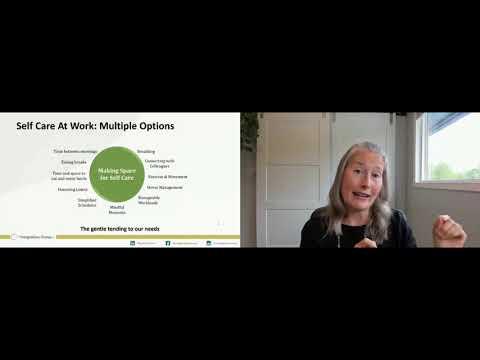
My personal definition of self-care is the gentle tending to our needs. Okay. The gentle tending to our needs. I like to make self-care super broad because when we make it broad, we start recognizing we can offer it to ourselves multiple times in the day. Okay. So think of anything that makes you feel fed, anything that leaves you feeling a little strengthened or rejuvenated, that's self-care.
And you can also think about what activities, people, or events can make you feel good. Okay. So just take a few moments here, make that list and separate it out. And I'll give you guys just a couple of minutes. I'm going to turn myself up. Here I am. I'm going to turn myself on mute, but I'm still here. And if anybody has any questions, I'm going to go back through the chat bar and I'll see if I can incorporate those two. Okay. So I'll give you guys just a couple more minutes here. Okay.
Okay. And for those of you still finishing up, no worries, no stress. But just start letting me know in the chat whose list was longer at home or at work. Just write down the longer list was either home or work. Let me know which one was longer for you. Home. That'll also clue me in as to when you guys are done. Yeah. Home. Homework. Okay. Yeah. Home, home, home. Yeah. So every once in a while, I'll find somebody who says their, their list at work is longer. Most of the time I find folks, most of the, most of the presentations I give, it's usually home.
And there's a reason for that. For the vast majority of us, we have the tendency to think of self-care as something that we do later. We have the tendency to hold and wait for it, right? We wait. I call it rushing to relax. Okay. Rushing to relax. So what oftentimes happens throughout our day is this is actually a part and a component. Remember how that initial slide, the self-care and the boundaries and awareness around it, right? So the self-care piece, this is the energetic piece. This is the part that feeds us in our day so that we're not depleted at the end of it. And remember how I was talking about self-care needs to be really, really broad for us to start viewing it in a different way. So that we start thinking about
self-care not only on a Friday night, right? Not only at the end of our work day, but so that we start feeding it to ourselves throughout our day. And that's really a game changer for us in terms of giving ourselves more energy throughout the day. Okay. So there's a lot of ways we can look at self-care. These are just a handful of them. Would love to think if you guys have any that you'd like to share with the group. I love to see those. But some of the ones that I really love is that very short breathing exercise that we did at the beginning. Now, I call that a breathing exercise. I was very particular with that. Not a meditation or a mindfulness exercise. If you love breathing exercises,
I would recommend connecting in with a strong meditation or mindfulness teacher. There's some subtle nuances there that can really support you deeply with that if you like that. But I love breathing exercises because they're so short and they can connect us so deeply with our body in such a quick way. The other thing, connecting with colleagues. Somebody had mentioned earlier, a cup of coffee. Absolutely. Yes. Right. Just taking a cup of coffee and not thinking about work and not talking about work in that moment can be a wonderful way to recharge ourselves just a little bit. Exercise and movement. People ask me, well, how do you exercise at work? Well, there's a couple ways you can do it actually. So one, if you have enough of a long lunch break or something like that,
you can do a quick walk around the building if you're in a place where you can walk. I've seen people wear FitBits and actually walk the halls. For me personally, what I end up doing is I'll go to the restroom or I'll go to an empty conference room. This is all pre-COVID of course, right? And I'll do arm stretches. I'll do arm rolls. I'll do neck rolls. And I'll just kind of move my body for about five minutes because I need that, especially since I'm heads down. I'm the kind of person who I'll go heads down and I'll forget. It's like an hour later. So I need to move my body.
And that's a simple way. The other thing was those fabulous ergonomic stretches. If you've ever seen those, you can Google those, you know, find a quick, you know, update on how to do some ergonomic stretches at the office, different things like that. Stress management. And for the purposes of this presentation, right, we've got kind of a little bit of a short time. I'm going to have to go through these a little bit quick, but you can kind of start to get a flavor that we don't have to wait, right? We don't have to wait for the end of our day. We can look at manageable workloads. Remember how I was talking about self-care gives the energy so that when we look at and we take some time with
our awareness, we can start identifying ways to shift how we engage our work, right? How we engage our work so that we can start taking breaks. We can start honoring what our real limits are. Okay. Okay. We'll keep diving. So what I want to do right now is I want to give a common definition for us between a boundary and limit. It's amazing to me that most of the time when I give a presentation, in fact, quick question for you guys, how many of you have ever been formally trained on how to set a boundary at work? Yes or no?
How many of you have been formally trained on setting a boundary at work? The vast majority of the time, almost nobody says no, almost, or I'm sorry, almost no one says yes. The only time that I've found folks who really do boundary work in the work setting is usually working with non-profits who usually work in some sort of trauma-based situation. I've seen it with therapists and counselors and psychologists when I speak with those folks, but in the vast majority of presentations that I give, most people have never been taught in business how to set a boundary, which is astounding to me because it's the basics of how to say no and when to know what our no is internally. Okay. So if you, if it's no for you,
don't worry, you're in good company. And if it's yes for you, great. So boundary, it's really just the line that marks the limit of an area. Okay. They provide clarity about what our limits are. And it's really the base route. It's what's okay and what's not okay. That's what a boundary is. Now a limit is that point beyond which something can't go beyond, right? That's our limit. Now it's really important to understand that limits, there's not a good or a bad with the limit. They just are, right? No good or bad, no judgments. Really, really, really critical in that limit piece. They're not good or bad. They just are.
And they help understanding what our limits are is what helps us set a boundary. Okay. So within the limit world, there's many types of limits. Okay. Lots and lots of types of limits. I want to talk about three specifically physical limits, emotional limits, and mental limits. Okay. So physical limits and examples of these is there can be a physical limit of our physical being, right? So if I'm typing a lot and let's say that I have some carpal tunnel and I keep going and I keep working through the pain, well, eventually, I might have to go to the doctor and the doctor might have to get me some surgery. And that surgery and that physical limitation arose when then I had to take four weeks off of work because of my carpal
tunnel, right? So that was a limitation, not good or bad, right? It just is. And then that, so it's oftentimes marked by like pain in the body. There's an emotional limit too, right? You can see this. You can see the spectrum of something kind of basic like a little bit of frustration or irritation all the way over to anger, right? That's an emotional limit is when we, when we reach that max and then we kind of blow, right? That's an emotional limit. Okay. And we see the same thing with mental limits. Mental limits. We can really see this if anybody's ever studied for a really large exam of any sort. We might feel really brain fog at the end of it or tired or exhausted.
Likewise, if we've been working too many hours, you can look at research and studies on overwork and you can see how we actually get mental, mental challenge, mentally challenged, right? From the perspective that we can't think anymore because we're so fatigued mentally, right? So there's limits on those. So those are some examples of the types of limits we have. So here's another exercise for us. Okay.
So let's go through. I'm going to give you guys a few more minutes for this one. Okay. I'd love you to just identify an example of a time that you hit a limit and set a boundary. Okay. And you can do it either or. It can be either at home or it can be at work. It doesn't matter to me. Okay. And then as part two, I just want you to review that. Just think back in your mind and consider the following questions.
Were there any signs or warnings that you were approaching that limit or did you perhaps know you were reaching it in advance or did it hit you completely unaware? Okay. And I'll give you guys just about two to three minutes on this and I'm going to go back through the chat. Okay. Two to three minutes. Thank you.
Excellent, about another minute. All right. Okay. So I find this exercise really helpful because it gives us some understanding, right? For me, the real light bulb came off for me when I realized that there was a difference between a boundary and a limit. Because for me, they were enmeshed beforehand. I didn't realize that there was a difference between the two.
And once I saw that and that became really clear for me, it helped me understand when I hit a limit. Because oftentimes what happens for us in our worlds, right, is we go about our world and we will hit our limit first. And then we will set a boundary out of that. And the challenge with it, it's really, really painful to do that, right?
It's painful, it's risky, and unpredictable because we don't necessarily know how we're going to respond until we hit our limit. And it's based on a variety of things, our own past upbringing, our own personal triggers, the environment that we find ourselves in. It's really, really risky and unpredictable, especially in a work setting. So yeah, let's keep going.
Good work. Okay, so I really love this image because it kind of helps me understand and delineate between that boundary and the limit, right? So the comfort zone is that super comfy space where we're not necessarily doing a lot of growth, but we're super comfy and maybe happy and warm, right? But then the adventure zone, this is the opportunity for growth for us with the boundary setting, is that's that adventure zone.
And then the danger zone, that's our limit space, okay? Now, remember how I was telling you that a lot of times what will happen for us, this old paradigm that most of us go through, is we have this old approach. And by the way, this is everyone. And we still use this approach. I will use this. All of us will use this approach till the day we move on, right?
And that's okay. It's a trial and error approach. And this is how most of us function. It's also how most of us have been taught to set boundaries, which is we hit a limit first. And then out of that, we take reflection time because we don't like it, right? And I'll give you a good example. I'm really exhausted.
Let's say that I had an early morning phone call. I was in the phone with somebody at 6 o'clock in the morning, and then I ran back-to-back meetings until 11 o'clock. Finally had a quick lunch break, right back into back-to-back meetings. And I was really stressed. I dealt with a really stressful client in the afternoon, felt a lot of pressure.
And then I ran home, hustled, and I was late to the house. My kids were there. My husband was there. The dog was there barking. Dinner wasn't made. The house was a mess. And I just blow, right? I've hit my emotional limit for the day. I've hit my mental limit for the day. And I blow. Then I have to deal with the aftermath, right?
And my aftermath is my personal reflection of, oh, man, that went really crappy, and I don't want that to happen again, right? And then, because of that, I set a boundary. And my new boundary is, you know, if I have a day like that again at work, I'm going to pull over on the road before I come home and take a five-minute breath, right?
I'm going to take some time for myself before I walk in that door and shift my mood and connect with myself before I have to connect in with whatever I walk into, right? That's that classic scenario that the vast majority of us, how we set boundaries. And the paradigm that we're pushing, right, and we recommend, and what works for me and I've seen work with for the folks that we work with, is this concept of working on self-care first, providing ourselves the energy.
You can even see in my last example that pulling off the road is a form of what? It's a form of self-care, right? It's the recognition and the awareness that I need a moment. That I've had a crappy day and that that's okay and that I'm approaching my limit and that that's okay because there's nothing wrong with the limit.
I'm just aware of it. And then because of that, I work on my self-care and I practice that awareness piece throughout the day. I'm not waiting until Friday to focus on it. I'm integrating it throughout my work day. And then out of that, it becomes really clear, oh man, I'm having a really tough day right now and I need a breath, right?
I need a breath and I need a cup of coffee or I need a cup of tea or I need a walk or I need whatever it is that I need, right? It becomes really clear so that then I can start to set a healthy boundary. And when I come home, say, hey, you guys, I've had a really tough day today.
Mama just needs a little pause. Can I go in the back room for about 15 minutes before I come back out? You know, those kinds of conversations because I'm aware of what my limit is. Yeah. Okay. So I want to wrap up here with a couple, this is my disclaimer slide. This is the slide that I always put out there because it's really important to understand that setting boundaries in the workplace is really, really challenging.
And I want to be really clear in this space that when I talk about work boundaries within this slide, I'm not talking about harassment issues or anything along those lines. Those need to be addressed immediately, right? And you need to find support for that. I'm not addressing that when I talk about work boundaries. I'm talking about work boundaries specifically in relation to how I say yes or no to my workload overload.
Okay. So we'll table that concept of harassment or something like that over here. So this slide is only in relation to workload overload. But work, when you look at boundaries in the workplace, it's a very different place to play, right? Because we're dealing with root issues of survival. I'm dealing with whether or not I have a roof over my head and whether I have food on my table for me and my family.
It's a big deal, right? Being able to say no in that context, it's really important to understand that. It's important to understand that we're dealing with issues of present and future fiscal stability and financial stability for ourselves. We're dealing with reputation, professional goals. In a caring profession, if you happen to work in healthcare or you happen to work in a nonprofit organization, when you say no to something, there is still an onslaught of need, whether that's a patient that needs support, whether that's a child who needs tears to be dried, right?
All of these needs are very real. So we need to have that context when we look at setting boundaries in the workplace. Caution and care is needed, really. Really, it's just the ability to tap in. And it's why it's so important that we focus on the self-care piece, right? It's not the only piece. We still need the boundaries piece, right?
If we're only focusing on the self-care, it's not enough. We have to do both, right? Because the boundaries piece is what changes the structure of how we work. The self-care piece changes us, our engagement with everything. The boundaries change the structure of how we're engaging work, okay? But we need to be able to listen to and access that inner wisdom.
We need to be understanding of the variables that are all around us. People will oftentimes say, oh, well, would you, should I set a boundary here? And my response is always, I don't know, because I don't know your supervisor. I don't know your corporate culture. I don't know the situation you find in. I don't understand the deadlines that you have that are pushed.
It's really important to really have a clear picture of what we're stepping into, which is why I always say, if we have boundary issues in the workspace, it's more than often, more than likely, that we also have boundary opportunities in other spaces, too. Whether that's because we're volunteering for volunteer organizations or we sit on a board or perhaps we have a lot of friends and we have a lot of family obligations and we have some opportunity to practice understanding what our needs are and vocalizing that in some safe spaces first.
And that's what I always recommend. When we're first starting to try in this boundary stuff, practice in the safe spaces first, okay? And then remember that if you're in a situation where you're frustrated because maybe you can't push a boundary because your corporate culture isn't going to support it, some corporate cultures won't, which is a detriment because there's actually tons of benefits that organizations see when they start to have really healthy, strong, empowered individuals that not only are taking good care of themselves internally, but also setting up work structures to support themselves and their teams in very strong ways.
But just know that over time, committing to that self-care and awareness piece, the boundaries will come out of that. All right. Good work, folks. Way to hang in with me. Okay. So last couple things. I just want to give you guys some examples of some applied practice. So we can look at this. I'm just going to pick out a few.
Obviously, you guys can read the slide. But just a couple quick examples. So if we become aware of the need for boundaries, a really simple implementation of this that I've seen on teams is just simply using delayed delivery in our email, right? It's just not sending emails at 7 o'clock or 8 o'clock or, goodness knows, 10 o'clock at night, right?
Something simple like that can have a huge impact on team culture. Aware of physical limits. You know, we can choose to take a stretch break for ourselves and also let folks around us know that we're doing that to support our bodies because we're trying to support whatever issues going on for us in the moment, right? If we have back-to-back meetings, we can schedule those 5 or 15 minutes after the hour.
For those of us who run back-to-back meetings, we have those options, we have those choices, and we have that power. So, you know, boundaries is really that place where there is so much leverage. There's so much opportunity for us in that space. And, yeah. And so you guys recognize this slide, and I invite you to just connect in with yourselves for a moment.
And for this last minute here, we'll just close our eyes for one moment or open them if you'd like to find a spot. And just think to yourself, how would it feel in your body to support yourself deeper at work? And what is one step you could take to do that? When you're ready, you can open your eyes and wiggle your fingers.
I'm going to stay in the chat for a little bit. You guys, thank you so much. It's just been lovely being with you guys. Thank you for all the engagement. I so appreciate it. And I'll stay in the chat if anybody has any questions. And thank you for your time. So good to see you guys. Thank you.
Oh, yeah. You can follow me on Facebook. And I'm on, you can, there's only like one Woodry out there. There's not very many Woodrys in the world. So you can find me, Woodry, at LinkedIn and everything like that. Integration group is also on Facebook and things like that. So good to see you guys. Thank you. I see all the thank yous.
If anybody has any questions, I'm still here. I'm more than happy to support you with anything you guys need. Thank you for your time. Thank you.
Transcribed automatically; names checked against the speaker record. Select a time to jump there.
Article based on this talk
Dlaczego wyznaczanie granic dopiero po osiągnięciu limitu szkodzi w pracy
Woodrie Burich przekonuje, że dbanie o siebie w trakcie dnia pracy buduje świadomość, by wyznaczać granice, zanim stres wymknie się spod kontroli.
W skrócie
Woodrie Burich, założycielka i coachka kadry zarządzającej w The Integration Group, twierdzi, że większość profesjonalistów wyznacza granice w trudny sposób: najpierw osiąga limit fizyczny, emocjonalny lub psychiczny i dopiero wtedy decyduje, co zmienić. W tych warsztatach proponuje inną kolejność. Wbudować dbanie o siebie w dzień pracy, wykorzystać wytworzoną w ten sposób energię, by zauważyć, co naprawdę się dzieje, i pozwolić, by granice wyrosły z tej świadomości, zanim pojawi się limit.
Najważniejsze wnioski
Rozpoznawać różne sposoby wspierania dbania o siebie w miejscu pracy.
Rozumieć i definiować różnicę między granicą a limitem.
Ćwiczyć narzędzia i strategie uważności wspierające siebie w pracy.
Stworzyć spersonalizowaną listę narzędzi wsparcia w pracy.
Obciążenie rośnie, gdy patrzymy w inną stronę
Burich rozpoczyna każdą prezentację krótkim ćwiczeniem oddechowym, powołując się na badania nad jego korzyściami fizjologicznymi oraz na uczucie, jak ujęła to jedna z jej nauczycielek, przejścia od docierania tutaj do bycia tutaj. Następnie szkicuje, jak naprawdę przebiega większość karier. Ludzie wyobrażają sobie pracę jako serię intensywnych szczytów i spokojniejszych dolin, ale z czasem odpowiedzialność rośnie, zarówno w pracy, jak i poza nią, w związku z obowiązkami rodzinnymi i opiekuńczymi. Szczyty i doliny wciąż się pojawiają, tyle że teraz na rosnącej linii trendu.
Efekt często przychodzi bez ostrzeżenia: „Pewnego dnia nagle budzimy się wyczerpani i wypaleni, i nie bardzo wiemy dlaczego, prawda?” (6:07)
Branża technologiczna, jak mówi, dokłada własne warstwy. Jest presja zerowych przestojów i dyżurów, która towarzyszy ludziom nawet na stanowiskach kierowniczych, wczesne i późne rozmowy w różnych strefach czasowych, konieczność rozumienia zarówno technologii, jak i branży klienta, ciągłe uczenie się od nowa i podnoszenie kwalifikacji oraz wiedza przypisana do ról, którą w projekcie ma tylko garstka osób. Cel nakreślenia tego obrazu jest prosty: „Bo jeśli nie widzimy naszej rzeczywistości, nie możemy jej zmienić, prawda?” (10:12)
Osobom, które chcą poznać dowody stojące za tym obrazem, poleca trzy książki: Dying for a Paycheck profesora Stanford University Jeffreya Pfeffera, cenioną przez nią za ilościowe dane z ubezpieczeń zdrowotnych, Overwhelmed dziennikarki Brigid Schulte oraz Making Motherhood Work autorstwa Caitlyn Collins dla kobiet pełniących funkcje opiekuńcze.
Dlaczego benefity i programy wellbeingowe nie wystarczają
Organizacje i poszczególne osoby próbowały wielu rozwiązań: zarządzania czasem, siłowni i masaży w biurze, fizjoterapii, elastycznych godzin pracy, urlopów, przerw między kolejnymi pracami, programów wellbeingowych, mindfulness i medytacji. Burich ceni je wszystkie, ale jasno wskazuje ich ograniczenia: „Wszystko to jest świetne, ale nie rozwiązuje sedna problemu, którym jest to, że już robimy za dużo.” (13:05)
Jej alternatywa łączy dbanie o siebie z pracą nad granicami, a całość otacza świadomość. Dbanie o siebie dostarcza energii do trudniejszej pracy refleksji i introspekcji. „To trochę tak, jakby trzeba było naładować baterię, zanim użyje się jej do świadomości, zanim użyje się jej do introspekcji.” (14:01) Gdy ludzie nie są wyczerpani pod koniec dnia, jak mówi, rzeczywistość ich sytuacji staje się jasna, a granice znacznie łatwiej wyznaczyć.
Pośpiech, by odpocząć
W pierwszym ćwiczeniu uczestnicy wypisują sposoby dbania o siebie, które praktykują w pracy i w domu, a następnie zapisują, jak często stosują każdy z nich. Na większości jej sesji lista domowa jest dłuższa. Burich wyjaśnia dlaczego: „Zdecydowana większość z nas ma tendencję do myślenia o dbaniu o siebie jako o czymś, co robimy później. Mamy tendencję do wstrzymywania się i czekania na to, prawda?” (17:40) Nazywa to pośpiechem, by odpocząć.
Aby temu przeciwdziałać, celowo utrzymuje szeroką definicję: „Moja osobista definicja dbania o siebie to łagodne zaspokajanie naszych potrzeb.” (16:06) Liczy się wszystko, co sprawia, że czujemy się nakarmieni, wzmocnieni lub odświeżeni. Jej przykłady z dnia pracy to krótkie ćwiczenia oddechowe, kawa ze współpracownikiem bez rozmowy o pracy, spacer wokół budynku, pięć minut krążenia ramion i szyi w pustej sali konferencyjnej, ćwiczenia ergonomiczne i zwracanie uwagi na to, czy obciążenie pracą jest do udźwignięcia.
Granica to nie limit
Burich pyta, ile osób kiedykolwiek przeszło formalne szkolenie z wyznaczania granic w pracy. Prawie nikt nie odpowiada twierdząco, co uważa za zdumiewające, bo to podstawa umiejętności rozpoznania, kiedy powiedzieć „nie”, i powiedzenia tego. Granicę definiuje jako linię wyznaczającą, co jest w porządku, a co nie, a limit jako punkt, poza który coś nie może wyjść. Co kluczowe, limity nie podlegają ocenie: „Bardzo ważne jest, by zrozumieć, że limit nie jest ani dobry, ani zły. Po prostu jest, prawda?” (22:05)
Opisuje trzy rodzaje: limity fizyczne, często sygnalizowane bólem, jak zespół cieśni nadgarstka kończący się operacją i tygodniami zwolnienia; limity emocjonalne, od irytacji po złość; oraz limity psychiczne, czyli mgłę umysłową po intensywnej nauce do egzaminów lub zbyt wielu godzinach pracy. Drugie ćwiczenie polega na przypomnieniu sobie sytuacji, w której uczestnicy osiągnęli limit i wyznaczyli granicę, oraz tego, czy były sygnały ostrzegawcze.
Stary paradygmat, z którego, jak mówi, wszyscy wciąż czasem korzystamy, to metoda prób i błędów: osiągnąć limit, przemyśleć sytuację, a potem wyznaczyć granicę. Problemem jest koszt: „To bolesne, ryzykowne i nieprzewidywalne, bo niekoniecznie wiemy, jak zareagujemy, dopóki nie osiągniemy limitu.” (27:31) Jej własny przykład to dzień z rozmowami o 6 rano, spotkaniami jedno po drugim i stresującym klientem, zakończony jej wybuchem w domu. Granica, którą potem wyznaczyła, czyli zatrzymanie samochodu na pięć minut oddechu przed wejściem do domu, sama w sobie jest dbaniem o siebie. Praktykowana przez cały dzień, ta świadomość pozwala jej poprosić rodzinę o 15 minut przerwy, zanim osiągnie limit.
Dlaczego granice w pracy wymagają ostrożności i troski
Burich wyraźnie zaznacza, że nękanie wykracza poza zakres jej wystąpienia i musi być natychmiast zgłaszane, z odpowiednim wsparciem. Skupia się na mówieniu „tak” lub „nie” wobec nadmiernego obciążenia pracą, a nawet to jest trudne, bo dotyka przetrwania, stabilności finansowej, reputacji i celów zawodowych, a w zawodach opiekuńczych potrzeba nie znika, gdy powie się „nie”. Dlatego obie części jej modelu są ważne: „Dbanie o siebie zmienia nas, nasze zaangażowanie we wszystko. Granice zmieniają strukturę tego, jak angażujemy się w pracę, dobrze?” (33:18)
Zaleca, by najpierw ćwiczyć granice w bezpieczniejszych sytuacjach, takich jak wolontariat, zarządy, przyjaciele i rodzina, oraz zaakceptować, że niektóre kultury korporacyjne nie będą ich wspierać. Jej praktyczne przykłady są drobne: opóźnione wysyłanie, by e-maile nie wychodziły w nocy, rozpoczynanie spotkań następujących jedno po drugim 5 lub 15 minut po pełnej godzinie oraz przerwy na rozciąganie z wyjaśnieniem współpracownikom, dlaczego. Na zakończenie prosi każdą osobę o wskazanie jednego kroku, który pozwoli jej głębiej zadbać o siebie w pracy.
Obejrzyj wystąpienie
Less Stress, More Ease: Using Self-Care and Boundaries at Work, Woodrie Burich, 38 minut: https://www.womentech.net/video/less-stress-more-ease-using-self-care-and-boundaries-work
O prelegentce
Woodrie Burich jest założycielką i coachką kadry zarządzającej w The Integration Group oraz założycielką grupowego programu coachingowego Boundaries Before Burnout. Łączy 10 lat doświadczenia w zarządzaniu stresem z ponad 20 latami doświadczenia w sprzedaży korporacyjnej i strategicznym doradztwie biznesowym dla dużych organizacji i firm z listy Fortune 500.
Pytania, na które odpowiada to wystąpienie
Czym różni się granica od limitu?
Dlaczego siłownie, elastyczne godziny pracy i programy wellbeingowe nie rozwiązują problemu wypalenia?
Dlaczego o siebie należy dbać w trakcie dnia pracy, a nie po nim?
Dlaczego wyznaczanie granic w pracy jest trudniejsze niż gdzie indziej?
Jakie proste praktyki wyznaczania granic mogą wprowadzić zespoły?
Wersja robocza przygotowana z pomocą AI na podstawie transkrypcji wystąpienia. Oczekuje na redakcję.
Frameworks and ideas mentioned
Self-care, boundaries and awareness model
Boundary versus limit
Physical, emotional and mental limits
Comfort, adventure and danger zones
Resources mentioned
Dying for a Paycheck by Jeffrey Pfeffer
Overwhelmed by Brigid Schulte
Making Motherhood Work by Caitlyn Collins
Ergonomic stretches for the office
Delayed delivery in email
Cite this talk
Woodrie Burich. "Less Stress, More Ease: Using Self-Care and Boundaries at Work." WomenTech Network, 2021. https://www.womentech.net/video/less-stress-more-ease-using-self-care-and-boundaries-work