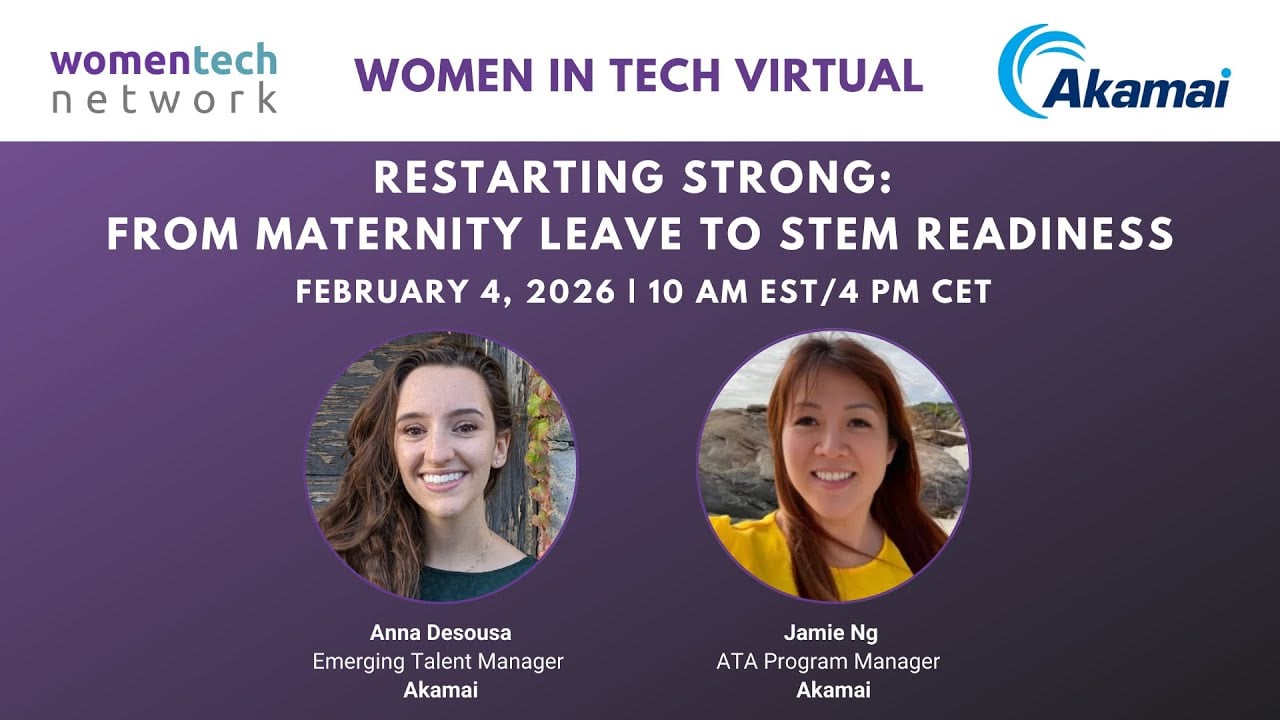
Restarting Strong: From Maternity Leave to STEM Readiness
36:462026
She smiled through a dressing-down on her first day back from leave
On her first morning back from maternity leave, she is pulled into a meeting where a senior leader is angry at her team, and she has to hide her face because she is smiling, thrilled to be talking to adults again. Anna D'Souza, who manages Akamai's emerging talent team, took two leaves in three years and came back different each time. What should a returner keep, and what should she leave behind?
Get stage-by-stage reflection questions for any leave, plus a scholarship route into STEM skills
Anna D'Souza of Akamai Technologies shares how two maternity leaves reshaped her values, from "people matter most" to "slow down", and offers stage-by-stage questions for anyone preparing for or returning from a leave. Jamie Ng then walks through the Akamai Technical Academy, a free-by-scholarship online program on Coursera that builds foundational STEM skills for workforce re-entry.
“And that was this new lesson, this new value that it's people that matter at the end of the day, not projects, not promotions.”
“I began to realize, again, just after taking a break from work, that it's a marathon. It's not a sprint.”
What you will learn
Use a leave of absence as a natural checkpoint to notice how your values have changed.
Ask targeted questions at each stage: preparing for leave, during it, preparing to return, returning and six months after.
Translate new values into daily choices, such as fewer meetings, delegating projects and protecting meal breaks.
Reframe reduced capacity with young children as a temporary season instead of a career failure.
Apply for a free Akamai Technical Academy scholarship to earn a network engineering or customer support certificate on Coursera.
Details
Level
All levels
Format
Talk
Technical depth
Non-technical
For
Returner, Career changer
Length
36:46
Published
February 2026
Questions this talk answers
How can a maternity or other leave change how you work?
Anna D'Souza says leave is a natural time for values to change; hers shifted to valuing people over projects and promotions, and then to slowing down and prioritising health.
What questions should you ask yourself before and after a leave?
Before leave, ask what your values and goals are; during it, who you are outside work; before returning, what you fear and missed; on return, what your day should look like and what to leave behind; months later, whether you followed through.
How do you manage work with two young children?
Anna keeps work and childcare separate by using a small at-home daycare and creating boundaries around the day, while admitting it remains hard.
What does the Akamai Technical Academy offer and what does it cost?
It offers two Coursera professional certificates, network engineering and customer consulting and support; Coursera normally costs 39 to 59 US dollars a month, but Akamai awards scholarships giving four months of free access.
What background do you need to join the Akamai Technical Academy?
No degree or special background is required, only genuine interest and English proficiency, since the materials were written in English.
Smiling through a dressing-down on day one back (67 s)
Leave taught her: it's a marathon, not a sprint (70 s)
Early parenthood is a season, give yourself grace (66 s)
So today we're really pleased to be hosting this conversation because it speaks to a moment that is both deeply personal and professional and it's significant for many women returning to work after maternity leave. It's a transition that often comes with renewed motivation and and I'm sorry here renewed motivation staffing priorities shifting priorities and real questions about confidence and skills and career decisions and direction in a very fast moving market.
Today's session is designed to address that transition head-on, honestly, practically, and with intention. I'm especially proud to introduce our partner for this session, Akamai Technologies, a great partner of Women Tech Network. They're globally recognized for its leadership, empowering and protecting digital experiences, but what stands out just as much is its commitment to expanding access to technical careers and creating meaningful on-ramps for key moments of transition for women. With us today, we have Anna D'Souza. She leads a global team of recruiters, Akamai, driving early talent strategies and programs that hire and train over 200 students and recent graduates annually. She champions program expansion into new regions, builds talent partnerships, and is passionate about leveraging emerging talent initiatives to foster diversity spark innovation and create meaningful impact in the workforce. Jamie Ng is also going to join us,
and she's the program manager at Akamai Technical Academy. She brings over 10 years of experience in learning and development, and she's passionate about designing programs that empower learners and support career growth in the tech industry. Jamie's going to talk about the Akamai Technical Academy program, and it's an initiative that is focused on equipping learners with foundation-level STEM knowledge to support workforce re-entry and prepare for technical career pathways.
So I encourage you to listen to this presentation through the lens of possibility, what's available, what's transferable, and what support can make a real difference at this stage in your career. So with that, I'm delighted to turn things over to Anna and our partners at Akamai. So I'm going to bring Anna to stage. Hi, Anna. Hi, everyone.
Hopefully you can see me. I'm happy that you're joining us. I'm going to bring up your presentation. I'm going to turn it over to you. Thank you, Lori. Appreciate the introduction. All right. Hi, everyone. So again, my name is Anna D'Souza, and I manage the emerging talent team at Akamai Technologies. So Akamai, just so you know, is a tech company headquartered up in Cambridge, Mass in the U.S., and I've been in the company for seven going on eight years.
And what I'm excited to talk to you all about today is returning to work after a leave of absence, specifically in my case, a maternity leave. I see a lot of you putting in the chat, you're from India, you're from Germany, UK. I know you get longer maternity leaves than us. I'm a little jealous, but I was lucky enough to have two five-month periods of leave back in 2023 and 2025.
And those experiences were very different and taught me a lot about who I am and also change the way I work. And that was really through a change in values. So what I want to share with you all today is that I think taking a leave from work, whether that's maternity or parental leave, a sabbatical, a medical leave is a natural time when our values change. So it's a good time to re-examine them. But first, let me tell you just a little bit more about myself so that you know who's talking to you today. So I have been married for six plus years and I live in Framingham in the US, which is where I grew up. I have two beautiful kids who are pictured there. My daughter Stella is
turning three this weekend. So happy birthday, Stella. And my son Charlie is going to be one in a few weeks. So they're almost exactly two years apart. And it is as crazy as you would imagine it to be. I have two dogs and a cat. I started at Akamai almost eight years ago. And I'm now I have the privilege of managing a global team of five. And the responsibility of the Emerging Talent Team is to handle recruitment and all the programming for interns, students, recent grads, as well as some non-traditional training initiatives. You'll hear more about that.
I work from home, as you can see in my fancy background. And some other fun facts, I'm the president of our Toastmasters chapter at Akamai. I've been involved in Toastmasters for a few years, which is why I try to do things like this and push my comfort zone and talk to people. And I love cooking. I don't have time for a lot of hobbies, but I have been baking breads lately.
That's been my thing. So let's actually get into the first leave. I'll tell you a little bit about it. So coming into my first leave, I'm pregnant. I'm naive. I have no idea what to expect. And my boss at the time, who had had two maternity leaves of her own at the company, pulled me into her office and wanted to give me some advice.
And the advice that she gave me was, first of all, you're going to have no money for a while after you have kids because daycare is so expensive. And that has been true. The second piece was that during my leave, don't check emails at all. And in fact, when I come back, delete all the emails. And I did do that. That was good advice. And the last thing that she said to me was, when you have little kids, especially, and you come back to work, expect things to change.
You're not going to be able to work in the same way that you did before. And that's okay. We support you through that. And it's all temporary. So give yourself some grace. And while that was good advice, it was all a little bit abstract to me because I was actually a lot more worried about different things at the time.
I was personally feeling very afraid that I was going to be supplanted in my role. I had wonderful team members who were going to be filling in for me while I was on my leave. And I really feared that they would do a better job than me and that I would come back and there wouldn't really be a role left. And that didn't happen. That was just a fear. But that was what was on my mind. And I was also starting to wonder whether I maybe needed to look for a new job.
I had been at my job for five years and I had kind of the five year itch where up to that point, I was always focused on tackling the next big project, getting the next promotion, working as hard and as fast as I could. And I thought, is there any more for me here? Is it time to move on? So that's what I thought I would do when I got back from leave. And then my daughter arrived and I went into labor on my due date. I actually, no joke, sent out my last email, checked off my to-do list, closed my laptop and went into labor. And she came the next morning and things were so different and so much harder than I expected them to be. And anyone who has
been a new parent can probably relate to this, but I was so stressed, so tired. I had no idea what I was doing and it was incredibly isolating. I remember there were so many days during my leave when I was sitting in a rocking chair in the dark, holding the baby largely by myself all day because my husband went back to work after two weeks and I didn't like it at all. I realized pretty quickly that being a stay-at-home mom is really hard work and it's probably not for me.
So it was a tough leave. And as I got ready to come back to work, I felt excited. And I thought that I would feel anxious because that was mostly what I had heard about. I went back on my first day and I dropped my daughter off at daycare, which went great. And I felt good about that.
And I logged on. And at eight o'clock in the morning, my first day back, I was pulled into a meeting. And it was one of those luckily very rare kind of fire alarm meetings where there was a senior leader very upset at the team. So I was taking the brunt of it and being yelled at. And I was sitting there, honest to God, I had to cover my face because I was smiling because I was so excited to be talking to adults again. I was excited to be back in my element and feeling confident about who I was and relatively in control of my day. And I realized that I really missed and needed work in a way that I didn't expect. So the rosy glasses stayed on for a few
weeks. And I remember different things would happen, different interactions. And it didn't matter if something went wrong. I was just happy to be around people again and to be talking to people. And I began to realize that something had changed for me out of my leave. And that was this new lesson, this new value that it's people that matter at the end of the day, not projects, not promotions. And I had really reset. Part of this, of course, was becoming a parent.
It changes so much about who you are. Part of it was just taking a leave. Taking a break from work was what I needed to get a new perspective on exactly what work had been giving to me for these years. So how did that translate into my day to day? In the little ways. I really try to pause when people reach out to me and just be kind and check in on how people are. I try to implement it into how I coach and manage my team, and I'm definitely not perfect with it, but it's become a new motto, and it came out of my first leave. So after I was back at work for a year, I found out I was pregnant with my second, and I was nervous because I thought that it was going to
be the same as before. I was going to be back in that rocking chair in the dark, but it wasn't. My second child came about two weeks early, and I actually had meetings scheduled for that Monday, So I had to log in at the hospital with the baby and like cancel my meetings. That wasn't great, but it was much easier the second time around.
He was an easier baby. I was much more confident. I was on medication, so I was less anxious. It was all around great. And it was the kind of maternity leave that I had hoped for. I would be able to strap the baby to my chest like you see in the photo and just go for long walks, listen to podcasts and audio books and do whatever, go shopping.
And I found that I had a lot more time to focus on my health, to eat regular meals and exercise, which was always a challenge in my day-to-day work. And I found that I had more space in my brain to be able to think creative thoughts and pursue hobbies and, again, kind of listening to books. So a new version of myself had emerged, and it made it a lot harder to go back.
I was starting to wonder whether going back to work was the right choice for me. And ultimately that choice was made because financially we can't swing me staying at home, but I didn't want to have less time with my baby and I didn't want to lose this new person that I had found when I was less stressed.
So I went back and it was a harder transition. I felt like I was having kind of an out of body experience for the first few weeks and I had a hard time getting back into it, but I did. I think time contributed its role. And I ended up feeling normal after a little while. But I started carrying forward another lesson and a new value out of this leave, which was to slow down. I began to realize, again, just after taking a break from work, that it's a marathon. It's not a sprint.
Health is a whole lot more important than packing your day with meetings. And so now I try to take less on my calendar. I try to pass off projects to people when I need to. And if it comes down to a meeting or making time for a meal, I make time for the meal. So this was another huge one coming out of my second leave. So now as I reflect over my entire return to work journey, I didn't think of it like this at the time, but looking back, I can see that there were a number of different stages where my values were really developing and it would have been helpful to ask myself certain questions to guide that process along. So I'll share those questions with you in case
it's helpful. And this is not meant to make it seem like a leave of absence from work is a time for a project and self-improvement and all of that. I don't believe that at all. On the contrary, I think that your values are naturally and organically going to change. It just requires a little bit of paying attention to that process to get a lot of value out of it.
So in the first stage, preparing for leave, this is where in the first time I was very afraid that I was going to be replaced, good questions to ask would be, what are my values right now? And what are my goals for my leave? It's pretty simple, but important to know. Then during the leave, how do I feel and who am I outside of work? Is anything changing for me with my values? And both times for me, things changed, but I didn't quite realize it until later.
Preparing for return, it's a time of high anxiety and excitement for probably everybody. What are my fears? What have I missed about work? And what do I want to take with me from my leave? Then at the real crux of it, returning to work, what are my values at work now based on whatever has changed for me?
What should my day look like to reflect those values? And what do I leave in the past? And then finally, in the post-return period, which is where I am again now for the last like six months, have I followed through on my changes? So six months later, have I followed through on my changes? Well, with the main lessons that I had learned, people are what matter and slow down, I would give myself a passing grade.
It's definitely true that the longer you're back at work, old habits start to reintroduce themselves. And I have the kind of job, like many of you may as well, where you log in in the morning and you're in meetings all day and emails and you're sitting at a desk and the day can fly by and it can be hard to remember these things.
But they really resurface all the time whenever I'm making decisions about what to do with my day. And they didn't before. But there's actually a new lesson that has really come into focus over the last six months. And it's because for me personally and having my second child, I've definitely hit a new wall that I haven't hit before. I am more tired. My day is more full. I can't put in the extra hours at night like I used to. I can't take on the extra projects and go the extra mile all the time. And I absolutely feel guilty about that. I'm used to doing extra. I want to be there more for my team. So it's a difficult feeling to feel like I have to step back a little bit.
So lately, I've been reflecting a lot on the advice my boss gave me way before this all started, which was that particularly when you have little, little kids, things are different and it is harder to put extra into work. And as cliche as it sounds, it is a season of life. It's temporary. And there will be times in the future where if you wish to, you can lean all the way back into your career and do extra.
But for now, give yourself some grace. So I've really been trying to remember that lately with sick kids and sick pets and missing work so often. It's been a really important lesson for me. There's a lot more lessons that I could cover, but I don't want to talk forever. I think that the moral of the story is ultimately this is a process that's going to happen by itself, whether you take a month for medical leave, whether you take a sabbatical or whether you're going on parental leave, whatever it's going to be.
It's important to pay attention to the process. And by asking questions about these values, we can bring more clarity, purpose, and ultimately joy, I think, to our careers. And even just going through this process of reflection, for me, it's definitely brought more purpose to mind. So that's it. Thank you. That's all I got. Happy to answer any questions too. Anna, that was fabulous. There's so many, there were so many great nuggets of information. I say nuggets of information. I hate that term, but it was so interesting that, you know, it doesn't matter whether it's a, it's a maternity leave or a parental leave or a sabbatical, we all face those fears, right? And having had my children years ago, I could absolutely empathize with some of the things you were saying. And then
having taken some breaks, you know, since then, for other reasons. Yeah, these are things that continually come up and your priorities do shift organically. Thank you for sharing your story. I really, really appreciate it. So, you know, let's see, we have some questions here. We can have a few questions and then we can move to Jamie. Let's see. Oh, here's one that's kind of a real question. I have a two month old and I wonder how I would manage work and caring for him.
How do you manage your day with two kids? Yeah. I mean, I see Asha, that's your question. I don't know what your plan is for childcare. I've had friends and family who have their kids at home while they work from home and they balance going to meetings and taking care of their kids. I, I could never do that. Um, just for me, the separation is really important. I find that when my kids are at home, like if they're sick, I feel so distracted and, and frustrated. So I send my kids to a small at home daycare during the day, which has worked out great for me. I'm really happy with that. And just trying to create some boundaries around the day, both in terms of work
and in terms of making sure my kids are cared for is the way that I manage it. It's tough though. It is hard. It is hard. And you do have to kind of work into it and find out what really fits for you and the family. There was another question here from Victoria. And I think I dealt with this. So it would be a good one maybe for you to give us some insight. Do you have any advice on managing guilt about sending the kids to daycare and missing out on the moments with them?
Oh, I know. That's a good question. I mean, I'll be honest with you. I am one of those parents who doesn't feel much guilt about my parents going to daycare specifically. I feel a lot of guilt, but I think it's more centered around work and not being able to give much to work. And I'm lucky for that because my kids love daycare. And I really view it as it's my village because I don't have an alternative village. I don't have parents who can watch my kids. So they go there and they play with their friends and their caregiver. And I feel really happy for them.
but of course it pops up. I mean, I think there are times when, when they're sick, especially, which happens every other week, their first year. It's really tough. It's really tough. Cause some days all I want to do is be with my kids and I'm trying to answer emails in between. And those days are really hard. It never quite goes away. The guilt is there.
Yeah. It doesn't matter when they're in their twenties, you still feel it right. When they need you, you feel like you have to interrupt everything. So I completely understand. Thank you, Anna, for sharing your story. I want to get to Jamie. So we'll bring you back at the end if there's some more questions because I think people are really very engaged on this. It's a great topic. Okay. So with that, we'll see you in a few minutes and I'm going to take Anna down and I'm going to bring up Jamie. Hi, Jamie. You're on mute, love. Hello. There you go. Okay.
So with that, I'm going to turn it over to Jamie. Jamie's going to talk about the ATA Technical Academy, and I'm going to bring up, you're going to do a demo, right, Jamie? I am. Wonderful. Okay, here you go. Thank you. So hello. I don't know if any of you have joined our previous sessions where we talked about Akamai Technical Academy, but I'm just gonna take this chance or opportunity to run everyone through it and I saw a question earlier on you know being worried about how to catch up again this is well somewhat like helping you catch up and maybe even you know switching your career right so again this is a Akamai Technical Academy. It's an online learning program where, you know, it helps you skill up in terms of
technical or STEM so that you can, you know, kind of go into this field if you are interested in it, right? I'm going to share the website link in chat. So, this being the biggest takeaway from the session. So, if you're interested in this online learning for STEM, then you want to enter into this technical career, check out our program.
It will help, you know, be like a stepping stone for like entry-level roles into this space. I'm going to run you through the website a little bit. Be sure to watch the videos that we have right up here in the banner. It explains the program a little bit more. And then I'm just going to share with you a little bit about what this program has to offer, right? We offer two professional certificates in this ATA program. One is network engineering and the other is customer consulting and support. So we offer again these two professional certificates and they are In partnership with Coursera, we have leveraged their platform to kind of host the whole training program.
So I'll go into one of it as a live example. So example with the Akamai Network Engineering Professional Certificate. This professional certificate is made up of five courses, right? So we have operating system fundamentals, networking fundamentals, Managing Relational Databases, Python Scripting Fundamentals, and Introduction to IT Security. So this professional certificate is, again, made up of five more bite-sized courses, right?
And I'll even dive in. So again, if you're interested, go ahead and enroll. And then once you enroll, you can go to the course. And I'll click onto it to show you what it looks like so that you know if it's, you know, something you can manage. So if you click on Go to Course, so it'll bring you to the first course of the five courses within this professional certificate.
And then you will see the different modules here. So we have nine modules in this one course. And then example, we get started. cause the causes are made up of videos and also readings i'm not gonna play it you can go ahead and check it out on your own um for example we have readings as well so just short readings and then you kind of go through the the program you just click on next um and then you know you kind of again go through like the next video or what's up next very much like a book or other online learning programs so the at the end of it right so the end of you know all the different modules we will have a capstone so this is where it's it's almost like a test right so well it is
a test it is an assessment test where you know it's a graded one so you'll need to pass before you are marked as completed for this particular course. If you need help, Coursera has recently introduced this AI coach. So example, you know, you can ask them to give you real life examples and then just, you know, read through whatever they put here just to keep you engaged in the program and give you more information and resources on what it's like when you go through the program.
so this is a fairly new feature if you don't like it just click it click it away so this is what the course looks like on Coursera Coursera is again our partner so we have you know all our learning material 100% online and then you can just you know go through it um at your own pace right i'm going to flip back into our website so as a tidbit for everyone who has joined here um to well cosera is not uh like a totally free platform so there is actually a monthly fee if you want to subscribe to it and that ranges between 39 to like 59 us dollars monthly. So our tidbit here is if you are keen on taking up this learning program, just go ahead
and register here. So once you register with Akamai, there'll be like a, it brings you to a Google document. And if you let us know, you know, why you would like a scholarship, we would be able to award you with one. And what this scholarship does is it gives you access into Coursera, into our Akamai learning program. So where you will see again, those two professional certificates, and you can go ahead and enroll and take those two certificates for free, right? You'll be given four months free access to this learning program. So I see some questions, I'm going to go ahead and tackle a couple all right so i think i tackled the first is the causes fee uh to enroll and compete so again we are offering out free scholarships uh if you let us know why you want
one um by just going here to register and then again there is a free form filling where you let us know um and then we'll assign you um a scholarship if you know you are able to kind of just let us know why you would like one otherwise it is that 39 to 59 us dollars monthly subscription to access this you know many other courses on Coursera right next question I see is the duration of each course so the duration of each course varies and I'll go back into it just because, oh, so that I can see for myself again.
It varies between two to three weeks per course at about a 10-hour commit, right? So to finish the Network Engineering Professional Certificate, it's estimated to take about three months. And to finish the other professional certificate, the Customer Consulting and Support Professional Certificate, it's estimated to take you 3.5 months. And this is, again, at about a 10-hour-a-week commit to the learning.
Jamie, we had another question here. Is there flexibility to extend the deadlines? Are you on a schedule that you have to complete it by? We do have, like, a four-month allocation. However, we have received, like, you know, people, like, just needing that additional grace due to maybe personal issues so if you do need an extension um the request is that you write to us let us know why you need the extension and you know that will frequently be granted back uh to you right like again just let us know um if not kind of automatically we will take it away after four months that's wonderful thank you jamie for that um we have another one here someone asked natalie asked um uh is the course updated regularly
so as things change technology changes it updated so well we uploaded it i think about three four years ago so we haven't done much but introduced a little bit of the ai and then there's also like forums and when now also the marketing system is done fairly automatically we are looking uh this year into, you know, just maybe enhancing or like you say, updating the causes. But at this point of time, it's not been updated very much. Well, it sounds like they're foundational, right? So the foundational piece of it's still, you know, maintained. So this is really an entry level course foundational. So, right. Am I correct? Yeah, it is. Okay. That makes sense. That makes sense. So you've answered a lot of questions. Another one here. What kind of background do
participants need to have before joining this is there is there a specific profile yes you need to be interested in i tell you if you're not it's going to be very hard to finish the program um and this is the truth right just being very candid here uh you don't need um a degree you don't need any uh very fancy background all you need to do is again be interested in it and have uh english level proficiency so again the whole program is you know the videos the readings they're all in english uh and and also that's like well that's kind of the core language that that uh you know it's being taught in Coursera does have a feature to translate um yeah but again the expectation is
that when we first wrote it it was all done in English and that's the the you know the basic expectations that you might be able to understand the documentation that way yeah absolutely Katie has another question here and I was thinking about this as well so when you think about this I mean you've had this program for for three or four years right now and so you've had a lot of students go through this program what kind of doors do you see that these certifications have opened for people so can you speak on that so once you okay so it's Akamai's commitment to support students through this a little bit right so for starters everyone who finishes either one of the professional certificates means you have put that three four months in finished that professional
certificate you would have to write in to let us know again due to some pdpa issues we can't just find you or reach out to you you would have to fill in a form so that we can reach out to you so our sources will do that and then see if there's any opportunity to match you with um entry-level positions within Akamai wow um again it's not a promise of a job right it really isn't uh there has to be a few aligning factors right like there has to be that kind of entry-level positions in the country um so if you're not unfortunately if you're not in a country where Akamai operates it's unlikely there's going to be a job opening there so um I think just to set
expectations but if there is then we would forward you along to the hiring managers to further the process along if we feel like you're a suitable candidate so this is one opportunity that Akamai is opening for learners I mean at this point in time we have also had some apprenticeship roles open up where we put some of the ATH students in but the other good thing is that you know we see or we have feedback from some of our students that has helped them get promotions within the company because they've managed to upskill themselves a little bit with some of this knowledge uh it's also managed to help them um like get land a role in stem i think this was you know one of the happiest stories right like they didn't get a job in akamai but
they got a job somewhere else and we are happy for them still right so we have a couple of testimonials in that uh ata page the website page just scroll all the way down to the bottom you'll see a couple of testimonials there we are working currently also this year to you know put in a little bit more testimonials we have already reached out to our graduates to try to find out you know how this program has benefited them or not and then we'll try to do a couple more stories to put on the site to share yeah yeah thank you Jamie for that I think the most important thing is to realize this is Akamai's commitment right to help other people develop a foundation in STEM
so it's not just about having a job at Akamai or finding a job it's about you supporting the ecosystem of driving people tech talent and education in STEM so very very important I know this has been a very successful program. And I know Akamai is very, very committed to it. And we thank you for that. So with that, I think we pretty much have all our questions answered. So with that, I want to thank you very, very much to both Anna and Jamie for participating.
And I'm going to take you off stage. We'll see you soon, Jamie. Thank you again very much. I'm going to bring Anna. Hi, Anna. You're back. Hello. Hi. We have a couple more questions. If you have a few more minutes, can you take a few more questions? Okay. So there was another question here about what about the impact of your leave on your career trajectory? That I think is another thing that people often think about. I was very afraid of that. I will say I'm very lucky to be in the Akamai environment, in the HR environment, where probably 80% of my immediate work colleagues have had parental leaves and have had kids relatively recently in their careers. So it's so understood and so supported. I've just never had an issue with people viewing leaves as
something that's going to stop you in your career. What I will say on sort of a softer front is it's been hard to catch up, especially the second time around. I find myself, because we had huge system changes while I was out, I find myself still six months later saying, oh, sorry, I don't know what happened last year. I have to check this. I have to check that. And that's been uncomfortable to feel like less of an authority after being out. But it's just a process of one step at a time, I think, slowly catching up. That's a great response to that. I think that's a question or a feeling a lot of people have, you know, once they're thinking about having a family or
taking a leave, like what's going to happen when I come back? Is it going to sort of derail my career. So thank you for sharing that experience. So with that, I think we covered all the questions. Anna, thank you so, so much for sharing your story and providing all that insight. And Jamie, thank you for sharing more information on the ATA. Everybody keep an eye on our weekly newsletter, too. We're going to be talking a little bit more about the ATA, and there you can get some more information on that. So thank you very much. I'm going to bring you both down, and I'll talk to you both probably in the next coming weeks or so. And so for everybody else, thank you for joining us
today. You know, we have webinars, several webinars a month. We've got two coming up that I want to make sure that you know about. We've got one with another partner of ours called Enable that is happening on February 18th. And it's talking about building a career, a rewarding career as a woman in tech. And then on February 25th, lucky us, we have another Akamai person presenting the performance culture, how to lead teams that win. And that will be delivered by Khalil Smith.
You don't want to miss that one. So thank you everybody for joining us. We very much appreciate you being here and we look forward to seeing you at our next session. Take care, everybody.
Transcribed automatically; names checked against the speaker record. Select a time to jump there.
Article based on this talk
What two maternity leaves can teach you about your values at work
Anna D'Souza of Akamai explains how each leave reset her priorities, and Jamie Ng shows a scholarship-backed route back into STEM skills.
In short
A leave from work, whether parental, medical or a sabbatical, is a natural moment when values change, and paying attention to that change can bring more clarity, purpose and joy to a career. Anna D'Souza, who manages the emerging talent team at Akamai Technologies, shares how two five-month maternity leaves reshaped how she works and offers questions for every stage of a leave. Her colleague Jamie Ng then introduces the Akamai Technical Academy, an online program that helps people build foundational STEM skills for re-entry into the workforce.
Key takeaways
Use a leave of absence as a natural checkpoint to notice how your values have changed.
Ask targeted questions at each stage: preparing for leave, during it, preparing to return, returning and six months after.
Translate new values into daily choices, such as fewer meetings, delegating projects and protecting meal breaks.
Reframe reduced capacity with young children as a temporary season instead of a career failure.
Apply for a free Akamai Technical Academy scholarship to earn a network engineering or customer support certificate on Coursera.
The first leave: fear, isolation and a surprising return
Before her first leave, D'Souza's worries were professional. She feared that the colleagues covering for her would do a better job and that there would be no role left when she came back. She was also feeling a five-year itch and wondering whether to move on. Her boss, who had taken two maternity leaves herself, advised her not to check email during leave, to delete the backlog on return, and to expect things to change.
The leave itself was much harder than expected: exhausting, isolating and spent largely alone with a newborn. Then came her first day back, when she was pulled into a rare emergency meeting with an upset senior leader and found herself hiding a smile. "And I realized that I really missed and needed work in a way that I didn't expect." (7:46)
That return produced her first new value. "And that was this new lesson, this new value that it's people that matter at the end of the day, not projects, not promotions." (8:26) In practice, she now pauses when people reach out, checks in on how they are, and tries to bring that into how she coaches and manages her team.
The second leave: learning to slow down
Her second child arrived two weeks early, and the leave was easier. She was more confident, had more time for her health, regular meals and exercise, and had room in her head for creative thoughts and hobbies. That made going back harder: she did not want to lose the less stressed person she had found. The return felt like an out-of-body experience for a few weeks before normality came back.
The lesson she carried forward was to slow down. "I began to realize, again, just after taking a break from work, that it's a marathon. It's not a sprint." (10:52) She now takes less onto her calendar and passes off projects when she needs to. "And if it comes down to a meeting or making time for a meal, I make time for the meal." (11:22)
Questions for every stage of a leave
D'Souza is clear that a leave is not meant to be a self-improvement project. "On the contrary, I think that your values are naturally and organically going to change. It just requires a little bit of paying attention to that process to get a lot of value out of it." (12:02)
She offers questions for five stages:
Preparing for leave: What are my values right now? What are my goals for my leave?
During the leave: How do I feel, and who am I outside of work? Is anything changing in my values?
Preparing to return: What are my fears? What have I missed about work? What do I want to take with me from my leave?
Returning to work: What are my values at work now? What should my day look like to reflect them? What do I leave in the past?
Post-return: Have I followed through on my changes?
Six months after her second return, she gives herself a passing grade, while admitting that old habits creep back in a job full of back-to-back meetings.
Hitting a new wall and giving yourself grace
With two young children, D'Souza has hit a wall she had not met before. She can no longer work extra hours at night or take on every extra project, and she feels guilty about it. She has returned to her old boss's advice. "And as cliche as it sounds, it is a season of life. It's temporary." (14:41)
In the Q&A she explains that she keeps work and childcare separate by using a small at-home daycare, which she views as her village. On the impact on her career, she says she has been lucky to work in an environment where most of her immediate colleagues have taken parental leave, though catching up after major system changes has left her feeling like less of an authority for a while.
A scholarship route into STEM skills
Jamie Ng, program manager at the Akamai Technical Academy, demonstrates the program's two professional certificates on Coursera: network engineering, and customer consulting and support. The network engineering certificate has five courses, covering operating systems, networking, relational databases, Python scripting and IT security, each ending in a graded assessment. Courses take two to three weeks at about ten hours a week, so a certificate takes roughly three to three and a half months.
Coursera normally charges 39 to 59 US dollars a month, but learners who register with Akamai and explain why they want a scholarship can receive four months of free access, with extensions available on request. No degree is needed, only interest and English proficiency. Graduates can ask to be considered for entry-level roles at Akamai, though Ng stresses that this is not a promise of a job.
Watch the talk
Restarting Strong: From Maternity Leave to STEM Readiness, with Anna D'Souza and Jamie Ng (Akamai Technologies), 37 minutes: https://www.womentech.net/video/restarting-strong-maternity-leave-stem-readiness
About the speaker
As introduced in the session, Anna D'Souza leads the emerging talent team at Akamai Technologies, running early talent recruiting and programs for interns, students, recent graduates and non-traditional training initiatives. She has been at Akamai for nearly eight years and manages a global team of five.
Questions this talk answers
How can a maternity or other leave change how you work?
What questions should you ask yourself before and after a leave?
How do you manage work with two young children?
What does the Akamai Technical Academy offer and what does it cost?
What background do you need to join the Akamai Technical Academy?
Drafted with AI from the talk transcript. Editor review pending.
Resources mentioned
Akamai Technical Academy
Akamai Network Engineering Professional Certificate
Customer Consulting and Support Professional Certificate
Coursera
WomenTech Network weekly newsletter
Cite this talk
WomenTech Network. "Restarting Strong: From Maternity Leave to STEM Readiness." WomenTech Network, 2026. https://www.womentech.net/video/restarting-strong-maternity-leave-stem-readiness