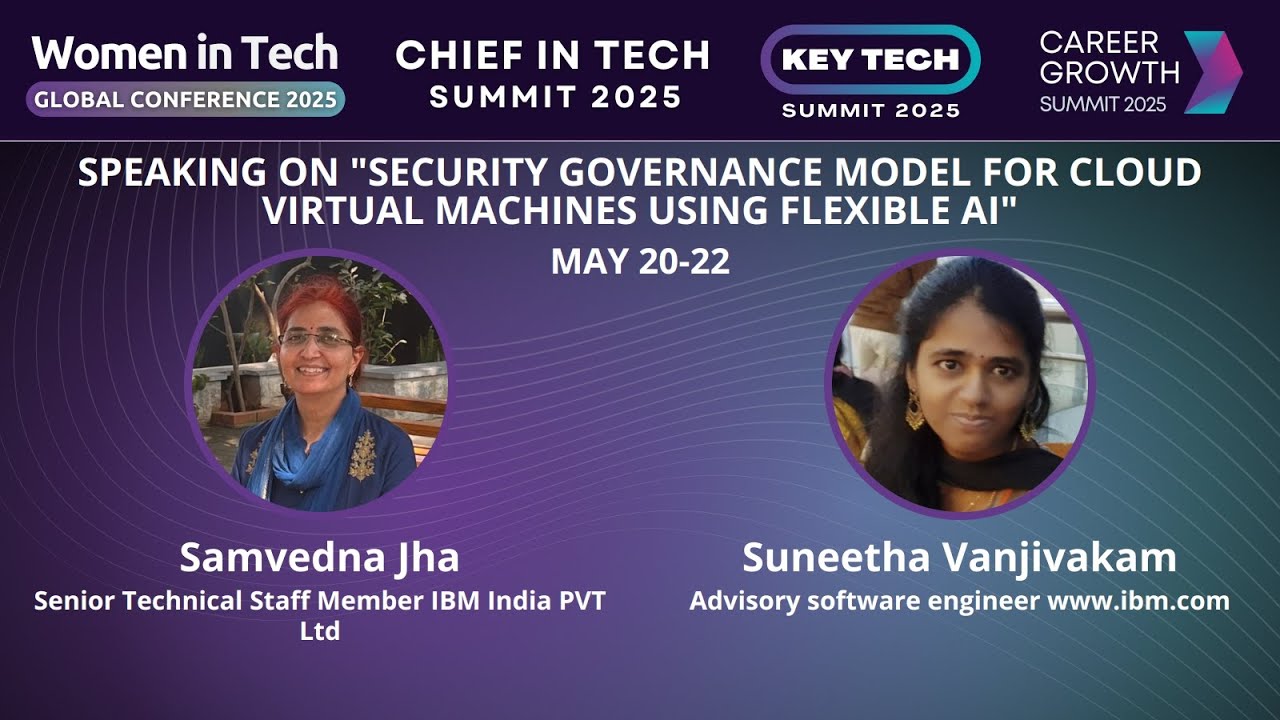
Security Governance model for Cloud virtual machines using flexible AI
Samvedna Jha19:212025
KI-Sicherheit ist nicht kostenlos: Schluss mit KI auf jeder Cloud-VM
KI-Sicherheitsfunktionen gibt es nicht umsonst, und für eine virtuelle Maschine, die öffentliche Tutorials ausliefert, rechtfertigt sich ihr Verbrauch nicht. Samvedna Jha, Security Architect für IBM Power mit über zwanzig Jahren Erfahrung, argumentiert, dass Cloud-Teams Energie und Kosten senken können, ohne Isolation oder Compliance zu schwächen. Offen bleibt: Welche VMs verdienen vollen KI-Schutz, und wer entscheidet, wann er abgeschaltet wird?
Lernen Sie das dreistufige Modell kennen, das festlegt, wie viel KI-Sicherheit jede VM erhält
Samvedna Jha und Co-Referentin Suneetha Vanjivakam von IBM schlagen ein Security-Governance-Modell für virtuelle Maschinen in der Cloud vor, bei dem KI-gestützter Schutz pro VM konfiguriert und nur bei Bedarf aktiviert wird. Sie argumentieren, dass eine Einstufung der VMs nach Kritikalität der Workloads die Isolation wahrt, Compliance-Anforderungen erfüllt und Energie sowie Kosten dauerhaft aktiver KI senkt.
“Denken Sie immer daran: Keine dieser KI-Funktionen, all die sogenannten coolen Funktionen, gibt es umsonst.”
“Sie sollten einen Mechanismus haben, mit dem Sie es aktivieren, wenn es erforderlich ist. Und wenn es nicht erforderlich ist, deaktivieren Sie es.”
What you will learn
Die vier Säulen Sicherheit, Compliance, Risikomanagement und flexible KI auf die Governance von Cloud-VMs anwenden.
VMs in geschäftskritische, mittlere und einfache Workloads einteilen, um den jeweils nötigen Umfang an KI-Sicherheit festzulegen.
Das bedarfsgesteuerte Aktivieren und Deaktivieren von KI-Sicherheitstools planen, um Energie- und Ressourcenkosten zu senken.
Etablierte Frameworks wie ISO 27001 und das NIST-Framework mit KI-gestützter Governance verknüpfen.
Erklären, wie die Konfiguration pro VM die Datenisolation schützt und die gemeinsame Ressourcennutzung sicher hält.
Details
Level
Intermediate
Format
Talk
Technical depth
Introductory technical
For
Mid-career, Senior individual contributor
Length
19:21
Published
July 2025
Questions this talk answers
Was bedeutet flexible KI für die Security Governance von Cloud-VMs?
Gemeint ist KI, die den Workload-Typ und die Daten einer VM als Input nutzt und daher nach den Anforderungen dieser VM statt blind angewendet wird. Sie soll Bedrohungen ohne menschliches Eingreifen erkennen, sich an den Workload anpassen sowie Selbstheilung und VM-spezifische Richtlinien unterstützen.
Warum sollten KI-Sicherheitstools nicht ständig auf jeder VM laufen?
KI-Funktionen sind nicht kostenlos und ressourcenhungrig. Werden sie nur bei Bedarf betrieben, spart das Energie und Ressourcen in der Cloud. VMs, die etwa öffentliche Informationen bereitstellen, rechtfertigen diese Kosten nicht.
Wie sollten VMs eingestuft werden, um den Bedarf an KI-Sicherheit zu bestimmen?
Geschäftskritische Workloads erhalten durchgängige KI-Sicherheit mit sofortiger Abwehr, mittlere Workloads (die häufigsten) erhalten grundlegende KI, und einfache Workloads wie öffentliche Tutorials benötigen den Schutz der zugrunde liegenden Hardware sowie Compliance.
Wie schützt Governance pro VM die Datenisolation und die gemeinsame Ressourcennutzung?
Die Konfiguration des Modells pro VM schützt die Daten jeder VM, da jede ihre eigenen Workloads trägt, und stellt sicher, dass gemeinsam genutzte Ressourcen nicht auf Kosten der Sicherheit verwendet werden. VM-Verantwortliche können entscheiden, ob KI benötigt, umgangen oder für einen Zeitraum deaktiviert wird.
Die Referentinnen nennen schnellere Innovation und Kosteneffizienz, Resilienz durch optimale Ressourcennutzung und Performance sowie ethische Aufsicht, die Audits, regulatorische Anforderungen und die Berichterstattung zum CO2-Fußabdruck erleichtert.
Good morning, good afternoon, everyone. Thank you for joining us today. So, you know, in the era where digital transformation is driving everything, every aspect of organization, our products. So, security is no longer, it's like an IT concern, right? It is, it's not something which is a tick mark anymore. It is a business imperative. And in that, whether you like, whether we like it, whether we like it, whether we like it.
or not, security governance is the framework that ensures that all the requirements we are meeting, we are, we have all these strategies in place. We have a way to handle the risk and things like that. So today we are going to explore the security governance model for the cloud virtual machines and why it is so important to empower it at this stage itself when AI is picking up in every, every area, how we can bring the innovation, how we can build trust.
across these digital subsystems and using which, which are going to use AI. So, with this, let us move to the next slide. So, you know, every presentation of security, we need to start with a kind of motivation, right? Because not only for, to handle the security aspect, but also to ensure that how are we handling the customer's requirement and making sure that everything is in place. So, the importance of security and governance for the VMs has, we have divided into four pillars, basically. The first one is the security, just to ensure that the data is protected, the sensitive data, irrespective of the nature of its nature, client customer data, they are all protected.
We are also meeting the compliance requirement, which is the second pillar. We are reducing the cyber security risk, which is the third pillar as part of risk management. And finally, we are bringing in flexible AI here. And the idea about this flexible AI to bring from cloud security is to have threat detection to ensure without human intervention, to have it like a very clear, fair detection.
So, it also should have to adapt to security based on the VM load it is having, based on the final workload which is running on that VM. And then the third point that we want to bring is that these VMs, when they get into a trouble and shoot mode, how to have them as a self-healing system, so that they not only, you know, go down, they also have ability to come up, come back up.
And then finally, we should have security policies per VM, where based on the type of the workload it is running, how to ensure that the policy actually is flexible enough for them to get into those, you know, to utilize those flexible AI. So, just to give a little overview for what flexible AI we are using here is, it actually is trying to bring the kind of input from the workload type it is running, the type of data it has, and based on that, the various decisions are made to ensure that this AI is not applied blindly, but based on the personalized requirements of that VM.
So, that is the main flexibility which is coming up here. With this, I will move to the next slide. Now, here, you know, we will be talking about the governance model that itself that we are talking about here, right. So, you must be aware of some of the well-known, widely adopted governance models we already have in industry.
For example, ISO 27001. And what is its purpose? Its purpose is to provide a systematic approach to manage sensitive information, to ensure it remains secure at all environments. There are physical controls which it handles. There are, you know, it is logical controls when it is about data center, but it has to enhance to ensure that it handles all the AI requirements also.
And that's, and when we are talking about the flexible AI for that matter. The next one, I would like to cite example is NIST framework itself. So, NIST actually will provide is a very well-known, widely accepted framework, every product, mostly all products meet all the NIST requirements. And their also approach is to manage the cybersecurity risk. And, you know, it has provided various guidelines to handle various type of, you know, the main pillars, for example, integrity.
You have identify, protect, detect, respond, and recover the system. So, based on this example, what we are proposing here in our session today is about this model powered by the flexible AI, specifically targeting the virtualization platform, where in each server itself, each resource itself, you are trying to virtualize it to achieve, to run multiple virtual machines on the same hardware resource, right?
So, what we actually propose here is to have enabled disablement of AI. You need not have AI for all this. You should have a mechanism by which, when it is required, you enable it. And when it is not required, you disable it. So, you know, that type of governance model should be in place. Then, next point is about decide that each VM, basically, you know, when it requires, AI needs a security governance model or not.
For example, in any public data, which is like a very publicly available information, you don't want to spend your resources and tools to basically apply AI there, or basically to apply any governance model. You can actually utilize that resource to do something which is like more critical with respect to the mission or the workload that VM is running.
And then, final point is about, you don't have to use this AI all the time. When it is needed, use it. It also helps you to save energy and resources in the cloud itself. Always remember that none of these AI features, all the so-called cool features, they do not come for free. They actually are very much resource-eating, you know, applications and tools.
And my friend Sunita will actually talk about it more detail in next slides. But these all are very much important and why we need to have it a mechanism to not use it all the time when not needed specifically. So, we have divided, you know, our VMs at a very high level in three categories basically. The VMs which are running the mission critical workload, where we would like to have AI to handle the end-to-end security completely.
Where in case of attack, any security incident, you not only are informed about it, but also there is a mitigation which is applied immediately. And I can cite one example, where in an insider attack, if they are trying to do some malicious activity for your VM to get destroyed or misbehaved, there should be an AI mechanism that triggers and it gives you the complete security so that it stops the harm or the damage at a level which you can recover back.
The next one we would want to highlight is about the medium workload. This is the most commonly, you know, workload which is deployed in our organizations. And then we don't, we have, we need to have basic AI, right? We need not have like a very advanced or complicated, which is like resource exhaustive AI mechanism or things that we need to deploy here.
And then the finally, which is a very simple workflow. Where in you don't, they can be as simple as a tutorials, which do not need any kind of fees or any kind of, you know, membership to access it. If these are like the publicly available information, which any user can get it. Just that you need to protect your underlying hardware and resource.
You need to have a security compliance in place. And for that, we need to have a governance model. So with this, let me move to the next slide. And I will request Sunita to, you know, share some of the insights about it. Yeah. Thank you, Samwedna. So hi, hi all. This is Sunita Advisory Software Engineer working with IBM India Systems Development Labs.
So continuing with what my SDSM Samwedna has conveyed in this session. Let me start with the significance why AI should be flexible for every cloud VM runtime. So when it comes to AI models, I think data is the core heart of the AI models. Only with the data, we can bring out more insights and more, you know, more purposeful decisions we can make with the data.
But when we collect the data, I mean, it should be very conscious and it should be flexible enough for VM rather than it should be configured. I mean, it is configured on a global scope level. So this session is more about what is that, you know, significance we can bring out when the AI is per VM. So the one such principles which can be protected properly or, you know, the core heart of security is the data isolation.
When it comes to VMs, VM data should be protected properly because each VM carries its respective workloads. So the data isolation principle can be properly governed when we keep this security governance model per VM. And another principle is the resource sharing principle. When it comes to cloud VMs, VMs share a lot of resources, but it should not be at the cost of security.
The security governance model, when it is configured per VM, resource sharing will be on purpose and it will be on purpose. And when we bring the VM owner into the picture here, VM owner is given a liberty to decide whether AI is really needed or AI should be on pass or AI can be disabled for a timeframe, depending on the workload that is running on the cloud.
So the, the, the, the overall purpose of this here is we should be made, we should use AI, we should bring out interesting insights from AI. We should you, we should, we should, we should, we should bring out every value. We can give it to our end customers from our applications, but AI should be flexible enough to save our power consumption and energy costs.
So that is a more, uh, uh, significance, uh, that can be brought out when the AI is flexible, when it is configured per VM. So we will see what, what can be the expected outcomes, particularly when it is really flexible. So here, here is a small glimpse of the data. We can see what we can see from international data corporation.
So the report, uh, the report, the report statistics, we can see here with every year by year, how the over consumption and energy costs are rising and the surging demands for electricity. When, when we are, uh, when we are consuming AI, uh, without, without making it flexible or consciously being used for applications. So when it is really, uh, flexible, we can bring down this and make this more sustainable and, you know, uh, for, uh, future generations.
I think already large language models or small, large, small language models, which are already, uh, in the market by all the market leaders in the, uh, you know, AI, they are making their way to save our energy and power consumption. Making it, making them agent AI, uh, which is, uh, making them, you know, small, small agents, which is going to bring down the data center costs.
Because when, when the agents are really working on, uh, working on small, small purposes, there is no, there is no need for more power or more energy you can use at a global level, uh, you know, for the whole product. So when it comes to agents, it is, it, it can be even at a granular level of VM and it, it can be more granular level of, even for that VM also for a particular purpose, the AI can be used.
So, um, uh, that is the more, uh, expected outcome of this, uh, um, of this more flexible AI that can be brought out here. And, um, uh, this is the evidence we can, uh, we can see here from the, uh, power consumption and energy data. Um, somewhere now, can we go to conclusion? Yeah. So, um, here we conclude, um, we know AI is gaining a lot of momentum, but AI should be more flexible enough and more conscious enough, you know, uh, not to, uh, to bring a lot, uh, not to just solve the problems, uh, but it should not break any virtualization boundaries.
We build in our cloud VM products and the security governance model we bring on, uh, our, uh, AI, the, the security governance models, which is powered by AI, which is, uh, you know, uh, which is per VM. It should be more flexible enough to, uh, configure or de-configure at any moment or not to enforce on, uh, overall VMs and the outcome.
We, we will evaluate periodically, uh, so that, you know, it should, it should not be always running, uh, you know, saving our data center costs and energy costs. So the, the, that's, uh, uh, that's the conclusion of this, uh, session. So Samvedna, go to your back. Okay. So thanks. Thanks, Sunita. I think, uh, you know, the, the, the main important thing that, you know, as Sunita highlighted and as a, as a whole, we would like to highlight here is why to bring this flexible, you know, AI solution, uh, in case of this, you know, cloud VM security governance.
And, uh, because the, the well-known facts are, you know, for example, I can consider a few of the items, uh, as a, you know, talking point, it gives you faster innovation. Very, when Sunita highlighted, right. Why you need to have this AI tools run all the time when it is consuming so much of energy and power of your, uh, you know, VMs, you are paying for it, right.
At the end of the day. So, uh, it, it's not so important. You, whenever it is required, whenever deployment requires, enable it. And also there are some work, some VMs are only doing the experimentation or, you know, deployment before moving to market. So for such things also, it, it is so important that, you know, these, these will actually give us a very cost efficient solution.
The next one we can talk about with respect to the resilience. It is like, you know, when you have this type of model, where on need basis, we are having some governance model for these AI to be used. It gives you, it maintains the performance of these environments very, very, uh, you know, at the optimal level, because here you are utilizing the resources at the, at the hundred percent.
It is not that you are, there is a waste or anything which, you know, which, which can be found on. And last, last important thing is about the ethical oversight. So what happens is, uh, many times you must have been involved as a security analyst or security investigator in the forensic of any malicious activity done on the VMs.
Now, when you have such a requirement, these flexible, flexible implementation actually gives you very easy for audit, you know, meet the regulation requirement and also adjust the, you know, the requirements as per your organization's values. So lot of our, you know, not only for the security, but in general, carbon footprint requirement has become one of the important aspect, right?
Lot of, lot of companies are trying to achieve that. Now, this will be one of the small step to take forward, to have it run when needed. And you, you can always calculate it back and show this much carbon footprint has been saved. So, you know, such, for such thing, it can be helpful. Now, let me cite you with couple of examples where actually this flexible AI is showing really good output.
So first one, I would like to cite IBM Watson help. So, these AI is, as it may suggest, right, it is related to some healthcare industry. So, these AI subsystem actually, it adopts to the new medical research and the patient data. So, it's not that, you know, it is, this AI is not just like based on this, any hypothetical theory.
It actually goes with the history data. It adapts to it for the next time. So, it is also learning, like a human doctor. They are also learning, right? They, when we go to any doctor, they ask us for a lot of history and then only they come out, you know, about the present situation, right? So, in the same way, it has to learn.
So, this, this, it is adopting flexible AI in a different way. So, if I go to another cloud platform, for example, you know, Azure ML, which is one of the cloud platform available. So, they are using these deployment of custom models, which is learned from the previous, you know, trained data that you have supplied. So, it's not like a blank foundational model is available to you on which you can run your ML or any algorithm or any tool or, you know, derive anything out of it.
So, people are seeing a lot of advantages for this flexible AI. And just, it is such a high time that instead of reacting, it is so important to have things and all of us here will appreciate because of our, you know, work background that insecurity, why it is so important to bring such principle now itself, so that these governance models are helping us in many, many different, you know, forums.
So, you know, not only to meet security requirements, but also to ensure that we do not bring additional burden because more and more, we are moving to cloud and you know that in cloud, you have a VM, which is like a shared resource. So, how it, it can meet all the underlying principle of virtualization. And at the same time, you, you get, you know, platform which is scalable, which is reusable.
And most importantly, it is secure for, you know, peace of, peace for us and for the, you know, organization. So, I hope you found the, you know, details useful. We will be very happy to, you know, help or, you know, guide or, you know, talk, have continued discussion offline as well. We both are available on LinkedIn platform.
And, you know, thanks to Women in Technology Forum, which gave us this opportunity to come and share our, you know, session today. Thanks a lot. And thank you very much for all of your time and, you know, coming here for this session. Thank you.
Transcribed automatically; names checked against the speaker record. Select a time to jump there.
Article based on this talk
Warum sich KI-Sicherheit für Cloud-VMs nur bei Bedarf einschalten sollte
Samvedna Jha und Suneetha Vanjivakam von IBM schlagen ein Governance-Modell pro VM vor, das Workloads einstuft, die Isolation schützt und die Energiekosten dauerhaft aktiver KI senkt.
Kurz gefasst
Samvedna Jha, Senior Technical Staff Member bei IBM, argumentiert, dass KI-gestützte Sicherheit für virtuelle Maschinen in der Cloud nicht standardmäßig überall laufen sollte. Gemeinsam mit Co-Referentin Suneetha Vanjivakam schlägt sie ein Governance-Modell vor, bei dem KI pro VM konfiguriert, an die Kritikalität des jeweiligen Workloads angepasst und nur bei Bedarf aktiviert wird. So bewahren Organisationen Isolation und Compliance und senken zugleich Energie und Kosten dauerhaft aktiver KI.
Wichtigste Erkenntnisse
Ein Security-Governance-Modell für Produkte, die den Einsatz von KI planen
Die Vorteile flexibler KI
KI nur dann einsetzen, wenn sie benötigt wird
Warum Security Governance jetzt KI braucht
Jha stellt Governance zu Beginn in den Mittelpunkt der digitalen Transformation. Sicherheit sei kein Häkchen auf einer Liste und kein reines IT-Thema mehr: "Sie ist eine geschäftliche Notwendigkeit." (0:00) Governance ist das Rahmenwerk, das sicherstellt, dass Anforderungen erfüllt werden, Strategien vorhanden sind und Risiken behandelt werden. Sie argumentiert, dass es gerade jetzt gestärkt werden muss, da KI in alle Bereiche vordringt.
Ihr Modell ruht auf vier Säulen: Schutz sensibler Daten unabhängig von ihrer Art, Erfüllung von Compliance-Anforderungen, Verringerung von Cybersicherheitsrisiken und Einbindung flexibler KI. Flexible KI erkennt nach ihrer Beschreibung Bedrohungen ohne menschliches Eingreifen, passt die Sicherheit an den Workload der jeweiligen VM an, hilft VMs als selbstheilende Systeme bei der Wiederherstellung und unterstützt pro VM festgelegte Sicherheitsrichtlinien. Da sie den Workload-Typ und die Daten einer VM als Input nutzt, folgt sie den Anforderungen dieser VM, statt blind angewendet zu werden.
Ihren Vorschlag verankert sie in Frameworks, die Fachleute bereits kennen. ISO 27001 bietet einen systematischen Ansatz zum Umgang mit sensiblen Informationen über physische und logische Kontrollen, und das NIST-Framework ordnet Cybersicherheitsrisiken entlang von Identifizieren, Schützen, Erkennen, Reagieren und Wiederherstellen. Beide müssten nun, so ihre Einschätzung, auch KI-Anforderungen abdecken.
KI nur bei Bedarf einschalten
Kern des Vorschlags ist ein Governance-Mechanismus zum Aktivieren und Deaktivieren von KI: "Sie sollten einen Mechanismus haben, mit dem Sie es aktivieren, wenn es erforderlich ist. Und wenn es nicht erforderlich ist, deaktivieren Sie es." (5:07) Für jede VM sollte geprüft werden, ob sie tatsächlich ein KI-gestütztes Governance-Modell benötigt. Eine VM, die öffentlich verfügbare Informationen bereitstellt, rechtfertigt die Kosten beispielsweise nicht, und diese Ressourcen können stattdessen kritischeren, missionsrelevanten Workloads zugutekommen.
Jha sagt deutlich, warum das wichtig ist: "Denken Sie immer daran: Keine dieser KI-Funktionen, all die sogenannten coolen Funktionen, gibt es umsonst." (5:57) KI-Tools verbrauchen erhebliche Ressourcen, daher spart ihr Einsatz nur bei Bedarf Energie und Ressourcen in der Cloud.
Drei Stufen von VM-Workloads
Um die Entscheidung praxistauglich zu machen, ordnen die Referentinnen VMs drei übergeordneten Kategorien zu. Geschäftskritische Workloads erhalten durchgängige KI-Sicherheit einschließlich automatischer Reaktion: "Bei einem Angriff oder einem Sicherheitsvorfall werden Sie nicht nur darüber informiert, sondern es wird auch sofort eine Gegenmaßnahme angewendet." (6:49) Jhas Beispiel ist ein Insider, der versucht, eine VM zu zerstören oder zu stören. Hier sollte KI eingreifen und den Schaden auf ein Maß begrenzen, von dem sich die Organisation erholen kann.
Mittlere Workloads, die sie als die häufigsten in Organisationen beschreibt, benötigen grundlegende KI statt fortgeschrittener, ressourcenintensiver Mechanismen. Einfache Workloads, etwa frei verfügbare Tutorials, brauchen kaum mehr als den Schutz der zugrunde liegenden Hardware und Ressourcen, wobei Security-Compliance und ein Governance-Modell weiterhin bestehen.
Isolation, gemeinsame Ressourcen und Energie
Suneetha Vanjivakam übernimmt den zweiten Teil des Vortrags und erklärt, warum KI für jede Cloud-VM flexibel statt global konfiguriert sein sollte. Governance pro VM schütze zwei zentrale Prinzipien der Virtualisierung. Das erste ist die Datenisolation, da jede VM ihre eigenen Workloads trägt. Das zweite ist die Ressourcenteilung: "Bei Cloud-VMs teilen sich VMs viele Ressourcen, aber das sollte nicht auf Kosten der Sicherheit gehen." (9:20) Die VM-Verantwortlichen erhalten die Freiheit zu entscheiden, ob KI benötigt wird, umgangen werden soll oder für einen Zeitraum deaktiviert werden kann.
Anschließend wendet sie sich dem Thema Energie zu und verweist auf Daten der International Data Corporation auf ihrer Folie. Laut der Referentin zeigen die Zahlen ein jährliches Wachstum von Energieverbrauch, Energiekosten und Strombedarf, wenn KI eingesetzt wird, ohne sie flexibel zu gestalten. Kleinere Sprachmodelle und agentische KI für eng umrissene Zwecke seien ein Weg, mit dem Marktführer den Stromverbrauch von Rechenzentren senken, und solche Agenten könnten auf Ebene einer einzelnen VM oder sogar eines einzelnen Zwecks innerhalb dieser VM arbeiten. Ihr Fazit: KI-gestützte Governance sollte sich leicht konfigurieren oder entfernen lassen, darf niemals Virtualisierungsgrenzen verletzen und sollte regelmäßig bewertet werden, statt ständig zu laufen.
Der Business Case: Kosten, Resilienz und Aufsicht
Jha schließt mit dem Nutzen. Flexible KI unterstützt schnellere Innovation und Kosteneffizienz, denn Organisationen zahlen für den Strom, den dauerhaft aktive Tools verbrauchen, und VMs, die nur für Experimente oder Vorab-Deployments genutzt werden, benötigen sie selten. Sie fördert Resilienz, indem sie die Ressourcennutzung effizient und die Performance auf optimalem Niveau hält. Zudem unterstützt sie ethische Aufsicht: Für Analystinnen und Analysten, die bösartige Aktivitäten auf VMs untersuchen, erleichtert eine flexible Umsetzung Audits und die Erfüllung regulatorischer Anforderungen und ermöglicht Kontrollen, die die Werte der Organisation widerspiegeln.
Nachhaltigkeit rundet die Argumentation ab. "Das wird einer der kleinen Schritte nach vorn sein, es nur bei Bedarf laufen zu lassen. Und Sie können es jederzeit zurückrechnen und zeigen, wie viel CO2-Fußabdruck eingespart wurde." (16:02) Als Beispiele für flexible KI in der Praxis nennt sie IBM Watson Health, das sich an neue medizinische Forschung und Patientendaten anpasst, sowie das Deployment eigener, mit bereitgestellten Daten trainierter Modelle in Azure ML. Sie fordert Sicherheitsteams auf, diese Prinzipien jetzt umzusetzen, statt später nur zu reagieren.
Den Vortrag ansehen
"Security Governance model for Cloud virtual machines using flexible AI" von Samvedna Jha (19 Minuten): https://www.womentech.net/video/security-governance-model-cloud-virtual-machines-using-flexible-ai
Über die Referentin
Samvedna Jha ist Senior Technical Staff Member bei IBM India PVT Ltd und dort als Security Architect für IBM Power in Bengaluru tätig, mit weltweiter technischer Verantwortung für die Sicherheits- und Compliance-Anforderungen der Power-Produkte. Sie verfügt über mehr als zwanzig Jahre Erfahrung, hat einen Master-Abschluss in Computer Application und ist Autorin von Blogs, IBM Redbooks und veröffentlichten Disclosures.
Fragen, die dieser Vortrag beantwortet
Was bedeutet flexible KI für die Security Governance von Cloud-VMs?
Warum sollten KI-Sicherheitstools nicht ständig auf jeder VM laufen?
Wie sollten VMs eingestuft werden, um den Bedarf an KI-Sicherheit zu bestimmen?
Wie schützt Governance pro VM die Datenisolation und die gemeinsame Ressourcennutzung?