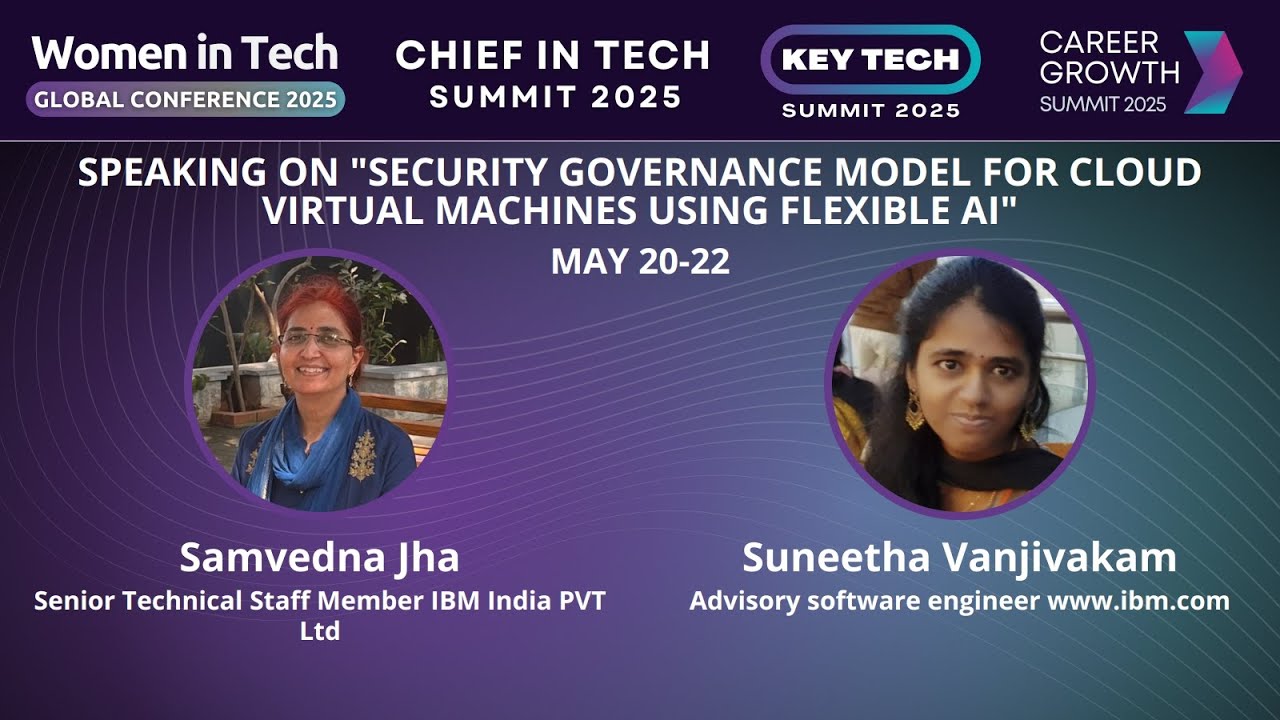
Security Governance model for Cloud virtual machines using flexible AI
Samvedna Jha19:212025
La seguridad con IA no es gratis: deje de ejecutarla en todas las VM de la nube
Las funciones de seguridad con IA no son gratuitas, y activarlas en una máquina virtual que sirve tutoriales públicos no justifica lo que consumen. Samvedna Jha, arquitecta de seguridad de IBM Power con más de veinte años de experiencia, sostiene que los equipos de nube pueden reducir energía y costes sin debilitar el aislamiento ni el cumplimiento normativo. La pregunta abierta es qué VM merecen protección completa con IA y quién decide cuándo se desactiva.
Descubra el modelo de tres niveles que decide cuánta seguridad con IA recibe cada VM
Samvedna Jha y su copresentadora Suneetha Vanjivakam, de IBM, proponen un modelo de gobernanza de seguridad para máquinas virtuales en la nube en el que la protección basada en IA se configura por VM y se activa solo cuando hace falta. Sostienen que clasificar las VM por criticidad de la carga de trabajo preserva el aislamiento, cumple la normativa y reduce el consumo energético y el coste de una IA siempre activa.
“Recuerden siempre que ninguna de estas funciones de IA, todas esas funciones supuestamente geniales, son gratuitas.”
“Deben tener un mecanismo por el cual, cuando se necesite, lo activen. Y cuando no se necesite, lo desactiven.”
What you will learn
Aplicar los cuatro pilares de seguridad, cumplimiento, gestión de riesgos e IA flexible a la gobernanza de VM en la nube.
Clasificar las VM en cargas de trabajo críticas, medias y simples para decidir cuánta seguridad con IA necesita cada una.
Planificar la activación y desactivación bajo demanda de herramientas de seguridad con IA para reducir costes energéticos y de recursos.
Relacionar marcos establecidos como ISO 27001 y el marco del NIST con la gobernanza impulsada por IA.
Explicar cómo la configuración por VM protege el aislamiento de datos y mantiene seguro el uso compartido de recursos.
Details
Level
Intermediate
Format
Talk
Technical depth
Introductory technical
For
Mid-career, Senior individual contributor
Length
19:21
Published
July 2025
Questions this talk answers
¿Qué significa la IA flexible para la gobernanza de seguridad de las VM en la nube?
Es una IA que toma como entrada el tipo de carga de trabajo y los datos que contiene una VM, de modo que se aplica según los requisitos propios de esa VM y no a ciegas. Debe detectar amenazas sin intervención humana, adaptarse a la carga de trabajo y admitir la autorreparación y políticas por VM.
¿Por qué las herramientas de seguridad con IA no deberían ejecutarse en todas las VM todo el tiempo?
Las funciones de IA no son gratuitas y consumen muchos recursos, por lo que ejecutarlas solo cuando se necesitan ahorra energía y recursos en la nube. Las VM que sirven información pública, por ejemplo, no justifican el coste.
¿Cómo deben clasificarse las VM para decidir cuánta seguridad con IA necesitan?
Las cargas críticas reciben seguridad con IA de extremo a extremo con mitigación inmediata, las cargas medias (las más comunes) reciben IA básica, y las cargas simples, como los tutoriales públicos, necesitan protección del hardware subyacente más cumplimiento normativo.
¿Cómo protege la gobernanza por VM el aislamiento de datos y el uso compartido de recursos?
Configurar el modelo por VM protege los datos de cada VM, ya que cada una ejecuta sus propias cargas de trabajo, y garantiza que los recursos compartidos no se usen a costa de la seguridad. Los propietarios de las VM pueden decidir si la IA es necesaria, se omite o se desactiva durante un periodo.
¿Qué beneficios empresariales aporta la gobernanza con IA flexible?
Las ponentes citan una innovación más rápida y eficiencia de costes, resiliencia gracias al uso óptimo de recursos y al rendimiento, y una supervisión ética que facilita auditorías, la normativa y los informes de huella de carbono.
Active la seguridad con IA solo cuando la necesite (74 s)
Tres niveles de cargas de trabajo en VM en la nube (83 s)
Auditorías, ética y ahorro de carbono (71 s)
Good morning, good afternoon, everyone. Thank you for joining us today. So, you know, in the era where digital transformation is driving everything, every aspect of organization, our products. So, security is no longer, it's like an IT concern, right? It is, it's not something which is a tick mark anymore. It is a business imperative. And in that, whether you like, whether we like it, whether we like it, whether we like it.
or not, security governance is the framework that ensures that all the requirements we are meeting, we are, we have all these strategies in place. We have a way to handle the risk and things like that. So today we are going to explore the security governance model for the cloud virtual machines and why it is so important to empower it at this stage itself when AI is picking up in every, every area, how we can bring the innovation, how we can build trust.
across these digital subsystems and using which, which are going to use AI. So, with this, let us move to the next slide. So, you know, every presentation of security, we need to start with a kind of motivation, right? Because not only for, to handle the security aspect, but also to ensure that how are we handling the customer's requirement and making sure that everything is in place. So, the importance of security and governance for the VMs has, we have divided into four pillars, basically. The first one is the security, just to ensure that the data is protected, the sensitive data, irrespective of the nature of its nature, client customer data, they are all protected.
We are also meeting the compliance requirement, which is the second pillar. We are reducing the cyber security risk, which is the third pillar as part of risk management. And finally, we are bringing in flexible AI here. And the idea about this flexible AI to bring from cloud security is to have threat detection to ensure without human intervention, to have it like a very clear, fair detection.
So, it also should have to adapt to security based on the VM load it is having, based on the final workload which is running on that VM. And then the third point that we want to bring is that these VMs, when they get into a trouble and shoot mode, how to have them as a self-healing system, so that they not only, you know, go down, they also have ability to come up, come back up.
And then finally, we should have security policies per VM, where based on the type of the workload it is running, how to ensure that the policy actually is flexible enough for them to get into those, you know, to utilize those flexible AI. So, just to give a little overview for what flexible AI we are using here is, it actually is trying to bring the kind of input from the workload type it is running, the type of data it has, and based on that, the various decisions are made to ensure that this AI is not applied blindly, but based on the personalized requirements of that VM.
So, that is the main flexibility which is coming up here. With this, I will move to the next slide. Now, here, you know, we will be talking about the governance model that itself that we are talking about here, right. So, you must be aware of some of the well-known, widely adopted governance models we already have in industry.
For example, ISO 27001. And what is its purpose? Its purpose is to provide a systematic approach to manage sensitive information, to ensure it remains secure at all environments. There are physical controls which it handles. There are, you know, it is logical controls when it is about data center, but it has to enhance to ensure that it handles all the AI requirements also.
And that's, and when we are talking about the flexible AI for that matter. The next one, I would like to cite example is NIST framework itself. So, NIST actually will provide is a very well-known, widely accepted framework, every product, mostly all products meet all the NIST requirements. And their also approach is to manage the cybersecurity risk. And, you know, it has provided various guidelines to handle various type of, you know, the main pillars, for example, integrity.
You have identify, protect, detect, respond, and recover the system. So, based on this example, what we are proposing here in our session today is about this model powered by the flexible AI, specifically targeting the virtualization platform, where in each server itself, each resource itself, you are trying to virtualize it to achieve, to run multiple virtual machines on the same hardware resource, right?
So, what we actually propose here is to have enabled disablement of AI. You need not have AI for all this. You should have a mechanism by which, when it is required, you enable it. And when it is not required, you disable it. So, you know, that type of governance model should be in place. Then, next point is about decide that each VM, basically, you know, when it requires, AI needs a security governance model or not.
For example, in any public data, which is like a very publicly available information, you don't want to spend your resources and tools to basically apply AI there, or basically to apply any governance model. You can actually utilize that resource to do something which is like more critical with respect to the mission or the workload that VM is running.
And then, final point is about, you don't have to use this AI all the time. When it is needed, use it. It also helps you to save energy and resources in the cloud itself. Always remember that none of these AI features, all the so-called cool features, they do not come for free. They actually are very much resource-eating, you know, applications and tools.
And my friend Sunita will actually talk about it more detail in next slides. But these all are very much important and why we need to have it a mechanism to not use it all the time when not needed specifically. So, we have divided, you know, our VMs at a very high level in three categories basically. The VMs which are running the mission critical workload, where we would like to have AI to handle the end-to-end security completely.
Where in case of attack, any security incident, you not only are informed about it, but also there is a mitigation which is applied immediately. And I can cite one example, where in an insider attack, if they are trying to do some malicious activity for your VM to get destroyed or misbehaved, there should be an AI mechanism that triggers and it gives you the complete security so that it stops the harm or the damage at a level which you can recover back.
The next one we would want to highlight is about the medium workload. This is the most commonly, you know, workload which is deployed in our organizations. And then we don't, we have, we need to have basic AI, right? We need not have like a very advanced or complicated, which is like resource exhaustive AI mechanism or things that we need to deploy here.
And then the finally, which is a very simple workflow. Where in you don't, they can be as simple as a tutorials, which do not need any kind of fees or any kind of, you know, membership to access it. If these are like the publicly available information, which any user can get it. Just that you need to protect your underlying hardware and resource.
You need to have a security compliance in place. And for that, we need to have a governance model. So with this, let me move to the next slide. And I will request Sunita to, you know, share some of the insights about it. Yeah. Thank you, Samwedna. So hi, hi all. This is Sunita Advisory Software Engineer working with IBM India Systems Development Labs.
So continuing with what my SDSM Samwedna has conveyed in this session. Let me start with the significance why AI should be flexible for every cloud VM runtime. So when it comes to AI models, I think data is the core heart of the AI models. Only with the data, we can bring out more insights and more, you know, more purposeful decisions we can make with the data.
But when we collect the data, I mean, it should be very conscious and it should be flexible enough for VM rather than it should be configured. I mean, it is configured on a global scope level. So this session is more about what is that, you know, significance we can bring out when the AI is per VM. So the one such principles which can be protected properly or, you know, the core heart of security is the data isolation.
When it comes to VMs, VM data should be protected properly because each VM carries its respective workloads. So the data isolation principle can be properly governed when we keep this security governance model per VM. And another principle is the resource sharing principle. When it comes to cloud VMs, VMs share a lot of resources, but it should not be at the cost of security.
The security governance model, when it is configured per VM, resource sharing will be on purpose and it will be on purpose. And when we bring the VM owner into the picture here, VM owner is given a liberty to decide whether AI is really needed or AI should be on pass or AI can be disabled for a timeframe, depending on the workload that is running on the cloud.
So the, the, the, the overall purpose of this here is we should be made, we should use AI, we should bring out interesting insights from AI. We should you, we should, we should, we should, we should bring out every value. We can give it to our end customers from our applications, but AI should be flexible enough to save our power consumption and energy costs.
So that is a more, uh, uh, significance, uh, that can be brought out when the AI is flexible, when it is configured per VM. So we will see what, what can be the expected outcomes, particularly when it is really flexible. So here, here is a small glimpse of the data. We can see what we can see from international data corporation.
So the report, uh, the report, the report statistics, we can see here with every year by year, how the over consumption and energy costs are rising and the surging demands for electricity. When, when we are, uh, when we are consuming AI, uh, without, without making it flexible or consciously being used for applications. So when it is really, uh, flexible, we can bring down this and make this more sustainable and, you know, uh, for, uh, future generations.
I think already large language models or small, large, small language models, which are already, uh, in the market by all the market leaders in the, uh, you know, AI, they are making their way to save our energy and power consumption. Making it, making them agent AI, uh, which is, uh, making them, you know, small, small agents, which is going to bring down the data center costs.
Because when, when the agents are really working on, uh, working on small, small purposes, there is no, there is no need for more power or more energy you can use at a global level, uh, you know, for the whole product. So when it comes to agents, it is, it, it can be even at a granular level of VM and it, it can be more granular level of, even for that VM also for a particular purpose, the AI can be used.
So, um, uh, that is the more, uh, expected outcome of this, uh, um, of this more flexible AI that can be brought out here. And, um, uh, this is the evidence we can, uh, we can see here from the, uh, power consumption and energy data. Um, somewhere now, can we go to conclusion? Yeah. So, um, here we conclude, um, we know AI is gaining a lot of momentum, but AI should be more flexible enough and more conscious enough, you know, uh, not to, uh, to bring a lot, uh, not to just solve the problems, uh, but it should not break any virtualization boundaries.
We build in our cloud VM products and the security governance model we bring on, uh, our, uh, AI, the, the security governance models, which is powered by AI, which is, uh, you know, uh, which is per VM. It should be more flexible enough to, uh, configure or de-configure at any moment or not to enforce on, uh, overall VMs and the outcome.
We, we will evaluate periodically, uh, so that, you know, it should, it should not be always running, uh, you know, saving our data center costs and energy costs. So the, the, that's, uh, uh, that's the conclusion of this, uh, session. So Samvedna, go to your back. Okay. So thanks. Thanks, Sunita. I think, uh, you know, the, the, the main important thing that, you know, as Sunita highlighted and as a, as a whole, we would like to highlight here is why to bring this flexible, you know, AI solution, uh, in case of this, you know, cloud VM security governance.
And, uh, because the, the well-known facts are, you know, for example, I can consider a few of the items, uh, as a, you know, talking point, it gives you faster innovation. Very, when Sunita highlighted, right. Why you need to have this AI tools run all the time when it is consuming so much of energy and power of your, uh, you know, VMs, you are paying for it, right.
At the end of the day. So, uh, it, it's not so important. You, whenever it is required, whenever deployment requires, enable it. And also there are some work, some VMs are only doing the experimentation or, you know, deployment before moving to market. So for such things also, it, it is so important that, you know, these, these will actually give us a very cost efficient solution.
The next one we can talk about with respect to the resilience. It is like, you know, when you have this type of model, where on need basis, we are having some governance model for these AI to be used. It gives you, it maintains the performance of these environments very, very, uh, you know, at the optimal level, because here you are utilizing the resources at the, at the hundred percent.
It is not that you are, there is a waste or anything which, you know, which, which can be found on. And last, last important thing is about the ethical oversight. So what happens is, uh, many times you must have been involved as a security analyst or security investigator in the forensic of any malicious activity done on the VMs.
Now, when you have such a requirement, these flexible, flexible implementation actually gives you very easy for audit, you know, meet the regulation requirement and also adjust the, you know, the requirements as per your organization's values. So lot of our, you know, not only for the security, but in general, carbon footprint requirement has become one of the important aspect, right?
Lot of, lot of companies are trying to achieve that. Now, this will be one of the small step to take forward, to have it run when needed. And you, you can always calculate it back and show this much carbon footprint has been saved. So, you know, such, for such thing, it can be helpful. Now, let me cite you with couple of examples where actually this flexible AI is showing really good output.
So first one, I would like to cite IBM Watson help. So, these AI is, as it may suggest, right, it is related to some healthcare industry. So, these AI subsystem actually, it adopts to the new medical research and the patient data. So, it's not that, you know, it is, this AI is not just like based on this, any hypothetical theory.
It actually goes with the history data. It adapts to it for the next time. So, it is also learning, like a human doctor. They are also learning, right? They, when we go to any doctor, they ask us for a lot of history and then only they come out, you know, about the present situation, right? So, in the same way, it has to learn.
So, this, this, it is adopting flexible AI in a different way. So, if I go to another cloud platform, for example, you know, Azure ML, which is one of the cloud platform available. So, they are using these deployment of custom models, which is learned from the previous, you know, trained data that you have supplied. So, it's not like a blank foundational model is available to you on which you can run your ML or any algorithm or any tool or, you know, derive anything out of it.
So, people are seeing a lot of advantages for this flexible AI. And just, it is such a high time that instead of reacting, it is so important to have things and all of us here will appreciate because of our, you know, work background that insecurity, why it is so important to bring such principle now itself, so that these governance models are helping us in many, many different, you know, forums.
So, you know, not only to meet security requirements, but also to ensure that we do not bring additional burden because more and more, we are moving to cloud and you know that in cloud, you have a VM, which is like a shared resource. So, how it, it can meet all the underlying principle of virtualization. And at the same time, you, you get, you know, platform which is scalable, which is reusable.
And most importantly, it is secure for, you know, peace of, peace for us and for the, you know, organization. So, I hope you found the, you know, details useful. We will be very happy to, you know, help or, you know, guide or, you know, talk, have continued discussion offline as well. We both are available on LinkedIn platform.
And, you know, thanks to Women in Technology Forum, which gave us this opportunity to come and share our, you know, session today. Thanks a lot. And thank you very much for all of your time and, you know, coming here for this session. Thank you.
Transcribed automatically; names checked against the speaker record. Select a time to jump there.
Article based on this talk
Por qué la seguridad con IA para VM en la nube debe activarse solo cuando se necesita
Samvedna Jha y Suneetha Vanjivakam, de IBM, proponen un modelo de gobernanza por VM que clasifica las cargas de trabajo, protege el aislamiento y reduce el coste energético de una IA siempre activa.
En resumen
Samvedna Jha, Senior Technical Staff Member en IBM, sostiene que la seguridad impulsada por IA para máquinas virtuales en la nube no debería ejecutarse en todas partes de forma predeterminada. Junto con su copresentadora Suneetha Vanjivakam, propone un modelo de gobernanza en el que la IA se configura por VM, se ajusta a la criticidad de cada carga de trabajo y se activa solo cuando se necesita, de modo que las organizaciones mantienen el aislamiento y el cumplimiento normativo mientras reducen la energía y el coste de una IA siempre activa.
Puntos clave
Un modelo de gobernanza de seguridad para productos que planean usar IA
Las ventajas de usar IA flexible
Usar la IA solo cuando se necesita
Por qué la gobernanza de seguridad necesita IA ahora
Jha comienza situando la gobernanza en el centro de la transformación digital. La seguridad ya no es una casilla que marcar ni un asunto limitado al área de TI, afirma: "Es un imperativo empresarial". (0:00) La gobernanza es el marco que garantiza que se cumplan los requisitos, que existan estrategias y que se gestione el riesgo, y sostiene que debe reforzarse ahora, mientras la IA se extiende a todos los ámbitos.
Su modelo se apoya en cuatro pilares: proteger los datos sensibles sea cual sea su naturaleza, cumplir los requisitos normativos, reducir el riesgo de ciberseguridad e incorporar IA flexible. La IA flexible, según su descripción, detecta amenazas sin intervención humana, adapta la seguridad a la carga de trabajo que se ejecuta en cada VM, ayuda a las VM a recuperarse como sistemas autorreparables y admite políticas de seguridad definidas por VM. Como toma como entrada el tipo de carga de trabajo y los datos que contiene una VM, sigue los requisitos propios de esa VM en lugar de aplicarse a ciegas.
Fundamenta la propuesta en marcos que los profesionales ya conocen. ISO 27001 ofrece un enfoque sistemático para gestionar información sensible mediante controles físicos y lógicos, y el marco del NIST organiza el riesgo de ciberseguridad en torno a identificar, proteger, detectar, responder y recuperar. Ambos, sugiere, deben ampliarse ahora para cubrir los requisitos de la IA.
Activar la IA solo cuando se necesita
El núcleo de la propuesta es un mecanismo de gobernanza para activar y desactivar la IA: "Deben tener un mecanismo por el cual, cuando se necesite, lo activen. Y cuando no se necesite, lo desactiven". (5:07) Cada VM debe evaluarse para determinar si realmente necesita un modelo de gobernanza basado en IA. Una VM que sirve información pública, por ejemplo, no justifica el coste, y esos recursos pueden destinarse a cargas de trabajo más críticas y vinculadas a la misión.
Jha es tajante sobre por qué esto importa: "Recuerden siempre que ninguna de estas funciones de IA, todas esas funciones supuestamente geniales, son gratuitas". (5:57) Las herramientas de IA consumen muchos recursos, por lo que usarlas solo cuando se necesitan ahorra energía y recursos en la nube.
Tres niveles de cargas de trabajo en VM
Para que la elección sea práctica, las ponentes clasifican las VM en tres categorías generales. Las cargas críticas reciben seguridad con IA de extremo a extremo, incluida la respuesta automática: "En caso de ataque, de cualquier incidente de seguridad, no solo se le informa, sino que también se aplica una mitigación de inmediato". (6:49) El ejemplo de Jha es el de alguien interno que intenta destruir o interrumpir una VM, caso en el que la IA debería intervenir y contener el daño a un nivel del que la organización pueda recuperarse.
Las cargas medias, que describe como las más comunes en las organizaciones, necesitan IA básica en lugar de mecanismos avanzados que consumen muchos recursos. Las cargas simples, como los tutoriales de libre acceso, necesitan poco más que la protección del hardware y los recursos subyacentes, manteniendo el cumplimiento de seguridad y un modelo de gobernanza.
Aislamiento, recursos compartidos y energía
Suneetha Vanjivakam dirige la segunda parte de la charla y explica por qué la IA debe ser flexible para cada VM en la nube en lugar de configurarse de forma global. La gobernanza por VM, afirma, protege dos principios básicos de la virtualización. El primero es el aislamiento de datos, porque cada VM ejecuta sus propias cargas de trabajo. El segundo es el uso compartido de recursos: "En las VM en la nube, las VM comparten muchos recursos, pero no debería ser a costa de la seguridad". (9:20) El propietario de la VM tiene libertad para decidir si la IA es necesaria, si debe omitirse o si puede desactivarse durante un periodo.
Luego aborda la energía, citando datos de International Data Corporation mostrados en su diapositiva. Según la ponente, las cifras muestran un crecimiento interanual del consumo energético, los costes de energía y la demanda eléctrica cuando la IA se usa sin hacerla flexible. Los modelos de lenguaje más pequeños y la IA agéntica creada para fines específicos, señala, son una de las formas en que los líderes del mercado están reduciendo el consumo eléctrico de los centros de datos, y esos agentes podrían operar a nivel de una sola VM o incluso de un único propósito dentro de ella. Su conclusión: la gobernanza impulsada por IA debe ser fácil de configurar o eliminar, nunca debe romper los límites de la virtualización y debe evaluarse periódicamente en lugar de ejecutarse todo el tiempo.
El caso de negocio: coste, resiliencia y supervisión
Jha cierra con los beneficios. La IA flexible favorece una innovación más rápida y la eficiencia de costes, ya que las organizaciones pagan la energía que consumen las herramientas siempre activas, y las VM usadas solo para experimentación o despliegues previos al lanzamiento rara vez las necesitan. Favorece la resiliencia al mantener un uso eficiente de los recursos y un rendimiento óptimo. También favorece la supervisión ética: para los analistas que investigan actividad maliciosa en las VM, una implementación flexible facilita el cumplimiento de auditorías y requisitos regulatorios y permite que los controles reflejen los valores de la organización.
La sostenibilidad completa el argumento. "Ahora bien, este será uno de los pequeños pasos para avanzar, que se ejecute cuando se necesite. Y ustedes, ustedes siempre pueden calcularlo y mostrar cuánta huella de carbono se ha ahorrado". (16:02) Cita IBM Watson Health, que se adapta a nuevas investigaciones médicas y datos de pacientes, y el despliegue en Azure ML de modelos personalizados entrenados con datos proporcionados como ejemplos de IA flexible en acción, e insta a los equipos de seguridad a adoptar estos principios ahora en lugar de reaccionar más tarde.
Vea la charla
"Security Governance model for Cloud virtual machines using flexible AI", de Samvedna Jha (19 minutos): https://www.womentech.net/video/security-governance-model-cloud-virtual-machines-using-flexible-ai
Sobre la ponente
Samvedna Jha es Senior Technical Staff Member en IBM India PVT Ltd, donde trabaja como arquitecta de seguridad de IBM Power en Bengaluru con responsabilidad técnica mundial sobre los requisitos de seguridad y cumplimiento de los productos Power. Cuenta con más de veinte años de experiencia, tiene una maestría en Aplicaciones Informáticas y es autora de blogs, IBM Redbooks y divulgaciones publicadas.
Preguntas que responde esta charla
¿Qué significa la IA flexible para la gobernanza de seguridad de las VM en la nube?
¿Por qué las herramientas de seguridad con IA no deberían ejecutarse en todas las VM todo el tiempo?
¿Cómo deben clasificarse las VM para decidir cuánta seguridad con IA necesitan?
¿Cómo protege la gobernanza por VM el aislamiento de datos y el uso compartido de recursos?
¿Qué beneficios empresariales aporta la gobernanza con IA flexible?
Redactado con IA a partir de la transcripción de la charla. Pendiente de revisión editorial.