What does Cloud adoption and transition mean for an enterprise
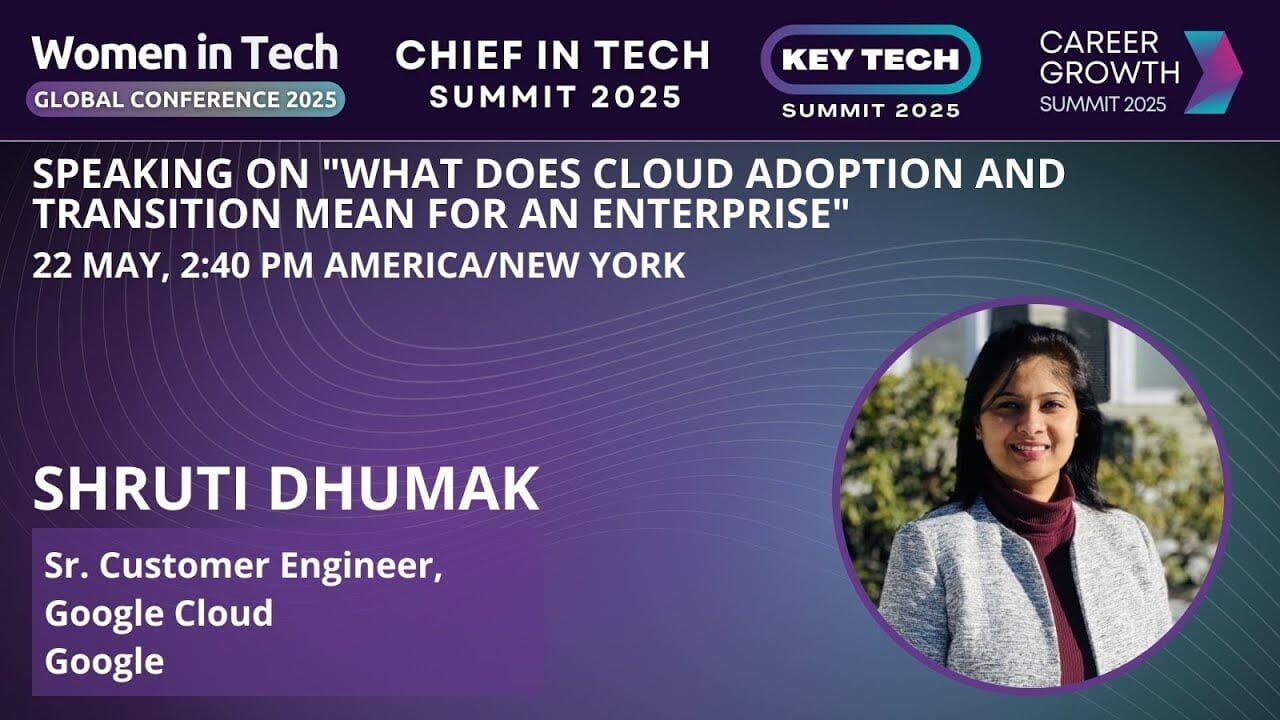
 Shruti Dhumak
Sr. Customer Engineer, Google Cloud, Google
Pick your reason for moving to the cloud before you pick a hyperscaler
How do you build systems that ship fast, scale under load and stay understandable when something breaks? Angles range from moving workloads off the data center and breaking up monoliths to database replication, server-driven UI, observability, DevOps culture, shift-left quality and open source contribution seen from company and community sides. Developers, testers, platform and infrastructure engineers, and career switchers eyeing DevOps or QA will find practical patterns and starting points.
113 talks 103 speakers 44 hours 2020 to 2026
Search the whole library
Shruti Dhumak
Sr. Customer Engineer, Google Cloud, Google
Pick your reason for moving to the cloud before you pick a hyperscaler
 Akanksha Gupta
Engineering Manager, Robinhood
Robinhood moved its UI to the server and shipped in days instead of weeks
More people outside Jane Street now contribute to Dune than inside it
 AmyJune Hineline
Senior Community Manager, Opensource.com at Red Hat
A hospice nurse who found code wasn't for her became a Drupal core mentor
 Sneha Poddar
Technical Lead
Wrong builds reach production when developers and ops never talk
A trading firm's build tool now has more outside contributors than inside
Moving frees teams from maintaining a data center so they can focus on business logic and products, and it gives visibility into costs. The speaker groups the benefits as agility, scalability, cost optimization and security, which together create room for innovation.
What does Cloud adoption and transition mean for an enterprise, Shruti DhumakThe server returns both the data model (what to display) and the view model (how to display it), so the client becomes a rendering slate with very little logic of its own.
Rapid Iterations with Server Driven UI, Akanksha GuptaMinsky says a healthy ecosystem gives the firm outside software to use, makes its main language attractive to recruits, and encourages external tools to integrate with its code.
Consuming, Contributing, Collaborating: Open Source from all sides by Ron MinskyNo. AmyJune lists documentation, READMEs and how-to guides, linting and coding standards, unit tests, design, marketing, user experience and accessibility testing, and translations as valuable contributions.
Finding a Niche in Open Source Contributions, AmyJune HinelineDevelopment and operations end up working in silos, creating a wall of confusion where ops does not know which build of which service goes to which environment. This often leads to wrong builds in the wrong environment and production issues.
DevOps is not a role, its a culture, Sneha PoddarOpen source grows the ecosystem the company depends on, helps recruiting, and gives outside developers something to integrate with, which aligns external tools with internal needs.
Consuming, Contributing, Collaborating: Open Source from all sides by Ron MinskySyntactically and functionally they are close enough, and semantically they share the same ideology because they solve the same problems created by Java and Objective-C.
Kotlin vs. Swift, Not So Different After All, Bianca CurutanNicola Martin starts from the ISTQB definition covering quality policy, objectives, planning, control, assurance and improvement, but argues that quality is really a culture and a mindset that leadership champions and all teams adopt.
We Need To Talk About Quality, Nicola Martin MBCS Peculiar C UmehSoftware Engineer, PeTECH In.3 talks
 Nicola Martin MBCSHead of Quality, Adarga2 talks
 Zarka SultanaPrincipal Consultant (Software Quality Engineer)2 talks
 Kamila OliveiraMicrosoft MVP, Backend Developer, Ame Digital2 talks
 Deepika KatakeLead Software Engineer, Biofourmis2 talksShruti DhumakSr. Customer Engineer, Google Cloud, Google1 talkAkanksha GuptaEngineering Manager, Robinhood1 talkAmyJune HinelineSenior Community Manager, Opensource.com at Red Hat1 talkSneha PoddarTechnical Lead1 talk
 Bianca CurutanSoftware Engineer, Postmates1 talk
 Sravanthi KondojuData Platform Engineering Lead, Target1 talk
 Hina GandhiSenior Software Engineer, Cisco1 talk
“So it is very important for any organization to think why should we make that move?” Shruti Dhumak, What does Cloud adoption and transition mean for an enterprise
“The biggest thing here is that even once this is done, we are really at the mercy of our customers to go ahead and update their app version so that they can make use of the latest features.” Akanksha Gupta, Rapid Iterations with Server Driven UI
“Because I think an important thing to remember is contributing in open source is a repeated game, right?” , Consuming, Contributing, Collaborating: Open Source from all sides by Ron Minsky
Bianca Curutan
Software Engineer, Postmates
Kotlin and Swift look like rival camps but share one ideology
Nicola Martin MBCS
Head of Quality, Adarga
Quality fails when only the QA team is talking about it
Sravanthi Kondoju
Data Platform Engineering Lead, Target
A data job can get stuck with no change in your data or your code
Hina Gandhi
Senior Software Engineer, Cisco
Microservices cut a 24-hour job to two hours, but she says never start there
 SANGEETHA RAJKUMAR
Senior TPM, Microsoft
Without observability, a cloud product cannot scale or prove its value
 Krishna Kripa Radhakrishnan
Lead DevOps Engineer, ANSYS Inc
One broken pipeline can break many engineers, so DevOps is a culture
 Lin Byrne
Engineering Manager, Okta
A peer can hold up your code for any reason, and that invites bias
 Sumita Palanisamy
Director of Engineering, CarGurus
DevOps goes nowhere without executive sponsors and the data to win them
 Bárbara Almeida
Software Engineer II, Cadence Design Systems
A half-finished migration let Java code grow back almost to where it started
 Shuchi Mittal
Global Head of Digital Transformation Platforms
Some developers were rebuilding a platform another team already ran
 Laia López +3
Frontend Engineer, Wallapop
Wallapop cut definition bugs 55% after making quality the whole team's job
 Ria Bhatia +1
Software Engineer
Your upload was confirmed, yet a replica says your video does not exist
 Anvita Jain
Senior Software Engineer, Netflix
Footage once traveled by hand; now some pipelines run for months
 Shweta Sharma
Senior Software Engineer, Intuit
In a microservice system, failures multiply and causes stop being obvious
Zarka Sultana
Principal Consultant (Software Quality Engineer)
Lift and shift, refactor or replace: each cloud move needs different tests
 Zarka Sultana
Principal Consultant, Sogeti UK (Part of Capgemini)
Moving to the cloud fails users unless testing travels with the migration
 Miriana Itani
Android Team Lead
A Compose counter that never counts, and what it teaches about state
 Nicole van der Hoeven
Developer Advocate (Performance Testing), k6.io
Describing software and writing it are turning into the same job
 Nazerke Seidan
Software Engineer, Salesforce
A student's open source search engine work turned into a Salesforce job
 Preethi Baskaran
Software Engineer, Uber
Your API change can take down a consumer who deployed nothing
Peculiar C Umeh
Software Engineer, PeTECH In.
Most Android developers never harness the full power of Jetpack Navigation
 Ayushi Gupta
Student | Data product management intern, Bhilai Institute of Technology | KYCHub
Two lines of Python can do the work of 10 or 15 in other languages
 Sumana Saha
Software Engineer, Ratepay GmbH
Write the test before the code, and let the failure tell you what to build
Kamila Oliveira
Microsoft MVP, Backend Developer, Ame Digital
Java runs your code line by line, then compiles only what you repeat